---
title: Module [Day] 3 of CM-5000 Crisis Management Expert Implementer [BL-HL-CM-4-5]
description: Module (Day) 3 of CM-5000 Crisis Management Expert Implementer [BL-CM-5]
image: https://blog.bcm-institute.org/hubfs/Blended%20Learning%20Crisis%20Management/BL-CM-5/CM-5%20Course%20Content-Requirement/CourseContent_Mod3.png
---
[](http://www.bcm-institute.org/)
- [Home](https://www.bcm-institute.org/)
- [About Us](https://www.bcm-institute.org/about-us-3/)
- [A President’s Perspective](https://www.bcm-institute.org/about-us/a-presidents-perspective/)
- [Our History](https://www.bcm-institute.org/about-us/our-history/)
- [Our Advisory Council](https://www.bcm-institute.org/about-us/our-advisory-council/)
- [Customers’ Testimonials](https://www.bcm-institute.org/about-us/customers-testimonials/)
- [Credential Verification](https://www.bcm-institute.org/about-us/credential-verification/)
- [Courses](https://blog.bcm-institute.org/blog/course-fees-for-blended-learning-courses-master-catalog)
- [ISO 22301 Business Continuity Management System Audit](https://blog.bcm-institute.org/audit/business-continuity-management-audit-courses)
- [ISO 22301 Business Continuity Management](https://blog.bcm-institute.org/bcm/business-continuity-management-courses)
- [Crisis Communication](https://blog.bcm-institute.org/crisis-communication/crisis-communication-courses)
- [Crisis Management](https://blog.bcm-institute.org/en/crisis-management/courses)
- [IT Disaster Recovery](https://blog.bcm-institute.org/it-disaster-recovery/courses)
- [Operational Resilience](https://blog.bcm-institute.org/operational-resilience/courses)
- [Operational Resilience Audit](https://blog.bcm-institute.org/operational-resilience-audit/courses)
- [Certification](https://blog.bcm-institute.org/certification/types-of-certifications-offered)
- [ISO 22301 BCMS Audit Certification](https://blog.bcm-institute.org/certification/business-continuity-management-audit-certification)
- [ISO22301 Business Continuity Management Certification](https://blog.bcm-institute.org/bcm/business-continuity-management-certification)
- [Crisis Communication Certification](https://blog.bcm-institute.org/crisis-communication/crisis-communication-certification)
- [Crisis Management Certification](https://blog.bcm-institute.org/en/crisis-management/crisis-management-certification)
- [IT Disaster Recovery Planning Certification](https://blog.bcm-institute.org/it-disaster-recovery/it-disaster-recovery-certification)
- [Operational Resilience Certification](https://blog.bcm-institute.org/operational-resilience/operational-resilience-certification)
- [Operational Resilience Audit Certification](https://blog.bcm-institute.org/operational-resilience-audit)
- [Seminars](https://blog.bcm-institute.org/meet-the-expert/mte-webinar-mainpage)
- [Store](https://www.bcm-institute.org/store-2/)
- [Contact Us](http://www.bcm-institute.org/about-us/contact-us/)
-
-

# Module \[Day\] 3 of CM-5000 Crisis Management Expert Implementer \[BL-HL-CM-4-5\]
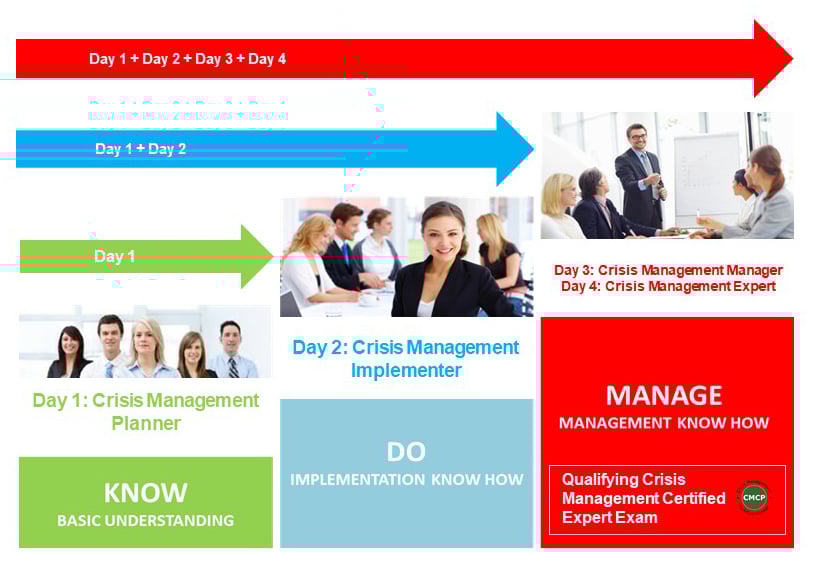
This article detailed the course curriculum and objective of Module 3 of CM-5000 or CM-400 Blended Learning \[BL\] courses. In Hybrid Learning \[HL\], this is Day 3 of the onsite CM-5000 or Day 1 of the CM-400 course.
The course content of Module 3 is presented as Session 1 and Session 2. In Hybrid Learning, both sessions are conducted within one day whereby, the course content for Session 1 is the morning session of the HL course.
Upon completing Modules 3 and 4, you must attempt the Qualifying Crisis Management Certified Expert (CMCE) Examination.
[Steve Sobak](https://blog.bcm-institute.org/crisis-management/author/steve-sobak) Apr 15, 2020
[![\[Back to\] What is BL-CM-5?](https://no-cache.hubspot.com/cta/default/3893111/6c825721-f9cd-4c36-8b72-b3fefb8c3cb1.png)](https://cta-redirect.hubspot.com/cta/redirect/3893111/6c825721-f9cd-4c36-8b72-b3fefb8c3cb1)
### CM-5000 Crisis Management Expert Implementer Training Roadmap \[Module\] \[Day\] 3
#### Description of Module 3 Course
[](https://cta-redirect.hubspot.com/cta/redirect/3893111/ce1d4175-abe3-4003-97bd-edc3f0c5a59a)Module \[Day\] 3 discusses the key roles and responsibilities of the Crisis Management Team (CMT) and the teams that support it.
It discusses the bidirectional flow of information between the CMT and other stakeholders during the pre-crisis phase, focusing on prevention planning, crisis preparation, and crisis monitoring.
In this module, participants will be taught about crisis information flow and how to set up mechanisms for detecting potential crises.
Vital information is collected for assessment, processing, and dissemination during the onset of a crisis.
This lesson discusses crisis notification and escalation processes in depth. It concludes the discussion on crisis information flows by touching on post-crisis events and the use of information in the aftermath.
[](https://cta-redirect.hubspot.com/cta/redirect/3893111/aef2c5e6-b982-4acd-a91b-0c93ecf9439e)On top of that, it provides critical considerations for selecting and equipping a crisis command centre. The functions, types, characteristics, and design principles of a command centre are discussed.
The importance of crisis communications is discussed alongside key concepts and terminologies.
The lesson will also address interested parties and strategies for meeting the audience's information needs. Media handling during a crisis and key considerations for crisis communication will be discussed.
Students will be introduced to crisis leadership and its importance to success or failure in crisis management. The course is conducted in two 3-hour sessions, each lasting 2 hours, with one hour of pre-reading.
- Module 3 Session 1 **\[M3-S1\]** \[Duration: 3-hour online workshop and 1-hour pre-reading\]
- Module 3 Session 2 **\[M3-S2\]** \[Duration: 3-hour online workshop and 1-hour pre-reading\]
#### Detailed Course Content
| **Topic** | **Description** |
| --- | --- |
| **\[BL\] Module 3 Session 1 - \[HL\] Morning Session** | |
| **Establish Crisis Management Team** | - Identify roles, responsibilities, structure, and Composition of CM Team - Understand crisis versus incident |
| **Manage Crisis Flow of Events (Pre-crisis)** | - Understand the phases and activities of the pre- crisis stage - Develop crisis code, notification and escalation process |
| **Manage Crisis Flow of Events (During Crisis)** | - Understand the phases and activities during crisis stage - Walk through the activities occurring during a crisis - Understand the critical timeline when managing a crisis |
| **Manage Crisis Flow of Events (Post-Crisis)** | - Understand the phases and activities of the post crisis stage - Identify the flow of events executed post-crisis - Relate content to ISO 22300 Societal Security - Guidelines for Incident Preparedness and Operational Continuity Management |
| **\[BL\] Module 3 Session 2 - \[HL\] Afternoon Session** | |
| **Set up Command Centre Operations** | - Understand Command Centre terminology, concept and operations - Appreciate strategic and tactical roles during a crisis. - Relate content to ISO 22320 Societal Security - Emergency Management - Requirements for Command and Control Management. |
| **Execute Crisis Communication** | - Understand crisis communication concepts and terminology - Identify stakeholders and methods to communicate with them - Apply the media management techniques |
| **Manage Crisis Leadership** | - Identify the key characteristics of crisis leadership - Determine the key principles in leading a crisis |
| **Maintain Training and Awareness** | - Identify competencies for CM professionals - Develop training needs and schedule |
#### **Deliverables**
#### [![\[BL-HL-CM-3-4-5\] Phases Learning Roadmap CM-300-CM-400-CM-5000 Crisis Management Course Phase](https://no-cache.hubspot.com/cta/default/3893111/5ff26902-051e-4cf3-a8b2-ed16dc0af61b.png)](https://cta-redirect.hubspot.com/cta/redirect/3893111/5ff26902-051e-4cf3-a8b2-ed16dc0af61b)
- Able to project and program manage a CM programme
- Able to execute Crisis Communication
##### Government Funding
| **Singapore**[](https://cta-redirect.hubspot.com/cta/redirect/3893111/923bd6c0-3947-4040-9b76-4d3044b18a7d) | The section applies to Singaporeans and permanent residents eligible for SkillsFuture Singapore funding. Malaysians also qualify for HRD Corp funding from the Malaysian government. Click the icons to find out more about the funding. | **Malaysia**[](https://cta-redirect.hubspot.com/cta/redirect/3893111/13a448f1-f09c-42da-a57e-0988e41658c5) |
| --- | --- | --- |
[](https://cta-redirect.hubspot.com/cta/redirect/3893111/d5427a2a-00dc-4e1f-82d1-74734626401d)
###### SkillsFuture Singapore Credit Claim \[New Initiative starting April 2020\] Additional Funding
To claim SkillsFuture Credit (additional funding for Singaporeans), click the "SkillsFuture Credit Claimable" button to learn more about SkillsFuture Singapore (SSG).
#### Find out more about Blended Learning \[BL\] or Hybrid Learning \[HL\] for CM-5000 and CM-300
| [](https://cta-redirect.hubspot.com/cta/redirect/3893111/dd120e7f-9fe2-49ed-ad24-489b81c06739) | [![\[BL-CM\] \[5\] Register](https://no-cache.hubspot.com/cta/default/3893111/82024308-16f4-4491-98be-818a882c6286.png)](https://cta-redirect.hubspot.com/cta/redirect/3893111/82024308-16f4-4491-98be-818a882c6286) | [](https://cta-redirect.hubspot.com/cta/redirect/3893111/b29594fe-d44a-4ff8-8160-03f7ce454385) |
| --- | --- | --- |
| [](https://cta-redirect.hubspot.com/cta/redirect/3893111/c3546220-6c76-4a10-8c76-4040b94e09e5) | [](https://cta-redirect.hubspot.com/cta/redirect/3893111/03294547-1df3-435c-9243-971c3d9bb6ce) | [](https://cta-redirect.hubspot.com/cta/redirect/3893111/5ffecd2d-8000-4805-b5e3-e9ead2e259cc) |
| [](https://cta-redirect.hubspot.com/cta/redirect/3893111/30bcbbbf-c8ea-48d8-8643-da2638f3f0f8) | Please feel free to send us a note if you have any of these questions.[![Email to Sales Team \[BCM Institute\]](https://no-cache.hubspot.com/cta/default/3893111/3c53daeb-2836-4843-b0e0-645baee2ab9e.png)](https://cta-redirect.hubspot.com/cta/redirect/3893111/3c53daeb-2836-4843-b0e0-645baee2ab9e) | [](https://cta-redirect.hubspot.com/cta/redirect/3893111/c8aaf76b-4c0b-402a-ad12-c8aff24eb911) |
## **Comments**
### More Posts
[](https://cta-redirect.hubspot.com/cta/redirect/3893111/04334171-099a-49e5-becc-c8c082c7947f)

All rights reserved. Copyright 2026