


Introduction
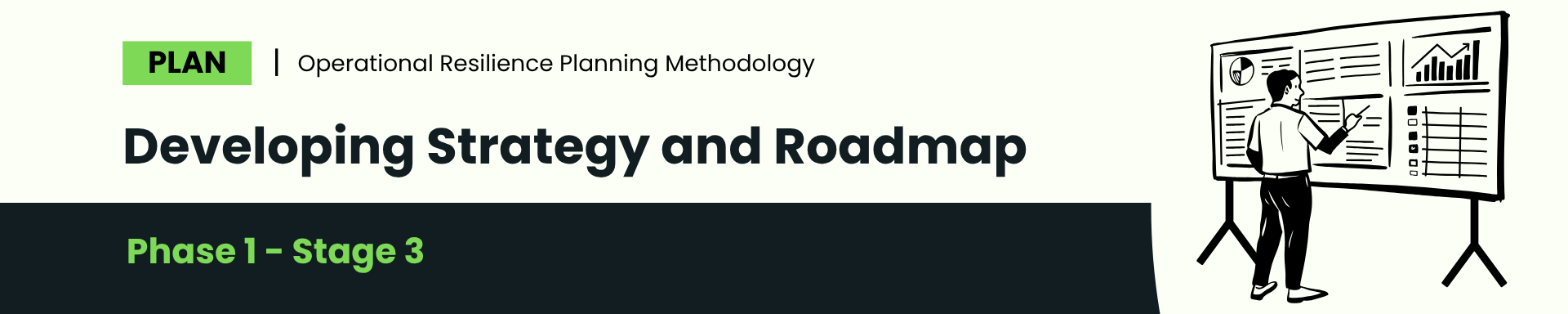
Strategy tells an organisation where it wants to be, and a roadmap shows how it will get there. The Develop Strategy and Roadmap stage bridges the gap between the current state and the desired future state of resilience for Bank Julius Baer (BJB). It takes the insights from the capability assessment and the gap analysis and turns them into a structured plan aligned with the bank's goals.
Purpose of the Chapter
This chapter explains how to move from a list of gaps to an approved roadmap. After reading it you should be able to write a measurable vision, set objectives, engage stakeholders, and sequence initiatives so that the plan is believable to the board and to the supervisor.
Vision and Strategy
A vision names a target outcome and a date, links to the bank's corporate vision and is measurable. A strategy describes the route and accounts for constraints such as budget and competing programmes.
Illustrative example: BJB Singapore states that by the end of year three, every critical business service will have a mapped resource chain, an approved impact tolerance and at least one successful integrated test. Progress is reported to the board each quarter.
Implementation Steps
Step 1: Assess the Current State
Draw on the maturity scorecards and the gap register. Do not repeat the work, but confirm that it is current.
Step 2: Define Objectives
Align objectives with business goals and risk appetite: limit the impact of disruption, ensure timely recovery and meet regulatory requirements.
Illustrative example: objective one is to reduce the number of client-facing services without a recovery owner from all to none. Objective two is to cover all material third parties with exit and contingency plans.
Step 3: Engage Stakeholders
Involve senior management, business units, technology, risk and compliance, and secure buy-in early. Roadmaps that are written by the resilience team alone tend to stall when funding is requested.
Illustrative example: the OR lead holds working sessions with the heads of operations, technology, compliance and the relationship management teams, and records the commitments each head makes.
Step 4: Develop the Roadmap
Work through a sequence: clarify the challenges behind the strategic goals, set the objectives needed, assess the capabilities required, choose courses of action for the most critical gaps, group actions into initiatives and sequence the initiatives. Prioritise by impact and feasibility.
Illustrative example: year one covers governance, service identification and mapping. Year two covers impact tolerances and the first scenario tests. Year three covers training at scale, self-assessment and the first independent review.
Making the Roadmap Hold
Attach an owner, a budget line and a measure of completion to each initiative. Mark dependencies, for example that tolerances cannot be set before services are identified. Review it twice a year, because new regulation or a major incident can change priorities. Where Group programmes already cover part of the work, show how the Singapore plan reuses them [verify].
Writing the Vision Statement
A vision statement should be short enough to remember and measurable enough to check. A useful template is: by [date], [number or proportion] of the bank's critical services will have [capability], as shown by [evidence]. For BJB, an illustrative statement might read: by the end of year three, all critical business services will have a mapped resource chain, an approved impact tolerance and a successful integrated test, as shown in the annual self-assessment and reviewed by an independent party. The statement is linked to the bank's wider strategy, for example its goals for client trust and service quality.
Prioritising and Sequencing Initiatives
Initiatives should be ranked by impact and feasibility, then arranged by dependency. Some constraints are fixed. Impact tolerances cannot be approved before critical services are identified. Integrated testing cannot be done before dependencies are mapped. Training at scale should follow the publication of policies. Where several initiatives depend on one team, such as technology, stagger the work so that the team is not overloaded in the same quarter.
Illustrative roadmap extract for BJB Singapore:
- Quarter 1 to 2: governance, service catalogue, first three critical services identified.
- Quarter 3 to 4: mapping for those services, draft tolerances, supplier-to-service register.
- Year 2: approved tolerances for all critical services, first tabletop exercises, first integrated test for payments.
- Year 3: staff training at scale, first annual self-assessment and first independent review.
Funding and Tracking
Each initiative needs a funding source, a sponsor and two or three measures of progress. Review the roadmap with the executive committee twice a year. If a major incident or a regulatory change occurs, re-sequence the roadmap openly and record the reason. A roadmap that never changes is as suspicious as one that changes every month. Report progress to the board using a simple traffic-light view with a sentence on each amber or red initiative.
Summary Table
| Step | Activity | Output |
|---|---|---|
| 1 | Assess current state | Confirmed baseline |
| 2 | Define objectives | Objectives tied to appetite |
| 3 | Engage stakeholders | Documented commitments |
| 4 | Develop roadmap | Sequenced initiatives with milestones |
 Conclusion
A roadmap is credible when it is realistic about resources and clear about order. For BJB it is the document that converts analysis into commitments. The next stage fixes the level of disruption that the board is prepared to accept.
Sources
Continue reading: Chapter 6, Confirming Risk Appetite of OR Plan Phase for Bank Julius Baer, sets the boundaries for acceptable disruption.


| C5 | C6 | C7 |
 |
 |
 |