


eBook 3 [CORE]: Chapter 8
Crisis Response Strategy for Jamiyah
Home for the Aged
Introduction

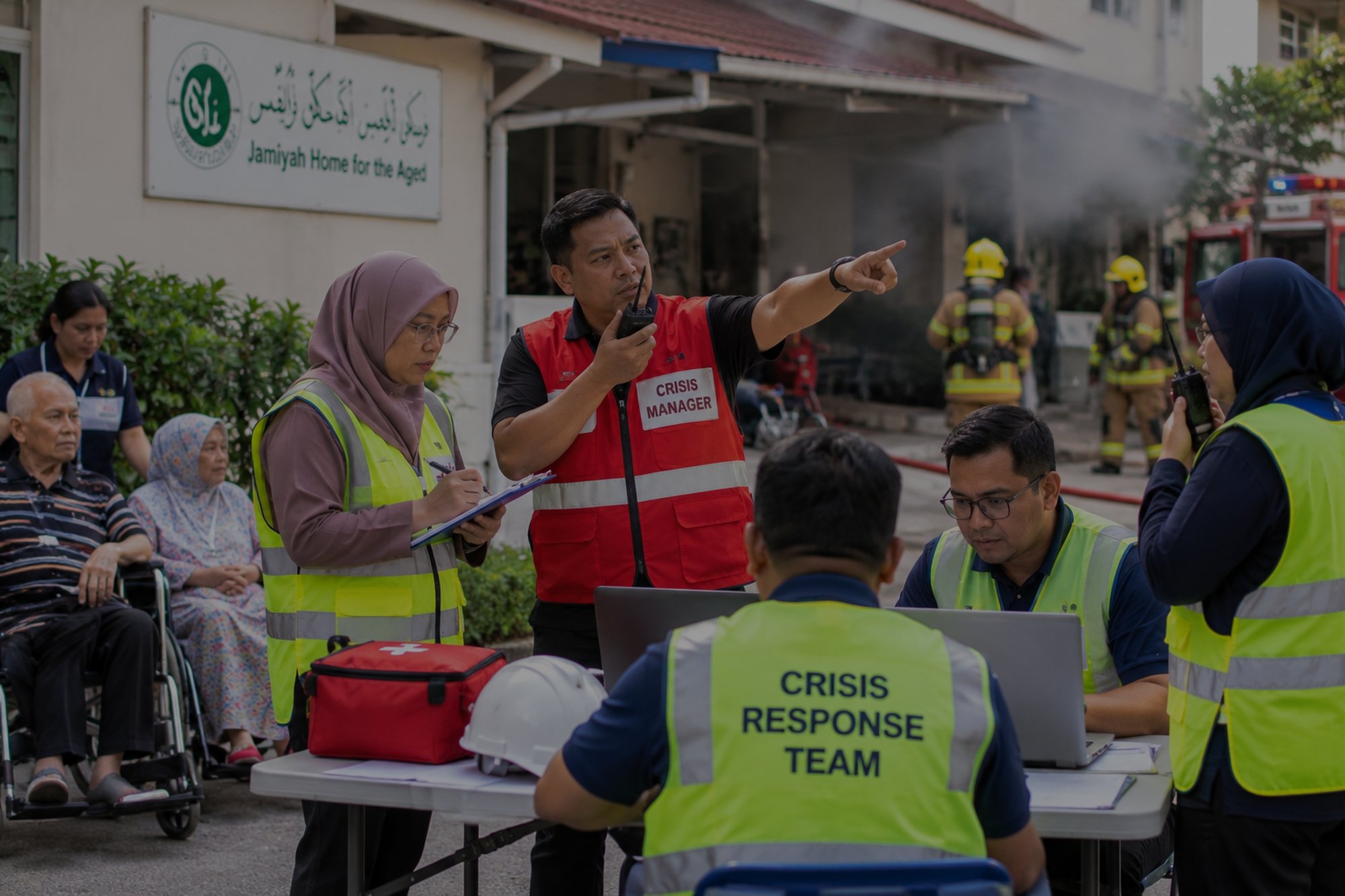
 Even with strong prevention, a crisis can still happen. This chapter, Crisis Management Strategy (CMS) Part 2, sets out Jamiyah Home for the Aged's (JHA) crisis response strategy. It lists the same threats and crisis scenarios as Chapter 7 and, for each one, states how the home will respond and why.
The chapter follows the Crisis Response Strategy template (CST2 v2) of the Business Continuity Management (BCM) Institute. Its aim is to end a crisis quickly while maintaining the home's integrity and credibility and, where possible, turning it into a positive experience.
Every rating, control, strategy, and time target in this chapter is a proposed draft built from public information about JHA and must be validated by JHA before use.
The Four Response Strategies
The template offers four basic responses. The working definitions below are used in this chapter.
- Do nothing: take no active step, because the issue is small or action would make it worse.
- Stonewall: refuse to give information or comment.
- Respond and defend: act, give honest information and defend the home with facts.
- Take the offensive: act firmly against the source of the problem, for example through a report to the police or legal action.
For a charity that cares for frail people, stonewalling is rarely suitable. Residents, families, regulators and donors expect openness, and the Commissioner of Charities expects good governance. This is why the table uses Respond and defend for 18 of the 19 entries and Take the offensive for 1. Do nothing and Stonewall are discussed in the remarks where they might be tempting but are not advised.
How to Read the Table
Table 8.1 has seven columns. The description column narrows the scenario to what it would look like at the home. The strategy column names the response type. The details column says what the home will do in practice; the justification column explains why, based on the financial effect and the effect on reputation; and the remarks column adds notes and links.
Table 8.1: Crisis response strategy for Jamiyah Home for the Aged
| Crisis Type | Type of Threats / Crisis Scenario | Detailed Description of the Type of Threats / Crisis Scenario | Response Strategy | Details of Strategy | Justification of Strategy | Remarks |
|---|---|---|---|---|---|---|
| Natural | Flash flood | Heavy rain floods access routes or lower floors and delays staff, supplies and ambulances. | Respond and defend | Activate the duty manager, move residents and stock away from water, brief staff on alternative routes, and tell families what is happening. | Quick, open action protects residents and shows the home is in control; financial impact is moderate and reputational risk is low if communication is clear. | Link to flood response checklist and weather alerts. |
| Natural | Extreme heat | Hot weather raises the risk of dehydration and heat exhaustion for frail residents. | Respond and defend | Start extra hydration rounds, move residents to cooled rooms, call the doctor for any at-risk resident, and update families. | Prompt care prevents harm and shows duty of care; the cost is small compared with hospital admissions. | Check cooling equipment before the hot season. |
| Technological | Prolonged power outage | Mains power fails for many hours and stops lifts, fans, oxygen devices and fridges. | Respond and defend | Switch to backup power, protect oxygen and medication, prioritise vulnerable residents, call the utility and update families. | Life-critical devices need power; a prepared response limits harm and legal exposure. | Test backup power at least twice a year. |
| Technological | Ransomware attack | Criminals lock care records and demand payment. | Respond and defend | Disconnect affected devices, switch to paper forms, call the information technology provider and the police, inform regulators and families as needed and do not pay without board advice. | Fast containment protects records and care; paying a ransom has no guarantee and raises legal questions. | Restore from backup is the primary route. |
| Technological | Nurse call system failure | Call bells and alarms stop working and residents cannot summon help. | Respond and defend | Start hourly rounds, hand out backup bells, call the contractor and record the fault and response. | The risk is to life, so a visible and immediate response is needed; the cost of extra rounds is modest. | Review the contractor response time. |
| Confrontation | Family dispute over care or visitor limits | A family member confronts staff in public or online over care decisions or visiting limits. | Respond and defend | Meet the family privately, listen, explain the facts and the rules, record the meeting and escalate to the Superintendent if needed. | Calm, respectful engagement protects relationships and reputation at low cost. | Use a written complaint route. |
| Confrontation | Dispute with a contractor or supplier | A contractor stops service or threatens legal action over payment or contract terms. | Respond and defend | Meet the supplier, review the contract, activate the backup supplier and involve legal advice if needed. | Protecting service to residents matters more than winning the argument. | Keep records of all communication. |
| Malevolence | False or malicious allegation of abuse or neglect | Someone makes an untrue claim about care, online or to an authority. | Respond and defend | Co-operate fully with any investigation, share facts with the authorities, protect residents and staff and issue a short factual statement. | Open co-operation preserves trust; hiding facts would harm the charity. | Seek legal advice early. Stonewall is not suitable for a charity. |
| Malevolence | Scam that uses the JHA name to collect donations | Fraudsters pose as the home to collect money. | Take the offensive | Report to the police and the platform, warn supporters through official channels and ask the bank to freeze accounts. | Active action stops losses and protects donors; the legal and reputational cost of inaction is high. | Keep evidence such as screenshots. |
| Organisational Misdeeds – Skewed Management Values | Cost cutting that harms care quality | Pressure to save money leads to unsafe staffing or lower care standards. | Respond and defend | Pause the cuts, review the effect on residents, inform the board and correct course in the open. | Care quality is the purpose of the charity; the reputational and regulatory costs of poor care exceed the savings. | Align with the Code of Governance for Charities. |
| Organisational Misdeeds – Deception | Inaccurate reporting to funders or regulators | Figures or care records given to authorities are wrong or misleading. | Respond and defend | Correct the record, tell the authority, investigate the cause and apply discipline where needed. | Early honest correction limits penalties and protects trust. | Seek legal advice before disclosure. |
| Organisational Misdeeds – Management Misconduct | Conflict of interest or misuse of charity funds | A manager or board member puts personal gain ahead of the home. | Respond and defend | Suspend the person involved, secure records, start an independent investigation and inform the Commissioner of Charities as required. | Acting at once protects charitable assets and the public's trust. | Confirm reporting duties with the Commissioner of Charities. |
| Workplace Violence | Aggression by a resident or visitor toward staff | Staff are hit, shouted at or threatened. | Respond and defend | Make the area safe, offer first aid and counselling, record the event and review the care plan or visitor rules. | Staff safety affects retention and care quality; the response is low cost. | Report to police when needed. |
| Rumours | False social media posts about an outbreak or neglect | Untrue posts spread fear among families and the public. | Respond and defend | Check facts, publish a short correction on official channels, contact the families directly and ask platforms to remove false posts. | A fast, factual reply stops a rumour from becoming a crisis. | Avoid arguing online. |
| Rumours | Rumour that the home will close | Families and staff hear that the home is closing or merging. | Respond and defend | Hold briefings, state the facts, answer questions and give a contact for concerns. | Anxiety among frail residents and staff is costly; clear information reduces it. | Doing nothing is not suitable when anxiety is high. |
| Lack of Fund | Fall in donations | Donations drop because of a weak economy or a loss of public trust. | Respond and defend | Review the budget, engage donors, explore new fundraising and tell the board. | Reserves buy time; donors respond to honest, clear updates. | Align with the Code of Governance reserves guidance. |
| Lack of Fund | Funding shortfall or delayed grants | Grants or subsidies arrive late or are reduced. | Respond and defend | Talk to the funder, adjust spending without affecting care, and seek short-term bridging funds. | Care for residents must continue; early contact with funders solves most delays. | Report the cash position to the board each week. |
| Due to Natural Factors | Infectious disease outbreak | A cluster of illness spreads among residents and staff. | Respond and defend | Isolate cases, notify the authorities through the doctor, restrict visits, keep families informed and apply the outbreak playbook. | Quick isolation and honest updates protect lives and trust; the cost of delay is high. | Confirm the notification steps with the Ministry of Health and the Communicable Diseases Agency. |
| Due to Natural Factors | Sudden loss of the Superintendent or a key leader | Illness or death removes a key leader at short notice. | Respond and defend | Activate the deputy, tell staff and families, tell the Managing Agent and regulators and arrange support. | Continuity of leadership keeps the home stable. | Review the succession plan yearly. |
Principles Behind the Responses
- Residents first. Every response begins with residents' safety and dignity.
- Speak early and truthfully. Families and staff should hear bad news from the home before they hear it from others.
- Follow the rules. When a regulator must be told, the home tells them, and the person responsible for compliance keeps a record.
- Keep a record. Decisions, times, and reasons are written down so the home can learn and show what it did.
- Protect privacy. Public statements never name residents or give personal details.
Putting the Strategy to Work
A response strategy is only useful if people know it.
The home should turn each row into a short action card, train the team to use it and test it through scenario exercises such as those in Chapter 3.
The most serious entries, such as the infectious disease outbreak and the ransomware attack, should have a full playbook with named roles, time targets and message templates.
The entries should also be checked against the notification duties that apply to JHA, including the rules of the Ministry of Social and Family Development (MSF), the Ministry of Health (MOH), and the Communicable Diseases Agency (CDA), which the home should validate.
- Assign a lead role for each response.
- Prepare holding statements for the most likely scenarios.
- Run at least two exercises a year, using different scenarios.
- Review the strategy after every incident and exercise.

Conclusion
The crisis response strategy completes the set of templates in this eBook. Together with the threat list, the scenarios, the controls, the risk ratings and the prevention strategy, it gives JHA a coherent starting point for crisis management. The next step is for the home's own team to challenge, correct, and own every table, then rehearse it.
Ready to build your own crisis management capability? Explore the BCM Institute certification and competency-based courses at https://blog.bcm-institute.org/certification.


More Information About Crisis Management Blended/ Hybrid Learning Courses
To learn more about the course and schedule, click the buttons below for CM-300 Crisis Management Implementer [CM-3] and CM-5000 Crisis Management Expert Implementer [CM-5].