


eBook 3 [CORE]: Chapter 3

List of Crisis Scenarios for Jamiyah
Home for the Aged
Introduction

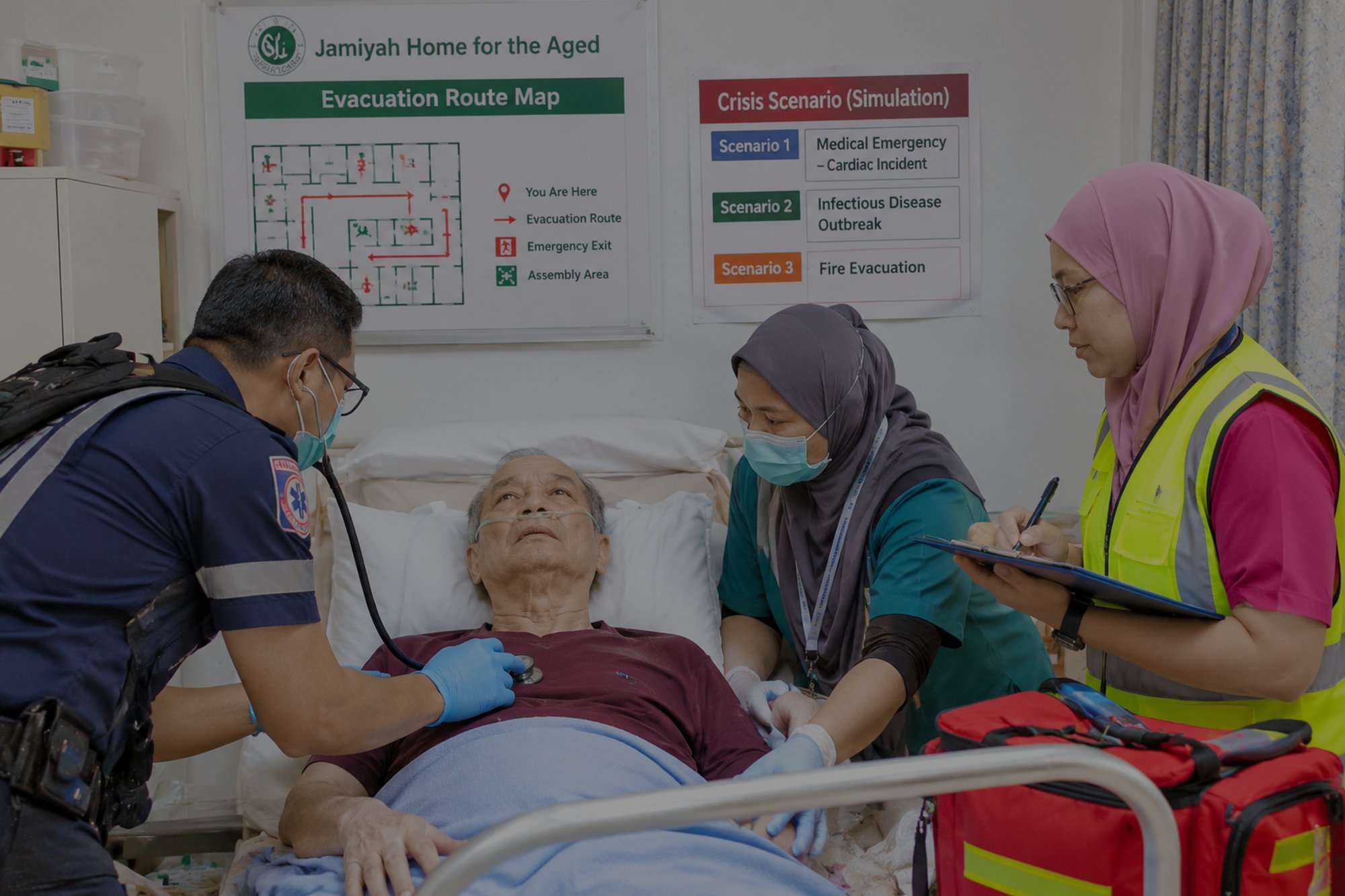
 A long list of threats is useful, but a crisis management team cannot plan in detail for all of them at once. This chapter, Crisis Scenario Risk Assessment (CRA) Part 1-2, selects the crisis scenarios that Jamiyah Home for the Aged (JHA) should plan for first. A crisis scenario is a specific, realistic story of how a threat could unfold, with enough detail to test plans and train people.
The chapter picks 6 scenarios from the 22 threats in Chapter 2. The series asks for between three and eight scenarios, so the home can plan, exercise and keep each one up to date.
Every rating, control, strategy, and time target in this chapter is a proposed draft built from public information about JHA and must be validated by JHA before it is used.
How the Scenarios were Chosen
Three tests were applied. A scenario had to link to a threat that Chapter 6 rates High or Extreme. It had to threaten the safety of residents, because that is the core purpose of the home. It also had to require decisions from leaders and communication with several groups, not just a technical fix.
The infectious disease outbreak is the only threat rated Extreme. The other five scenarios are rated High. Table 3.1 shows each scenario and its linked threats, and the full scoring is in Chapter 6.
Table 3.1: Crisis scenarios for Jamiyah Home for the Aged
| No. | Crisis scenario | Linked threats from Chapter 2 | What could happen | Risk level | Expected period of disruption | Main stakeholders |
|---|---|---|---|---|---|---|
| S1 | Infectious disease outbreak among residents and staff | T08 Infectious disease outbreak | A cluster of illness spreads across rooms and shifts; isolation is needed, and visits are restricted. | Extreme | 1 to 4 weeks | Residents and staff, families, the Ministry of Health, the Communicable Diseases Agency, doctors |
| S2 | Severe shortage of care staff | T09 Shortage of care staff | Many staff are absent at the same time, and safe care cannot be provided on one or more shifts. | High | 3 to 7 days | Residents, staff, agency, families, Ministry of Social and Family Development |
| S3 | Fire and evacuation of frail residents | T05 Fire | A fire starts at night, smoke spreads, and staff must move residents who cannot walk without help. | High | 1 to 4 weeks | Residents, staff, fire service, families, insurers, media |
| S4 | Prolonged power outage | T14 Power outage | Mains power fails for many hours; lifts, fans, oxygen devices and medication fridges stop. | High | 1 to 3 days | Residents, staff, power utility, doctors, pharmacy |
| S5 | Ransomware attack with personal data breach | T17 Ransomware attack, T21 Personal data breach | Care records and rosters are locked, and personal data may be leaked. | High | 3 to 7 days / 1 to 4 weeks | Residents, families, staff, regulators, media, insurers |
| S6 | Medication and medical supply interruption | T11 Medication and medical supply interruption | Medication and care supplies cannot be delivered for several days. | High | 3 to 7 days | Residents, pharmacy, doctors, suppliers, families |
The Scenarios in Brief
S1: Infectious disease outbreak
This scenario has the highest rating. Residents share rooms, dining areas and caregivers, and many have other illnesses. Under the guidance of the Ministry of Health (MOH), an outbreak can be considered when two or more linked cases of the same illness appear, or when cases exceed what is expected (MOH infectious disease notification). The JHA team should know exactly who spots the signs, who isolates the resident and who calls the doctor.
S2: Severe shortage of care staff
Safe care needs a minimum number of staff on every shift. If many people are absent at once, the home may need agency cover, volunteers and changed routines. The scenario tests the roster, the call-in tree and the decision to limit non-essential activities.
S3: Fire and evacuation
Fire is rare but has the largest impact on life. Many residents cannot walk unaided, so the plan must cover horizontal movement within the building, evacuation aids, night staffing and the role of the fire service.
S4: Prolonged power outage
The loss of power affects lights, fans, lifts, oxygen devices and medication fridges. The scenario tests backup power, a priority list of loads and the home's links with the power utility and the doctors.
S5: Ransomware attack with personal data breach
A cyber attack can lock the records needed for medication rounds and rosters. It can also expose personal data. The scenario tests paper fallback forms, restoring from backup, and the duty to inform the right authorities and families.
S6: Medication and medical supply interruption
Residents depend on timely medication and supplies. The scenario tests stock buffers, backup suppliers and the doctor's approval for substitutes.
Questions to Ask in an Exercise
The same questions work for every scenario. They help the crisis management team move from a story to a decision.
- Who notices the problem first, and who do they tell?
- Who decides that this is a crisis, and what is the trigger?
- What must be done for residents in the first hour, and what can wait?
- Which outside bodies must be told, and by whom?
- What should families hear, and who will say it?
- What would make the situation worse, and how can the team avoid it?
A good exercise ends with a short list of gaps. Each gap becomes an action in the treatment and control table, with an owner and a date, so that the scenario leads to a real improvement.
Using the Scenarios
Each scenario should be turned into a short exercise. The crisis management team reads the story, answers who decides, who is told and what happens in the first hour, and records the gaps. The answers feed the treatment table in Chapter 5, the prevention strategy in Chapter 7 and the response strategy in Chapter 8.
Scenarios should be reviewed when the home changes, for example after a building project, a new supplier or a change in licence class under the Social Residential Homes Act (SRHA).

Conclusion
The 6 scenarios in this chapter give JHA a focused starting point for crisis planning. Each one is linked to threats that are rated High or Extreme, and each one affects residents directly. Chapter 4 now looks more closely at the technology threats that sit behind several of them.
Ready to build your own crisis management capability? Explore the Business Continuity Management (BCM) Institute certification and competency-based courses at https://blog.bcm-institute.org/certification.


More Information About Crisis Management Blended/ Hybrid Learning Courses
To learn more about the course and schedule, click the buttons below for CM-300 Crisis Management Implementer [CM-3] and CM-5000 Crisis Management Expert Implementer [CM-5].