

Disclaimer
This article is provided for general informational and educational purposes only. It summarises publicly available regulatory guidance issued by Bank Negara Malaysia.
BCM Institute is not affiliated with, endorsed by, or acting on behalf of Bank Negara Malaysia. The name “Bank Negara Malaysia” is used strictly for descriptive and reference purposes.
Explainer: R10 Business Continuity Management Guidelines
Notification of Disruption to the Banks


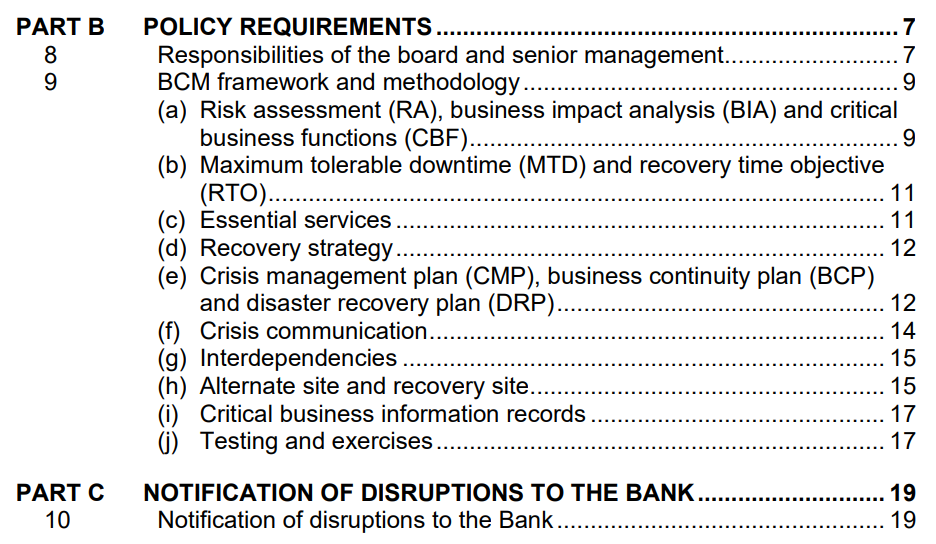
 Click the button to access the official BCM policy document (December 2022 release). A sample table of contents is provided below for reference.
Notification of Disruption
To ensure efficient management of disruptions within the banking sector, the guidelines emphasise the importance of timely notification. Financial institutions must implement an effective notification process that enables them to inform relevant parties about the occurrence of a disruption promptly.
Key Considerations for Notification of Disruption
Key considerations for notification of disruption include:
Internal Notification
Financial institutions should establish clear lines of communication within their organisation to ensure that the relevant personnel are promptly informed about disruptions. This includes establishing escalation procedures and designated contact points for various departments and business units.
External Notification
Financial institutions must promptly notify the relevant supervisory authority, regulatory bodies, and other stakeholders as required. The notification should include details of the disruption, its impact on operations, and the actions to manage the situation.
Communication Channels
Financial institutions should establish secure and reliable communication channels for efficient notification during disruptions. These channels should be regularly tested and updated to ensure their effectiveness.
Timeliness
Notifications should be sent promptly, enabling stakeholders to initiate appropriate response measures and support financial institutions in managing the disruption effectively.
Conclusion
Part C of the Business Continuity Management (BCM) Guidelines highlights the importance of timely notification. Financial institutions must implement an effective notification process that enables them to inform relevant parties about the occurrence of a disruption promptly.
This article is an independent informational summary for educational purposes. It is not affiliated with, endorsed by, or officially representing any regulatory authority.





![Register [BL-B-3]*](https://no-cache.hubspot.com/cta/default/3893111/ac6cf073-4cdd-4541-91ed-889f731d5076.png)


![FAQ [BL-B-3]](https://no-cache.hubspot.com/cta/default/3893111/b3824ba1-7aa1-4eb6-bef8-94f57121c5ae.png)

![Email to Sales Team [BCM Institute]](https://no-cache.hubspot.com/cta/default/3893111/3c53daeb-2836-4843-b0e0-645baee2ab9e.png)


