---
title: [CM] [WH] [E3] [CRA] [P3] Risk Impact and Likelihood Assessment
description: [CM] [WH] [E3] [CRA] [P3] Risk Impact and Likelihood Assessment
image: https://blog.bcm-institute.org/hubfs/Woodlands%20Health%20Campus%20Morepost/E3/%5BCM%5D%20%5BWH%5D%20%5BE3%5D%20%5BRAR%5D%20%5BT3%5D%20Risk%20Impact%20and%20Likelihood%20Assessment.png
---
[](http://www.bcm-institute.org/)
- [Home](https://www.bcm-institute.org/)
- [About Us](https://www.bcm-institute.org/about-us-3/)
- [A President’s Perspective](https://www.bcm-institute.org/about-us/a-presidents-perspective/)
- [Our History](https://www.bcm-institute.org/about-us/our-history/)
- [Our Advisory Council](https://www.bcm-institute.org/about-us/our-advisory-council/)
- [Customers’ Testimonials](https://www.bcm-institute.org/about-us/customers-testimonials/)
- [Credential Verification](https://www.bcm-institute.org/about-us/credential-verification/)
- [Courses](https://blog.bcm-institute.org/blog/course-fees-for-blended-learning-courses-master-catalog)
- [ISO 22301 Business Continuity Management System Audit](https://blog.bcm-institute.org/audit/business-continuity-management-audit-courses)
- [ISO 22301 Business Continuity Management](https://blog.bcm-institute.org/bcm/business-continuity-management-courses)
- [Crisis Communication](https://blog.bcm-institute.org/crisis-communication/crisis-communication-courses)
- [Crisis Management](https://blog.bcm-institute.org/en/crisis-management/courses)
- [IT Disaster Recovery](https://blog.bcm-institute.org/it-disaster-recovery/courses)
- [Operational Resilience](https://blog.bcm-institute.org/operational-resilience/courses)
- [Operational Resilience Audit](https://blog.bcm-institute.org/operational-resilience-audit/courses)
- [Certification](https://blog.bcm-institute.org/certification/types-of-certifications-offered)
- [ISO 22301 BCMS Audit Certification](https://blog.bcm-institute.org/certification/business-continuity-management-audit-certification)
- [ISO22301 Business Continuity Management Certification](https://blog.bcm-institute.org/bcm/business-continuity-management-certification)
- [Crisis Communication Certification](https://blog.bcm-institute.org/crisis-communication/crisis-communication-certification)
- [Crisis Management Certification](https://blog.bcm-institute.org/en/crisis-management/crisis-management-certification)
- [IT Disaster Recovery Planning Certification](https://blog.bcm-institute.org/it-disaster-recovery/it-disaster-recovery-certification)
- [Operational Resilience Certification](https://blog.bcm-institute.org/operational-resilience/operational-resilience-certification)
- [Operational Resilience Audit Certification](https://blog.bcm-institute.org/operational-resilience-audit)
- [Seminars](https://blog.bcm-institute.org/meet-the-expert/mte-webinar-mainpage)
- [Store](https://www.bcm-institute.org/store-2/)
- [Contact Us](http://www.bcm-institute.org/about-us/contact-us/)
-
-
##### Operational Readiness: Crisis Management Implementation for Woodlands Health

# \[CM\] \[WH\] \[E3\] \[CRA\] \[P3\] Risk Impact and Likelihood Assessment
[![\[CM\] \[WH\] Title Banner](https://no-cache.hubspot.com/cta/default/3893111/bc533b6f-6398-4f7f-9683-66b9686fad5e.png)](https://cta-redirect.hubspot.com/cta/redirect/3893111/bc533b6f-6398-4f7f-9683-66b9686fad5e)
The Risk Impact and Likelihood Assessment (RAR) builds upon the threats identified in *Part 1-1: CRA – List of Threats* by evaluating the potential consequences and probability of each scenario.
For Woodlands Hospital, this process is essential to determine which threats pose the greatest risk to service continuity, patient safety, and organisational resilience.
By assessing each crisis scenario across multiple impact areas—finance, operations, legal and regulatory compliance, reputation, social responsibility, people, and assets/IT systems—this chapter provides a quantitative basis for prioritising preparedness and response measures.
Each risk is scored for its potential severity and likelihood, resulting in a Risk Rating and Risk Level classification. The assessment also considers the expected period of disruption, enabling more precise contingency planning.
This structured analysis ensures that resources are allocated to the most critical vulnerabilities, supports decision-making at both operational and leadership levels, and aligns with the National Healthcare Group’s risk management framework and Singapore’s broader national resilience objectives.
[![\[Banner\] \[Title\] \[CM\] \[E3\] Part 3_ Risk Impact and Likelihood Assessment](https://no-cache.hubspot.com/cta/default/3893111/d550d6b9-dc02-4d39-814a-705d2362bd77.png)](https://cta-redirect.hubspot.com/cta/redirect/3893111/d550d6b9-dc02-4d39-814a-705d2362bd77)
[Moh Heng Goh](https://blog.bcm-institute.org/woodlands-hospital/author/moh-heng-goh) Jun 19, 2026
###### Crisis Management Certified Planner-Specialist-Expert
##### [![\[CM\] \[WH\] Title Banner](https://no-cache.hubspot.com/cta/default/3893111/bc533b6f-6398-4f7f-9683-66b9686fad5e.png)](https://cta-redirect.hubspot.com/cta/redirect/3893111/bc533b6f-6398-4f7f-9683-66b9686fad5e)
#### [![\[Banner\] \[Title\] \[CM\] \[E3\] Part 3_ Risk Impact and Likelihood Assessment](https://no-cache.hubspot.com/cta/default/3893111/d550d6b9-dc02-4d39-814a-705d2362bd77.png)](https://cta-redirect.hubspot.com/cta/redirect/3893111/d550d6b9-dc02-4d39-814a-705d2362bd77)
#### Introduction
[![\[CM\] \[WH\] \[E3\] \[RAR\] \[T3\] Risk Impact and Likelihood Assessment](https://no-cache.hubspot.com/cta/default/3893111/b9fb5156-f384-4658-a1f3-7a7b9dcab86d.png)](https://cta-redirect.hubspot.com/cta/redirect/3893111/b9fb5156-f384-4658-a1f3-7a7b9dcab86d)
For Woodlands Hospital, this process is essential to determine which threats pose the greatest risk to service continuity, patient safety, and organisational resilience.
By assessing each crisis scenario across multiple impact areas—finance, operations, legal and regulatory compliance, reputation, social responsibility, people, and assets/IT systems—this chapter provides a quantitative basis for prioritising preparedness and response measures.
Each risk is scored for its potential severity and likelihood, resulting in a Risk Rating and Risk Level classification. The assessment also considers the expected period of disruption, enabling more precise contingency planning.
This structured analysis ensures that resources are allocated to the most critical vulnerabilities, supports decision-making at both operational and leadership levels, and aligns with the National Healthcare Group’s risk management framework and Singapore’s broader national resilience objectives.
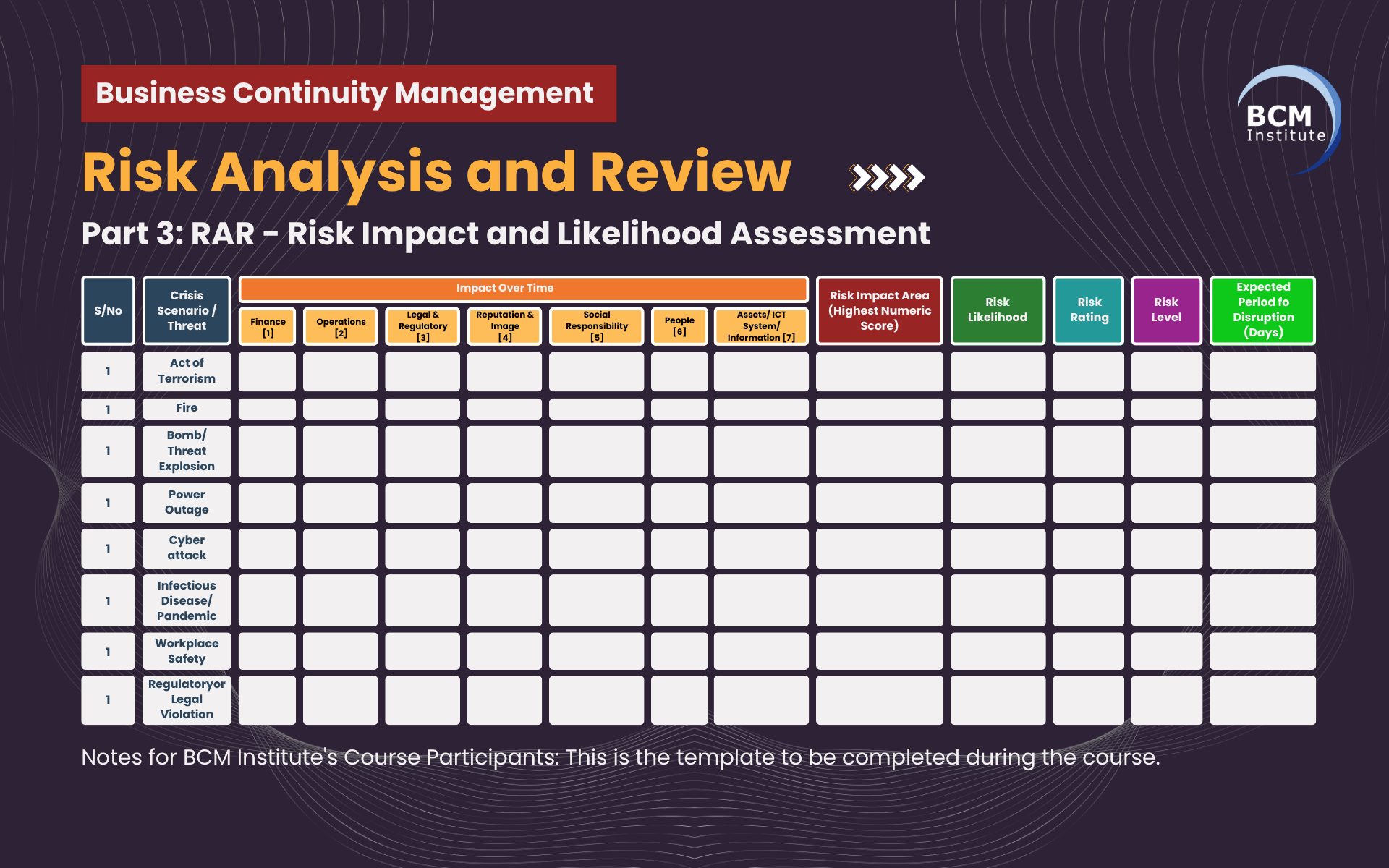
Below is the **\[CRA\] Part 3: Risk Impact and Likelihood Assessment** table for the Woodlands Hospital, derived from the earlier **\[CRA\] Part 1-1: List of Threats** and aligned with BCM Institute / BCMpedia risk analysis methodology.
Table Below: Notes for BCM Institute's Course Participants: This is the template for completing the "**\[CRA\] Part 3: Risk Impact and Likelihood Assessment**."
[](https://cta-redirect.hubspot.com/cta/redirect/3893111/972f1733-4274-42e5-9fc6-fe3acf70f929)
##### **[![\[Banner\] \[Title\] \[CM\] \[E3\] Part 3_ Risk Impact and Likelihood Assessment](https://no-cache.hubspot.com/cta/default/3893111/d550d6b9-dc02-4d39-814a-705d2362bd77.png)](https://cta-redirect.hubspot.com/cta/redirect/3893111/d550d6b9-dc02-4d39-814a-705d2362bd77)Table: \[CRA\] Part 3: Risk Impact and Likelihood Assessment** (Categorised by Crisis Types)
| Crisis Type | Type of Crisis Scenario | Finance | Operations | Legal & Regulatory | Reputation & Image | Social Responsibility | People | Assets / IT Systems / Information | Risk Impact Area (Highest Numeric Score) | Risk Likelihood (1–5) | Risk Rating (Impact × Likelihood) | Risk Level | Expected Period of Disruption |
| --- | --- | --- | --- | --- | --- | --- | --- | --- | --- | --- | --- | --- | --- |
| Denial of Access – Natural Disaster | Flooding | 3 | 5 | 3 | 4 | 4 | 4 | 3 | Operations (5) | 3 | 15 | High | 1–3 days |
| Severe Haze | 3 | 4 | 3 | 4 | 5 | 4 | 2 | Social Responsibility (5) | 4 | 20 | Extreme | 1–2 weeks | |
| Extreme Weather (Storms / Lightning) | 2 | 4 | 2 | 3 | 3 | 3 | 3 | Operations (4) | 3 | 12 | Medium | Hours – 2 days | |
| Terrorist Attack / Bomb Threat | 4 | 5 | 5 | 5 | 5 | 5 | 4 | People (5) | 2 | 10 | Medium | 1–5 days | |
| Civil Unrest | 3 | 4 | 3 | 4 | 4 | 4 | 3 | Operations (4) | 2 | 8 | Medium | 1–3 days | |
| Unavailability of People | Pandemic / Infectious Disease | 4 | 5 | 4 | 5 | 5 | 5 | 3 | People (5) | 5 | 25 | Extreme | Weeks – Months |
| Mass Casualty Event in the Region | 3 | 5 | 4 | 4 | 5 | 5 | 3 | People (5) | 3 | 15 | High | Days – Weeks | |
| Disruption to the Supply Chain | Medical Supplies Shortage | 4 | 5 | 4 | 4 | 5 | 4 | 3 | Operations (5) | 4 | 20 | Extreme | 1–4 weeks |
| Food Supply Interruption | 3 | 4 | 3 | 4 | 5 | 4 | 2 | Social Responsibility (5) | 3 | 15 | High | 1–5 days | |
| Equipment and IT-Related Disruption | Power Outage | 4 | 5 | 4 | 4 | 4 | 4 | 5 | Assets/IT (5) | 3 | 15 | High | Hours – 2 days |
| IT System Failure / Cyberattack | 4 | 5 | 5 | 4 | 4 | 4 | 5 | Assets/IT (5) | 4 | 20 | Extreme | 1–7 days | |
| Medical Equipment Failure | 3 | 4 | 3 | 4 | 4 | 4 | 5 | Assets/IT (5) | 3 | 15 | High | 1–3 days | |
Risk Rating Guide
Risk Level bands (example guidance notes based on BCM Institute)
- Very Low: 1–5
- Low: 6–9
- Medium: 10–14
- High: 15–19
- Very High: ≥20
How to use this template
1. Impact Area Ratings: Score each of the seven categories from 1 (Very Low) to 5 (Very High).
2. Highest Impact: Select the highest score among those seven.
3. Likelihood: Assign a 1–5 rating based on your organisation's experience/frequency
4. Assign Risk Level based on the rating’s band.
5. Expected Disruption: Estimate downtime using organisational intelligence and context
[![Banner \[CM\] \[Summing Up\] \[E3\] \[CRA\] \[P3\] Risk Impact and Likelihood Assessment](https://no-cache.hubspot.com/cta/default/3893111/a3d3e509-b109-4c48-8c77-a5ea9d82df3a.png)](https://cta-redirect.hubspot.com/cta/redirect/3893111/a3d3e509-b109-4c48-8c77-a5ea9d82df3a)
The RAR findings highlight the varied scale and nature of risks facing Woodlands Hospital—from high-frequency operational disruptions to rare but high-impact events that could significantly affect the organisation’s ability to deliver care.
Scenarios such as pandemics, IT system failures, and critical supply shortages received the highest risk ratings, underscoring the need for robust mitigation measures, redundancy planning, and crisis response readiness.
By quantifying both impact and likelihood, this chapter transforms the earlier threat list into a prioritised, evidence-based risk register.
This enables Woodlands Health to channel investments, training, and contingency resources toward the areas of greatest vulnerability.
The CAR is not a one-off exercise; it should be reviewed periodically and updated in light of new data, evolving threats, and lessons learned from exercises or real incidents.
Maintaining an up-to-date risk profile is critical to ensuring that Woodlands Health remains prepared, responsive, and resilient in the face of emerging challenges.
[![x \[CM\] \[WH\] Title Banner](https://no-cache.hubspot.com/cta/default/3893111/d348ca17-2a61-48d3-a127-4f089fc7b0ee.png)](https://cta-redirect.hubspot.com/cta/redirect/3893111/d348ca17-2a61-48d3-a127-4f089fc7b0ee)
| **eBook 3: Starting Your Crisis Management Implementation** | | | |
| --- | --- | --- | --- |
| [![\[CM\] \[WH\] \[E3\] \[RAR\] \[T1-2\] List of Threats](https://no-cache.hubspot.com/cta/default/3893111/bf0c73a6-f409-4812-841c-fb74ae1f25fd.png)](https://cta-redirect.hubspot.com/cta/redirect/3893111/bf0c73a6-f409-4812-841c-fb74ae1f25fd) | [![\[CM\] \[WH\] \[E3\] \[RAR\] \[T1-2\] List of Threats](https://no-cache.hubspot.com/cta/default/3893111/0be8dee5-b355-494a-b37a-72d24e9ce397.png)](https://cta-redirect.hubspot.com/cta/redirect/3893111/0be8dee5-b355-494a-b37a-72d24e9ce397) | [![\[CM\] \[WH\] \[E3\] \[RAR\] \[T1-2\] \[Technology\] List of Threats](https://no-cache.hubspot.com/cta/default/3893111/d844e021-74a3-4c31-bb5c-737a4d7adc14.png)](https://cta-redirect.hubspot.com/cta/redirect/3893111/d844e021-74a3-4c31-bb5c-737a4d7adc14) | [![\[CM\] \[WH\] \[E3\] \[RAR\] \[T2\] Treatment and Control ](https://no-cache.hubspot.com/cta/default/3893111/5248bf84-4eb7-4fb2-a7e9-d81ad6a6cd64.png)](https://cta-redirect.hubspot.com/cta/redirect/3893111/5248bf84-4eb7-4fb2-a7e9-d81ad6a6cd64) |
| [![\[CM\] \[WH\] \[E3\] \[RAR\] \[T3\] Risk Impact and Likelihood Assessment](https://no-cache.hubspot.com/cta/default/3893111/b9fb5156-f384-4658-a1f3-7a7b9dcab86d.png)](https://cta-redirect.hubspot.com/cta/redirect/3893111/b9fb5156-f384-4658-a1f3-7a7b9dcab86d) | [![\[CM\] \[WH\] \[E3\] \[CMS\] \[T1\] Crisis Prevention Strategy ](https://no-cache.hubspot.com/cta/default/3893111/80086a3f-1402-420f-be85-453b758bdfa2.png)](https://cta-redirect.hubspot.com/cta/redirect/3893111/80086a3f-1402-420f-be85-453b758bdfa2) | [![\[CM\] \[WH\] \[E3\] \[CMS\] \[T2\] Crisis Response Strategy ](https://no-cache.hubspot.com/cta/default/3893111/45f7f17b-4574-4d0c-9d3a-07b416bd5e63.png)](https://cta-redirect.hubspot.com/cta/redirect/3893111/45f7f17b-4574-4d0c-9d3a-07b416bd5e63) | [](https://cta-redirect.hubspot.com/cta/redirect/3893111/066d31a8-fefc-4502-b41b-7b4889096ee8) |
| | | | |
#### More Information About Crisis Management Blended/ Hybrid Learning Courses
To learn more about the course and schedule, click the buttons below for the CM-300 Crisis Management Implementer \[CM-3\] and the CM-5000 Crisis Management Expert Implementer \[CM-5\].
| [](https://cta-redirect.hubspot.com/cta/redirect/3893111/5ffecd2d-8000-4805-b5e3-e9ead2e259cc) | [](https://cta-redirect.hubspot.com/cta/redirect/3893111/c3546220-6c76-4a10-8c76-4040b94e09e5) | [](https://cta-redirect.hubspot.com/cta/redirect/3893111/03294547-1df3-435c-9243-971c3d9bb6ce) |
| --- | --- | --- |
| [](https://cta-redirect.hubspot.com/cta/redirect/3893111/b29594fe-d44a-4ff8-8160-03f7ce454385) | [](https://cta-redirect.hubspot.com/cta/redirect/3893111/dd120e7f-9fe2-49ed-ad24-489b81c06739) | [![\[BL-CM\] \[5\] Register](https://no-cache.hubspot.com/cta/default/3893111/82024308-16f4-4491-98be-818a882c6286.png)](https://cta-redirect.hubspot.com/cta/redirect/3893111/82024308-16f4-4491-98be-818a882c6286) |
| [](https://cta-redirect.hubspot.com/cta/redirect/3893111/c8aaf76b-4c0b-402a-ad12-c8aff24eb911) | Please feel free to send us a note if you have any questions. [![Email to Sales Team \[BCM Institute\]](https://no-cache.hubspot.com/cta/default/3893111/3c53daeb-2836-4843-b0e0-645baee2ab9e.png)](https://cta-redirect.hubspot.com/cta/redirect/3893111/3c53daeb-2836-4843-b0e0-645baee2ab9e) | [](https://cta-redirect.hubspot.com/cta/redirect/3893111/30bcbbbf-c8ea-48d8-8643-da2638f3f0f8) |
| [](https://cta-redirect.hubspot.com/cta/redirect/3893111/83d00c12-c51c-4476-9902-69f9b7667a91) | [](https://cta-redirect.hubspot.com/cta/redirect/3893111/672d2949-6233-4b26-ad42-ae0dd0a1a3ac) | [](https://cta-redirect.hubspot.com/cta/redirect/3893111/3ca6f50d-a3c5-41b8-8da2-26feb8a7613e) |
### Your Comments Here:
### More Posts
[](https://cta-redirect.hubspot.com/cta/redirect/3893111/04334171-099a-49e5-becc-c8c082c7947f)

All rights reserved. Copyright 2026
```json
{
"@context" : "https://schema.org",
"@type" : "BlogPosting",
"author" : {
"@type" : "Person",
"name" : "Moh Heng Goh",
"url" : "https://blog.bcm-institute.org/woodlands-hospital/author/moh-heng-goh"
},
"dateModified" : "2026-06-19T12:15:55.862Z",
"datePublished" : "2026-06-19T10:35:49.000Z",
"headline" : "[CM] [WH] [E3] [CRA] [P3] Risk Impact and Likelihood Assessment",
"image" : [ "https://blog.bcm-institute.org/hubfs/Woodlands%20Health%20Campus%20Morepost/E3/%5BCM%5D%20%5BWH%5D%20%5BE3%5D%20%5BRAR%5D%20%5BT3%5D%20Risk%20Impact%20and%20Likelihood%20Assessment.png" ],
"mainEntityOfPage" : {
"@id" : "https://blog.bcm-institute.org/woodlands-hospital/cm-wh-e3-cra-p3-risk-impact-and-likelihood-assessment",
"@type" : "WebPage"
},
"publisher" : {
"@type" : "Organization",
"logo" : {
"@type" : "ImageObject",
"url" : "https://blog.bcm-institute.org/hubfs/BCMI%20Logo.png"
},
"name" : "BCMI Pte Ltd"
}
}
```