---
title: [BCM] [MOM] [E3] [BIA] [T1] [CBF] [6] Corporate Services and IT Infrastructure
description: [BCM] [MOM] [E3] [BIA] [T1] [CBF] [6] Corporate Services and IT Infrastructure
image: https://blog.bcm-institute.org/hubfs/Ministry%20of%20Manpower%20Graphic%20Folder/MOM%20E3%20Morepost/MOM%20CBF%206/%5BBCM%5D%20%5BMOM%5D%20%5BE3%5D%20%5BBIA%5D%20%5BT1%5D%20%5BCBF%5D%20%5B6%5D%20Corporate%20Services%20and%20IT%20Infrastructure.jpg
---
.
[](http://www.bcm-institute.org/)
- [Home](https://www.bcm-institute.org/)
- [About Us](https://www.bcm-institute.org/about-us-3/)
- [A President’s Perspective](https://www.bcm-institute.org/about-us/a-presidents-perspective/)
- [Our History](https://www.bcm-institute.org/about-us/our-history/)
- [Our Advisory Council](https://www.bcm-institute.org/about-us/our-advisory-council/)
- [Customers’ Testimonials](https://www.bcm-institute.org/about-us/customers-testimonials/)
- [Credential Verification](https://www.bcm-institute.org/about-us/credential-verification/)
- [Courses](https://blog.bcm-institute.org/blog/course-fees-for-blended-learning-courses-master-catalog)
- [ISO 22301 Business Continuity Management System Audit](https://blog.bcm-institute.org/audit/business-continuity-management-audit-courses)
- [ISO 22301 Business Continuity Management](https://blog.bcm-institute.org/bcm/business-continuity-management-courses)
- [Crisis Communication](https://blog.bcm-institute.org/crisis-communication/crisis-communication-courses)
- [Crisis Management](https://blog.bcm-institute.org/en/crisis-management/courses)
- [IT Disaster Recovery](https://blog.bcm-institute.org/it-disaster-recovery/courses)
- [Operational Resilience](https://blog.bcm-institute.org/operational-resilience/courses)
- [Operational Resilience Audit](https://blog.bcm-institute.org/operational-resilience-audit/courses)
- [Certification](https://blog.bcm-institute.org/certification/types-of-certifications-offered)
- [ISO 22301 BCMS Audit Certification](https://blog.bcm-institute.org/certification/business-continuity-management-audit-certification)
- [ISO22301 Business Continuity Management Certification](https://blog.bcm-institute.org/bcm/business-continuity-management-certification)
- [Crisis Communication Certification](https://blog.bcm-institute.org/crisis-communication/crisis-communication-certification)
- [Crisis Management Certification](https://blog.bcm-institute.org/en/crisis-management/crisis-management-certification)
- [IT Disaster Recovery Planning Certification](https://blog.bcm-institute.org/it-disaster-recovery/it-disaster-recovery-certification)
- [Operational Resilience Certification](https://blog.bcm-institute.org/operational-resilience/operational-resilience-certification)
- [Operational Resilience Audit Certification](https://blog.bcm-institute.org/operational-resilience-audit)
- [Seminars](https://blog.bcm-institute.org/meet-the-expert/mte-webinar-mainpage)
- [Store](https://www.bcm-institute.org/store-2/)
- [Contact Us](http://www.bcm-institute.org/about-us/contact-us/)
-
-
##### Resilient Support: Implementing Business Continuity Management at Ministry of Manpower (Singapore)

# \[BCM\] \[MOM\] \[E3\] \[BIA\] \[T1\] \[CBF\] \[6\] Corporate Services and IT Infrastructure
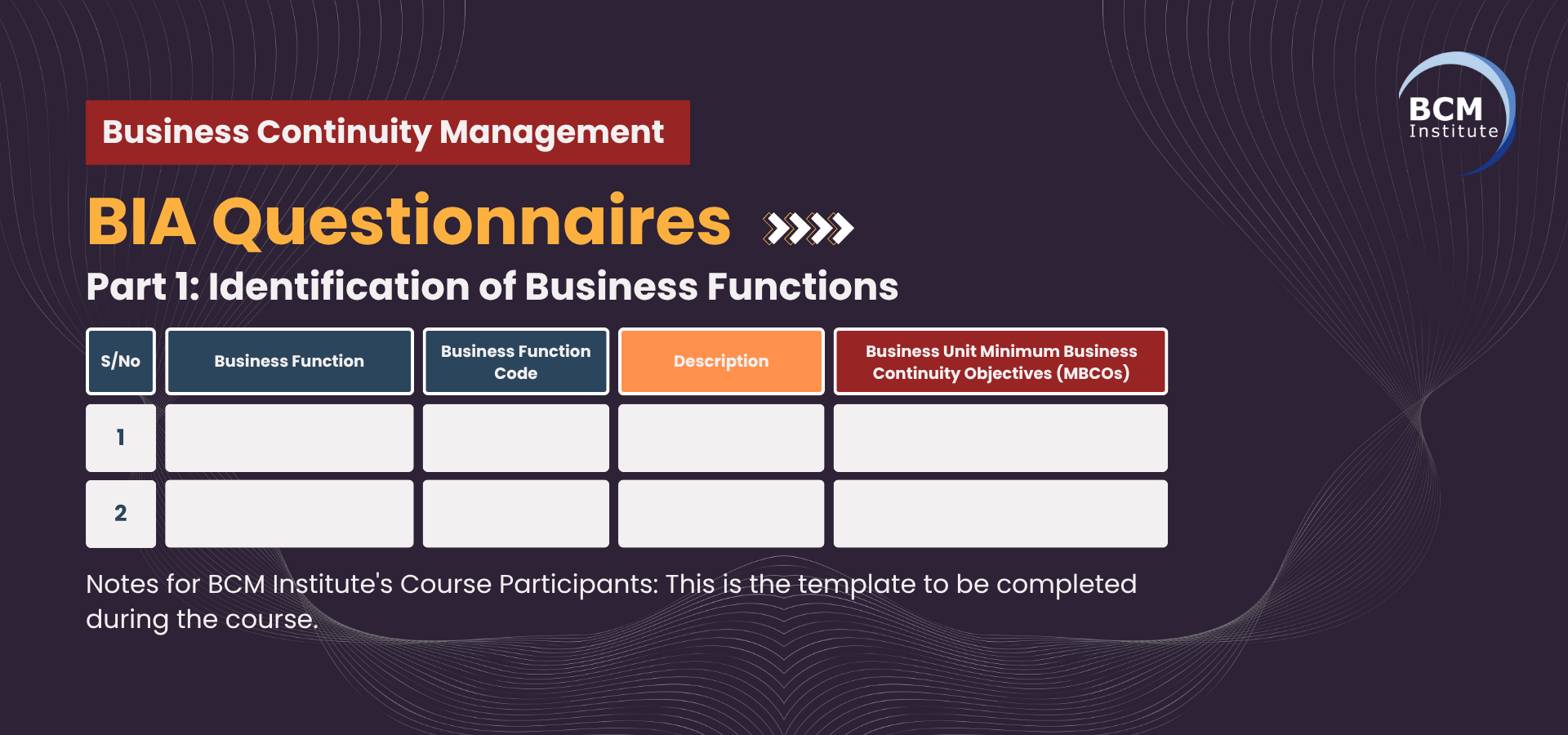
Part 1: Identification of Business Functions[](https://cta-redirect.hubspot.com/cta/redirect/3893111/8c9d094e-b019-4313-b949-b3f9b287beb1)
In the context of Business Continuity Management (BCM) for the Ministry of Manpower (MOM) in Singapore, the "Corporate Services and IT Infrastructure" function plays a crucial role in ensuring that the organisation's core support services remain resilient during disruptions.
This chapter will explore the Critical Business Function (CBF-6) "Corporate Services and IT Infrastructure," which includes several sub-functions essential to maintaining business operations.
The table below provides a detailed breakdown of each sub-function, its description, and the corresponding Business Unit Minimum Business Continuity Objective (MBCO) for each area.
These objectives are set to ensure that each business unit within corporate services and IT infrastructure can continue to operate with minimal disruption during an emergency or disaster.
[![Banner \[BCM\] \[E3\] \[BIA\] \[P1\] Identification of Business Functions](https://no-cache.hubspot.com/cta/default/3893111/206ddd7e-615a-42c8-aa2a-3416a1ad06b3.png)](https://cta-redirect.hubspot.com/cta/redirect/3893111/206ddd7e-615a-42c8-aa2a-3416a1ad06b3)
Part 2: Impact Area Of Business Functions
The Ministry of Manpower (MOM) plays a crucial role in regulating and overseeing the labour and employment sectors in Singapore, ensuring that the workforce operates efficiently and within the bounds of the law.
A critical component of the Ministry's ability to function effectively is the resilience of its corporate services and IT infrastructure.
Business continuity planning ensures that essential operations are maintained even in the face of disruption.
One of the key high-level critical business functions within the Ministry is CBF-6: Corporate Services and IT Infrastructure.
This function encompasses a wide range of activities, from governance and strategic planning to IT infrastructure continuity, and its resilience is pivotal in supporting the Ministry’s day-to-day operations and long-term strategic goals.
This chapter will provide a detailed breakdown of the sub-components (Sub-CBFs) within CBF-6—examining the business processes, impact areas, financial implications, and how disruptions may affect the Ministry’s Minimum Business Continuity Objectives (MBCOs).
Each Sub-CBF will be explored in-depth to understand the various elements contributing to the effective functioning of the Ministry, and how disruptions to these services could be mitigated.
[![Banner \[BCM\] \[E3\] \[BIA\] \[P2\] Impact Area of Business Functions](https://no-cache.hubspot.com/cta/default/3893111/182e67c2-aa89-4b0b-b3e9-144293680ea4.png)](https://cta-redirect.hubspot.com/cta/redirect/3893111/182e67c2-aa89-4b0b-b3e9-144293680ea4)
[Dr Goh Moh Heng](https://blog.bcm-institute.org/t-e3-bcm/author/dr-goh-moh-heng) Jan 6, 2026
###### Business Continuity Management Certified Planner-Specialist-Expert
###### [](https://cta-redirect.hubspot.com/cta/redirect/3893111/b6d9d894-8ae4-44fb-8bac-fc8128f9c44d)
[](https://cta-redirect.hubspot.com/cta/redirect/3893111/7ca79bbb-3795-4d02-8291-f7f6c33552b4)
[![Banner \[BCM\] \[E3\] \[BIA\] \[P1\] Identification of Business Functions](https://no-cache.hubspot.com/cta/default/3893111/206ddd7e-615a-42c8-aa2a-3416a1ad06b3.png)](https://cta-redirect.hubspot.com/cta/redirect/3893111/206ddd7e-615a-42c8-aa2a-3416a1ad06b3)
CBF-6 Corporate Services and IT Infrastructure
In the context of Business Continuity Management (BCM) for the Ministry of Manpower[![\[BCM\] \[MOM\] \[E3\] \[BIA\] \[T1\] \[CBF\] \[6\] Corporate Services and IT Infrastructure](https://no-cache.hubspot.com/cta/default/3893111/e270ba9d-5c31-4cd4-8ded-e67a69bcf827.png)](https://cta-redirect.hubspot.com/cta/redirect/3893111/e270ba9d-5c31-4cd4-8ded-e67a69bcf827) (MOM) in Singapore, the "Corporate Services and IT Infrastructure" function plays a crucial role in ensuring that the organisation's core support services remain resilient during disruptions.
This chapter will explore the Critical Business Function (CBF-6) "Corporate Services and IT Infrastructure," which includes several sub-functions essential to maintaining business operations.
The table below provides a detailed breakdown of each sub-function, its description, and the corresponding Business Unit Minimum Business Continuity Objective (MBCO) for each area.
These objectives are set to ensure that each business unit within corporate services and IT infrastructure can continue to operate with minimal disruption during an emergency or disaster.
Table P1: Identification of Business Functions for CBF-6
| Sub-CBF Code | Sub-CBF | Description of Sub-CBF | Business Unit Minimum Business Continuity Objective (MBCO) |
| --- | --- | --- | --- |
| 6.1 | Governance & Strategic Planning | Ensures that the strategic direction and governance framework for the Ministry are upheld during disruptions. This includes policy development, decision-making continuity, and planning. | The MBCO for Governance & Strategic Planning is to ensure the ability of senior management to make timely decisions regarding the allocation of resources and priorities. |
| 6.2 | Financial Management & Resource Allocation | Ensures the continuity of financial operations, including budgeting, resource allocation, and financial reporting during business disruptions. | The MBCO for Financial Management is to ensure the uninterrupted processing of financial transactions and the and availability of critical financial resources. |
| 6.3 | Human Resource Continuity | Ensures the continuity of essential human resources functions, including employee management, payroll, and recruitment, during a crisis. | The MBCO for Human Resource Continuity is to ensure the availability of critical HR staff and systems for payroll and essential personnel management. |
| 6.4 | Procurement & Contract Management | Covers the procurement and management of contracts with third-party suppliers, ensuring critical service providers are available during disruptions. | The MBCO for Procurement & Contract Management is to ensure continued access to essential goods and services, with alternative suppliers identified if needed. |
| 6.5 | IT Infrastructure & Digital Services Continuity | Ensures the continuity of IT services, including network infrastructure, data centres, and digital platforms required for operational continuity. | The MBCO for IT Infrastructure & Digital Services is to ensure that core IT systems and digital services remain operational with minimal downtime. |
| 6.6 | Internal Administration & Facilities Management | Ensures the continuity of internal administrative functions, including facilities management, and physical office operations, even during emergencies. | The MBCO for Internal Administration & Facilities Management is to ensure continued access to critical facilities, with alternate workspace arrangements in place. |
### [![Banner \[Summary\] \[BCM\] \[E1\] \[C10\] Identifying Critical Business Functions](https://no-cache.hubspot.com/cta/default/3893111/0e59113c-d17a-48a8-8c28-bb1bcf487857.png)](https://cta-redirect.hubspot.com/cta/redirect/3893111/0e59113c-d17a-48a8-8c28-bb1bcf487857)
The continuity of corporate services and IT infrastructure is paramount to the effective functioning of the Ministry of Manpower (MOM), especially during unforeseen disruptions.
By identifying the specific sub-functions under CBF-6 and establishing clear Minimum Business Continuity Objectives (MBCOs), MOM can ensure that its internal processes, financial management, human resources, procurement, IT infrastructure, and facilities management continue to support its mission even in times of crisis.
The strategic alignment of these objectives with BCM planning will help MOM mitigate risks, improve response times, and enhance overall resilience.
---
[](https://cta-redirect.hubspot.com/cta/redirect/3893111/b6d9d894-8ae4-44fb-8bac-fc8128f9c44d)[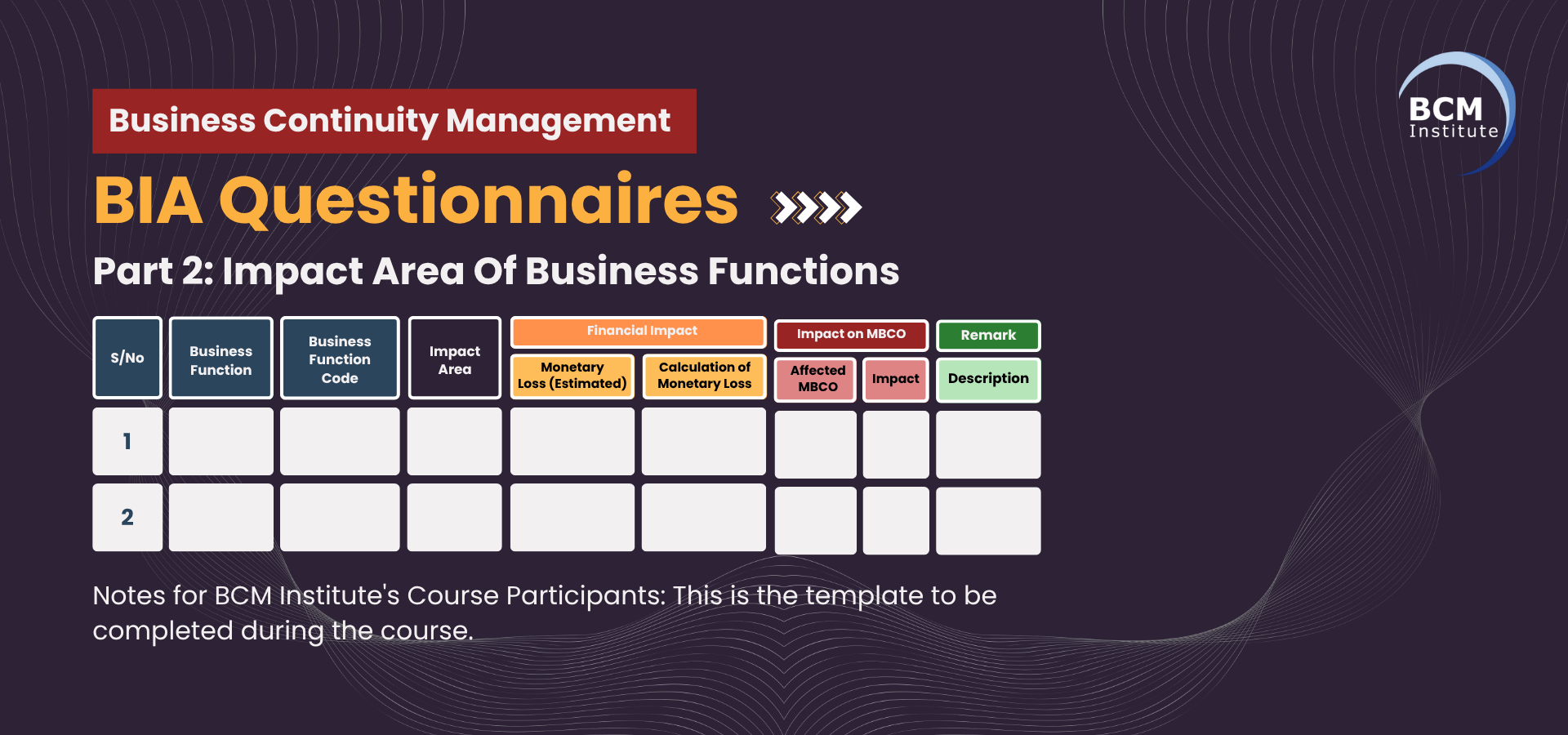](https://cta-redirect.hubspot.com/cta/redirect/3893111/6f3def45-6e82-4ee5-9e44-fc3946ad2398)
### [![Banner \[BCM\] \[E3\] \[BIA\] \[P2\] Impact Area of Business Functions](https://no-cache.hubspot.com/cta/default/3893111/182e67c2-aa89-4b0b-b3e9-144293680ea4.png)](https://cta-redirect.hubspot.com/cta/redirect/3893111/182e67c2-aa89-4b0b-b3e9-144293680ea4)
CBF-6: Corporate Services and IT Infrastructure
The Ministry of Manpower (MOM) plays a crucial role in regulating and overseeing the[![\[BCM\] \[MOM\] \[E3\] \[BIA\] \[T1\] \[CBF\] \[6\] Corporate Services and IT Infrastructure](https://no-cache.hubspot.com/cta/default/3893111/e270ba9d-5c31-4cd4-8ded-e67a69bcf827.png)](https://cta-redirect.hubspot.com/cta/redirect/3893111/e270ba9d-5c31-4cd4-8ded-e67a69bcf827) labour and employment sectors in Singapore, ensuring that the workforce operates efficiently and within the bounds of the law.
A critical component of the Ministry's ability to function effectively is the resilience of its corporate services and IT infrastructure.
Business continuity planning ensures that essential operations are maintained even in the face of disruption. One of the key high-level critical business functions within the Ministry is CBF-6: Corporate Services and IT Infrastructure.
This function encompasses a wide range of activities, from governance and strategic planning to IT infrastructure continuity, and its resilience is pivotal in supporting the Ministry’s day-to-day operations and long-term strategic goals.
This chapter will provide a detailed breakdown of the sub-components (Sub-CBFs) within CBF-6—examining the business processes, impact areas, financial implications, and how disruptions may affect the Ministry’s Minimum Business Continuity Objectives (MBCOs).
Each Sub-CBF will be explored in-depth to understand the various elements contributing to the effective functioning of the Ministry, and how disruptions to these services could be mitigated.
[![Banner \[Table\] \[BCM\] \[E3\] \[BIA\] \[P2\] Impact Areas of Business Functions \[BIAQ\]](https://no-cache.hubspot.com/cta/default/3893111/91582408-03ad-40e1-90e8-43ce62079aa6.png)](https://cta-redirect.hubspot.com/cta/redirect/3893111/91582408-03ad-40e1-90e8-43ce62079aa6)**Table P2: Impact Area Assessment for CBF-6**
| Sub-CBF Code | Sub-CBF | Impact Area | Financial Impact – Monetary Loss (Estimated) | Financial Impact – Calculation of Monetary Loss (State Formula for Calculations) | Impact on MBCO – Affect MBCO | Impact on MBCO – Impact | Remarks – Description |
| --- | --- | --- | --- | --- | --- | --- | --- |
| 6.1 | Governance & Strategic Planning | Loss of strategic oversight, delays in decision-making, and non-compliance with regulations | High | Estimated based on the cost of missed opportunities, regulatory fines, and delayed initiatives | Affects MBCO related to governance and compliance | Potential delays in project approvals, regulatory non-compliance, and missed strategic goals | Governance and strategic planning are fundamental for MOM's long-term direction and operational focus. Disruptions could significantly impact MOM’s agility and its ability to meet long-term objectives. |
| 6.2 | Financial Management & Resource Allocation | Delays in financial transactions, impact on resource allocation and budgeting | Medium | Based on the percentage of the operational budget affected by delays in financial processing or resource allocation | Affects MBCO related to financial stability and planning | Delays in the disbursement of resources could affect ongoing projects and staff compensation | Financial management is key to ensuring that MOM operates within its budget. Financial disruptions could hinder operations and public services. |
| 6.3 | Human Resource Continuity | Loss of critical personnel, inability to manage workforce levels and compensation | High | Estimated by the total payroll and cost to hire replacement staff in case of prolonged disruptions | Affects MBCO related to staffing and HR processes | Workforce shortages could lead to a reduction in productivity, delays in services, and high HR costs | Human resource continuity ensures that the Ministry can operate without disruptions caused by staff shortages or HR process failures. |
| 6.4 | Procurement & Contract Management | Delays in procuring goods/services, disruptions to contract fulfilment | Medium | Estimated by the average cost of delayed contracts and procurement timelines | Affects MBCO related to procurement timelines and supplier management | Delays in procurement processes could cause project delays and cost overruns | Procurement processes are critical in ensuring MOM’s operational needs are met. Any disruptions can impact service delivery and cause delays. |
| 6.5 | IT Infrastructure & Digital Services Continuity | Loss of IT systems, data breaches, or disruption to digital services | Very High | Calculated based on the estimated cost of system downtime, cybersecurity breaches, and the cost of restoring services | Affects MBCO related to IT systems and data availability | Disruption to IT services could halt operations, delay decision-making, and compromise data security | IT infrastructure continuity is the backbone of MOM’s operations. Any failure in this area has high financial and operational impacts. |
| 6.6 | Internal Administration & Facilities Management | Disruptions in facility services, loss of operational space, and health and safety concerns | Medium | Based on the cost of facility downtime, repairs, and the impact of operational inefficiencies | Affects MBCO related to operational space and employee safety | Facility disruptions could affect the day-to-day operational efficiency and the safety of employees | Administrative and facilities management is essential for MOM’s internal operations. Facility disruptions could lead to inefficiencies and employee safety concerns. |
### [![Banner \[BCM\] \[E3\] \[BIA\] \[Summing Up\] \[P2\] Impact Areas of Business Functions \[BIAQ\]](https://no-cache.hubspot.com/cta/default/3893111/76188041-e1c9-43d9-8efa-e550f46ad04d.png)](https://cta-redirect.hubspot.com/cta/redirect/3893111/76188041-e1c9-43d9-8efa-e550f46ad04d)
The resilience of CBF-6: Corporate Services and IT Infrastructure is integral to the Ministry of Manpower’s ability to deliver essential services and maintain its strategic focus.
A disruption in any of the Sub-CBFs can have far-reaching consequences, not only for the Ministry’s operational capacity but also for its ability to meet regulatory requirements, support its workforce, and engage in strategic planning.
Effective business continuity planning and risk management practices are crucial in safeguarding the Ministry's functions and ensuring it remains responsive and adaptive to the needs of the public and workforce.
By identifying the impact areas, estimating financial losses, and understanding the potential disruptions to MBCOs, the Ministry can better prioritise resources and establish recovery strategies to ensure continued service delivery even during crises.
This chapter highlights the importance of integrating business continuity practices into corporate services and IT infrastructure planning to enhance resilience in the face of unforeseen events.
| ###### Resilient Support: Implementing Business Continuity Management at Ministry of Manpower (Singapore) | | | | | | |
| --- | --- | --- | --- | --- | --- | --- |
| **eBook 3: Starting Your BCM Implementation** | | | | | | |
| **MBCO** | **P&S** | **RAR T1** | **RAR T2** | **RAR T3** | **BCS T1** | ** CBF** |
| [![\[BCM\] \[MOM\] \[E3\] \[BIA\] MBCO Corporate MBCO](https://no-cache.hubspot.com/cta/default/3893111/91c07ac1-2f4d-4acf-a002-df50ac7e8f19.png)](https://cta-redirect.hubspot.com/cta/redirect/3893111/91c07ac1-2f4d-4acf-a002-df50ac7e8f19) | [![\[BCM\] \[MOM\] \[E3\] \[BIA\] \[P&S\] Key Product and Services](https://no-cache.hubspot.com/cta/default/3893111/904a4659-6e74-4f50-a27d-b0543463d80a.png)](https://cta-redirect.hubspot.com/cta/redirect/3893111/904a4659-6e74-4f50-a27d-b0543463d80a) | [![\[BCM\] \[MOM\] \[E3\] \[RAR\] \[T1\] List of Threats](https://no-cache.hubspot.com/cta/default/3893111/41c8981e-45dd-416c-90e0-55c3a22753da.png)](https://cta-redirect.hubspot.com/cta/redirect/3893111/41c8981e-45dd-416c-90e0-55c3a22753da) | [![\[BCM\] \[MOM\] \[E3\] \[RAR\] \[T2\] Treatment and Control ](https://no-cache.hubspot.com/cta/default/3893111/02909b01-2511-4249-864b-967afcc727bc.png)](https://cta-redirect.hubspot.com/cta/redirect/3893111/02909b01-2511-4249-864b-967afcc727bc) | [![\[BCM\] \[MOM\] \[E3\] \[RAR\] \[T3\] Risk Impact and Likelihood Assessmen](https://no-cache.hubspot.com/cta/default/3893111/fd3dd074-a74d-45ec-8219-3cee4c0463c4.png)](https://cta-redirect.hubspot.com/cta/redirect/3893111/fd3dd074-a74d-45ec-8219-3cee4c0463c4) | [![\[BCM\] \[MOM\] \[E3\] \[BCS\] \[T1\] Mitigation Strategies and Justification](https://no-cache.hubspot.com/cta/default/3893111/06674b8b-3cf9-4855-a89a-ecd2baa9a395.png)](https://cta-redirect.hubspot.com/cta/redirect/3893111/06674b8b-3cf9-4855-a89a-ecd2baa9a395) | [![\[BCM\] \[MOM\] \[E1\] \[C10\] Identifying Critical Business Functions](https://no-cache.hubspot.com/cta/default/3893111/f19dbb07-448c-4021-9605-82ad98643d7f.png)](https://cta-redirect.hubspot.com/cta/redirect/3893111/f19dbb07-448c-4021-9605-82ad98643d7f) |
| **CBF-6 Corporate Services and IT Infrastructure ** | | | | | | |
| **DP** | **BIAQ T1** | **BIAQ T2** | **BIAQ T3** | **BCS T2** | **BCS T3** | **PD** |
| [![\[BCM\] \[MOM\] \[E3\] \[BIA\] \[DP\] \[CBF\] \[6\] Corporate Services and IT Infrastructure](https://no-cache.hubspot.com/cta/default/3893111/7df528c7-8335-4814-826a-e2e6378288aa.png)](https://cta-redirect.hubspot.com/cta/redirect/3893111/7df528c7-8335-4814-826a-e2e6378288aa) | [![\[BCM\] \[MOM\] \[E3\] \[BIA\] \[T1\] \[CBF\] \[6\] Corporate Services and IT Infrastructure](https://no-cache.hubspot.com/cta/default/3893111/e270ba9d-5c31-4cd4-8ded-e67a69bcf827.png)](https://cta-redirect.hubspot.com/cta/redirect/3893111/e270ba9d-5c31-4cd4-8ded-e67a69bcf827) | [![\[BCM\] \[MOM\] \[E3\] \[BIA\] \[T2\] \[CBF\] \[6\] Corporate Services and IT Infrastructure](https://no-cache.hubspot.com/cta/default/3893111/0c6d0fe0-c95e-45fe-9b99-a705b7bd5abc.png)](https://cta-redirect.hubspot.com/cta/redirect/3893111/0c6d0fe0-c95e-45fe-9b99-a705b7bd5abc) | [![\[BCM\] \[MOM\] \[E3\] \[BIA\] \[T3\] \[CBF\] \[6\] Corporate Services and IT Infrastructure](https://no-cache.hubspot.com/cta/default/3893111/d8a1aa4e-23a6-4890-ac50-541ecd5b5161.png)](https://cta-redirect.hubspot.com/cta/redirect/3893111/d8a1aa4e-23a6-4890-ac50-541ecd5b5161) | [![\[BCM\] \[MOM\] \[E3\] \[BCS\] \[T2\] \[CBF\] \[6\] Corporate Services and IT Infrastructure](https://no-cache.hubspot.com/cta/default/3893111/65a3976a-1ed7-46b4-b3e4-4c6b56129b19.png)](https://cta-redirect.hubspot.com/cta/redirect/3893111/65a3976a-1ed7-46b4-b3e4-4c6b56129b19) | [![\[BCM\] \[MOM\] \[E3\] \[BCS\] \[T3\] \[CBF\] \[6\] Minimum Resources Required during a Disaster](https://no-cache.hubspot.com/cta/default/3893111/a2056aa4-5dbc-4970-8705-0d42f5029f9f.png)](https://cta-redirect.hubspot.com/cta/redirect/3893111/a2056aa4-5dbc-4970-8705-0d42f5029f9f) | [![\[BCM\] \[MOM\] \[E3\] \[PD\] \[CBF\] \[6\] Corporate Services and IT Infrastructure](https://no-cache.hubspot.com/cta/default/3893111/c6ec7ad8-fb5a-4ee0-a208-8e5ec0101cf6.png)](https://cta-redirect.hubspot.com/cta/redirect/3893111/c6ec7ad8-fb5a-4ee0-a208-8e5ec0101cf6) |
#### More Information About Business Continuity Management Courses
To learn more about the course and schedule, click the buttons below for the BCM-300 Business Continuity Management Implementer \[BCM-3\] and the BCM-5000 Business Continuity Management Expert Implementer \[BCM-5\].
| [](https://cta-redirect.hubspot.com/cta/redirect/3893111/f3922b80-e96a-46d6-8993-dc150a5de2d5) | [](https://cta-redirect.hubspot.com/cta/redirect/3893111/9ff8a3dc-e39a-465b-929f-72e232cdd5fb) | [![Register \[BL-B-3\]*](https://no-cache.hubspot.com/cta/default/3893111/ac6cf073-4cdd-4541-91ed-889f731d5076.png)](https://cta-redirect.hubspot.com/cta/redirect/3893111/ac6cf073-4cdd-4541-91ed-889f731d5076) |
| --- | --- | --- |
| [](https://cta-redirect.hubspot.com/cta/redirect/3893111/21525c10-4003-4934-95fc-fe218174bc5b) | [](https://cta-redirect.hubspot.com/cta/redirect/3893111/46460171-c91a-4936-9bb2-8dc5928a0e02) | [](https://cta-redirect.hubspot.com/cta/redirect/3893111/1cb17ac7-50b2-4f88-bc4b-c7444e4b57b5) |
| [![FAQ \[BL-B-3\]](https://no-cache.hubspot.com/cta/default/3893111/b3824ba1-7aa1-4eb6-bef8-94f57121c5ae.png)](https://cta-redirect.hubspot.com/cta/redirect/3893111/b3824ba1-7aa1-4eb6-bef8-94f57121c5ae) | Please feel free to send us a note if you have any questions. [![Email to Sales Team \[BCM Institute\]](https://no-cache.hubspot.com/cta/default/3893111/3c53daeb-2836-4843-b0e0-645baee2ab9e.png)](https://cta-redirect.hubspot.com/cta/redirect/3893111/3c53daeb-2836-4843-b0e0-645baee2ab9e) | [](https://cta-redirect.hubspot.com/cta/redirect/3893111/9c199ae8-c470-4bb7-9612-73c7a084e94c) |
| [](https://cta-redirect.hubspot.com/cta/redirect/3893111/8999211a-2c51-4be7-bf49-c393f6c67974) | [](https://cta-redirect.hubspot.com/cta/redirect/3893111/5c1aa95d-f6dd-4067-a95c-5cc0c32d7ed8) | [](https://cta-redirect.hubspot.com/cta/redirect/3893111/086ab3b9-4d66-4a95-b2f7-1148e9803a9c) |
#### **Your Comments Here:**
### More Posts
[](https://cta-redirect.hubspot.com/cta/redirect/3893111/839787f4-a4fd-456f-accf-54c947026558)

All rights reserved. Copyright 2026
```json
{
"@context" : "https://schema.org",
"@type" : "BlogPosting",
"author" : {
"@type" : "Person",
"name" : "Dr Goh Moh Heng",
"url" : "https://blog.bcm-institute.org/t-e3-bcm/author/dr-goh-moh-heng"
},
"dateModified" : "2026-01-06T05:13:35.414Z",
"datePublished" : "2026-01-06T04:20:50.000Z",
"headline" : "[BCM] [MOM] [E3] [BIA] [T1] [CBF] [6] Corporate Services and IT Infrastructure",
"image" : [ "https://blog.bcm-institute.org/hubfs/Ministry%20of%20Manpower%20Graphic%20Folder/MOM%20E3%20Morepost/MOM%20CBF%206/%5BBCM%5D%20%5BMOM%5D%20%5BE3%5D%20%5BBIA%5D%20%5BT1%5D%20%5BCBF%5D%20%5B6%5D%20Corporate%20Services%20and%20IT%20Infrastructure.jpg" ],
"mainEntityOfPage" : {
"@id" : "https://blog.bcm-institute.org/t-e3-bcm/bcm-mom-e3-bia-t1-cbf-6-corporate-services-and-it-infrastructure",
"@type" : "WebPage"
},
"publisher" : {
"@type" : "Organization",
"logo" : {
"@type" : "ImageObject",
"url" : "https://blog.bcm-institute.org/hubfs/BCMI%20Logo.png"
},
"name" : "BCMI Pte Ltd"
}
}
```