

![Banner [BCM] [E3] [BIA] [P2] Impact Area of Business Functions](https://no-cache.hubspot.com/cta/default/3893111/182e67c2-aa89-4b0b-b3e9-144293680ea4.png)
![Banner [BCM] [E3] [BIA] [P1] Identification of Business Functions](https://no-cache.hubspot.com/cta/default/3893111/206ddd7e-615a-42c8-aa2a-3416a1ad06b3.png)
CBF-3 Workplace Safety and Health (WSH) Oversight
Workplace Safety and Health (WSH) Oversight is a core regulatory and governance responsibility of Singapore’s Ministry of Manpower (MOM).
This Critical Business Function (CBF-3) ensures that workplaces remain safe, healthy, and compliant with national WSH laws and standards, thereby protecting workers, sustaining business confidence, and supporting national economic resilience.![[BCM] [MOM] [E3] [BIA] [T1] [CBF] [3] Workplace Safety and Health (WSH) Oversight](https://no-cache.hubspot.com/cta/default/3893111/fadd3987-b8f1-47a0-9cbf-b63d8e132e7e.png)
From a Business Continuity Management (BCM) perspective, the uninterrupted execution of WSH oversight functions is essential, especially during crises such as pandemics, major industrial accidents, or systemic disruptions affecting high-risk sectors.
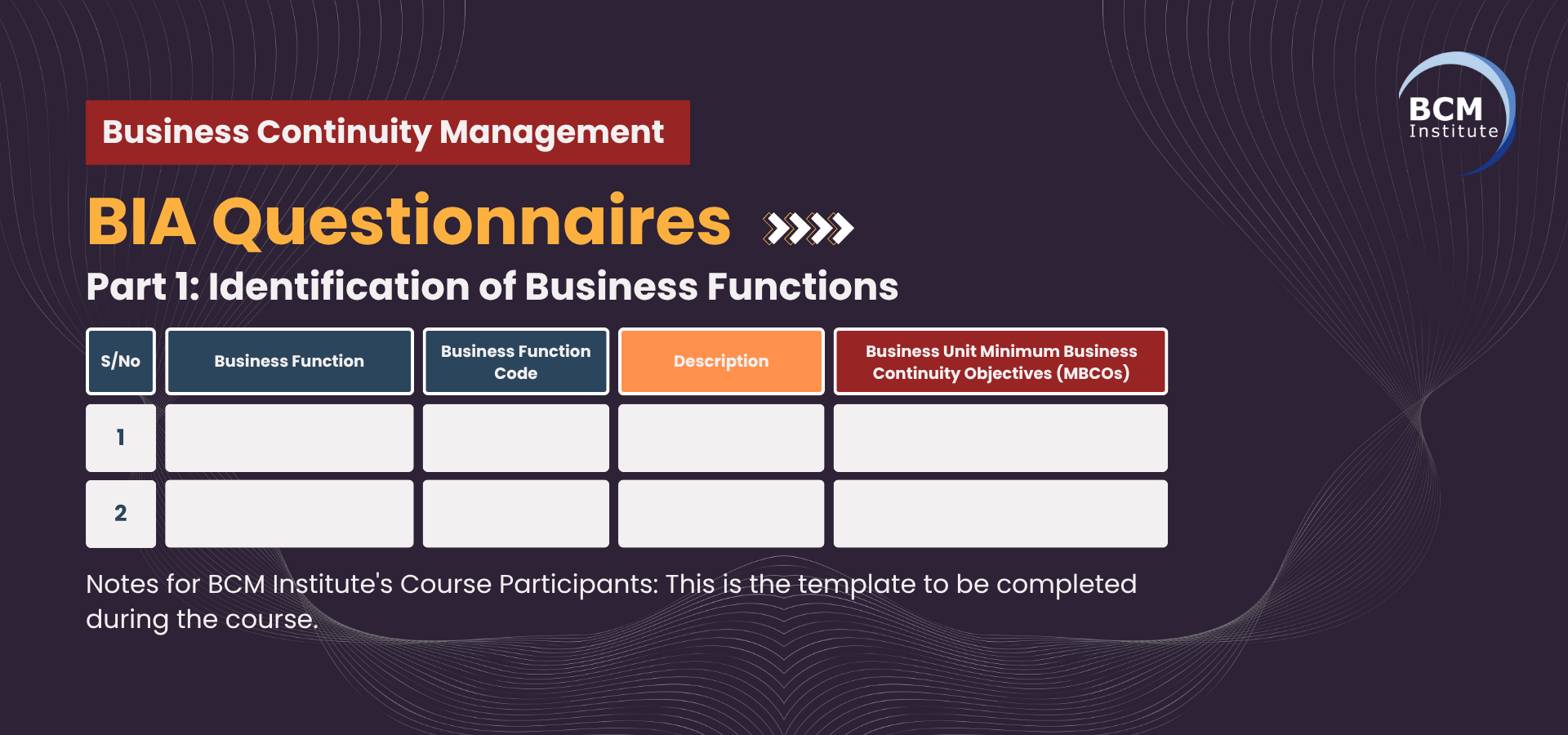
This chapter identifies and documents the sub-critical business functions (Sub-CBFs) under CBF-3 and establishes their Business Unit Minimum Business Continuity Objectives (BU MBCOs)—the minimum acceptable level of service each business unit must maintain during a disruption to prevent unacceptable regulatory, safety, or reputational consequences.
![Banner [Table] [BCM] [E3] [BIA] [P1] Identification of Critical Business Functions](https://no-cache.hubspot.com/cta/default/3893111/4fe499c9-0c19-46b4-8b6f-75450dba07d8.png)
Table P1: Critical Business Functions for CBF-3
|
Sub-CBF Code |
Sub-CBF |
Description of Sub-CBF |
Business Unit Minimum Business Continuity Objective (MBCO) |
|
3.1 |
Policy & Standards Development |
Development, review, and updating of WSH policies, codes of practice, and national standards to address emerging risks and align with international best practices. |
Maintain the capability to issue time-critical policy advisories, interim standards, and regulatory guidance to address emerging or crisis-related WSH risks. |
|
3.2 |
Legislative & Regulatory Oversight |
Administration, interpretation, and enforcement oversight of WSH legislation and subsidiary regulations to ensure legal compliance across industries. |
Ensure continuity of core regulatory decision-making, statutory approvals, and urgent legal interpretations required to uphold the WSH regulatory framework. |
|
3.3 |
Risk-Based Inspections & Enforcement |
Planning and execution of inspections, audits, and enforcement actions focusing on high-risk sectors, activities, and workplaces. |
Sustain risk-prioritised inspections and enforcement actions for high-risk workplaces to prevent imminent danger to life and serious safety breaches. |
|
3.4 |
Monitoring & Surveillance Programmes |
Ongoing monitoring of workplace safety trends, occupational disease data, and emerging systemic WSH risks through surveillance programmes. |
Maintain minimum monitoring and data analysis capability to detect abnormal safety trends or emerging threats requiring regulatory intervention. |
|
3.5 |
Accident Reporting & Incident Investigation |
Receipt, assessment, and investigation of workplace accidents, dangerous occurrences, and occupational diseases. |
Ensure uninterrupted intake of accident reports and conduct investigations for fatal, major, or systemic incidents within mandated timeframes. |
|
3.6 |
Stakeholder Engagement & Education |
Engagement with employers, workers, unions, industry associations, and service providers to promote WSH awareness and compliance. |
Maintain essential communication and advisory channels to disseminate critical WSH messages, alerts, and guidance during disruptions. |
|
3.7 |
Competent Person Certification & Registration |
Certification, registration, and renewal of WSH officers, auditors, and other competent persons are required under WSH regulations. |
Continue core certification and registration services necessary to support regulated industries and legally mandated WSH roles. |
|
3.8 |
Performance Monitoring & Reporting |
Measurement, analysis, and reporting of national WSH performance indicators to support governance, accountability, and policy decisions. |
Preserve minimum reporting and performance tracking capability to inform leadership and support national-level WSH oversight and decisions. |
![Banner [Summary] [BCM] [E1] [C10] Identifying Critical Business Functions](https://no-cache.hubspot.com/cta/default/3893111/0e59113c-d17a-48a8-8c28-bb1bcf487857.png)
The identification of Sub-CBFs under CBF-3 Workplace Safety and Health (WSH) Oversight provides a structured foundation for MOM’s Business Continuity Management programme.
By clearly defining the Business Unit Minimum Business Continuity Objectives (BU MBCOs), MOM ensures that critical regulatory, enforcement, and safety assurance activities can be sustained at an acceptable minimum level during disruptions.
These BU MBCOs serve as a practical benchmark for subsequent BCM phases, including Business Impact Analysis (BIA), recovery strategy development, and continuity planning.
Ultimately, maintaining continuity in WSH oversight reinforces MOM’s mandate to safeguard workers, uphold regulatory confidence, and sustain national resilience—especially during periods of heightened risk and uncertainty.

CBF-3: Workplace Safety and Health (WSH) Oversight
Workplace Safety and Health (WSH) Oversight is a critical regulatory and supervisory function of the Ministry of Manpower (MOM), directly supporting Singapore’s national objective of ensuring safe, healthy, and productive workplaces.
Under Business Continuity Management (BCM), CBF-3 Workplace Safety and Health (WSH) Oversight is classified as a critical business function due to its significant implications on public safety, regulatory compliance, national reputation, and socio-economic stability.
This chapter identifies and analyses the impact areas associated with disruptions to the key sub-business functions (Sub-CBFs) supporting WSH Oversight.
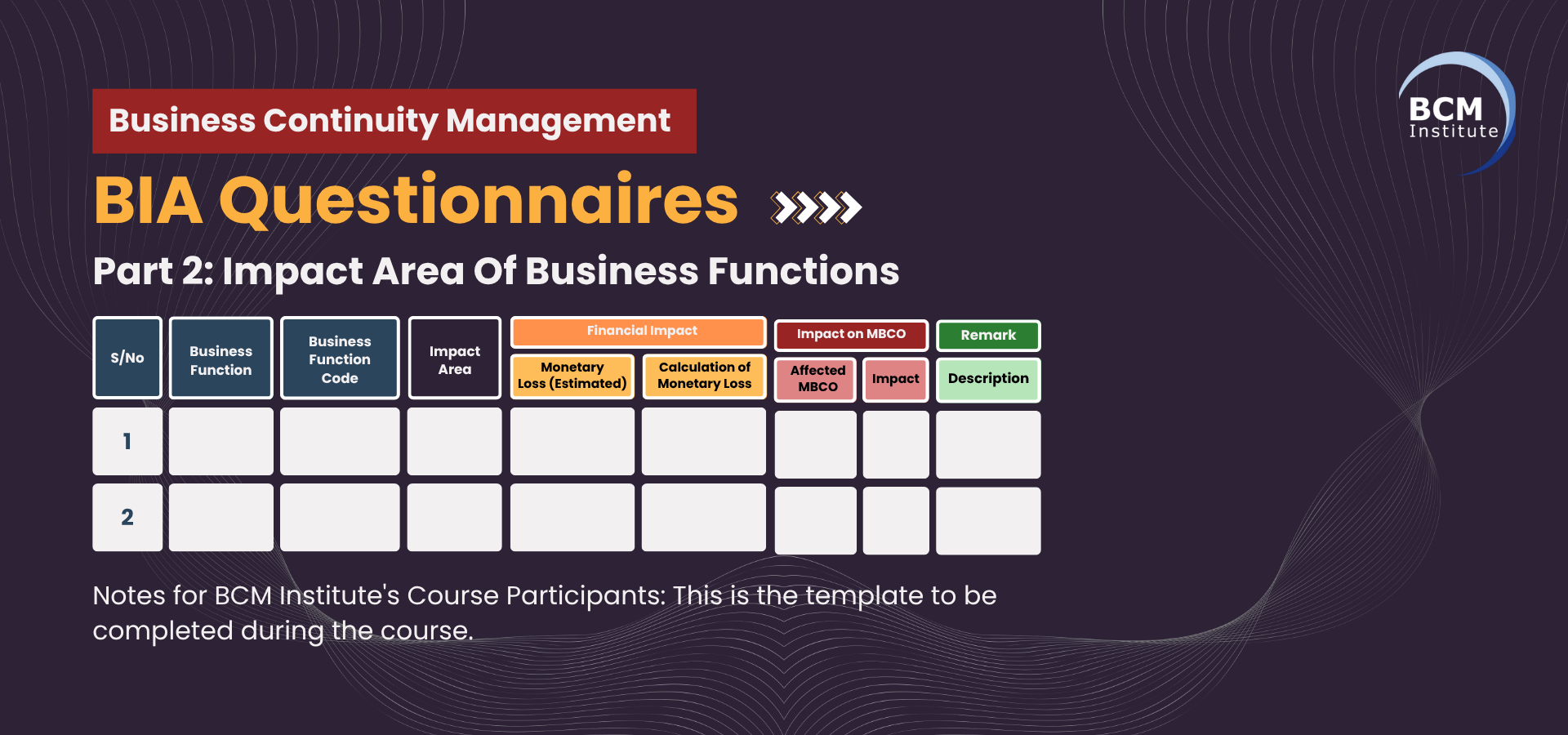
In accordance with BCMPedia Part 2: Impact Area of Business Functions v2.0, the analysis considers financial impact, effect on the organisation’s Minimum Business Continuity Objective (MBCO), and broader consequences such as regulatory breaches, loss of public confidence, and increased workplace risks.
This assessment supports informed decision-making during Business Impact Analysis (BIA) and continuity strategy development.
![Banner [Table] [BCM] [E3] [BIA] [P2] Impact Areas of Business Functions [BIAQ]](https://no-cache.hubspot.com/cta/default/3893111/91582408-03ad-40e1-90e8-43ce62079aa6.png) Table P2: Impact Area Assessment for CBF-1
Table P2: Impact Area Assessment for CBF-1
|
Sub-CBF Code |
Sub-CBF |
Impact Area |
Financial Impact – Monetary Loss (Estimated) |
Financial Impact – Calculation of Monetary Loss (State Formula for Calculations) |
Impact on MBCO – Affect MBCO |
Impact on MBCO – Impact |
Remarks – Description |
|
3.1 |
Policy & Standards Development |
Regulatory governance, national WSH framework |
Medium (S$200K–S$500K per incident) |
Cost of policy delays + remediation + stakeholder re-alignment costs |
Yes |
Delays in issuing updated WSH policies compromise regulatory leadership |
Inability to update standards may result in outdated safety requirements and misalignment with emerging risks. |
|
3.2 |
Legislative & Regulatory Oversight |
Legal compliance, statutory enforcement |
High (S$500K–S$2M) |
Regulatory non-compliance penalties + legal costs + corrective enforcement measures |
Yes |
Breach of statutory obligations and governance failures |
Disruption may lead to lapses in enforcement of WSH Act and subsidiary legislation. |
|
3.3 |
Risk-Based Inspections & Enforcement |
Worker safety, regulatory assurance |
Very High (S$1M–S$5M+) |
Increased accident costs + enforcement backlog + emergency interventions |
Yes |
Direct threat to worker safety and regulatory credibility |
Missed or delayed inspections can result in severe accidents, fatalities, and public scrutiny. |
|
3.4 |
Monitoring & Surveillance Programmes |
Early warning, hazard detection |
High (S$800K–S$3M) |
Cost of undetected risks + reactive interventions + data recovery |
Yes |
Reduced ability to identify emerging WSH risks |
Failure in surveillance weakens proactive risk mitigation and trend analysis. |
|
3.5 |
Accident Reporting & Incident Investigation |
Incident response, accountability |
Very High (S$1M–S$10M) |
Cost of delayed investigations + litigation exposure + compensation claims |
Yes |
Inability to meet investigation timelines and transparency expectations |
Delays undermine public trust and may breach statutory reporting timelines. |
|
3.6 |
Stakeholder Engagement & Education |
Industry compliance, awareness |
Medium (S$150K–S$400K) |
Cost of re-engagement programmes + increased non-compliance incidents |
Partial |
Reduced industry readiness and WSH awareness |
Disruption affects outreach to employers, workers, and unions, increasing unsafe practices. |
|
3.7 |
Competent Person Certification & Registration |
Workforce competency assurance |
High (S$500K–S$2M) |
Cost of backlog processing + interim risk controls + reputational impact |
Yes |
Inadequate supply of certified WSH professionals |
Delays in certification affect industry capability to manage workplace risks. |
|
3.8 |
Performance Monitoring & Reporting |
Governance, national reporting |
Medium–High (S$300K–S$1M) |
Cost of inaccurate reporting + corrective audits + stakeholder assurance |
Yes |
Impaired oversight and strategic decision-making |
Incomplete or delayed reporting affects MOM’s ability to track national WSH outcomes. |
![Banner [BCM] [E3] [BIA] [Summing Up] [P2] Impact Areas of Business Functions [BIAQ]](https://no-cache.hubspot.com/cta/default/3893111/76188041-e1c9-43d9-8efa-e550f46ad04d.png)
The impact analysis of CBF-3 Workplace Safety and Health (WSH) Oversight demonstrates that disruptions to this function can result in severe safety, regulatory, financial, and reputational consequences for the Ministry of Manpower and Singapore as a whole.
Several Sub-CBFs—particularly risk-based inspections, accident investigations, and regulatory oversight—have a direct and critical impact on MOM’s Minimum Business Continuity Objective (MBCO), requiring prioritised recovery and robust continuity strategies.
By clearly identifying impact areas and potential monetary losses, this chapter provides a structured foundation for MOM’s Business Impact Analysis (BIA) and supports the development of risk-informed recovery strategies.
Ensuring the resilience of WSH Oversight functions is essential not only for regulatory compliance but also for sustaining public trust, protecting workers, and maintaining national socio-economic stability.
![[BCM] [MOM] [E3] [BIA] MBCO Corporate MBCO](https://no-cache.hubspot.com/cta/default/3893111/91c07ac1-2f4d-4acf-a002-df50ac7e8f19.png)
![[BCM] [MOM] [E3] [BIA] [P&S] Key Product and Services](https://no-cache.hubspot.com/cta/default/3893111/904a4659-6e74-4f50-a27d-b0543463d80a.png)
![[BCM] [MOM] [E3] [RAR] [T1] List of Threats](https://no-cache.hubspot.com/cta/default/3893111/41c8981e-45dd-416c-90e0-55c3a22753da.png)
![[BCM] [MOM] [E3] [RAR] [T2] Treatment and Control](https://no-cache.hubspot.com/cta/default/3893111/02909b01-2511-4249-864b-967afcc727bc.png)
![[BCM] [MOM] [E3] [RAR] [T3] Risk Impact and Likelihood Assessmen](https://no-cache.hubspot.com/cta/default/3893111/fd3dd074-a74d-45ec-8219-3cee4c0463c4.png)
![[BCM] [MOM] [E3] [BCS] [T1] Mitigation Strategies and Justification](https://no-cache.hubspot.com/cta/default/3893111/06674b8b-3cf9-4855-a89a-ecd2baa9a395.png)
![[BCM] [MOM] [E1] [C10] Identifying Critical Business Functions](https://no-cache.hubspot.com/cta/default/3893111/f19dbb07-448c-4021-9605-82ad98643d7f.png)
![[BCM] [MOM] [E3] [BIA] [DP] [CBF] [3] Workplace Safety and Health (WSH) Oversight](https://no-cache.hubspot.com/cta/default/3893111/dd30c3fc-59b8-4622-b5ea-0b6386099d77.png)
![[BCM] [MOM] [E3] [BIA] [T2] [CBF] [3] Workplace Safety and Health (WSH) Oversight](https://no-cache.hubspot.com/cta/default/3893111/e2503e96-5580-4d63-95c2-7d5e3957eedc.png)
![[BCM] [MOM] [E3] [BIA] [T3] [CBF] [3] Workplace Safety and Health (WSH) Oversight](https://no-cache.hubspot.com/cta/default/3893111/ca75a23e-cdde-4d7f-8c25-cda2ae042c2e.png)
![[BCM] [MOM] [E3] [BCS] [T2] [CBF] [3] Workplace Safety and Health (WSH) Oversight](https://no-cache.hubspot.com/cta/default/3893111/e2ec9155-ac81-4e3b-a45f-abec7be8b873.png)
![[BCM] [MOM] [E3] [BCS] [T3] [CBF] [3] Minimum Resources Required during a Disaster](https://no-cache.hubspot.com/cta/default/3893111/47412b8c-1ce9-4a78-9e8f-50e8c98815c3.png)
![[BCM] [MOM] [E3] [PD] [CBF] [3] Workplace Safety and Health (WSH) Oversight](https://no-cache.hubspot.com/cta/default/3893111/05db2aca-40b0-48ad-b3da-f43e0fe55122.png)
More Information About Business Continuity Management Courses
To learn more about the course and schedule, click the buttons below for the BCM-300 Business Continuity Management Implementer [BCM-3] and the BCM-5000 Business Continuity Management Expert Implementer [BCM-5].


![Register [BL-B-3]*](https://no-cache.hubspot.com/cta/default/3893111/ac6cf073-4cdd-4541-91ed-889f731d5076.png)



![FAQ [BL-B-3]](https://no-cache.hubspot.com/cta/default/3893111/b3824ba1-7aa1-4eb6-bef8-94f57121c5ae.png)
![Email to Sales Team [BCM Institute]](https://no-cache.hubspot.com/cta/default/3893111/3c53daeb-2836-4843-b0e0-645baee2ab9e.png)


