

 The Implement Phase of Malaysian Life Reinsurance’s Operational Resilience Planning Methodology
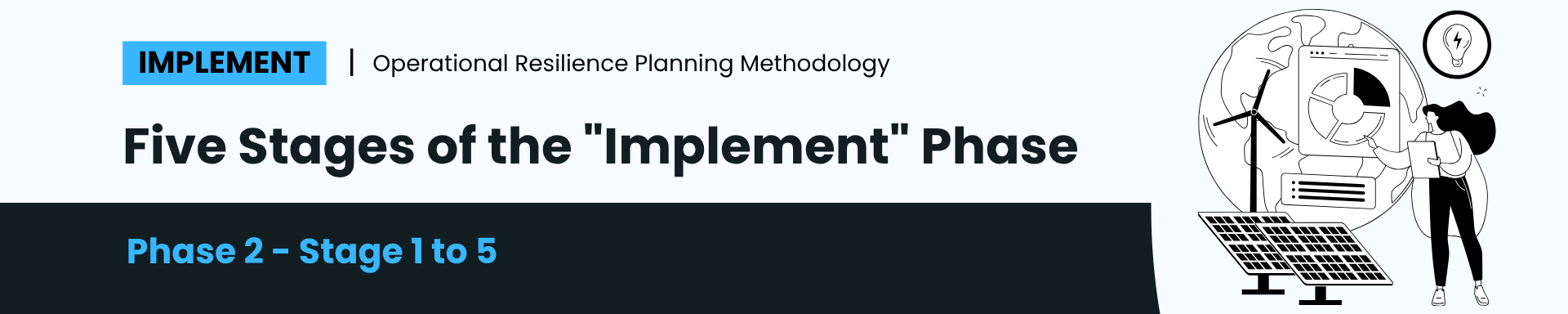
 The Implement phase converts the strategy and governance built in the Plan phase into measurable, repeatable, and evidence-based resilience for Malaysian Life Reinsurance Group Berhad (MLRe). It is where MLRe moves from asking "what should we do?" to demonstrating "can our critical services stay within tolerance?"
Why the Implement Phase Matters
Bank Negara Malaysia (BNM) expects institutions to understand which services could cause intolerable harm if disrupted, what those services depend on, and whether they can be kept within defined limits during severe but plausible events. The Implement phase produces this understanding and the evidence behind it, shifting the focus from internal functions and individual assets to the services delivered to cedants, takaful operators and the financial system.
The Five Stages of the Implement Phase
| Stage | Purpose | Chapter |
|---|---|---|
| 1. Identify Critical Business Services | Decide which services, such as treaty underwriting, claims settlement and retrocession, are critical | Chapter 9 |
| 2. Map Interconnections and Interdependencies | Trace the people, processes, technology, facilities, data and third parties behind each service | Chapter 10 |
| 3. Establish Impact Tolerance | Set the maximum tolerable disruption for each service, in time, volume or data integrity | Chapter 11 |
| 4. Perform Scenario Testing | Test severe but plausible scenarios such as cyber incidents, third-party failure and pandemic absence | Chapter 12 |
| 5. Improve Lessons Learned | Turn test and incident findings into concrete, verified improvements | Chapter 13 |
How the Stages Connect
Each stage depends on the one before. Tolerances cannot be set until services are identified, and scenarios cannot be designed without knowing dependencies. Lessons learned feed back into every earlier stage: a failed test may lead MLRe to revise a dependency map, strengthen a control or ask the Board to reconsider a tolerance.
Outputs to Expect
- A Board-approved inventory of critical business services
- Dependency maps for each critical service, including third parties
- Documented impact tolerances linked to risk appetite
- Scenario test reports showing whether tolerances were met
- A lessons-learned register with owned and tracked actions
Looking Ahead
Once these capabilities are working, the Sustain phase (Chapter 14) keeps them alive through culture, communication, training and assurance.


| eBook 3 | ||
 |
||
| C11 | C12 | C13 |
 |
 |
 |