
![[OR] [Full Banner] [M4] Pre reading for Participants](https://no-cache.hubspot.com/cta/default/3893111/230a731c-ff3f-45bd-bedb-13defd4dd6f6.png)

"Body of Knowledge" BOK Series for Phase-Stage of Operational Resilience Planning Methodology
Operational resilience has evolved into a strategic discipline that enables organisations to anticipate, withstand, respond to, recover from, and continuously adapt to disruptive events while maintaining the delivery of critical business services.
As regulatory expectations, interconnected risks, and stakeholder demands continue to grow, resilience professionals require more than a high-level understanding—they need a structured body of knowledge that guides them through every stage of implementation.
This Table of Contents serves as the gateway to a comprehensive 15-blog Operational Resilience Body of Knowledge (BoK) series, presenting a logical and practical roadmap that follows the complete Operational Resilience Planning Methodology.
Whether you are beginning your operational resilience journey or strengthening an existing programme, this series provides the knowledge, concepts, and practical guidance needed to develop, implement, and sustain an effective operational resilience capability.

![[OR] [TOC] [Plan] Body of Knowledge Series Banner](https://no-cache.hubspot.com/cta/default/3893111/be535a3e-f981-4210-8627-4eff19c11d94.png) |
||||
![[OR] [BOK] [1] [P1] [S1] Assess Capability and Maturity](https://no-cache.hubspot.com/cta/default/3893111/9beb95f4-c90f-4369-be31-cec0f72f7fdc.png) |
![[OR] [BOK] [2] [P1] [S2] Analyse Gap](https://no-cache.hubspot.com/cta/default/3893111/e1ec985f-2675-46fc-b948-d2d5d6cdfd6c.png) |
![[OR] [BOK] [3] [P1] [S3] Develop Strategy and Roadmap](https://no-cache.hubspot.com/cta/default/3893111/58346b86-05e5-40fe-a3c6-b3e320994630.png) |
![[OR] [BOK] [4] [P1] [S4] Confirm Risk Appetite](https://no-cache.hubspot.com/cta/default/3893111/94d662d4-794a-4ee5-b0e1-00a7ed0d33e0.png) |
![[OR] [BOK] [5] [P1] [S5] Develop and Embed Governance](https://no-cache.hubspot.com/cta/default/3893111/c7b86964-b492-4053-a2ea-a2ddeae39ecf.png) |
![[OR] [TOC] [Implement] Body of Knowledge Series Banner](https://no-cache.hubspot.com/cta/default/3893111/db60978d-7a5b-4691-b00f-285e71237aa0.png) |
||||
![[OR] [BOK] [6] [P2] [S1] Identify Critical Business Services](https://no-cache.hubspot.com/cta/default/3893111/a039c6e3-1574-476e-b922-932a3db0057d.png) |
![[OR] [BOK] [7] [P2] [S2] Map Processes and Resources](https://no-cache.hubspot.com/cta/default/3893111/bbf6bc20-b04b-4754-b1e1-ae7b128cfd16.png) |
![[OR] [BOK] [8] [P2] [S3] Set Impact Tolerance](https://no-cache.hubspot.com/cta/default/3893111/2a8e7e00-da4f-48d9-8ebf-384e838fa3ed.png) |
![[OR] [BOK] [9] [P2] [S4] Conduct Scenario Testing](https://no-cache.hubspot.com/cta/default/3893111/ad71fd8a-ced1-4e9b-96af-b4f6c8f3fbbf.png) |
![[OR] [BOK] [10] [P2] [S5] Improve Lesson Learnt](https://no-cache.hubspot.com/cta/default/3893111/56ef9e79-9d00-45b8-947f-9029325a2b6d.png) |
![[OR] [TOC] [Sustain] Body of Knowledge Series Banner](https://no-cache.hubspot.com/cta/default/3893111/2a139ae0-0365-4e5e-b037-70d76610def6.png) |
||||
![[OR] [BOK] [11] [P3] [S1] Introduce Cultural Change Management](https://no-cache.hubspot.com/cta/default/3893111/924d8373-8d78-45ee-82fb-27e30f2223c3.png) |
![[OR] [BOK] [12] [P3] [S2] Develop Communication Strategy](https://no-cache.hubspot.com/cta/default/3893111/a62205d3-c892-418a-97b7-c7a547483351.png) |
![[OR] [BOK] [13] [P3] [S3] Implement Training and Awareness](https://no-cache.hubspot.com/cta/default/3893111/4b259664-4fa3-420d-bc53-21bc95ec797f.png) |
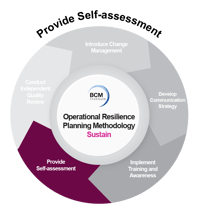
![[OR] [BOK] [14] [P3] [S4] Provide Self-assessment](https://no-cache.hubspot.com/cta/default/3893111/bc5bfc42-dad2-4a6c-a716-5592dc6d1c69.png) |
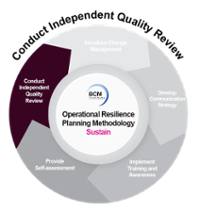
![[OR] [BOK] [15] [P3] [S5] Conduct Independent Quality Review](https://no-cache.hubspot.com/cta/default/3893111/dc6f86ab-8f6f-4753-9064-262ec7e8043c.png) |
This Table of Contents is more than an index—it is a structured learning pathway for operational resilience professionals seeking to build expertise from planning through implementation and continual improvement.
Each of the 15 blogs explores a specific phase or stage of the Operational Resilience Planning Methodology, allowing readers to progressively build their knowledge and understand how each component contributes to a mature, integrated resilience programme.
By following the complete series, practitioners, managers, and executives will gain a holistic understanding of operational resilience and be better equipped to design, implement, govern, and continuously enhance resilience capabilities that meet both organisational objectives and evolving regulatory expectations.

"Plan" Phase of the OR Planning Methodology


"Implement" Phase of the OR Planning Methodology


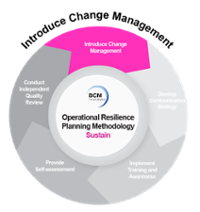
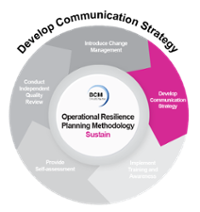
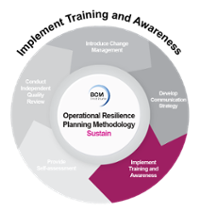
"Sustain" Phase of the OR Planning Methodology
More Information About OR-5000 [OR-5] or OR-300 [OR-3]
To learn more about the course and schedule, click the buttons below for the OR-3 Blended Learning OR-300 Operational Resilience Implementer course and the OR-5 Blended Learning OR-5000 Operational Resilience Expert Implementer course.





![[BL-OR] [3-4-5] View Schedule](https://blog.bcm-institute.org/hs-fs/hubfs/hub_generated/resized/e4287b59-1a43-4e10-8e43-c73b27b3ca39.png?width=172&height=50&name=e4287b59-1a43-4e10-8e43-c73b27b3ca39.png)
![[BL-OR] [3] FAQ OR-300](https://blog.bcm-institute.org/hs-fs/hubfs/hub_generated/resized/294e989f-8613-4bf3-96a5-a89408cfb9ca.png?width=150&height=150&name=294e989f-8613-4bf3-96a5-a89408cfb9ca.png)
![Email to Sales Team [BCM Institute]](https://blog.bcm-institute.org/hs-fs/hubfs/hub_generated/resized/850988ce-aa7d-4953-95cf-797635341edd.png?width=100&height=100&name=850988ce-aa7d-4953-95cf-797635341edd.png)