


![[OR] [BoK 7] [What Is] Map Interconnections and Interdependencies](https://no-cache.hubspot.com/cta/default/3893111/5ff2390e-02a2-4ab9-9691-66abb6d99c37.png)
![[OR] [Full Banner] [M2] Pre reading for Participants](https://no-cache.hubspot.com/cta/default/3893111/f040efa7-8a61-43d5-9cc9-539d3b9306a2.png)
![[OR] [Banner] [What Is] [P2] [S2] Map Interconnections and Interdependencies](https://no-cache.hubspot.com/cta/default/3893111/5f858518-eac8-46c0-9dd4-0d8dc22fa89a.png)
What is the Mapping of Interconnections and Interdependencies?
What are Interconnections?
 Interconnections are the linkages, relationships, and points of interaction among different components within an organisation’s operating environment.
These components typically include:
- Processes (workflows and activities)
- People (staff, teams, roles)
- Technology (applications, systems, infrastructure)
- Facilities (physical locations, data centres)
- Third parties (vendors, service providers)
Key Characteristics of Interconnections
- Represent how components are connected
- Focus on flows and interactions (e.g., data flow, process handoffs)
- Can be internal or external
- Often visualised through process maps, system diagrams, or network maps
Mapping is identifying, documenting, and understanding the "Processes", which are the activities that deliver critical business services.
An organisation should identify, document, and map the following "Resources" that are required to deliver each critical business service (CBS):
- people
- processes
- information
- technology
- third-party service providers
- facilities
This exercise should be undertaken collaboratively across the business to ensure comprehensive mapping. A sample of the detailed mapping is appended below. Each CBS has been mapped to its supporting resources.
[Sample] Mapping of Interconnections for Retail Banking
|
Component |
Interconnections Details |
|
People |
|
|
Processes |
|
|
Technology |
|
|
Third-Party Vendors |
|
|
Facilities |
|
Why Do We Map Interconnections?

Organisations must capture the key resources and dependencies that enable each critical business service to understand potential threats to operational resilience.
Mapping involves identifying interdependencies and interconnections among people, processes, information, technology, facilities, and third-party service providers.
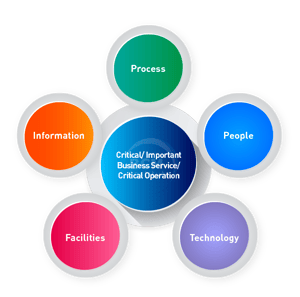
The mapping process enables an organisation to have sufficient details to:
- test against the scenario
- test vulnerabilities
- test remediation
When mapping the "Processes," the relationship with key resources should be considered:
- people
- processes
- technology
- third-party vendor
- facilities
- information
![[OR] [Banner] [How to] [P2] [S2] Map Interconnections and Interdependencies](https://no-cache.hubspot.com/cta/default/3893111/bde0890f-fc7e-4543-ac02-d32d78eaa9a2.png)
 How to Map Interconnections and Interdependencies Across the Organisation?
Mapping operational resilience dependencies and connections is essential to understanding interdependencies among business units, systems, processes, and external stakeholders.
The following actions are involved:
Identify Key Stakeholders
- Engage with business unit leaders, IT managers, risk management teams, and other relevant stakeholders to identify and involve the key departments and individuals responsible for critical business functions.
Conduct Dependency Analysis
- Analyse the dependencies between business units, systems, applications, processes, and external entities (suppliers, partners, regulatory bodies).
- This analysis helps identify the critical links and potential vulnerabilities.
Identify Internal Interdependencies among different Systems, Processes, and Functions
- Analyse how failures or disruptions in one area can impact others.
- Consider dependencies on IT infrastructure, data centres, communication networks, and personnel.
- Document these interdependencies to gain a comprehensive understanding of internal dependencies.
Identify External Interdependencies
- Assess the external interdependencies with third-party vendors, service providers, and other external entities.
- Identify critical relationships and dependencies on which the institution relies to deliver its services.
- Includes outsourced processes, cloud service providers, regulatory reporting systems, and other external dependencies.
- Evaluate the potential impact of disruptions in these relationships on the institution's operations.
Document Interconnections and Interdependencies
- Create a comprehensive inventory that documents [Refer to sample Table on Mapping of Interconnections and Interdependencies] the identified Interconnections and Interdependencies.
- Include information such as criticality, dependencies, contact persons, and relevant documentation.
- Document the identified Interconnections and Interdependencies in a structured manner.
- Develop visual representations, such as diagrams or flowcharts, to illustrate relationships and dependencies.
- Includes information on the relationship's nature, data flows, communication channels, and any contractual or legal obligations.
- Serve as a reference documentation for future analysis and planning.
Establish Communication Channels
- Establish effective communication channels to facilitate ongoing collaboration and information sharing among stakeholders.
- Ensure a common understanding of interdependencies and enable efficient coordination during disruptions.
Review and Update Regularly
- Review and update the Interconnections and Interdependencies mapping continuously to reflect changes in the organisational structure, processes, or external relationships.
- Ensure the accuracy and relevance of the mapping information.
![Banner [Summing] [OR] [E3] Map Interconnections and Interdependencies](https://no-cache.hubspot.com/cta/default/3893111/61e5330e-051c-4874-b6da-a1be8393c283.png)
[Sample] Table on Mapping of Interconnections and Interdependencies
Together, the “Interdependencies Detail” and “Interconnections” columns form the foundation of a meaningful Interconnections and Interdependencies map at a very strategic level
While “Interdependencies Detail” clarifies who is involved in delivering each sub-process and what it entails, “Interconnections” reveals the operational dynamics and systemic links that underpin the organisation's operational ecosystem.
This combination enables a deep understanding of the service architecture, facilitating targeted risk mitigation, business continuity planning, and operational resilience enhancement for each CBS.


"Implement" Phase of the OR Planning Methodology


More Information About Blended Learning OR-5000 [OR-5] or OR-300 [OR-3]
To learn more about the course and schedule, click the buttons below for the OR-3 Blended Learning OR-300 Operational Resilience Implementer course and the OR-5 Blended Learning OR-5000 Operational Resilience Expert Implementer course.


![[BL-OR] [3-4-5] View Schedule](https://no-cache.hubspot.com/cta/default/3893111/d0d733a1-16c0-4b68-a26d-adbfd4fc6069.png)
![[BL-OR] [3] FAQ OR-300](https://no-cache.hubspot.com/cta/default/3893111/f20c71b4-f5e8-4aa5-8056-c374ca33a091.png)
![Email to Sales Team [BCM Institute]](https://no-cache.hubspot.com/cta/default/3893111/3c53daeb-2836-4843-b0e0-645baee2ab9e.png)


