 This chapter is a comprehensive Operational Resilience Maturity Assessment Questionnaire aligned to the requirements of Bangko Sentral ng Pilipinas Circular No. 1203 (2024).
Operational Resilience Maturity Assessment (BSP Circular 1203 - Aligned)


This chapter is a comprehensive Operational Resilience Maturity Assessment Questionnaire aligned to the requirements of Bangko Sentral ng Pilipinas Circular No. 1203 (2024).
![[OR][BSP Guidelines] Key Implementation and Components](https://no-cache.hubspot.com/cta/default/3893111/cceda0e6-1ccc-48c6-8ecc-682910430f1a.png) The structure reflects the key regulatory expectations: governance integration, identification of critical operations, impact tolerance, scenario testing, dependency mapping, and response/recovery capabilities.
The structure reflects the key regulatory expectations: governance integration, identification of critical operations, impact tolerance, scenario testing, dependency mapping, and response/recovery capabilities.
Section 1: Governance and Oversight
Objective: Ensure operational resilience is embedded within governance structures.
- Has the Board approved an enterprise-wide Operational Resilience Framework (ORF)?
- Does the Board regularly review resilience posture, including critical operations and tolerance levels?
- Are roles and responsibilities for operational resilience clearly defined across the Board, senior management, and business units?
- Is operational resilience integrated into existing frameworks (ERM, BCM, IT risk, cyber resilience)?
- Does senior management regularly assess resilience capability and report gaps to the Board?
- Are escalation and decision-making protocols defined for disruption scenarios?
- Is there a dedicated committee or function overseeing operational resilience?
Section 2: Identification of Critical Operations (COs)
Objective: Identify services whose disruption would cause material harm.
 Has the bank identified and documented its critical operations (COs)?
- What criteria are used to determine “criticality” (e.g., customer impact, systemic risk)?
- Are COs mapped to products, services, and business lines?
- Are CO owners formally assigned and accountable?
- Is there a periodic review and validation of COs?
- Are regulatory and customer obligations considered in defining COs?
Section 3: Mapping of Interconnections and Dependencies
Objective: Understand vulnerabilities across the ecosystem.
- Has the bank mapped dependencies for each critical operation (People, Process, Technology, Third Parties)?
- Are upstream and downstream interdependencies documented?
- Are critical third-party providers identified and risk-assessed?
- Are single points of failure identified and mitigated?
- Is there visibility of data flows and system interconnectivity?
- Are concentration risks (e.g., single vendor, location) assessed?
Section 4: Impact Tolerance (Tolerance for Disruption)
Objective: Define acceptable levels of disruption.
 Has the bank established impact tolerances for each critical operation?
- Are tolerances defined in measurable terms (e.g., time, data loss, transaction volume)?
- Do tolerances align with customer expectations and regulatory requirements?
- Are tolerances linked to RTO/RPO and service level agreements?
- Are tolerance breaches monitored and reported?
- Are tolerances reviewed and updated periodically?
Section 5: Risk Identification and Scenario Design
Objective: Prepare for severe but plausible disruptions.
 Has the bank identified a range of severe but plausible scenarios?
- Do scenarios cover:
- Cyberattacks
- System outages
- Third-party failure
- Natural disasters (relevant to the Philippines)
- Pandemic or workforce disruption
- Are scenarios tailored to the bank’s risk profile and business model?
- Are scenario assumptions documented and validated?
- Are emerging risks (e.g., AI/model risks, climate risks) considered?
Section 6: Scenario Testing and Resilience Validation
Objective: Test the ability to remain within tolerance.
 Are scenario tests conducted regularly (e.g., annual, semi-annual)?
- Do tests assess whether critical operations remain within defined tolerances?
- Are different types of tests conducted (tabletop, simulation, live)?
- Are interdependencies and third-party failures included in tests?
- Are test results documented and reported to senior management/Board?
- Are remediation actions tracked to closure?
- Are lessons learned incorporated into policies and controls?
Section 7: Response and Recovery Capabilities
Objective: Ensure continuity and recovery during disruptions.
- Does the bank maintain an integrated incident response and recovery framework?
- Are incident classification and severity levels defined?
- Are recovery strategies aligned with impact tolerances?
- Is there a documented inventory of response and recovery actions?
- Are communication plans defined for internal and external stakeholders?
- Are crisis management teams trained and regularly exercised?
- Can the bank demonstrate the ability to continue delivering critical operations during a disruption?
Section 8: Business Continuity and ICT Resilience Integration
Objective: Align resilience with BCM and technology.
- Is operational resilience integrated with Business Continuity Plans?
- Are IT Disaster Recovery (DR) capabilities aligned with impact tolerances?
- Are cyber resilience controls embedded into operational resilience?
- Are backup systems, redundancy, and failover mechanisms tested?
- Is there alignment between operational resilience and ICT risk management?
Section 9: Third-Party Risk and Outsourcing Resilience
Objective: Manage external dependencies.
- Are third-party service providers included in resilience planning?
- Are service providers assessed for their resilience capabilities?
- Are contractual agreements aligned with impact tolerances?
- Are contingency plans in place for third-party failure?
- Are critical vendors subject to resilience testing or assurance reviews?
Section 10: Monitoring, Reporting, and Continuous Improvement
Objective: Sustain resilience capability.
- Are key resilience metrics and KRIs defined and monitored?
- Is there regular reporting of resilience posture to the Board?
- Are incidents analysed for root causes and systemic weaknesses?
- Is there a structured remediation and improvement program?
- Are internal audits and independent reviews conducted on ORF?
- Is the framework continuously improved based on testing and incidents?
Section 11: Self-Assessment and Regulatory Compliance
Objective: Meet BSP supervisory expectations.
![[OR][BSP Framework] Self-Assessment Questionnaire](https://no-cache.hubspot.com/cta/default/3893111/808fca4c-e301-47ae-baf8-cea747da6ee6.png) Has the bank completed the BSP-required self-assessment questionnaire (SAQ)?
Has the bank completed the BSP-required self-assessment questionnaire (SAQ)?- Are gaps identified through the SAQ formally tracked and remediated?
- Is there a documented roadmap to achieve full compliance?
- Are regulatory submissions and disclosures prepared and reviewed?
- Can the bank demonstrate alignment with the requirements of BSP Circular 1203?
 Maturity Rating Framework (Recommended)
Use a 7-level maturity scale:
Maturity Rating Guide (Optional Scoring Model)
For each question, assign:
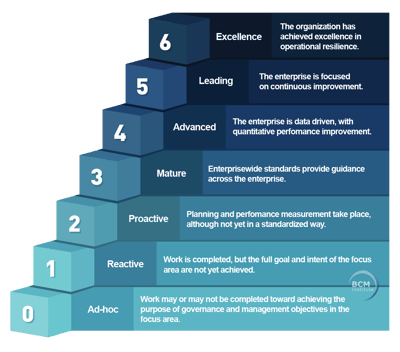 Level 0: Ad-hoc: Reactive, unstructured processes.
- Level 1: Reactive: Basic frameworks with sporadic execution.
- Level 2: Proactive: Formal policies and dedicated teams.
- Level 3: Mature: Anticipatory risk management.
- Level 4: Advanced: Integrated, data-driven strategies.
- Level 5: Leading: Predictive analytics and automation.
- Level 6: Excellence: Industry leadership through innovation.
Key Alignment with BSP Circular 1203
This questionnaire directly reflects BSP expectations that banks must:
- Identify critical operations
- Define tolerance for disruption
- Conduct scenario testing
- Map interdependencies
- Integrate resilience into governance and risk management
More Information About Blended Learning OR-5000 [BL-OR-5] or OR-300 [BL-OR-3]
To learn more about the course and schedule, click the buttons below for the OR-3 Blended Learning OR-300 Operational Resilience Implementer course and the OR-5 Blended Learning OR-5000 Operational Resilience Expert Implementer course.


![[BL-OR] [3-4-5] View Schedule](https://no-cache.hubspot.com/cta/default/3893111/d0d733a1-16c0-4b68-a26d-adbfd4fc6069.png)
![[BL-OR] [3] FAQ OR-300](https://no-cache.hubspot.com/cta/default/3893111/f20c71b4-f5e8-4aa5-8056-c374ca33a091.png)
![Email to Sales Team [BCM Institute]](https://no-cache.hubspot.com/cta/default/3893111/3c53daeb-2836-4843-b0e0-645baee2ab9e.png)