---
title: "[OR] [ISACA] [CIAG] [C1] Operational Resilience: Bridging Governance, Risk and Compliance Across Industries"
description: "[OR] [ISACA] [CIAG] [C1] Operational Resilience: Bridging Governance, Risk and Compliance Across Industries"
image: https://blog.bcm-institute.org/hubfs/Dr%20Goh%20Conference%20Graphic%20Folder/ISACA%20Conference%20Morepost/%5BISACA%5D%20%5BC1%5D%20Bridging%20GRC%20Across%20Industries.jpg
---
[](http://www.bcm-institute.org/)
- [Home](https://www.bcm-institute.org/)
- [About Us](https://www.bcm-institute.org/about-us-3/)
- [A President’s Perspective](https://www.bcm-institute.org/about-us/a-presidents-perspective/)
- [Our History](https://www.bcm-institute.org/about-us/our-history/)
- [Our Advisory Council](https://www.bcm-institute.org/about-us/our-advisory-council/)
- [Customers’ Testimonials](https://www.bcm-institute.org/about-us/customers-testimonials/)
- [Credential Verification](https://www.bcm-institute.org/about-us/credential-verification/)
- [Courses](https://blog.bcm-institute.org/blog/course-fees-for-blended-learning-courses-master-catalog)
- [ISO 22301 Business Continuity Management System Audit](https://blog.bcm-institute.org/audit/business-continuity-management-audit-courses)
- [ISO 22301 Business Continuity Management](https://blog.bcm-institute.org/bcm/business-continuity-management-courses)
- [Crisis Communication](https://blog.bcm-institute.org/crisis-communication/crisis-communication-courses)
- [Crisis Management](https://blog.bcm-institute.org/en/crisis-management/courses)
- [IT Disaster Recovery](https://blog.bcm-institute.org/it-disaster-recovery/courses)
- [Operational Resilience](https://blog.bcm-institute.org/operational-resilience/courses)
- [Operational Resilience Audit](https://blog.bcm-institute.org/operational-resilience-audit/courses)
- [Certification](https://blog.bcm-institute.org/certification/types-of-certifications-offered)
- [ISO 22301 BCMS Audit Certification](https://blog.bcm-institute.org/certification/business-continuity-management-audit-certification)
- [ISO22301 Business Continuity Management Certification](https://blog.bcm-institute.org/bcm/business-continuity-management-certification)
- [Crisis Communication Certification](https://blog.bcm-institute.org/crisis-communication/crisis-communication-certification)
- [Crisis Management Certification](https://blog.bcm-institute.org/en/crisis-management/crisis-management-certification)
- [IT Disaster Recovery Planning Certification](https://blog.bcm-institute.org/it-disaster-recovery/it-disaster-recovery-certification)
- [Operational Resilience Certification](https://blog.bcm-institute.org/operational-resilience/operational-resilience-certification)
- [Operational Resilience Audit Certification](https://blog.bcm-institute.org/operational-resilience-audit)
- [Seminars](https://blog.bcm-institute.org/meet-the-expert/mte-webinar-mainpage)
- [Store](https://www.bcm-institute.org/store-2/)
- [Contact Us](http://www.bcm-institute.org/about-us/contact-us/)
-
-
###### Operational Resilience: Bridging Governance, Risk and Compliance Across Industries
# \[OR\] \[ISACA\] \[CIAG\] \[C1\] Operational Resilience: Bridging Governance, Risk and Compliance Across Industries
[](https://cta-redirect.hubspot.com/cta/redirect/3893111/6f8e0a67-aae8-4512-99ea-b742e31391fc)Organisations today operate in an environment that is fundamentally different from that of a decade ago. The pace of change, the scale of disruption, and the level of interconnectedness across industries have increased significantly.
[](https://cta-redirect.hubspot.com/cta/redirect/3893111/d0f14396-4e25-42c7-9ebd-1b6159bf45c7)What was once considered a rare, high-impact event is now a recurring reality. Disruptions are no longer isolated incidents confined to a single system, department, or geography—they are systemic, cascading, and often unpredictable.
In this evolving landscape, organisations—whether in financial services, manufacturing, healthcare, logistics, or the public sector—face a common challenge: maintaining continuity of critical business services amid constant uncertainty.
Traditional approaches that focus solely on risk avoidance or recovery planning are no longer sufficient. Instead, organisations must recognise and adapt to the reality that disruption is inevitable.
This chapter sets the foundation for understanding why operational resilience has emerged as a critical discipline. It explores the nature of today’s operating environment, the drivers of disruption, and the implications for governance, risk, and compliance (GRC) across industries.
Note from Speaker:
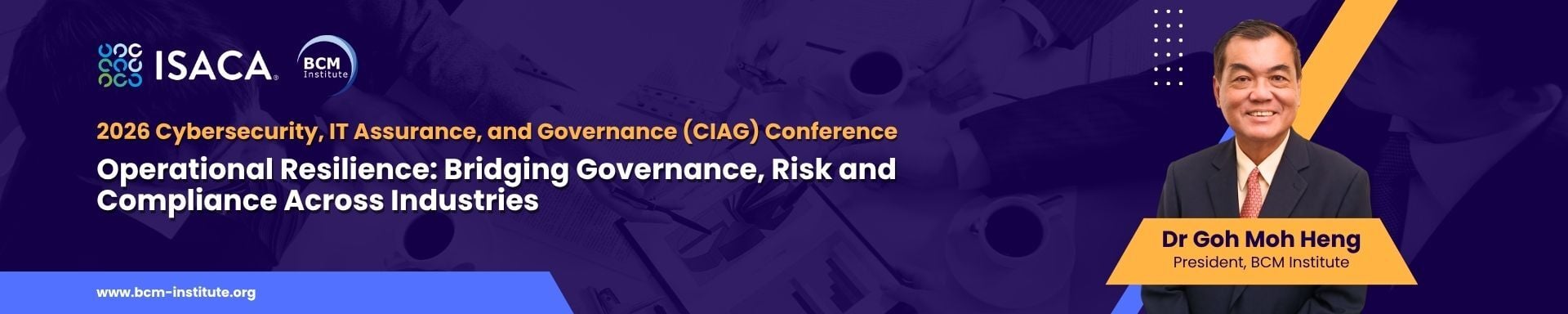
[](https://cta-redirect.hubspot.com/cta/redirect/3893111/d9ca3818-14aa-428b-a81d-edda4d191516)The presentation is summarised into a series of blog posts forming an eBook titled "*Operational Resilience: Bridging Governance, Risk and Compliance Across Industries*," summarising his presentation at the conference.
%20Across%20Industries%20ISACA%202026%20Keynote.jpg?width=361&height=203&name=Operational%20Resilience%20Bridging%20Governance%2c%20Risk%20and%20Compliance%20(GRC)%20Across%20Industries%20ISACA%202026%20Keynote.jpg)Dr Goh Moh Heng is speaking at the ISACA CIAG Conference as a Plenary Speaker.
The theme, *“The Digital Resilience Mandate: Governing Trust, Quantifying Risk, and Ensuring Compliance in the Quantum-AI Era,”* reflects the urgent need for leadership in an increasingly complex technological landscape.
[Dr Goh Moh Heng](https://blog.bcm-institute.org/operational-resilience/author/dr-goh-moh-heng) Mar 27, 2026
###### Operational Resilience Certified Planner-Specialist-Expert
### [](https://cta-redirect.hubspot.com/cta/redirect/3893111/6f8e0a67-aae8-4512-99ea-b742e31391fc)
### **Chapter 1**
### **Operational Resilience: Bridging Governance, Risk and Compliance Across Industries**
#### **The Reality of Today’s Operating Environment**
[![\[ISACA\] \[C1\] Bridging GRC Across Industries](https://no-cache.hubspot.com/cta/default/3893111/4056c202-1430-4e6b-b692-30c7beba4701.png)](https://cta-redirect.hubspot.com/cta/redirect/3893111/4056c202-1430-4e6b-b692-30c7beba4701)Organisations today operate in an environment that is fundamentally different from that of a decade ago. The pace of change, the scale of disruption, and the level of interconnectedness across industries have increased significantly.
What was once considered a rare, high-impact event is now a recurring reality. Disruptions are no longer isolated incidents confined to a single system, department, or geography—they are systemic, cascading, and often unpredictable.
In this evolving landscape, organisations—whether in financial services, manufacturing, healthcare, logistics, or the public sector—face a common challenge: maintaining continuity of critical business services amid constant uncertainty.
Traditional approaches that focus solely on risk avoidance or recovery planning are no longer sufficient. Instead, organisations must recognise and adapt to the reality that disruption is inevitable.
This chapter sets the foundation for understanding why operational resilience has emerged as a critical discipline. It explores the nature of today’s operating environment, the drivers of disruption, and the implications for governance, risk, and compliance (GRC) across industries.
#### **Purpose of the Chapter**
The purpose of this chapter is to help the reader:
- Understand the **key characteristics of the modern operating environment**
- Recognise the **types and sources of disruptions affecting organisations today**
- Appreciate the **increasing complexity and interdependencies within organisations**
- Identify why traditional risk management and business continuity approaches are no longer sufficient
- Establish the need for a **holistic operational resilience framework** that integrates governance, risk, and compliance
By the end of this chapter, the reader will gain a clear understanding of why operational resilience is not optional, but essential.
### **The Era of Constant Disruption**
We are now operating in an **“always-on disruption environment.”** Disruptions are no longer rare events—they are frequent, diverse, and evolving.
#### **Key Drivers of Disruption**
##### **Cyber Threats**
- Increasing sophistication of ransomware and cyberattacks
- Targeting of critical infrastructure and supply chains
- Blurring of boundaries between cyber risk and operational risk
##### **Technology Failures**
- System outages in core platforms
- Cloud service disruptions affecting multiple organisations simultaneously
- Over-reliance on complex IT ecosystems
##### **Third-Party and Supply Chain Dependencies**
- Outsourcing of critical operations
- Concentration risk in key vendors
- Lack of visibility over extended supply chains
##### **Geopolitical and Economic Instability**
- Trade disruptions
- Regulatory divergence
- Political uncertainty affecting operations
##### **Climate and Environmental Risks**
- Natural disasters
- Extreme weather events
- Long-term environmental shifts impacting infrastructure
These drivers demonstrate that disruption is no longer a question of *if*, but *when*.
#### **Increasing Interconnectivity and Complexity**
Modern organisations are no longer standalone entities. They operate within **highly interconnected ecosystems** that include:
- Internal business units
- External vendors and service providers
- Technology platforms and cloud infrastructure
- Regulatory bodies and market infrastructures
##### **The Implications of Interconnectivity**
- **Single Point of Failure Risks**
A failure in one component can trigger cascading failures across the organisation.
- **Hidden Dependencies**
Many organisations lack full visibility into upstream and downstream dependencies.
- **Systemic Impact**
Disruptions can extend beyond the organisation, affecting customers, partners, and even entire industries.
This complexity makes it increasingly difficult to predict and manage disruptions using traditional methods.
#### **The Shift from Prevention to Preparedness**
Historically, organisations focused on **risk prevention and incident recovery**. However, in today’s environment, this approach is insufficient.
##### **Traditional Approach**
- Risk avoidance
- Control-based frameworks
- Recovery planning (BCP/DRP)
##### **Modern Reality**
- Not all risks can be prevented
- Not all disruptions can be predicted
- Recovery alone is too late
##### **The Required Shift**
Organisations must move towards:
- **Preparedness over prevention**
- **Adaptability over rigidity**
- **Continuity of critical services over full system recovery**
This shift is at the heart of operational resilience.
#### **The Expanding Impact of Disruptions**
The consequences of disruptions today are broader and more severe than ever before.
##### **Types of Impact**
| **Impact Area** | **Description** |
| --- | --- |
| Customer Impact | Loss of access to essential services |
| Financial Impact | Revenue loss, increased operational costs |
| Reputational Impact | Loss of trust and brand damage |
| Regulatory Impact | Fines, sanctions, increased scrutiny |
| Operational Impact | Disruption to critical processes |
##### **Key Insight**
The true impact of disruption is not measured by system downtime, but by the **inability to deliver critical business services**.
#### **Regulatory Momentum and Cross-Industry Expectations**
Regulators—particularly in the financial sector—have taken the lead in defining expectations for operational resilience. However, these expectations are increasingly influencing non-financial sectors as well.
##### **Emerging Regulatory Themes**
- Identification of **Critical Business Services (CBS)**
- Setting of **Impact Tolerances**
- Requirement for **Scenario Testing**
- Focus on **end-to-end service delivery**
##### **Cross-Industry Spillover**
- Non-financial sectors are adopting similar principles
- Customers and stakeholders expect consistent service availability
- Boards are demanding greater assurance of resilience capabilities
Operational resilience is rapidly becoming a **universal expectation**, not just a regulatory requirement.
#### **The GRC Challenge in a Complex Environment**
Despite increased awareness of risks, many organisations struggle due to **fragmented Governance, Risk, and Compliance (GRC) structures**.
##### **Common Issues**
- Governance is disconnected from operational realities
- Risk management is not aligned with critical services
- Compliance focuses on documentation rather than capability
##### **Result**
- Organisations appear compliant but remain vulnerable
- Gaps are only exposed during real disruptions
##### **Key Observation**
The challenge is not the absence of frameworks, but the **lack of integration across GRC functions**.
#### **Why Operational Resilience is the Answer**
Operational resilience addresses the limitations of traditional approaches by:
- Focusing on **critical business services**
- Integrating **people, processes, technology, and third parties**
- Aligning **governance, risk, and compliance with operational execution**
- Emphasising **testing and continuous improvement**
It provides a **practical and actionable framework** for navigating today’s complex operating environment.
[](https://cta-redirect.hubspot.com/cta/redirect/3893111/801c11f6-14e1-45e6-b75d-ff17885348f2)
The reality of today’s operating environment is clear: disruption is inevitable, complexity is increasing, and the consequences of failure are more severe than ever before.
Organisations can no longer rely solely on traditional risk management or business continuity approaches to safeguard their operations.
Instead, they must embrace a new way of thinking—one that recognises the importance of maintaining the continuity of critical business services under all circumstances.
This requires a shift from siloed functions to an integrated, organisation-wide approach that bridges governance, risk, and compliance.
Operational resilience is not just a response to disruption—it is a strategic capability that enables organisations to survive, adapt, and thrive in an uncertain world.
[](https://cta-redirect.hubspot.com/cta/redirect/3893111/707eb98f-b082-4c1f-b013-408f2b49c61f)
Dr Goh Moh Heng is speaking at the ISACA CIAG Malaysia Conference as a Plenary Speaker. The presentation during Day 1 of the conference is summarised into a series of blog posts forming an eBook titled "Operational Resilience: Bridging Governance, Risk and Compliance Across Industries," summarising his presentation at the conference.
The theme, “The Digital Resilience Mandate: Governing Trust, Quantifying Risk, and Ensuring Compliance in the Quantum-AI Era,” reflects the urgent need for leadership in an increasingly complex technological landscape.
This is a summary of the presentation, designed to equip participants with the knowledge, frameworks, and practical techniques needed to enhance their GRC integration through Operational Resilience.
[](https://cta-redirect.hubspot.com/cta/redirect/3893111/707eb98f-b082-4c1f-b013-408f2b49c61f)
| **C1** | **C2** | **C3** | **C4** | **C5** |
| --- | --- | --- | --- | --- |
| [![\[ISACA\] \[C1\] Bridging GRC Across Industries](https://no-cache.hubspot.com/cta/default/3893111/4056c202-1430-4e6b-b692-30c7beba4701.png)](https://cta-redirect.hubspot.com/cta/redirect/3893111/4056c202-1430-4e6b-b692-30c7beba4701) | [![\[ISACA\] \[C2\] Why OR Matters Now](https://no-cache.hubspot.com/cta/default/3893111/5db0406a-8925-4f78-ac00-493ec9b40283.png)](https://cta-redirect.hubspot.com/cta/redirect/3893111/5db0406a-8925-4f78-ac00-493ec9b40283) | [![\[ISACA\] \[C3\] Understanding OR Concept & Framework](https://no-cache.hubspot.com/cta/default/3893111/daa721cd-a788-4825-9b36-39d71e919ce2.png)](https://cta-redirect.hubspot.com/cta/redirect/3893111/daa721cd-a788-4825-9b36-39d71e919ce2) | [![\[ISACA\] \[C4\] The GRC Disconnect](https://no-cache.hubspot.com/cta/default/3893111/78667faf-f49a-420b-8a12-e0d081f9794d.png)](https://cta-redirect.hubspot.com/cta/redirect/3893111/78667faf-f49a-420b-8a12-e0d081f9794d) | [![\[ISACA\] \[C5\] Bridging GRC Through OR](https://no-cache.hubspot.com/cta/default/3893111/8c6ff496-7b97-4e21-b176-f50ddf5bc98e.png)](https://cta-redirect.hubspot.com/cta/redirect/3893111/8c6ff496-7b97-4e21-b176-f50ddf5bc98e) |
| **C6** | **C7** | **C8** | **C9** | |
| [![\[ISACA\] \[C6\] Implementation Framework](https://no-cache.hubspot.com/cta/default/3893111/8dc8d748-0278-4d76-9c36-27a3009290a4.png)](https://cta-redirect.hubspot.com/cta/redirect/3893111/8dc8d748-0278-4d76-9c36-27a3009290a4) | [![\[ISACA\] \[C7\] Cross-Industry Application](https://no-cache.hubspot.com/cta/default/3893111/3a6d8e9b-4c2e-4026-9d43-8615856cb3d6.png)](https://cta-redirect.hubspot.com/cta/redirect/3893111/3a6d8e9b-4c2e-4026-9d43-8615856cb3d6) | [![\[ISACA\] \[C8\] Key Challenges & Pitfalls](https://no-cache.hubspot.com/cta/default/3893111/c36846d0-9189-4393-bf14-5ff20fbd02d2.png)](https://cta-redirect.hubspot.com/cta/redirect/3893111/c36846d0-9189-4393-bf14-5ff20fbd02d2) | [![\[ISACA\] \[C9\] Summing Up](https://no-cache.hubspot.com/cta/default/3893111/05c8b887-0736-4f91-8999-26414e1578ef.png)](https://cta-redirect.hubspot.com/cta/redirect/3893111/05c8b887-0736-4f91-8999-26414e1578ef) | [](https://cta-redirect.hubspot.com/cta/redirect/3893111/d0f14396-4e25-42c7-9ebd-1b6159bf45c7) |
| | | | | |
**[](https://cta-redirect.hubspot.com/cta/redirect/3893111/084e620a-46c5-419a-82ed-6a681d15c0b6)**
[](https://cta-redirect.hubspot.com/cta/redirect/3893111/309c3a80-4c3c-4eb9-811d-bd401ccb1610)For organisations looking to accelerate their journey, BCM Institute’s training and certification programs, including the **OR-5000 Operational Resilience Expert Implementer course**, provide in-depth insights and practical toolkits for effectively embedding this model.
#### More Information About OR-5000 \[OR-5\] or OR-300 \[OR-3\]
Gain Competency: For organisations looking to accelerate their journey, BCM Institute’s training and certification programs, including the OR-5000 Operational Resilience Expert Implementer course, provide in-depth insights and practical toolkits for effectively embedding this model.
To learn more about the course and schedule, click the buttons below for the \[OR-3\] OR-300 Operational Resilience Implementer course and the \[OR-5\] OR-5000 Operational Resilience Expert Implementer course.
| [](https://cta-redirect.hubspot.com/cta/redirect/3893111/3530eccb-515d-401e-afc2-3469e26d7fbf) | [](https://cta-redirect.hubspot.com/cta/redirect/3893111/fdd4fa9c-ed69-40c1-925f-4eb6a1c5c255) | [](https://cta-redirect.hubspot.com/cta/redirect/3893111/77a34b84-0a6d-44f8-b8d6-6ab04cdf5edd) |
| --- | --- | --- |
| [](https://cta-redirect.hubspot.com/cta/redirect/3893111/6e5c0cda-39b9-4bbd-b3d4-4cf46a790b14) | [](https://cta-redirect.hubspot.com/cta/redirect/3893111/a68a08aa-36d3-4216-9551-202c9fde06ea) | [![ \[BL-OR\] \[3-4-5\] View Schedule](https://no-cache.hubspot.com/cta/default/3893111/d0d733a1-16c0-4b68-a26d-adbfd4fc6069.png)](https://cta-redirect.hubspot.com/cta/redirect/3893111/d0d733a1-16c0-4b68-a26d-adbfd4fc6069) |
| [![\[BL-OR\] \[3\] FAQ OR-300](https://no-cache.hubspot.com/cta/default/3893111/f20c71b4-f5e8-4aa5-8056-c374ca33a091.png)](https://cta-redirect.hubspot.com/cta/redirect/3893111/f20c71b4-f5e8-4aa5-8056-c374ca33a091) | If you have any questions, click to contact us.[![Email to Sales Team \[BCM Institute\]](https://no-cache.hubspot.com/cta/default/3893111/3c53daeb-2836-4843-b0e0-645baee2ab9e.png)](https://cta-redirect.hubspot.com/cta/redirect/3893111/3c53daeb-2836-4843-b0e0-645baee2ab9e) | [](https://cta-redirect.hubspot.com/cta/redirect/3893111/7f2718a4-ea80-4f84-a319-dc2d4df37a46) |
| [](https://cta-redirect.hubspot.com/cta/redirect/3893111/74b1e556-8cd2-4a74-8821-db1804534955) | [](https://cta-redirect.hubspot.com/cta/redirect/3893111/f2bd8eb1-32d2-4732-9267-ea53223cf58f) | [](https://cta-redirect.hubspot.com/cta/redirect/3893111/084e620a-46c5-419a-82ed-6a681d15c0b6) |
#### **Your Comments Here:**
### More Posts
[](https://cta-redirect.hubspot.com/cta/redirect/3893111/d41714c9-8019-4282-95bf-08d62ddc4710)

All rights reserved. Copyright 2026