

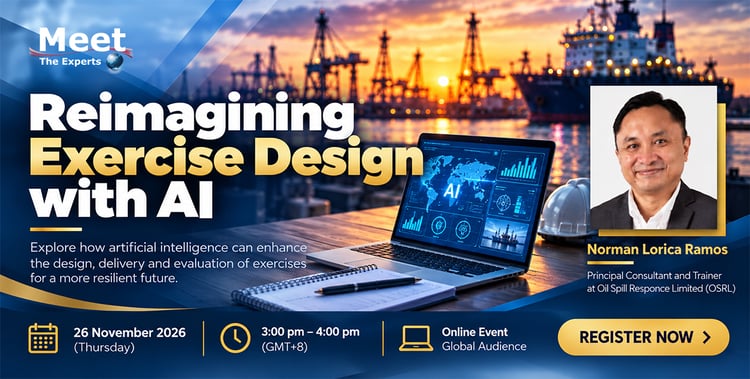
Part 1: Reimagining Exercise Design with AI – Establishing the Fundamentals of AI-Assisted Exercise Design
Introduction


The emergence of generative AI is creating new opportunities for BCM and CM professionals to improve the effectiveness and efficiency of exercise design.
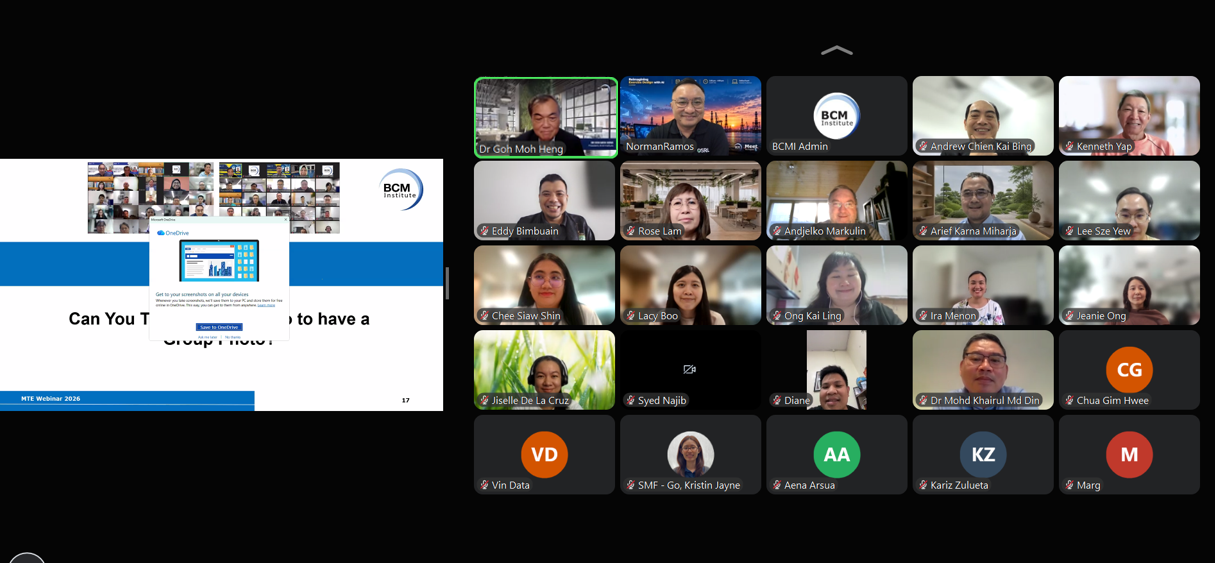
During BCM Institute's Meet-the-Expert webinar, Norman Ramos shared his practical experiences in integrating AI into exercise development, highlighting both its potential and limitations.
His presentation reinforced that effective AI-assisted exercise design must begin with a sound understanding of conventional exercise design principles.
Understanding the Fundamentals of Exercise Design
Norman emphasised that every exercise must begin with clearly defined objectives.
These objectives determine the exercise design, evaluation criteria, facilitation approach, and expected outcomes.
The exercise process should incorporate participant feedback, observations, debriefing, recommendations and continuous improvement.
For example, a notification exercise may evaluate:
- Time taken to complete notification.
- Accuracy of information communicated.
- Functionality of communication hardware and software.
- Effectiveness of established notification procedures.
AI can support each stage of the exercise process, but the exercise objectives must remain the foundation for determining success.
Designing Realistic and Meaningful Exercise Scenarios
Exercise scenarios must reflect the organisation's actual operating environment, geographical location, business activities and organisational culture.
Norman highlighted that an effective exercise design should incorporate:
- A realistic and contextually relevant scenario.
- A logical storyline or narrative.
- Exercise injects that progressively challenge participants.
- Expected responses aligned with existing plans and procedures.
- Appropriate evaluation criteria.
- Visual materials that enhance participant understanding.
AI can assist exercise designers in developing these components while reducing the time required to prepare exercise materials.
However, exercise designers must ensure that AI-generated scenarios remain relevant to the organisation's actual challenges and vulnerabilities.
Enhancing Exercise Realism Through AI-Generated Injects
Traditional exercise injects may require considerable time and resources to develop.
AI enables exercise designers to create a wider variety of simulated materials, including:
- Emails and notifications.
- Breaking news reports.
- Photographs and incident illustrations.
- Social media posts and videos.
- Simulated media coverage.
- Developing crisis scenarios.
These materials can improve participant immersion and help exercise teams understand the evolving consequences of an incident.
Norman illustrated this through examples involving oil spill incidents, emergency response activities, and simulated media reporting.
The objective is not simply to create impressive visuals but to generate meaningful challenges that support the exercise objectives.
Understanding the Anatomy of an Effective AI Prompt
One of the webinar's key messages was that the quality of AI-generated outputs depends significantly on the quality of the instructions provided.
Norman identified four essential components of an effective AI prompt:
Context: Provide relevant organisational background, operating conditions, and exercise requirements.
Specificity: Clearly identify the scenario, participants, processes or capabilities being exercised.
Clarity: Provide precise instructions and avoid ambiguous requirements.
Desired Outcome: Define the expected deliverable, including its structure, format and intended use.
Rather than treating AI as a conventional search engine, professionals should engage with AI by providing structured instructions, relevant information, and clearly defined goals.
Developing AI Prompt Engineering Capabilities
Norman recommended several practical approaches to improving AI-generated exercise materials:
- Break complex assignments into manageable tasks.
- Provide relevant reference materials and templates.
- Specify the intended audience and exercise participants.
- Define the required format, tone and level of detail.
- Provide examples of acceptable outputs.
- Review and refine AI-generated materials through multiple iterations.
The initial development of an effective prompt may require considerable effort. However, once refined, it can improve consistency and productivity in subsequent exercises.
Human Expertise Remains Essential
Despite advances in AI capabilities, Norman cautioned against accepting AI-generated information without verification.
AI may produce inaccurate assumptions, misleading information, or unrealistic exercise scenarios when instructions are incomplete or insufficiently precise.
Experienced BCM and CM professionals must therefore remain responsible for reviewing, validating and approving exercise materials.

Summing Up
AI provides significant opportunities to enhance exercise design, improve participant engagement and reduce administrative effort.
However, effective AI-assisted exercise design begins with established exercise principles, clearly defined objectives, realistic scenarios and appropriate evaluation criteria.
The ability to develop effective prompts and provide meaningful feedback is becoming an increasingly important competency for BCM and CM professionals.
The objective is not to allow AI to design exercises independently, but to enable exercise designers to develop better exercises through the responsible application of AI.
 This is Part 1 of the two-part summary of Norman Ramos's presentation during BCM Institute's Meet-the-Expert webinar.
Dr Goh Moh Heng, President of BCM Institute, summarises this webinar.
Dr Goh Moh Heng, President of the BCM Institute, summarises this webinar. If you have any questions, please speak to the author.

For Parts 1 & 2 ...
Click the icon below to continue reading parts of Norman's presentation.
| Reimagining Exercise Design With AI | |||||


More Information About Crisis Management Blended/ Hybrid Learning Courses
To learn more about the course and schedule, click the buttons below for CM-300 Crisis Management Implementer [CM-3] and CM-5000 Crisis Management Expert Implementer [CM-5].