



Part 2: Testing Reality — Lessons from Air Selangor’s Full-Scale Crisis Simulation
Introduction

Building on its strong BCM foundation, Pengurusan Air Selangor executed a full-scale bomb threat simulation designed to test not just plans, but organisational behaviour under pressure.
Designing a Realistic, High-Stakes Scenario
The exercise was intentionally complex:
- Full building evacuation at headquarters
- Activation of crisis escalation and command centre
- Relocation of critical operations to alternate sites
- IT recovery using backup systems
- Simulation conducted during the peak operational period
More than 300 personnel participated, alongside external agencies including police, fire services, and emergency responders—making it a true inter-agency exercise.
Four Objectives, One Integrated Test
The simulation focused on four critical dimensions:
- Evacuation effectiveness — speed, crowd control, and safety
- Crisis management activation — leadership response and decision-making
- External coordination — seamless collaboration with authorities
- Business continuity & IT readiness — sustaining operations under disruption
This provided a 360-degree view of organisational preparedness—from ground response to strategic command.
Execution Highlights: Where Plans Meet Reality
The simulation unfolded in stages:
- Bomb threat received and escalated immediately
- Suspicious items were identified, followed by a controlled explosion scenario
- Full evacuation executed within 10 minutes
- Crisis Command Centre activated in parallel
- Operations resumed at alternate sites using backup systems
- Final clearance and joint press briefing conducted
The results were telling: systems worked, coordination was effective, and recovery was achievable under pressure.
Where Improvement Still Matters
Despite strong performance, the exercise surfaced critical enhancement areas:
- Evacuation refinement — improving communication and flow control
- Leadership decision-making — strengthening crisis deliberation at the CMT level
- IT recovery alignment — reviewing recovery time objectives (RTO/RPO)
- Operational readiness — ensuring alternate sites and logistics are fully optimised
Additional recommendations included:
- Use of coded communication during threats
- Deployment readiness (e.g., ambulances, equipment)
- Enhanced physical security measures
ISO 22301 in Action
 The exercise directly validated key components of ISO 22301:
- Response structure effectiveness
- Monitoring and performance measurement
- Post-exercise evaluation and improvement
- Continuous refinement of plans and SOPs
This reinforces an important shift: ISO standards should guide real-world resilience—not sit as static documentation.
The Real Value: Culture, Not Just Capability
Perhaps the most important outcome was cultural:
- Crisis management became cross-functional, not siloed
- Teams experienced real-time pressure, improving confidence
- Leadership engagement increased through active participation
Simulations like this move organisations from reactive response to proactive readiness.
What’s Next? Scaling Up the Challenge
Air Selangor is now preparing for a large-scale dam-crisis simulation—a far more complex, high-impact scenario that involves broader stakeholder coordination.
This signals a shift in maturity: from testing individual capabilities to stress-testing entire systems.

A well-designed simulation doesn’t just validate plans—it exposes assumptions, strengthens leadership, and embeds resilience into the organisation’s DNA.
For organisations looking to elevate their BCM approach, the message is clear:
Don’t just simulate crises—simulate reality.

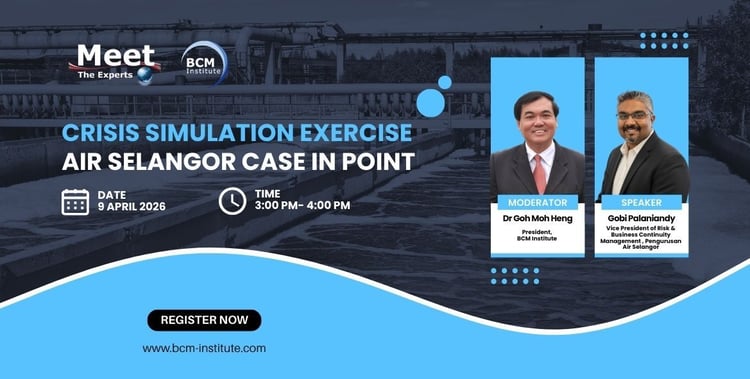
 This is Part 2 of the two-part summary of Gobi's presentation during BCM Institute's Meet-the-Expert webinar. The webinar is summarised by Dr Goh Moh Heng, President of the BCM Institute.
Dr Goh Moh Heng, President of BCM Institute, summarises this webinar. If you have any questions, please speak to the author.
 For Parts 1 & 2 ...
Click the icon below to continue reading parts of Gobi Palaniandy's presentation.
| Crisis Simulation Exercise - Air Selangor Case in Point | |||||



More Information About Crisis Management Courses
To learn more about the course and schedule, click the buttons below for the CM-300 Crisis Management Implementer [CM-3] and the CM-5000 Crisis Management Expert Implementer [CM-5].


![[BL-CM] [5] Register](https://no-cache.hubspot.com/cta/default/3893111/82024308-16f4-4491-98be-818a882c6286.png)

![Email to Sales Team [BCM Institute]](https://no-cache.hubspot.com/cta/default/3893111/3c53daeb-2836-4843-b0e0-645baee2ab9e.png)


