---
title: [MTE] [Apr 2026] [P1] Crisis Simulation Exercise - Air Selangor Case in Point
description: [MTE] [Apr 2026] [P1] Crisis Simulation Exercise - Air Selangor Case in Point
image: https://blog.bcm-institute.org/hubfs/Gobi%20Palaniandy%20Graphic%20Folder/IC_MTE%20Summary_Gobi%20Palaniandy_Part%201.png
---
[](http://www.bcm-institute.org/)
- [Home](https://www.bcm-institute.org/)
- [About Us](https://www.bcm-institute.org/about-us-3/)
- [A President’s Perspective](https://www.bcm-institute.org/about-us/a-presidents-perspective/)
- [Our History](https://www.bcm-institute.org/about-us/our-history/)
- [Our Advisory Council](https://www.bcm-institute.org/about-us/our-advisory-council/)
- [Customers’ Testimonials](https://www.bcm-institute.org/about-us/customers-testimonials/)
- [Credential Verification](https://www.bcm-institute.org/about-us/credential-verification/)
- [Courses](https://blog.bcm-institute.org/blog/course-fees-for-blended-learning-courses-master-catalog)
- [ISO 22301 Business Continuity Management System Audit](https://blog.bcm-institute.org/audit/business-continuity-management-audit-courses)
- [ISO 22301 Business Continuity Management](https://blog.bcm-institute.org/bcm/business-continuity-management-courses)
- [Crisis Communication](https://blog.bcm-institute.org/crisis-communication/crisis-communication-courses)
- [Crisis Management](https://blog.bcm-institute.org/en/crisis-management/courses)
- [IT Disaster Recovery](https://blog.bcm-institute.org/it-disaster-recovery/courses)
- [Operational Resilience](https://blog.bcm-institute.org/operational-resilience/courses)
- [Operational Resilience Audit](https://blog.bcm-institute.org/operational-resilience-audit/courses)
- [Certification](https://blog.bcm-institute.org/certification/types-of-certifications-offered)
- [ISO 22301 BCMS Audit Certification](https://blog.bcm-institute.org/certification/business-continuity-management-audit-certification)
- [ISO22301 Business Continuity Management Certification](https://blog.bcm-institute.org/bcm/business-continuity-management-certification)
- [Crisis Communication Certification](https://blog.bcm-institute.org/crisis-communication/crisis-communication-certification)
- [Crisis Management Certification](https://blog.bcm-institute.org/en/crisis-management/crisis-management-certification)
- [IT Disaster Recovery Planning Certification](https://blog.bcm-institute.org/it-disaster-recovery/it-disaster-recovery-certification)
- [Operational Resilience Certification](https://blog.bcm-institute.org/operational-resilience/operational-resilience-certification)
- [Operational Resilience Audit Certification](https://blog.bcm-institute.org/operational-resilience-audit)
- [Seminars](https://blog.bcm-institute.org/meet-the-expert/mte-webinar-mainpage)
- [Store](https://www.bcm-institute.org/store-2/)
- [Contact Us](http://www.bcm-institute.org/about-us/contact-us/)
-
-

# \[MTE\] \[Apr 2026\] \[P1\] Crisis Simulation Exercise - Air Selangor Case in Point
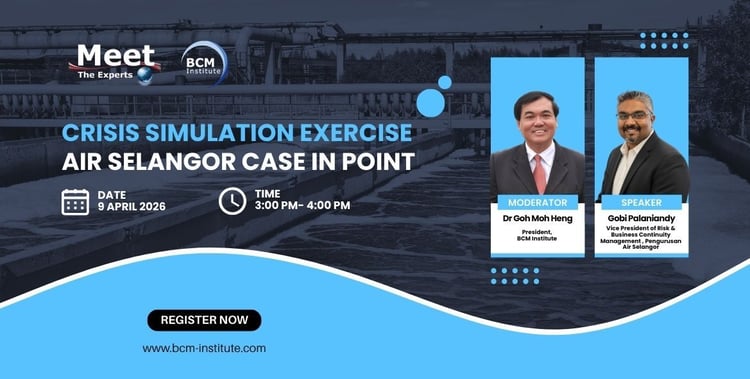
[](https://cta-redirect.hubspot.com/cta/redirect/3893111/777e862d-236b-4da4-8e41-0fb9415dea6a)[](https://cta-redirect.hubspot.com/cta/redirect/3893111/512b7bb7-ae13-4f9f-9152-85dba01a499f)This is Part 1 of our summary for the Meet-the-Expert April 2026, reflecting insights from the recent webinar that concluded on April 9, 2026, featuring guest speaker **Gobi Palaniandy**.
[](https://cta-redirect.hubspot.com/cta/redirect/3893111/2dadb833-3712-4048-b732-393adcc0e96d)Gobi Palaniandy is a seasoned crisis management professional with extensive experience in leading high-stakes operational and continuity exercises across critical infrastructure sectors.
This is Part 1 of the summarised presentation for the Meet-the-Expert Webinar.
Part 1: From Infrastructure to Incident Response
This is Part 1 of the summarised presentation from the Meet-the-Expert Webinar, featuring insights from **Gobi Palaniandy**.
It explores the organisation’s BCM foundations, governance structure, and the anchoring of crisis simulation in risk management and ISO 22301.
[Moh Heng Goh](https://blog.bcm-institute.org/meet-the-expert/author/moh-heng-goh) Apr 21, 2026
### 
### Part 1: From Infrastructure to Incident Response — Inside Air Selangor’s Crisis Simulation Strategy
#### **Introduction**
[](https://cta-redirect.hubspot.com/cta/redirect/3893111/777e862d-236b-4da4-8e41-0fb9415dea6a)*[](https://cta-redirect.hubspot.com/cta/redirect/3893111/2dadb833-3712-4048-b732-393adcc0e96d)*
*“Crisis Simulation Exercise – Air Selangor Case in Point,”* **Gobi Palaniandy** shared a practitioner-led perspective on how large-scale utilities operationalise crisis preparedness beyond theory.
#### **Resilience Starts with Scale Awareness**
As Malaysia’s primary water service provider, **Pengurusan Air Selangor** operates a vast and complex infrastructure—spanning dams, treatment plants, pipelines, and monitoring systems. The scale alone introduces a critical reality: even minor disruptions can cascade into widespread impact, affecting millions.
This operational context shapes their approach to Business Continuity Management (BCM)—where resilience is not optional, but embedded into governance, leadership, and daily decision-making.
#### **Governance That Drives Action**
Air Selangor’s BCM is anchored within a structured risk governance framework, supported by board-level oversight and a dedicated risk management function. The key focus areas include:
- Identifying emerging risks that impact operations and reputation
- Embedding BCM into strategic decision-making
- Ensuring alignment with standards such as **ISO 22301**
- Promoting a culture of risk awareness across all levels
This governance model ensures crisis preparedness is not siloed—but integrated across the organisation.
#### **Speed and Clarity: The Escalation Backbone**
A standout feature is their structured crisis escalation flow:
- Incidents are classified (Green, Yellow, Red) based on severity
- Reporting must happen within **30 minutes**, with escalation within **1 hour**
- Activation flows from operational sites to BCM, then to senior leadership
This disciplined approach reduces ambiguity during critical moments, ensuring decisions are timely and coordinated.
#### **Why a Bomb Threat Scenario?**
Rather than defaulting to traditional disaster scenarios, Air Selangor selected a **bomb threat simulation**—a high-impact, increasingly relevant risk globally and locally.
The rationale:
- Reflects real-world threat trends across sectors
- Tests evacuation, decision-making, and communication under pressure
- Forces the activation of both crisis management and business continuity plans
More importantly, it creates a realistic environment where leadership behaviour—not just processes—can be evaluated.
#### **Beyond Compliance: Aligning with National and Global Standards**
The simulation was not conducted in isolation. It aligned with:
- Malaysia’s national disaster management directives (NADMA)
- International BCM standards like **ISO 22301**
This dual alignment ensures both regulatory compliance and adherence to global best practices—positioning simulations as a strategic tool rather than a checkbox exercise.
### [](https://cta-redirect.hubspot.com/cta/redirect/3893111/7a6d118f-9e00-4849-a013-9cbe38dbda19)
Air Selangor’s approach demonstrates that effective crisis simulation begins long before the exercise itself. It is built on governance, clarity of roles, and a deep understanding of operational risk.
In Part 2, we explore how the simulation was executed, what worked, and the critical lessons that reshaped their resilience strategy.
[](https://cta-redirect.hubspot.com/cta/redirect/3893111/ed46006a-c398-47c1-a86f-1fdb3bc41a6d)[](https://cta-redirect.hubspot.com/cta/redirect/3893111/d9ca3818-14aa-428b-a81d-edda4d191516)This is Part 1 of the two-part summary of Gobi's presentation during BCM Institute's Meet-the-Expert webinar. The webinar is summarised by Dr Goh Moh Heng, President of the BCM Institute.
*Dr Goh Moh Heng, President of BCM Institute, summarises this webinar. If you have any questions, please speak to the author.*
*[](https://cta-redirect.hubspot.com/cta/redirect/3893111/9f00129b-47f5-4a92-8db4-88b9bc250036)*
### **For Parts 1 & 2 ...**
Click the icon below to continue reading parts of Gobi Palaniandy's presentation.
| **Crisis Simulation Exercise - Air Selangor Case in Point** | | | | | |
| --- | --- | --- | --- | --- | --- |
| [](https://cta-redirect.hubspot.com/cta/redirect/3893111/2dadb833-3712-4048-b732-393adcc0e96d) | [](https://cta-redirect.hubspot.com/cta/redirect/3893111/3bf1a079-27ad-4286-aa60-888e1ab04a13) | [](https://cta-redirect.hubspot.com/cta/redirect/3893111/777e862d-236b-4da4-8e41-0fb9415dea6a) | [](https://cta-redirect.hubspot.com/cta/redirect/3893111/d3b1f209-7048-4ddd-ba51-91443583a276) | [](https://cta-redirect.hubspot.com/cta/redirect/3893111/0514a188-45e1-4d7f-b3da-a1fb4be1a0c8) | [](https://cta-redirect.hubspot.com/cta/redirect/3893111/d9ca3818-14aa-428b-a81d-edda4d191516) |
#### More Information About Crisis Management Courses
To learn more about the course and schedule, click the buttons below for the CM-300 Crisis Management Implementer \[CM-3\] and the CM-5000 Crisis Management Expert Implementer \[CM-5\].
| [](https://cta-redirect.hubspot.com/cta/redirect/3893111/5ffecd2d-8000-4805-b5e3-e9ead2e259cc) | [](https://cta-redirect.hubspot.com/cta/redirect/3893111/c3546220-6c76-4a10-8c76-4040b94e09e5) | [](https://cta-redirect.hubspot.com/cta/redirect/3893111/03294547-1df3-435c-9243-971c3d9bb6ce) |
| --- | --- | --- |
| [](https://cta-redirect.hubspot.com/cta/redirect/3893111/b29594fe-d44a-4ff8-8160-03f7ce454385) | [](https://cta-redirect.hubspot.com/cta/redirect/3893111/dd120e7f-9fe2-49ed-ad24-489b81c06739) | [![\[BL-CM\] \[5\] Register](https://no-cache.hubspot.com/cta/default/3893111/82024308-16f4-4491-98be-818a882c6286.png)](https://cta-redirect.hubspot.com/cta/redirect/3893111/82024308-16f4-4491-98be-818a882c6286) |
| [](https://cta-redirect.hubspot.com/cta/redirect/3893111/c8aaf76b-4c0b-402a-ad12-c8aff24eb911) | Please feel free to send us a note if you have any questions. [![Email to Sales Team \[BCM Institute\]](https://no-cache.hubspot.com/cta/default/3893111/3c53daeb-2836-4843-b0e0-645baee2ab9e.png)](https://cta-redirect.hubspot.com/cta/redirect/3893111/3c53daeb-2836-4843-b0e0-645baee2ab9e) | [](https://cta-redirect.hubspot.com/cta/redirect/3893111/30bcbbbf-c8ea-48d8-8643-da2638f3f0f8) |
| [](https://cta-redirect.hubspot.com/cta/redirect/3893111/83d00c12-c51c-4476-9902-69f9b7667a91) | [](https://cta-redirect.hubspot.com/cta/redirect/3893111/672d2949-6233-4b26-ad42-ae0dd0a1a3ac) | [](https://cta-redirect.hubspot.com/cta/redirect/3893111/3ca6f50d-a3c5-41b8-8da2-26feb8a7613e) |
### More Posts
[](https://cta-redirect.hubspot.com/cta/redirect/3893111/ed46006a-c398-47c1-a86f-1fdb3bc41a6d)

All rights reserved. Copyright 2026