


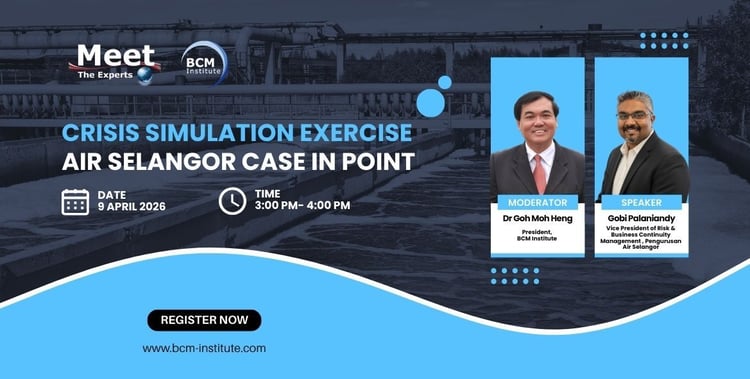
Lessons Learned from “Crisis Simulation Exercise - Air Selangor Case in Point”

 The session “Crisis Simulation Exercise – Air Selangor Case in Point” by Gobi Palaniandy of Pengurusan Air Selangor offers more than just a walkthrough of a simulation—it presents a practical blueprint for elevating crisis readiness from theory to execution.
Drawing from both the foundational approach (Part 1) and the full-scale simulation outcomes (Part 2), several key lessons emerge for organisations looking to strengthen their Business Continuity and Crisis Management capabilities.
1. Strong Foundations Enable Realistic Simulations
One of the clearest takeaways is that effective simulations don’t start with scenarios—they start with structure.
Air Selangor’s success is rooted in:
- Clear governance and board-level oversight
- Embedded risk management practices
- Alignment with ISO 22301
This ensures simulations are not isolated exercises, but extensions of an already mature BCM framework. Without this foundation, even the most sophisticated simulation risks becoming a superficial drill.
2. Scenario Selection Should Reflect Real Threats
The choice of a bomb threat scenario was deliberate—and instructive.
Rather than defaulting to predictable disruptions, the exercise was designed to:
- Reflect evolving local and global threat landscapes
- Test high-pressure decision-making
- Challenge both the operational and leadership response
The lesson here is simple: simulations must be relevant and uncomfortable enough to expose weaknesses.
3. Speed and Structure Are Critical in Crisis Response
The simulation reinforced the importance of having a clear escalation framework:
- Defined severity levels (Green, Yellow, Red)
- Strict reporting and escalation timelines
- Direct communication pathways to decision-makers
This structure ensured that response actions—from evacuation to command centre activation—were executed within minutes. In real crises, speed without structure creates chaos; structure enables speed.
4. Test the Entire Ecosystem, Not Just Internal Teams
A standout strength of the exercise was its inter-agency collaboration.
By involving police, fire services, medical responders, and security units, Air Selangor ensured:
- Realistic coordination challenges
- Clear communication protocols across organisations
- Stronger interoperability during actual emergencies
This highlights a critical point: crisis management does not operate in isolation. External stakeholders must be part of the equation.
5. Simulations Must Go Beyond Plans to Test Behaviour
While systems and processes were validated, the real value came from observing:
- Leadership decision-making under pressure
- Communication clarity during uncertainty
- Team coordination across functions
This shifts the role of simulations—from validating documents to evaluating human response, which is often the weakest link in a crisis.
6. Business Continuity Must Be Operationally Proven
The exercise demonstrated that Business Continuity Plans must be executable—not theoretical.
Key validations included:
- Relocation of critical functions to alternate sites
- IT recovery using backup systems
- Continuity of operations during disruption
At the same time, gaps were identified—particularly around recovery time objectives and logistical readiness—reinforcing the need to stress-test continuity strategies regularly.
7. Continuous Improvement Is the Real Outcome
One of the most valuable outcomes was not what worked, but what needed improvement.
Air Selangor translated findings into actionable enhancements:
- Refining evacuation protocols and communication methods
- Strengthening crisis leadership readiness
- Improving IT recovery alignment and logistics
- Updating BCM documentation and SOPs
This reflects the true intent of ISO 22301—continuous improvement, not one-time compliance.
8. Culture Shift: From Reactive to Proactive
Perhaps the most important lesson is a cultural one.
The simulation:
- Increased leadership engagement
- Encouraged cross-functional collaboration
- Embedded crisis awareness into everyday thinking
Over time, this shifts organisations from reacting to crises to anticipating and preparing for them.
9. Scale and Complexity Should Evolve Over Time
Air Selangor’s next step—a large-scale dam crisis simulation—signals a progressive approach to maturity.
Rather than repeating similar drills, they are:
- Expanding scenario complexity
- Increasing stakeholder involvement
- Stress-testing system-wide resilience
This highlights the importance of evolving simulation programmes in line with organisational growth and risk exposure.
 Final Reflection
The Air Selangor case demonstrates that crisis simulation is not about ticking boxes—it is about building confidence, capability, and coordination under pressure.
For organisations seeking to enhance their resilience, the message is clear:
- Build strong foundations
- Design realistic, high-impact scenarios
- Involve the right stakeholders
- And most importantly, learn and adapt continuously
Because in a real crisis, preparedness is not measured by plans—but by performance.
 Dr Goh Moh Heng, President of BCM Institute, summarises this webinar. If you have any questions, please speak to the author.

Click the icon below to continue reading parts of Gobi Palaniandy's presentation.
| Crisis Simulation Exercise - Air Selangor Case in Point | |||||




More Information About Crisis Management Courses
To learn more about the course and schedule, click the buttons below for the CM-300 Crisis Management Implementer [CM-3] and the CM-5000 Crisis Management Expert Implementer [CM-5].


![[BL-CM] [5] Register](https://no-cache.hubspot.com/cta/default/3893111/82024308-16f4-4491-98be-818a882c6286.png)

![Email to Sales Team [BCM Institute]](https://no-cache.hubspot.com/cta/default/3893111/3c53daeb-2836-4843-b0e0-645baee2ab9e.png)


