![[CM] [E3] [Risk Assessment] Risk Impact and Likelihood Assessment](https://no-cache.hubspot.com/cta/default/3893111/6473f3f0-1a3f-4096-9276-628cb639f2c9.png)
![[CM] [SIT] Legal Disclaimer Banner](https://no-cache.hubspot.com/cta/default/3893111/7cd96343-be69-4196-84d6-73f1153f1d2f.png)
![[CM] [E3] [Risk Assessment] Risk Impact and Likelihood Assessment](https://blog.bcm-institute.org/hs-fs/hubfs/RYT%20eBook%20Blog%20Banner/RYT%20E3%20Long%20Banner/%5BCM%5D%20%5BE3%5D%20%5BRisk%20Assessment%5D%20Risk%20Impact%20and%20Likelihood%20Assessment.png?width=1920&height=220&name=%5BCM%5D%20%5BE3%5D%20%5BRisk%20Assessment%5D%20Risk%20Impact%20and%20Likelihood%20Assessment.png)
Introduction
![[CM] [SIT] [E3] [RAR] [T3] Risk Impact and Likelihood Assessment](https://no-cache.hubspot.com/cta/default/3893111/7e6a7430-be49-4aa6-a58f-5dbdc4e3a482.png)
Building upon the identified threats and crisis scenarios outlined in [CRA] Part 1-1: List of Threats, this chapter systematically evaluates each scenario based on its potential impact across multiple organisational dimensions and its likelihood of occurrence.
This structured assessment enables SIT to move beyond qualitative risk identification to a quantitative, prioritised understanding of exposure, aligned with established BCM methodologies.
In the context of a higher learning institution such as SIT—operating within Singapore’s highly digitalised and interconnected environment—the impact of disruptions extends beyond financial loss to include academic continuity, regulatory compliance, student well-being, and institutional reputation.
By analysing impact areas such as Finance, Operations, Legal & Regulatory, Reputation, Social Responsibility, People, and IT/Information assets, this chapter provides a holistic view of organisational vulnerability.
The incorporation of likelihood ratings and risk scoring further supports the identification of high and extreme risks that require immediate attention in subsequent phases, such as strategy development, mitigation planning, and resilience testing.
Below is the [CRA] Part 3: Risk Impact and Likelihood Assessment table for the Singapore Institute of Technology, derived from the earlier [CRA] Part 1-1: List of Threats and aligned with BCM Institute / BCMpedia risk analysis methodology.
Table Below: Notes for BCM Institute's Course Participants: This is the template for completing the "[CRA] Part 3: Risk Impact and Likelihood Assessment."
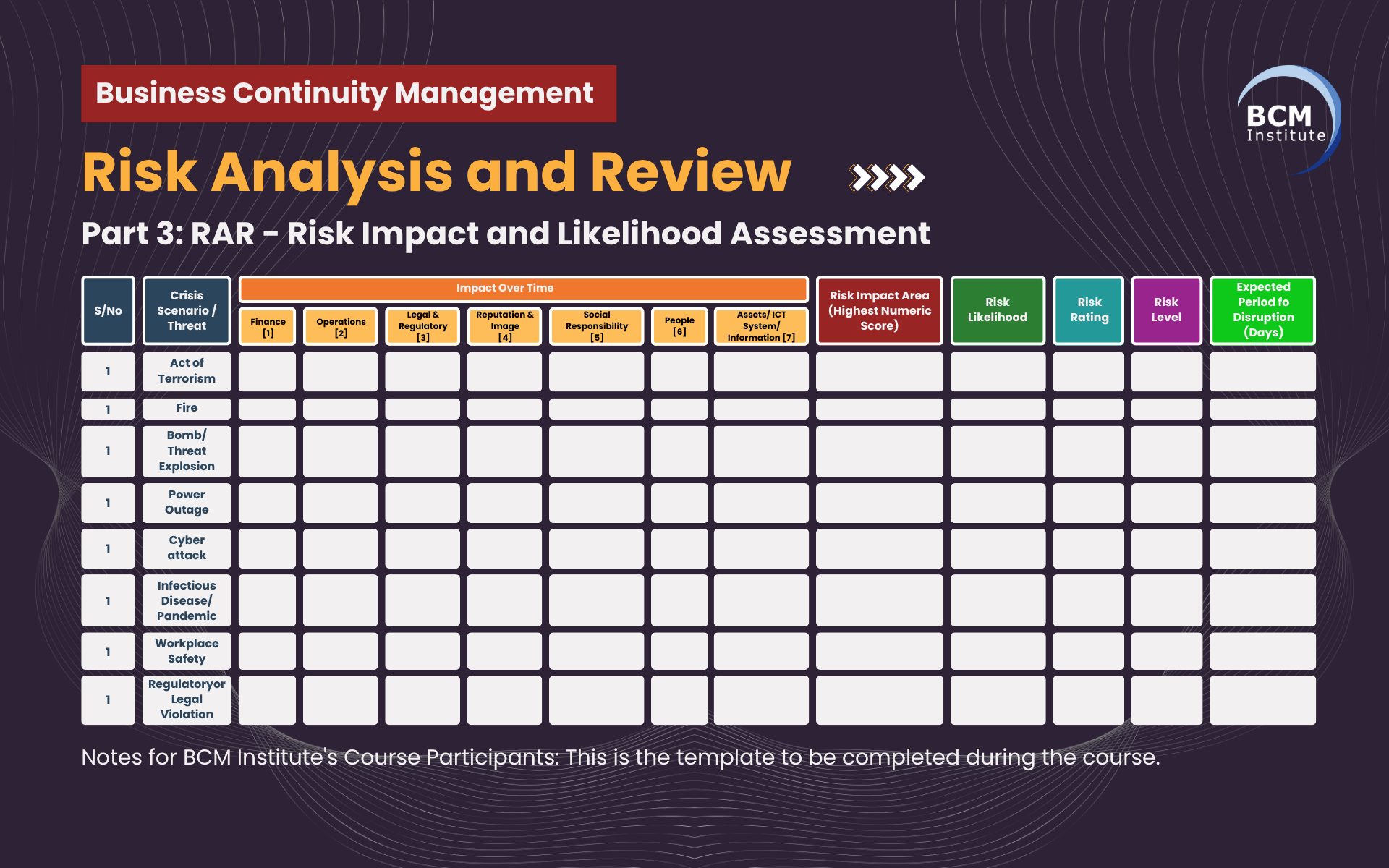
Table: [CRA] Part 3: Risk Impact and Likelihood Assessment (Categorised by Crisis Types)
|
Crisis Type |
Type of Crisis Scenario |
Finance |
Operations |
Legal & Regulatory |
Reputation & Image |
Social Responsibility |
People |
Assets / IT / Info |
Highest Impact Score |
Likelihood |
Risk Rating |
Risk Level |
Expected Period of Disruption |
|
Denial of Access – Natural Disaster |
Flood affecting campus (e.g., Punggol Digital District) |
4 |
5 |
3 |
4 |
4 |
5 |
4 |
5 |
3 |
15 |
Medium |
Days to Weeks |
|
Denial of Access – Natural Disaster |
Pandemic outbreak (e.g., COVID-like) |
5 |
5 |
5 |
4 |
5 |
5 |
3 |
5 |
4 |
20 |
High |
Weeks to Months |
|
Denial of Access – Man-made Disaster |
Fire in a campus building |
4 |
5 |
4 |
4 |
4 |
5 |
5 |
5 |
3 |
15 |
Medium |
Days to Weeks |
|
Denial of Access – Man-made Disaster |
Terrorist threat/ bomb scare |
4 |
5 |
5 |
5 |
5 |
5 |
3 |
5 |
2 |
10 |
Low |
Hours to Days |
|
Unavailability of People |
Mass staff/student absenteeism |
4 |
5 |
3 |
3 |
4 |
5 |
2 |
5 |
4 |
20 |
Medium |
Days to Weeks |
|
Unavailability of People |
Key personnel loss (critical faculty/IT admin) |
3 |
4 |
3 |
3 |
3 |
5 |
3 |
5 |
3 |
15 |
Low |
Days |
|
Supply Chain Disruption |
Failure of outsourced IT/ cloud provider |
5 |
5 |
4 |
5 |
4 |
4 |
5 |
5 |
4 |
20 |
High |
Hours to Days |
|
Supply Chain Disruption |
Disruption to facility management/vendor services |
3 |
4 |
3 |
3 |
3 |
4 |
3 |
4 |
3 |
12 |
Low |
Days |
|
Equipment / IT Disruption |
Cyberattack (ransomware on student systems) |
5 |
5 |
5 |
5 |
4 |
4 |
5 |
5 |
4 |
20 |
High |
Days to Weeks |
|
Equipment / IT Disruption |
Network outage/ system downtime (LMS failure) |
4 |
5 |
3 |
4 |
3 |
4 |
5 |
5 |
4 |
20 |
High |
Hours to Days |
|
Equipment / IT Disruption |
Data breach (student/ staff personal data) |
5 |
4 |
5 |
5 |
4 |
4 |
5 |
5 |
3 |
15 |
Low |
Weeks |
|
Equipment / IT Disruption |
Failure of critical lab equipment |
3 |
4 |
2 |
3 |
3 |
3 |
4 |
4 |
3 |
12 |
Low |
Days |
Risk Rating Guide
Risk Level bands (example guidance notes based on BCM Institute)
How to use this template
- Impact Area Ratings: Score each of the seven categories from 1 (Very Low) to 5 (Very High).
- Highest Impact: Select the highest score among those seven.
- Likelihood: Assign a 1–5 rating based on your organisation's experience/frequency
- Assign Risk Level based on the rating’s band.
- Expected Disruption: Estimate downtime using organisational intelligence and context
Key Observations and Insights
1. Concentration of Extreme (Very High) Risks
The following crisis scenarios fall into the Extreme Risk category, requiring priority mitigation and resilience strategies:
- Pandemic outbreak
- Mass absenteeism
- Cyberattack (ransomware)
- IT/cloud service provider failure
- Network/LMS outage
These risks share a common dependency on digital infrastructure and people availability, which are critical to SIT’s academic delivery model.
2. Technology as a Critical Risk Driver
A significant proportion of high-to-extreme risks are linked to:
- IT systems (LMS, student systems, cloud platforms)
- Cybersecurity threats
- Data protection obligations
This reinforces the need for strong Cyber Resilience and ICT Continuity integration within SIT’s Crisis Management framework.
3. People-Centric Risk Exposure
Scenarios such as:
- Pandemic
- Mass absenteeism
- Key personnel loss
demonstrate that human capital is a single point of failure, particularly in teaching delivery, research continuity, and IT operations.
4. Regulatory and Reputation Sensitivity
Events like:
- Data breaches
- Cyberattacks
- Terror threats
have high Legal & Regulatory and Reputation impacts, especially within Singapore’s strict regulatory environment (e.g., PDPA compliance).
5. Disruption Duration Patterns
- Short-term disruptions (hours–days): IT outages, bomb threats
- Medium-term (days–weeks): Fire, cyberattacks
- Long-term (weeks–months): Pandemic
This supports the need for tiered recovery strategies (RTO/RPO alignment).

The Risk Impact and Likelihood Assessment provides the Singapore Institute of Technology with a clear, prioritised risk landscape, enabling informed decision-making in crisis management and operational resilience planning.
By quantifying both the severity of potential impacts and the probability of occurrence, SIT is able to differentiate between routine operational risks and critical threats that could significantly disrupt its academic mission and stakeholder obligations.
This prioritisation is essential for allocating resources effectively and ensuring that the most severe and probable risks are addressed with appropriate urgency.
While natural and man-made disasters remain relevant, the most severe threats arise from cyber incidents, system outages, and large-scale workforce disruption, reflecting SIT’s reliance on technology-enabled education and interconnected service delivery.
To strengthen resilience, SIT should prioritise:
- Integrated IT Disaster Recovery and Cyber Resilience capabilities
- Workforce continuity planning (e.g., hybrid teaching, cross-training)
- Third-party risk management for critical vendors
- Scenario-based testing for high-impact events
The findings from this chapter highlight the increasing importance of technology resilience, people continuity, and third-party dependencies in SIT’s operating model.
As the institution advances into subsequent phases—such as Business Impact Analysis (BIA), Crisis Management Strategy, and Testing & Exercising—this assessment serves as a foundational reference point.
Ultimately, it ensures that SIT’s crisis management framework is risk-informed, data-driven, and aligned with international best practices, strengthening its ability to respond to, recover from, and adapt to disruptions in an increasingly complex risk environment.
![x [CM] [SIT] Title Banner](https://no-cache.hubspot.com/cta/default/3893111/ac11333b-2002-43b6-9cbf-a85a01f35ce1.png)
![[CM] [GEN] [E3] [C1] Starting Your BCM Implementation](https://no-cache.hubspot.com/cta/default/3893111/a1d12928-4a0a-40a4-a390-6cd01a6f88ad.png)
![[CM] [SIT] [E3] [RAR] [T1-1] List of Threats](https://no-cache.hubspot.com/cta/default/3893111/b808b80d-150f-46e7-9ce1-905e66593ef5.png)
![[CM] [SIT] [E3] [RAR] [T1-2] List of Threats](https://no-cache.hubspot.com/cta/default/3893111/42c34692-d93d-443d-8064-83807c3f95a7.png)
![[CM] [SIT] [E3] [RAR] [P1-3] [Technology] List of Threats](https://no-cache.hubspot.com/cta/default/3893111/54bfa3cb-36bd-412b-9d0e-d961657215aa.png)
![[CM] [SIT] [E3] [RAR] [T2] Treatment and Control](https://no-cache.hubspot.com/cta/default/3893111/0d301475-ef94-4bba-bff2-c9a59521cd91.png)
![[CM] [SIT] [E3] [CMS] [T1] Crisis Prevention Strategy](https://no-cache.hubspot.com/cta/default/3893111/e5370101-5bdd-4e4f-931d-25d53bd946f7.png)
![[CM] [SIT] [E3] [CMS] [T2] Crisis Response Strategy](https://no-cache.hubspot.com/cta/default/3893111/9eed27f2-9c27-4fca-b9c9-f270e2511e53.png)
More Information About Crisis Management Blended/ Hybrid Learning Courses
To learn more about the course and schedule, click the buttons below for the CM-300 Crisis Management Implementer [CM-3] and the CM-5000 Crisis Management Expert Implementer [CM-5].


![[BL-CM] [5] Register](https://no-cache.hubspot.com/cta/default/3893111/82024308-16f4-4491-98be-818a882c6286.png)

![Email to Sales Team [BCM Institute]](https://no-cache.hubspot.com/cta/default/3893111/3c53daeb-2836-4843-b0e0-645baee2ab9e.png)