---
title: [CM] [SIT] [E3] [CRA] [P1-2] List of Crisis Scenarios [3 to 8]
description: [CM] [SIT] [E3] [CRA] [P1-2] List of Crisis Scenarios [3 to 8]
image: https://blog.bcm-institute.org/hubfs/CM%20SIT%20Graphic%20Folder/SIT%20CM%20E3%20Morepost/%5BCM%5D%20%5BSIT%5D%20%5BE3%5D%20%5BRAR%5D%20%5BT1-2%5D%20List%20of%20Threats.jpg
---
.
[](http://www.bcm-institute.org/)
- [Home](https://www.bcm-institute.org/)
- [About Us](https://www.bcm-institute.org/about-us-3/)
- [A President’s Perspective](https://www.bcm-institute.org/about-us/a-presidents-perspective/)
- [Our History](https://www.bcm-institute.org/about-us/our-history/)
- [Our Advisory Council](https://www.bcm-institute.org/about-us/our-advisory-council/)
- [Customers’ Testimonials](https://www.bcm-institute.org/about-us/customers-testimonials/)
- [Credential Verification](https://www.bcm-institute.org/about-us/credential-verification/)
- [Courses](https://blog.bcm-institute.org/blog/course-fees-for-blended-learning-courses-master-catalog)
- [ISO 22301 Business Continuity Management System Audit](https://blog.bcm-institute.org/audit/business-continuity-management-audit-courses)
- [ISO 22301 Business Continuity Management](https://blog.bcm-institute.org/bcm/business-continuity-management-courses)
- [Crisis Communication](https://blog.bcm-institute.org/crisis-communication/crisis-communication-courses)
- [Crisis Management](https://blog.bcm-institute.org/en/crisis-management/courses)
- [IT Disaster Recovery](https://blog.bcm-institute.org/it-disaster-recovery/courses)
- [Operational Resilience](https://blog.bcm-institute.org/operational-resilience/courses)
- [Operational Resilience Audit](https://blog.bcm-institute.org/operational-resilience-audit/courses)
- [Certification](https://blog.bcm-institute.org/certification/types-of-certifications-offered)
- [ISO 22301 BCMS Audit Certification](https://blog.bcm-institute.org/certification/business-continuity-management-audit-certification)
- [ISO22301 Business Continuity Management Certification](https://blog.bcm-institute.org/bcm/business-continuity-management-certification)
- [Crisis Communication Certification](https://blog.bcm-institute.org/crisis-communication/crisis-communication-certification)
- [Crisis Management Certification](https://blog.bcm-institute.org/en/crisis-management/crisis-management-certification)
- [IT Disaster Recovery Planning Certification](https://blog.bcm-institute.org/it-disaster-recovery/it-disaster-recovery-certification)
- [Operational Resilience Certification](https://blog.bcm-institute.org/operational-resilience/operational-resilience-certification)
- [Operational Resilience Audit Certification](https://blog.bcm-institute.org/operational-resilience-audit)
- [Seminars](https://blog.bcm-institute.org/meet-the-expert/mte-webinar-mainpage)
- [Store](https://www.bcm-institute.org/store-2/)
- [Contact Us](http://www.bcm-institute.org/about-us/contact-us/)
-
-
##### Ebook Series

# \[CM\] \[SIT\] \[E3\] \[CRA\] \[P1-2\] List of Crisis Scenarios \[3 to 8\]
[![x \[CM\] \[SIT\] Title Banner](https://no-cache.hubspot.com/cta/default/3893111/ac11333b-2002-43b6-9cbf-a85a01f35ce1.png)](https://cta-redirect.hubspot.com/cta/redirect/3893111/ac11333b-2002-43b6-9cbf-a85a01f35ce1)
In today’s complex and highly interconnected operating environment, institutions such as the Singapore Institute of Technology (SIT) are exposed to a wide spectrum of crisis scenarios that extend beyond traditional disaster events.
These crises may emerge from human behaviour, organisational weaknesses, malicious intent, or external socio-economic and environmental factors.
Unlike physical disruptions that primarily affect infrastructure and access, crises often unfold during ongoing operations, placing significant pressure on leadership, decision-making processes, and communication channels.
This chapter presents a structured identification and categorisation of potential crisis scenarios relevant to SIT, based on established BCM Institute and BCMpedia frameworks.
The scenarios are grouped into key crisis types, including confrontation, malevolence, organisational misdeeds, workplace violence, rumours, financial constraints, and natural factors.
[![\[CM\] \[E3\] \[Risk Assessment\] List of Threats and Crisis Scenario \[Part 2\]](https://no-cache.hubspot.com/cta/default/3893111/dc11ba44-67c2-424c-8ceb-b5ace0685d51.png)](https://cta-redirect.hubspot.com/cta/redirect/3893111/dc11ba44-67c2-424c-8ceb-b5ace0685d51)
Note from Author: This is a drilled-down version of the crisis scenario. In the assignment template, Item 1 is "Natural Disaster", and Item 2 is "Technology"; they are treated as disasters typically managed by the business continuity plan. Items 3 to 8 are crisis scenarios.
[Moh Heng Goh](https://blog.bcm-institute.org/en/ebook-cm/author/moh-heng-goh) Apr 12, 2026
###### Crisis Management Certified Planner-Specialist-Expert
##### [![\[CM\] \[SIT\] Legal Disclaimer Banner](https://no-cache.hubspot.com/cta/default/3893111/7cd96343-be69-4196-84d6-73f1153f1d2f.png)](https://cta-redirect.hubspot.com/cta/redirect/3893111/7cd96343-be69-4196-84d6-73f1153f1d2f)
### ![\[CM\] \[E3\] \[Risk Assessment\] List of Threats and Crisis Scenario \[Part 1\] (2)](https://blog.bcm-institute.org/hs-fs/hubfs/RYT%20eBook%20Blog%20Banner/RYT%20E3%20Long%20Banner/%5BCM%5D%20%5BE3%5D%20%5BRisk%20Assessment%5D%20List%20of%20Threats%20and%20Crisis%20Scenario%20%5BPart%201%5D%20(2).png?width=1920&height=220&name=%5BCM%5D%20%5BE3%5D%20%5BRisk%20Assessment%5D%20List%20of%20Threats%20and%20Crisis%20Scenario%20%5BPart%201%5D%20(2).png)
#### **Introduction to \[CRA\] Part 1-2: CRA – List of Crisis Scenarios**
[![\[CM\] \[SIT\] \[E3\] \[RAR\] \[T1-2\] List of Threats](https://no-cache.hubspot.com/cta/default/3893111/42c34692-d93d-443d-8064-83807c3f95a7.png)](https://cta-redirect.hubspot.com/cta/redirect/3893111/42c34692-d93d-443d-8064-83807c3f95a7)In today’s complex and highly interconnected operating environment, institutions such as the Singapore Institute of Technology (SIT) are exposed to a wide spectrum of crisis scenarios that extend beyond traditional disaster events.
These crises may emerge from human behaviour, organisational weaknesses, malicious intent, or external socio-economic and environmental factors.
Unlike physical disruptions that primarily affect infrastructure and access, crises often unfold during ongoing operations, placing significant pressure on leadership, decision-making processes, and communication channels.
This chapter presents a structured identification and categorisation of potential crisis scenarios relevant to SIT, based on established BCM Institute and BCMpedia frameworks.
The scenarios are grouped into key crisis types, including confrontation, malevolence, organisational misdeeds, workplace violence, rumours, financial constraints, and natural factors.
Each scenario has been contextualised to reflect both Singapore's national environment and the operational realities of a higher education institution.
The purpose of this chapter is to provide SIT with a comprehensive overview of plausible crisis scenarios, forming a critical foundation for subsequent phases, including crisis risk assessment, strategy development, and crisis response planning.
Below is the structured table for **\[CRA\] Part 1-2: CRA – List of Crisis Scenarios for** the Singapore Institute of Technology, aligned with BCM Institute / BCMpedia guidance on crisis scenario categories and examples.
#### [![\[Banner\] \[Title\] \[CM\] \[E3\] Part 1-2_ List of Crisis Scenarios](https://no-cache.hubspot.com/cta/default/3893111/6b07e8ef-f126-443b-bcbf-3a51c3748227.png)](https://cta-redirect.hubspot.com/cta/redirect/3893111/6b07e8ef-f126-443b-bcbf-3a51c3748227)List of Threats/ Crisis Scenarios for Singapore Institute of Technology \[3 to 8\]
Table Below: Notes for BCM Institute's Course Participants: This is the template for completing the "**\[CRA\] Part 1-2: CRA – List of Crisis Scenarios** ."
##### 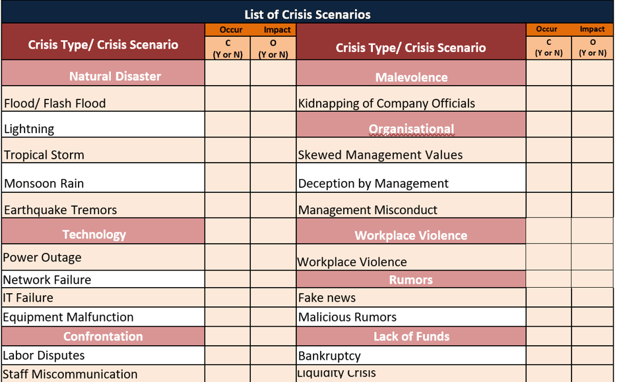
*Note that Item 1, Natural Disaster, and Item 2, Technology, in the above template are considered as a disaster. Item 3 is the start of the crisis scenario "Confrontation", and item 8 is the crisis scenario "Due to Natural Factor". Items 3 to 8 are documented in the table below *
##### **Table \[CRA\] Part 1-2: List of Crisis Scenarios for Singapore Institute of Technology \[Item 3 to 8\]**
| Crisis Type | Type of Threats / Crisis Scenarios | Description of Threats | Country Level (Singapore) | Organisation Level (SIT) |
| --- | --- | --- | --- | --- |
| 3. Confrontation | Student protests/ campus demonstrations | Organised protests by students or external groups caused disruption to campus operations and reputation | Yes | Yes |
| | Industrial action/ staff dispute | Conflict between management and staff (e.g. union-related issues) leading to disruption of teaching and services | No | Yes |
| | Activism / public demonstrations | External activist groups targeting university policies or partnerships | Yes | Yes |
| 4. Malevolence | Cyberattack/ ransomware | Malicious cyber intrusion affecting academic systems, student data, or research databases | Yes | Yes |
| | Sabotage of facilities | Intentional damage to campus infrastructure, labs, or IT systems | Yes | Yes |
| | Terrorism/bomb threat | Threats or actual attacks targeting public institutions such as universities | Yes | Yes |
| | Data breach/information theft | Theft or exposure of confidential student, staff, or research data | Yes | Yes |
| 5a. Organisational Misdeeds – Skewed Management Values | Poor governance / unethical decision-making | Leadership decisions prioritising profit, rankings, or partnerships over ethics or compliance | No | Yes |
| | Ignoring regulatory requirements | Failure to comply with MOE or regulatory standards affecting accreditation | No | Yes |
| 5b. Organisational Misdeeds – Deception | Misrepresentation of academic results | Manipulation or falsification of student performance or research outputs | No | Yes |
| | False reporting/ disclosure | Providing inaccurate information to regulators, stakeholders, or the public | No | Yes |
| 5c. Organisational Misdeeds – Management Misconduct | Corruption/ bribery | Improper practices in procurement, admissions, or partnerships | Yes | Yes |
| | Harassment/ abuse of authority | Misconduct by leadership affecting staff or students | No | Yes |
| 6. Workplace Violence | Physical assault on campus | Violence involving students, staff, or visitors within campus premises | Yes | Yes |
| | Armed intrusion / active attacker | Severe security incident involving weapons on campus | Yes | Yes |
| | Bullying/ harassment incidents | Escalated interpersonal conflicts affecting safety and morale | No | Yes |
| 7. Rumours | Social media misinformation | Viral spread of false information affecting SIT’s reputation or causing panic | Yes | Yes |
| | Fake news / reputational attack | External parties spreading damaging rumours about academic quality or incidents | Yes | Yes |
| | Internal misinformation | Miscommunication within the campus leads to confusion during incidents | No | Yes |
| 8. Lack of Funds | Budget cuts/funding shortfall | Reduction in government funding or grants affecting operations and programs | Yes | Yes |
| | Research funding withdrawal | Loss of sponsorships or grants impacting ongoing research projects | Yes | Yes |
| | Cash flow constraints | Financial mismanagement leading to the inability to sustain operations | No | Yes |
##### **Notes and Alignment to BCMpedia**
- Crisis scenarios differ from disaster-type threats, as they often occur while operations are still accessible but under stress, requiring management and communication responses.
- The categories used (Confrontation, Malevolence, Organisational Misdeeds, Workplace Violence, Rumours, Lack of Funds) align with BCM Institute crisis scenario classification frameworks.
- Each scenario has been contextualised for a **Singapore-based university environment**, ensuring relevance to SIT’s academic, research, and campus operations.
[![Banner \[CM\] \[Summing Up\] \[E3\] \[CRA\] \[P1-2\] List of Crisis Scenarios](https://no-cache.hubspot.com/cta/default/3893111/0b39136b-caa1-43ea-bd65-cd33b90c2bfc.png)](https://cta-redirect.hubspot.com/cta/redirect/3893111/0b39136b-caa1-43ea-bd65-cd33b90c2bfc)
Identifying crisis scenarios is a crucial step in strengthening the Singapore Institute of Technology's crisis management capabilities.
By systematically outlining a diverse range of threats—from reputational risks driven by misinformation to operational challenges arising from funding constraints or workplace incidents—this chapter ensures that SIT is better prepared to anticipate and respond to both internal and external crises.
A well-defined list of crisis scenarios enables SIT to move beyond reactive approaches and towards proactive preparedness.
It supports informed decision-making, enhances situational awareness, and facilitates the development of targeted crisis management strategies and communication plans aligned with the principles of ISO 22361.
Ultimately, this structured approach strengthens institutional resilience, safeguards stakeholder trust, and ensures that SIT can continue to fulfil its academic and societal mission even in the face of adversity.
[![x \[CM\] \[SIT\] Title Banner](https://no-cache.hubspot.com/cta/default/3893111/ac11333b-2002-43b6-9cbf-a85a01f35ce1.png)](https://cta-redirect.hubspot.com/cta/redirect/3893111/ac11333b-2002-43b6-9cbf-a85a01f35ce1)
| **eBook 3: Starting Your Crisis Management Implementation** | | | |
| --- | --- | --- | --- |
| [![\[CM\] \[GEN\] \[E3\] \[C1\] Starting Your BCM Implementation](https://no-cache.hubspot.com/cta/default/3893111/a1d12928-4a0a-40a4-a390-6cd01a6f88ad.png)](https://cta-redirect.hubspot.com/cta/redirect/3893111/a1d12928-4a0a-40a4-a390-6cd01a6f88ad) | [![\[CM\] \[SIT\] \[E3\] \[RAR\] \[T1-1\] List of Threats](https://no-cache.hubspot.com/cta/default/3893111/b808b80d-150f-46e7-9ce1-905e66593ef5.png)](https://cta-redirect.hubspot.com/cta/redirect/3893111/b808b80d-150f-46e7-9ce1-905e66593ef5) | [![\[CM\] \[SIT\] \[E3\] \[RAR\] \[T1-2\] List of Threats](https://no-cache.hubspot.com/cta/default/3893111/42c34692-d93d-443d-8064-83807c3f95a7.png)](https://cta-redirect.hubspot.com/cta/redirect/3893111/42c34692-d93d-443d-8064-83807c3f95a7) | [![\[CM\] \[SIT\] \[E3\] \[RAR\] \[P1-3\] \[Technology\] List of Threats](https://no-cache.hubspot.com/cta/default/3893111/54bfa3cb-36bd-412b-9d0e-d961657215aa.png)](https://cta-redirect.hubspot.com/cta/redirect/3893111/54bfa3cb-36bd-412b-9d0e-d961657215aa) |
| [![\[CM\] \[SIT\] \[E3\] \[RAR\] \[T2\] Treatment and Control](https://no-cache.hubspot.com/cta/default/3893111/0d301475-ef94-4bba-bff2-c9a59521cd91.png)](https://cta-redirect.hubspot.com/cta/redirect/3893111/0d301475-ef94-4bba-bff2-c9a59521cd91) | [![\[CM\] \[SIT\] \[E3\] \[RAR\] \[T3\] Risk Impact and Likelihood Assessment](https://no-cache.hubspot.com/cta/default/3893111/7e6a7430-be49-4aa6-a58f-5dbdc4e3a482.png)](https://cta-redirect.hubspot.com/cta/redirect/3893111/7e6a7430-be49-4aa6-a58f-5dbdc4e3a482) | [![\[CM\] \[SIT\] \[E3\] \[CMS\] \[T1\] Crisis Prevention Strategy](https://no-cache.hubspot.com/cta/default/3893111/e5370101-5bdd-4e4f-931d-25d53bd946f7.png)](https://cta-redirect.hubspot.com/cta/redirect/3893111/e5370101-5bdd-4e4f-931d-25d53bd946f7) | [![\[CM\] \[SIT\] \[E3\] \[CMS\] \[T2\] Crisis Response Strategy](https://no-cache.hubspot.com/cta/default/3893111/9eed27f2-9c27-4fca-b9c9-f270e2511e53.png)](https://cta-redirect.hubspot.com/cta/redirect/3893111/9eed27f2-9c27-4fca-b9c9-f270e2511e53) |
| | | | |
More Information About Crisis Management Blended/ Hybrid Learning Courses
To learn more about the course and schedule, click the buttons below for the CM-300 Crisis Management Implementer \[CM-3\] and the CM-5000 Crisis Management Expert Implementer \[CM-5\].
| [](https://cta-redirect.hubspot.com/cta/redirect/3893111/5ffecd2d-8000-4805-b5e3-e9ead2e259cc) | [](https://cta-redirect.hubspot.com/cta/redirect/3893111/c3546220-6c76-4a10-8c76-4040b94e09e5) | [](https://cta-redirect.hubspot.com/cta/redirect/3893111/03294547-1df3-435c-9243-971c3d9bb6ce) |
| --- | --- | --- |
| [](https://cta-redirect.hubspot.com/cta/redirect/3893111/b29594fe-d44a-4ff8-8160-03f7ce454385) | [](https://cta-redirect.hubspot.com/cta/redirect/3893111/dd120e7f-9fe2-49ed-ad24-489b81c06739) | [![\[BL-CM\] \[5\] Register](https://no-cache.hubspot.com/cta/default/3893111/82024308-16f4-4491-98be-818a882c6286.png)](https://cta-redirect.hubspot.com/cta/redirect/3893111/82024308-16f4-4491-98be-818a882c6286) |
| [](https://cta-redirect.hubspot.com/cta/redirect/3893111/c8aaf76b-4c0b-402a-ad12-c8aff24eb911) | Please feel free to send us a note if you have any questions. [![Email to Sales Team \[BCM Institute\]](https://no-cache.hubspot.com/cta/default/3893111/3c53daeb-2836-4843-b0e0-645baee2ab9e.png)](https://cta-redirect.hubspot.com/cta/redirect/3893111/3c53daeb-2836-4843-b0e0-645baee2ab9e) | [](https://cta-redirect.hubspot.com/cta/redirect/3893111/30bcbbbf-c8ea-48d8-8643-da2638f3f0f8) |
| [](https://cta-redirect.hubspot.com/cta/redirect/3893111/83d00c12-c51c-4476-9902-69f9b7667a91) | [](https://cta-redirect.hubspot.com/cta/redirect/3893111/672d2949-6233-4b26-ad42-ae0dd0a1a3ac) | [](https://cta-redirect.hubspot.com/cta/redirect/3893111/3ca6f50d-a3c5-41b8-8da2-26feb8a7613e) |
### Your Comments Here:
---

---

---
---


All rights reserved. Copyright 2026
```json
{
"@context" : "https://schema.org",
"@type" : "BlogPosting",
"author" : {
"@type" : "Person",
"name" : "Moh Heng Goh",
"url" : "https://blog.bcm-institute.org/en/ebook-cm/author/moh-heng-goh"
},
"dateModified" : "2026-06-07T07:15:38.058Z",
"datePublished" : "2026-04-12T07:33:19.000Z",
"headline" : "[CM] [SIT] [E3] [CRA] [P1-2] List of Crisis Scenarios [3 to 8]",
"mainEntityOfPage" : {
"@id" : "https://blog.bcm-institute.org/en/ebook-cm/cm-sit-e3-cra-p1-2-list-of-crisis-scenarios-3-to-8",
"@type" : "WebPage"
},
"publisher" : {
"@type" : "Organization",
"logo" : {
"@type" : "ImageObject",
"url" : "https://blog.bcm-institute.org/hubfs/BCMI%20Logo.png"
},
"name" : "BCMI Pte Ltd"
}
}
```