![[CM] [SIT] Legal Disclaimer Banner](https://no-cache.hubspot.com/cta/default/3893111/7cd96343-be69-4196-84d6-73f1153f1d2f.png)
Chapter 12
Summary and Strategic Outlook for Crisis Management Readiness for SIT

![eBook Cover [CM] [SIT] [E1] [2D]](https://no-cache.hubspot.com/cta/default/3893111/a2714b57-016b-4475-93f8-b43f412bbea6.png) This chapter provides a consolidated overview of crisis management (CM) readiness for the Singapore Institute of Technology (SIT), forming the foundation for the eBook Crisis-Ready Campus: A Strategic Framework for Crisis Management at Singapore Institute of Technology.
This chapter provides a consolidated overview of crisis management (CM) readiness for the Singapore Institute of Technology (SIT), forming the foundation for the eBook Crisis-Ready Campus: A Strategic Framework for Crisis Management at Singapore Institute of Technology.
It aligns with the principles of ISO 22361 and outlines how an applied-learning university like SIT can strengthen crisis preparedness, response, and recovery.
Introducing Crisis Management for SIT
Crisis Management (CM) at SIT refers to a structured, coordinated approach to anticipating, responding to, and recovering from crises that threaten its people, operations, reputation, and stakeholder trust.
As a university operating within Singapore’s highly connected and digital ecosystem, SIT must adopt a proactive CM framework that ensures:
- Protection of students, faculty, and staff
- Continuity of academic and operational activities
- Preservation of institutional credibility
CM complements SIT’s broader resilience agenda by focusing on decision-making under uncertainty, leadership coordination, and stakeholder communication.
Singapore Institute of Technology is Singapore’s first university of applied learning, established to deliver industry-relevant education and produce work-ready graduates.
Key characteristics include:
- Strong industry integration through applied learning and work-study programmes
- A mission to maximise learner potential and innovate with industry
- A centralised campus within the Punggol Digital District, enabling collaboration with technology and business ecosystems
These characteristics shape SIT’s risk profile:
- High reliance on digital infrastructure
- Extensive stakeholder ecosystem (students, industry partners, regulators)
- Complex operational environment (academic, research, and industry integration)
 Identifying Crisis Management Goals for SIT
Aligned with ISO 22361, SIT’s CM goals should include:
- Life Safety and Well-being: Protect students, staff, and visitors
- Operational Continuity: Maintain academic delivery and essential services
- Reputation Protection: Safeguard SIT’s standing as a trusted institution
- Stakeholder Confidence: Ensure transparent and timely communication
- Regulatory Compliance: Align with Singapore's national crisis and emergency frameworks
These goals must be measurable, integrated into governance structures, and regularly reviewed.
 Differentiating Crisis Management and Business Continuity Management
|
Aspect |
Crisis Management (CM) |
Business Continuity Management (BCM) |
|
Focus |
Strategic response and leadership decisions |
Operational recovery and continuity |
|
Scope |
Reputation, stakeholder trust, safety |
Processes, systems, and services |
|
Trigger |
Crisis scenarios (high uncertainty, ambiguity) |
Disruptions (e.g. system failures) |
|
Leadership |
Senior leadership (Crisis Management Team) |
Operational teams |
Key Insight
CM manages the “unknown and complex”, while BCM ensures the “known and recoverable.” Both must be integrated for SIT to achieve operational resilience.
 Identifying the Types of Crisis Scenarios
SIT may face a wide spectrum of crisis scenarios, including:
- Natural: Pandemics, haze, flooding
- Technological: Cyberattacks, system outages, data breaches
- Organisational Misconduct: Academic fraud, governance failures
- Confrontation: Student protests or stakeholder disputes
- Malevolence: Terror threats or deliberate harm
- Workplace Violence: Campus safety incidents
- Rumours: Social media misinformation affecting reputation
- Financial Constraints: Funding or resource limitations
Each scenario requires predefined response strategies and escalation protocols.
 Assessing Risks and Threats
Risk assessment at SIT involves:
- Identifying vulnerabilities (e.g. digital dependency, campus centralisation)
- Evaluating impact severity (academic disruption, safety risks, reputational damage)
- Assessing the likelihood of occurrence
- Prioritising risks for mitigation and preparedness
Given SIT’s applied learning model, third-party risks and industry dependencies must also be incorporated into risk assessments.
 Implementing the Crisis Management Planning Methodology
SIT should adopt a structured CM planning methodology comprising:
![[CM] [SIT] [E1] [C8] Implementing the CM Planning Methodology](https://no-cache.hubspot.com/cta/default/3893111/77927905-bf78-49de-bea6-e2602a05d6f8.png) Project Management (PM) – Establish governance and scope
Project Management (PM) – Establish governance and scope - Crisis Scenario Risk Analysis (CAR) – Identify and analyse threats
- Business Impact Analysis (BIA) – Determine critical functions
- Crisis Strategy (BCS) – Develop response strategies
- Plan Development (PD) – Document crisis response plans
- Testing and Exercising (TE) – Validate preparedness through simulations
- Programme Management (PgM) – Sustain and improve CM capability
This lifecycle ensures continuous improvement and organisational learning.
 Pre-Crisis: Risk Identification and Crisis Preparedness
Before a crisis occurs, SIT must focus on:
- Scenario planning and contingency development
- Early warning systems and monitoring indicators
- Training and awareness programmes
- Crisis team readiness and resource allocation
Preparedness ensures that SIT can detect, anticipate, and mitigate crises before they escalate.
 During Crisis: Crisis Response and Decision-Making
During a crisis, SIT must activate:
- Crisis escalation protocols
- Crisis Management Team (CMT) with defined roles
- Structured decision-making frameworks
- Clear communication channels (internal & external)
Key priorities:
- Rapid situational awareness
- Timely and accurate communication
- Coordinated response across academic and operational units
 Post-Crisis: Crisis Recovery
After the crisis, SIT transitions to recovery by:
- Restoring academic and operational functions
- Providing psychological and stakeholder support
- Conducting post-incident reviews and lessons learned
- Managing reputation recovery and public confidence
Post-crisis management ensures that SIT emerges stronger and more resilient, reinforcing its role as Singapore’s university for industry.
![[Summary] [CM] [E1] [C12] Summary and Strategic Outlook](https://no-cache.hubspot.com/cta/default/3893111/d502bb05-c08f-4c4b-be6b-cda7305d8d7f.png)
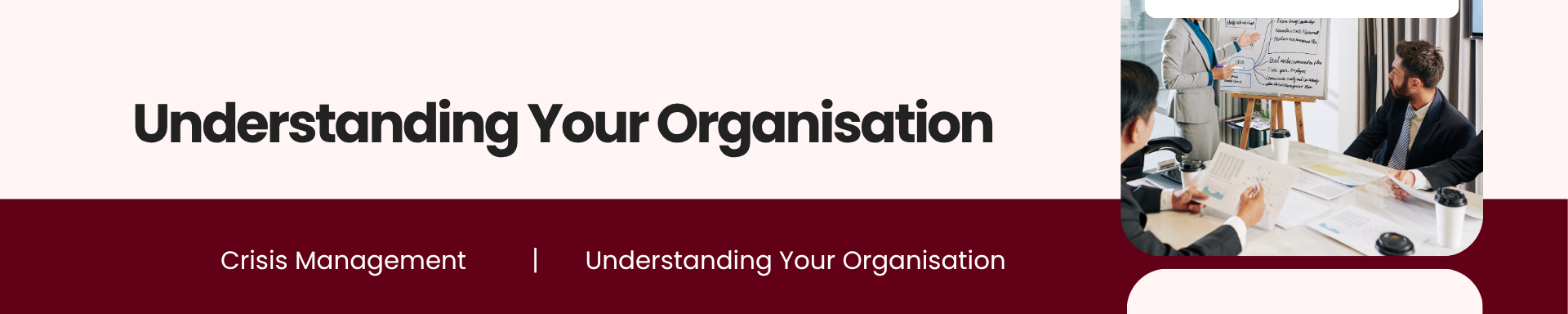
Understanding the organisational context of the Singapore Institute of Technology is fundamental to building an effective crisis management capability.
SIT’s applied learning model, industry integration, and digital ecosystem create both opportunities and vulnerabilities that must be addressed through a structured, ISO 22361-aligned CM framework.
By integrating crisis preparedness, response, and recovery into its institutional strategy, SIT can enhance its operational readiness and serve as a model for resilience across Singapore’s higher education sector.
![x [CM] [SIT] Title Banner](https://no-cache.hubspot.com/cta/default/3893111/ac11333b-2002-43b6-9cbf-a85a01f35ce1.png)
![[CM] [SIT] [E1] [C1] Overview of Case Study](https://no-cache.hubspot.com/cta/default/3893111/c306682c-662e-43ff-9827-263b8a185f30.png)
![[CM] [SIT] [E1] [C2] Understanding Your Organisation](https://no-cache.hubspot.com/cta/default/3893111/5bb8d4e5-a096-4e49-a4dc-b19050e134e7.png)
![[CM] [SIT] [E1] [C3] Establishing CM Goals](https://no-cache.hubspot.com/cta/default/3893111/b1be0165-3080-4042-8859-f932fd7ea2cd.png)
![[CM] [SIT] [E1] [C4] CM Vs BCM](https://no-cache.hubspot.com/cta/default/3893111/c606b602-57b3-41ff-8f4e-1c26adbf45ee.png)
![[CM] [SIT] [E1] [C5] Identifying the Types of Crisis Scenarios](https://no-cache.hubspot.com/cta/default/3893111/6d8c5080-64b3-4799-a43c-793a153fd9bf.png)
![[CM] [SIT] [E1] [C5A] Technological Crisis Scenarios](https://no-cache.hubspot.com/cta/default/3893111/950c2f25-e066-4d7c-8d2b-025b42e2b0ae.png)
![[CM] [SIT] [E1] [C6] Assessing Risks and Threats](https://no-cache.hubspot.com/cta/default/3893111/d2359b4e-e4ea-4da8-85af-cedfc06717f0.png)
![[CM] [SIT] [E1] [C7] Composing the CM Team](https://no-cache.hubspot.com/cta/default/3893111/ffe3bd40-3117-4baa-926a-121807395d35.png)
![[CM] [SIT] [E1] [C9] Pre-Crisis - Risk Identification and Crisis Preparedness](https://no-cache.hubspot.com/cta/default/3893111/077341af-cdfe-4644-a420-092c1158a151.png)
![[CM] [SIT] [E1] [C10] During Crisis - Crisis Response and Decision-Making](https://no-cache.hubspot.com/cta/default/3893111/e8036dfa-5a13-4cfa-97a9-6186e3673cf2.png)
![[CM] [SIT] [E1] [C11] Post Crisis - Crisis Recovery](https://no-cache.hubspot.com/cta/default/3893111/3be8d3fc-39a0-432d-859c-4644cec92ad4.png)
![[CM] [SIT] [E1] [C13] [Back Cover] CM eBook 1](https://no-cache.hubspot.com/cta/default/3893111/3845b345-5344-42d7-8a17-4691c64a807a.png)
More Information About Crisis Management Blended/ Hybrid Learning Courses
To learn more about the course and schedule, click the buttons below for the CM-300 Crisis Management Implementer [CM-3] and the CM-5000 Crisis Management Expert Implementer [CM-5].


![[BL-CM] [5] Register](https://no-cache.hubspot.com/cta/default/3893111/82024308-16f4-4491-98be-818a882c6286.png)

![Email to Sales Team [BCM Institute]](https://no-cache.hubspot.com/cta/default/3893111/3c53daeb-2836-4843-b0e0-645baee2ab9e.png)