

Post-crisis Stage
 Performance Criteria to Manage Post-Crisis Operations
The performance criteria for the CM team to manage post-crisis operations include:
- Account for and demobilise resources
- Initiate post-incident recovery
- Evaluate and document the effectiveness of operations
- Debrief all relevant people
- Recommend improvements to the crisis management process
Restore
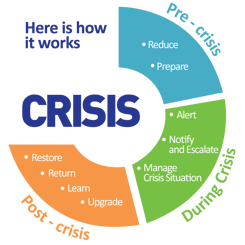
- The acute stage of the crisis has passed, and the organisation can focus on a return to normal operations.
- Repair confidence in the organisation and its products.
Return
- Restore the business to normality as quickly as possible.
- Actions are taken to return to a normal or an even safer situation following the crisis; and
- Declare the end of the crisis.
Performance Criteria to document and review the crisis and response.
- Ensure recording occurs promptly
- Record and analyse feedback from stakeholders/ witnesses
- Identify and record the cause of the crisis event
- Generate and distribute required reports and findings to appropriate personnel.
Learn
- Evaluate the effects.
- Appoint a crisis evaluation team to assess the handling of the crisis and recommend changes in crisis procedures.
- Note that the crisis evaluation team members should be different from the CM team members.
- Build the document log from which people learn; and
- Learn from the crisis and put that learning to work.
Upgrade
The final stage of crisis management (Woods, 2015) is when things begin to return to normal. Effective resolutions for the situation are put into practice, and if they go as planned, the incident begins to fade from the spotlight
Deliver all information promised to stakeholders as soon as that information is known.
- Keep stakeholders updated on the progress of recovery efforts, including any corrective measures taken and the status of investigations.
- Analyse the crisis management effort for lessons, and integrate them into the organisation’s crisis management system.
- Initiate repair of the organisation
Plan for Post-Crisis Rebuilding
When planning, the organisation should anticipate the situation after a crisis. The medium- and long-term planning should assess the potential damage that might be incurred during a crisis.
The organisation should identify how to prevent similar crises while maximising recovery and minimising damage.
At the same time, the organisation should consider the type of communications program that would help to restore confidence in the company and its products.
All crises develop at different rates (Immediate, Emerging and Sustained), and last for different durations (crisis events occur quickly, over time and continue over time), thus affecting the approach and timing of the needed CM and Crisis Communication frameworks.
Crisis Communication
In the post-crisis phase, the organisation is returning to business as usual. The crisis is no longer the focal point of management’s attention, but still requires some attention. As noted earlier, reputation repair may be continued or initiated during this phase.
There is essential follow-up communication is required. First, crisis managers often promise to provide additional information during the crisis phase. The crisis managers must deliver on those informational promises or risk losing the trust of the public wanting the information.
Second, the organisation needs to release updates on the recovery process, corrective actions, and investigations of the crisis.
The amount of follow-up communication required depends on the information promised during the crisis and the time required to complete the recovery process.


Goh, M. H. (2016). A Manager’s Guide to Implement Your Crisis Management Plan. Business Continuity Management Specialist Series (1st ed., p. 192). Singapore: GMH Pte Ltd.
Extracted from During Crisis
Find out more about Blended Learning CM-300 [BL-CM-3] & CM-5000 [BL-CM-5]
 |
 |
 |
 |
![TMM [BL-CM-5]](https://no-cache.hubspot.com/cta/default/3893111/54680a64-9914-4958-8cec-1bc451ed5053.png) |
![[BL-CM] [5] Register](https://no-cache.hubspot.com/cta/default/3893111/82024308-16f4-4491-98be-818a882c6286.png) |
 |
Please feel free to send us a note if you have any of these questions to sales.ap@bcm-institute.org |  |

