


![[BCM] [E3] [BIA] [P1] [P2] [P3] [P4] {P5] [P6] Template](https://no-cache.hubspot.com/cta/default/3893111/d0508ed9-8fef-4cbe-a91b-337f2f8a2463.png)

CBF-1 Residential Care and Resident Safety
Introduction

Assessing the impact of business functions over time is a critical component of Business Impact Analysis (BIA).
It determines how the consequences of disruption to individual operational processes increase as the period of unavailability becomes longer.
For Jamiyah Singapore (JS), this assessment is particularly important for CBF-1 Residential Care and Resident Safety because the organisation's residential care activities may require continuous supervision, safeguarding, essential daily living support, nutrition, hygiene, healthcare coordination, and emergency response.
Unlike conventional administrative processes, where disruption may initially cause delays or backlogs, interrupting residential care activities can have immediate consequences for resident safety and welfare.
The BIA must therefore distinguish between activities that can tolerate temporary suspension and those that require uninterrupted delivery or immediately available alternative arrangements.
This chapter assesses the progressive impact of disruption to the 26 Sub-Critical Business Functions (Sub-CBFs) identified in BIA Part 1 and evaluated in BIA Part 2.
The assessment provides a structured basis for determining Recovery Time Objectives (RTOs), Maximum Tolerable Periods of Disruption (MTPDs), vulnerable periods and recovery priorities.
Purpose of the Impact-Over-Time Assessment
The primary purpose is to determine when disruption consequences become unacceptable and to establish the recovery requirements needed to protect the overall Critical Business Function.
The assessment enables Jamiyah Singapore to:
- Evaluate how operational, safety, regulatory, financial and stakeholder impacts escalate over time.
- Identify activities that require immediate continuity arrangements.
- Determine realistic recovery targets for individual Sub-CBFs.
- Establish the maximum tolerable disruption period for each activity.
- Identify periods of heightened vulnerability.
- Prioritise recovery resources and continuity investments.
- Provide evidence for Business Continuity Strategy and Business Continuity Plan development.
Why Business Impacts Escalate Over Time
The consequences of disruption generally increase as essential resources are depleted, service backlogs accumulate, resident needs remain unmet, and alternative arrangements become harder to sustain.
For example, a temporary interruption to routine resident admission processing may initially have limited consequences. However, a prolonged interruption could create an increasing backlog of urgent placement requests.
In contrast, losing resident supervision may create an unacceptable safety risk immediately. In such cases, waiting several hours to restore the activity would not be appropriate.
The impact-over-time assessment must therefore consider both how quickly consequences emerge and how severe they are.
Relationship Between RTO, MTPD, and Vulnerable Period
Recovery Time Objective (RTO) is the target time within which an interrupted activity must be resumed at its required minimum level.
Maximum Tolerable Period of Disruption (MTPD) is the maximum duration beyond which the consequences of disruption become unacceptable.
Vulnerable Period refers to a specific operational period or circumstance during which interruption would cause particularly significant consequences.
The RTO should be shorter than the MTPD to provide a recovery margin. However, for safety-critical activities, the organisation must not interpret this margin as permission to suspend essential care or safeguarding.
Where uninterrupted service is required, the organisation must maintain the minimum safe capability through immediate alternative arrangements.
Assessment Assumptions
The assessment uses the following assumptions:
- The disruption affects the individual Sub-CBF while other functions may remain available unless they are identified as dependencies.
- Impact scores represent the consequences of the affected activity remaining unavailable or below its approved BU MBCO.
- The scores are cumulative and generally do not decrease over time.
- The assessment assumes no fully effective alternative arrangement has already eliminated the disruption consequences.
- Where immediate continuity is essential, the proposed RTO refers to activating or restoring an acceptable alternative capability, not permission for an unsafe service interruption.
- The RTOs and MTPDs are proposed planning targets that require validation against actual resident dependency levels, staffing, facilities, and applicable obligations.
For safety-critical activities, the proposed RTO and MTPD values are deliberately short. Actual clinical, safeguarding or emergency circumstances may require immediate action without any tolerable interruption.
Impact Scoring Methodology
The assessment uses a five-point impact scale.
|
Score |
Impact Level |
Interpretation for Residential Care |
|
1 |
Very Low |
Minimal disruption; routine activities can be deferred with negligible immediate consequences |
|
2 |
Low |
Manageable operational inconvenience or backlog; essential care remains unaffected |
|
3 |
Moderate |
Noticeable service deterioration, additional resource requirements or increasing stakeholder consequences |
|
4 |
High |
Serious disruption to essential activities, significant safety concerns or substantial operational consequences |
|
5 |
Very High |
Unacceptable disruption, potentially involving severe resident safety, safeguarding, care continuity or regulatory consequences |
Interpretation of the Scores
A score of 5 does not necessarily mean that an adverse event has occurred. It indicates that the consequences of continued disruption have reached, or could reach, an unacceptable level under the assumed scenario.
For essential care activities, a score of 5 may be reached before the first four-hour assessment interval.
Therefore, interpret the time-based scores alongside the RTO and MTPD, rather than using them as the sole basis for determining acceptable recovery times.
Relationship Between Impact Scores and Recovery Targets
The proposed RTO should allow the affected process to resume before the disruption reaches an unacceptable level.
The MTPD identifies the outer limit beyond which continued unavailability would be unacceptable.
For example, if resident supervision cannot safely be interrupted, the organisation must maintain that capability continuously. An immediate continuity requirement is more appropriate than a conventional multi-hour restoration target.
For less time-sensitive activities, a longer recovery period may be appropriate, provided that the consequences remain manageable and urgent exceptions are addressed.
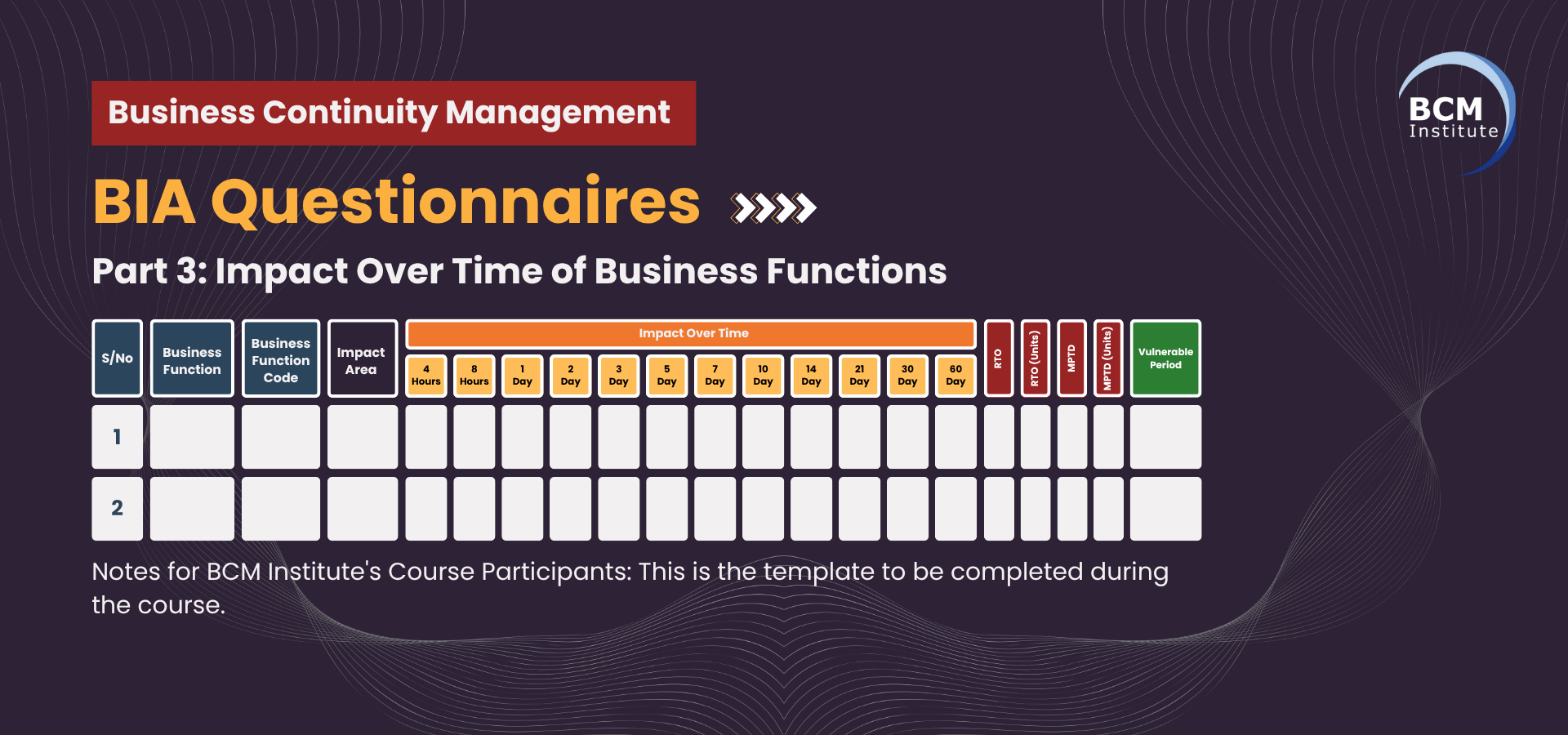
![Banner [Table] [BCM] [E3] [BIA] [[P3] Impact Over Time of Business Functions [BIAQ]](https://no-cache.hubspot.com/cta/default/3893111/b31bbcc9-edc2-4fc8-9cae-5c5797e36f84.png)
Impact Over Time of Business Functions for CBF-1 Residential Care and Resident Safety
Scores: 1 = Very Low, 2 = Low, 3 = Moderate, 4 = High, 5 = Very High. All RTOs and MTPDs are illustrative planning targets. “Immediate” denotes no planned interruption of the minimum safe capability; the accompanying time value is a contingency activation or escalation target, not a permitted safety gap.
Impact progression across disruption intervals
The table is wide; scroll horizontally to view all assessment intervals and recovery requirements.
Table BIA Part 3: Impact Over Time of Business Functions for CBF-1 Residential Care and Resident Safety
|
Sub-CBF Code |
Sub-Critical Business Function |
Highest-Impact Area |
4 Hours |
8 Hours |
1 Day |
2 Days |
3 Days |
5 Days |
7 Days |
10 Days |
14 Days |
21 Days |
30 Days |
60 Days |
Recovery Time Objective (RTO) |
Maximum Tolerable Period of Disruption (MTPD) |
Vulnerable Period |
|
1.1 |
Receive and Assess Resident Referrals |
Operational |
1 |
2 |
2 |
3 |
3 |
4 |
4 |
4 |
5 |
5 |
5 |
5 |
8 hours |
48 hours |
Emergency placement requests; weekends and public holidays when referral options are limited |
|
1.2 |
Coordinate Resident Admission and Registration |
Regulatory |
1 |
2 |
3 |
3 |
4 |
4 |
4 |
5 |
5 |
5 |
5 |
5 |
8 hours |
24 hours |
Urgent admissions, after-hours placement and resident transfer periods |
|
1.3 |
Assess Resident Care and Support Requirements |
Operational |
2 |
3 |
4 |
4 |
5 |
5 |
5 |
5 |
5 |
5 |
5 |
5 |
4 hours |
12 hours |
New admissions, post-hospital discharge and significant changes in resident condition |
|
1.4 |
Develop and Maintain Individual Resident Care Plans |
Information |
1 |
2 |
3 |
3 |
4 |
4 |
5 |
5 |
5 |
5 |
5 |
5 |
8 hours |
48 hours |
New admissions, care handovers, staff rotation and material changes in care needs |
|
1.5 |
Allocate Residential Accommodation and Facilities |
Operational |
3 |
4 |
5 |
5 |
5 |
5 |
5 |
5 |
5 |
5 |
5 |
5 |
2 hours |
8 hours |
Facility evacuation, urgent admissions and periods of high occupancy |
|
1.6 |
Determine and Assign Residential Care Staffing |
Human Resources |
5 |
5 |
5 |
5 |
5 |
5 |
5 |
5 |
5 |
5 |
5 |
5 |
Immediate; contingency activation within 30 minutes |
1 hour |
Shift changes, overnight shifts, staff illness outbreaks and public holidays |
|
1.7 |
Maintain Resident Supervision and Accountability |
Operational |
5 |
5 |
5 |
5 |
5 |
5 |
5 |
5 |
5 |
5 |
5 |
5 |
Immediate; no planned safety gap |
15 minutes |
Overnight periods, shift handovers, evacuation and high-dependency care periods |
|
1.8 |
Provide Essential Daily Living Assistance |
Customer / Stakeholder |
3 |
4 |
5 |
5 |
5 |
5 |
5 |
5 |
5 |
5 |
5 |
5 |
1 hour |
4 hours |
Morning and evening care routines; high-dependency resident care periods |
|
1.9 |
Provide Essential Meals and Hydration |
Third-Party Dependency |
3 |
4 |
5 |
5 |
5 |
5 |
5 |
5 |
5 |
5 |
5 |
5 |
2 hours |
6 hours |
Meal service periods, hot weather, dietary-dependent care and supplier interruptions |
|
1.10 |
Maintain Personal Hygiene and Sanitation Support |
Operational |
3 |
4 |
5 |
5 |
5 |
5 |
5 |
5 |
5 |
5 |
5 |
5 |
2 hours |
8 hours |
Morning care, toileting needs, infectious disease incidents and water outages |
|
1.11 |
Coordinate Essential Medication and Healthcare Support |
Regulatory |
5 |
5 |
5 |
5 |
5 |
5 |
5 |
5 |
5 |
5 |
5 |
5 |
Immediate for time-critical care; contingency within 15 minutes |
30 minutes |
Scheduled time-critical medication, acute deterioration and clinical handovers |
|
1.12 |
Monitor Resident Welfare and Changes in Condition |
Operational |
5 |
5 |
5 |
5 |
5 |
5 |
5 |
5 |
5 |
5 |
5 |
5 |
Immediate; no planned monitoring gap |
30 minutes |
Overnight monitoring, acute illness and periods of heightened resident vulnerability |
|
1.13 |
Maintain Resident Safeguarding and Protection |
Legal |
5 |
5 |
5 |
5 |
5 |
5 |
5 |
5 |
5 |
5 |
5 |
5 |
Immediate; no planned safeguarding gap |
15 minutes |
Periods of reduced supervision, resident transfers and safeguarding incidents |
|
1.14 |
Maintain Residential Facility Safety and Security |
Regulatory |
5 |
5 |
5 |
5 |
5 |
5 |
5 |
5 |
5 |
5 |
5 |
5 |
Immediate protective action; contingency within 30 minutes |
1 hour |
Fire alarms, security breaches, night-time occupancy and severe weather |
|
1.15 |
Maintain Essential Utilities and Environmental Conditions |
Operational |
4 |
5 |
5 |
5 |
5 |
5 |
5 |
5 |
5 |
5 |
5 |
5 |
30 minutes |
2 hours |
Power and water outages, extreme heat, overnight care and equipment-dependent care |
|
1.16 |
Manage Resident Incidents and Immediate Emergencies |
Operational |
5 |
5 |
5 |
5 |
5 |
5 |
5 |
5 |
5 |
5 |
5 |
5 |
Immediate; no planned emergency response gap |
15 minutes |
Falls, medical emergencies, fires, missing residents and other immediate threats |
|
1.17 |
Maintain Resident Records and Essential Information |
Information |
3 |
4 |
5 |
5 |
5 |
5 |
5 |
5 |
5 |
5 |
5 |
5 |
1 hour |
8 hours |
Medication administration, care handovers, emergency relocation and admission |
|
1.18 |
Coordinate Resident and Family Communications |
Customer / Stakeholder |
2 |
3 |
4 |
4 |
5 |
5 |
5 |
5 |
5 |
5 |
5 |
5 |
2 hours |
12 hours |
Emergency evacuation, serious incidents, relocation and changes to visiting arrangements |
|
1.19 |
Coordinate External Healthcare and Emergency Services |
Third-Party Dependency |
5 |
5 |
5 |
5 |
5 |
5 |
5 |
5 |
5 |
5 |
5 |
5 |
Immediate for emergencies; contingency within 15 minutes |
30 minutes |
Acute medical events, emergency transfers and periods of limited transport availability |
|
1.20 |
Maintain Essential Residential Supplies and Equipment |
Third-Party Dependency |
2 |
3 |
4 |
4 |
5 |
5 |
5 |
5 |
5 |
5 |
5 |
5 |
4 hours |
24 hours |
Stock depletion, supplier disruption, outbreak response and emergency relocation |
|
1.21 |
Manage Resident Activities and Essential Welfare Support |
Customer / Stakeholder |
1 |
2 |
2 |
3 |
3 |
4 |
4 |
5 |
5 |
5 |
5 |
5 |
24 hours |
72 hours |
Extended confinement, major routine disruption and periods of heightened psychosocial need |
|
1.22 |
Activate Residential Care Continuity Arrangements |
Operational |
5 |
5 |
5 |
5 |
5 |
5 |
5 |
5 |
5 |
5 |
5 |
5 |
15 minutes |
1 hour |
Major facility incidents, loss of essential services and simultaneous resource failures |
|
1.23 |
Coordinate Emergency Resident Relocation and Alternative Accommodation |
Operational |
5 |
5 |
5 |
5 |
5 |
5 |
5 |
5 |
5 |
5 |
5 |
5 |
Immediate initiation; mobilisation within 30 minutes |
2 hours |
Fire, structural hazards, major utility failure and unsafe residential premises |
|
1.24 |
Maintain Essential Care at the Recovery Location |
Operational |
5 |
5 |
5 |
5 |
5 |
5 |
5 |
5 |
5 |
5 |
5 |
5 |
Immediate upon transfer; no planned care gap |
30 minutes |
Arrival at recovery premises, first overnight period and initial care handovers |
|
1.25 |
Restore Normal Residential Care Operations |
Financial |
1 |
1 |
2 |
2 |
3 |
3 |
4 |
4 |
4 |
5 |
5 |
5 |
7 days |
21 days |
Prolonged temporary accommodation, scheduled facility reopening and resident return |
|
1.26 |
Conduct Post-Incident Review and Care Continuity Improvement |
Reputation |
1 |
1 |
1 |
2 |
2 |
3 |
3 |
4 |
4 |
5 |
5 |
5 |
7 days |
21 days |
After significant incidents, before recurrence of identified risks and scheduled governance reviews |
Important Interpretation of Immediate-Continuity Requirements
For Sub-CBFs involving essential resident supervision, safeguarding, emergency response, time-critical healthcare, and care at an alternative location, the proposed MTPDs indicate escalation boundaries rather than acceptable periods of unsafe service loss.
A 15-minute or 30-minute MTPD must not be interpreted as permission to leave residents unsupervised, delay emergency care or suspend safeguarding.
Where the minimum safe capability must be continuous, Jamiyah Singapore should establish immediate alternative arrangements and use the time targets only to measure the activation of additional contingency resources.
In these cases, the effective tolerable interruption to the minimum safe service may be zero.
Interpretation of the Four-Hour Impact Scores
The first scoring interval is four hours. However, several safety-critical processes may reach a Very High impact level well before four hours.
The table, therefore, uses the RTO and MTPD columns to identify shorter operational requirements.
For formal adoption, Jamiyah Singapore should consider adding supplementary assessment intervals, such as immediate, 15 minutes, 30 minutes, one hour, and two hours, for activities with critical safety dependencies.
Analysis of Recovery Time Objectives
Immediate and Near-Immediate Recovery Requirements
The following Sub-CBFs have particularly short recovery or contingency activation requirements.
|
Sub-CBF |
Recovery Requirement |
Principal Reason |
|
1.6 Residential Care Staffing |
Immediate; contingency within 30 minutes |
Maintain safe staffing and supervision |
|
1.7 Resident Supervision |
Immediate |
Protect resident safety and accountability |
|
1.11 Medication and Healthcare Coordination |
Immediate for time-critical care |
Prevent avoidable clinical harm |
|
1.12 Resident Welfare Monitoring |
Immediate |
Detect deterioration and urgent concerns |
|
1.13 Safeguarding |
Immediate |
Maintain resident protection |
|
1.14 Facility Safety and Security |
Immediate protective action |
Prevent exposure to unsafe conditions |
|
1.16 Incident and Emergency Response |
Immediate |
Enable protective action and emergency escalation |
|
1.19 External Emergency Services Coordination |
Immediate for emergencies |
Enable urgent healthcare assistance |
|
1.22 Continuity Activation |
15 minutes |
Mobilise essential contingency arrangements |
|
1.23 Emergency Relocation |
Immediate initiation |
Protect residents when premises become unsafe |
|
1.24 Care at Recovery Location |
Immediately upon transfer |
Maintain essential care during relocation |
These functions should be prioritised during Business Continuity Strategy development.
Short-Term Recovery Requirements
Other essential processes may require restoration within hours, depending on the availability of safe interim arrangements.
Examples include access to resident information, essential supplies, accommodation allocation, meals, sanitation, and family communications.
Validate the proposed recovery targets through practical exercises and resource capability assessments.
Longer-Term Recovery Requirements
Activities such as routine admission administration, selected welfare programmes, post-incident reviews, and restoring normal residential operations may have longer recovery targets.
However, approved procedures must still address urgent exceptions.
For example, routine admission processing may be deferred, but an urgent safeguarding placement may require immediate assessment and coordination.
Maximum Tolerable Period of Disruption Assessment
The MTPD provides an important boundary for continuity planning.
It indicates the maximum duration beyond which continued disruption would create unacceptable consequences.
For CBF-1, determine MTPDs primarily based on resident safety, essential care requirements, safeguarding obligations, and the operational ability to maintain minimum service levels.
Financial costs and administrative backlogs remain relevant, but they should not override critical safety considerations.
Relationship Between RTO and MTPD
The proposed RTO should be shorter than the MTPD.
For example, Sub-CBF 1.17 Maintain Resident Records and Essential Information has an illustrative RTO of one hour and MTPD of eight hours.
This means Jamiyah Singapore should aim to restore access to essential information within one hour, while recognising that an extended interruption may create increasingly serious care coordination risks.
The eight-hour MTPD is not a blanket permission to operate without the necessary resident information. Time-critical information must remain accessible through secure alternative arrangements.
Validating MTPDs
The BCM Coordinator should facilitate workshops with residential care management, safeguarding personnel, healthcare representatives and supporting functions to validate the proposed MTPDs.
Validation should consider resident dependency levels, staffing requirements, facility conditions, available alternative arrangements and the consequences of delayed recovery.
Where an activity cannot be safely interrupted, document the MTPD as effectively zero for the minimum safe capability, with separate targets for contingency activation and full operational restoration.
Vulnerable Period Assessment
A Vulnerable Period is a time or circumstance when disruption to a business function would have particularly significant consequences.
For residential care, vulnerable periods may be associated with daily care routines, staff handovers, resident admission and transfer, medication schedules, overnight operations, major incidents or periods of increased resident dependency.
Table 6.1: Key Vulnerable Periods for CBF-1
|
Vulnerable Period |
Relevant Sub-CBFs |
BCM Planning Implication |
|
Overnight Residential Operations |
1.6, 1.7, 1.12, 1.13, 1.14 |
Ensure sufficient supervision, emergency response capability and escalation arrangements |
|
Morning and Evening Care Routines |
1.8, 1.9, 1.10, 1.11 |
Maintain care staffing, meals, hygiene support and healthcare coordination |
|
Staff Shift Changes |
1.4, 1.6, 1.7, 1.17 |
Protect care handovers, accountability and access to essential resident information |
|
Resident Admission and Transfer |
1.1–1.5, 1.17, 1.19 |
Ensure accurate assessments, safe placement and continuity of care information |
|
Infectious Disease Outbreaks |
1.6, 1.10, 1.11, 1.12, 1.20 |
Maintain staffing, infection prevention, care coordination and essential supplies |
|
Major Facility or Utility Failure |
1.14, 1.15, 1.22–1.24 |
Enable rapid continuity activation, safe relocation and alternative care |
|
Emergency Relocation |
1.7, 1.17–1.19, 1.23, 1.24 |
Maintain resident accountability, communications, safe transfer and essential care |
|
Prolonged Temporary Accommodation |
1.20, 1.21, 1.24, 1.25 |
Sustain supplies, resident welfare, care arrangements and restoration planning |
|
Post-Incident Recovery and Review |
1.25, 1.26 |
Verify restoration readiness and implement urgent corrective actions |
Consider vulnerable periods when planning staffing, contingency resources, supplier arrangements, exercises, and recovery procedures.
Implications for Business Continuity Strategy Development
The impact-over-time assessment identifies how quickly each Sub-CBF must be maintained or recovered.
The Business Continuity Strategy phase should determine how to meet these requirements.
Table 7.1: Recovery Requirements and Potential Strategies
|
Recovery Requirement |
Relevant Sub-CBFs |
Potential Business Continuity Strategy |
|
Continuous resident supervision |
1.6, 1.7 |
Contingency staffing, cross-trained personnel and emergency supervision arrangements |
|
Immediate healthcare coordination |
1.11, 1.19 |
Approved clinical escalation, alternative healthcare contacts and emergency transfer arrangements |
|
Continuous safeguarding |
1.13 |
Designated safeguarding personnel, alternative reporting channels and escalation procedures |
|
Rapid utility contingency |
1.15 |
Backup power, emergency water and safe alternative premises |
|
Rapid information access |
1.17 |
Protected backups and secure downtime records |
|
Emergency continuity activation |
1.22 |
Defined activation authority, contact trees and pre-authorised resources |
|
Emergency relocation |
1.23 |
Suitable alternative accommodation, transport arrangements and resident transfer procedures |
|
Care continuity at the recovery location |
1.24 |
Pre-planned staffing, supplies, care records and recovery-site operating arrangements |
|
Restoration of normal operations |
1.25 |
Facility readiness checks, phased return and verified care handovers |
Evaluate these strategies for feasibility, safety, cost, resource availability, and compliance with applicable requirements.
Implications for Business Continuity Plan Development
The Business Continuity Plan should translate the recovery requirements into practical procedures.
For each relevant Sub-CBF, the plan should identify:
- The minimum acceptable service level.
- The RTO and MTPD.
- Activation criteria and escalation triggers.
- Responsible personnel and decision-making authority.
- Required resources and supporting dependencies.
- Alternative arrangements.
- Step-by-step recovery actions.
- Communication and stakeholder notification requirements.
- Verification and restoration criteria.
For safety-critical functions, procedures should prioritise immediate protective action and continuity of essential care rather than waiting for formal recovery milestones.
Validation Through Testing and Exercising
The proposed RTOs and MTPDs should be tested through suitable exercises.
For example, a residential facility evacuation exercise may assess whether Jamiyah Singapore can initiate relocation, account for all residents, arrange transport and maintain essential care at an alternative location.
A utility failure exercise may evaluate the ability to activate backup arrangements and sustain safe environmental conditions.
A workforce shortage exercise may test whether contingency staffing can maintain essential supervision across required shifts.
Exercise results should identify whether the proposed recovery targets are achievable and whether the minimum service levels can be maintained.
Where gaps are identified, the BCM Coordinator should work with the relevant CBF Owners to improve strategies, resources and procedures.
Review and Approval
Validate and approve the impact-over-time assessment before adopting it as the formal recovery requirements for CBF-1.
Table 10.1: Recommended Review Responsibilities
|
Assessment Activity |
Responsible Contributor |
Required Review |
|
Validate impact scores |
Residential Care Process Owners |
Head of Residential Care |
|
Validate safety-critical recovery requirements |
Residential Care and Safeguarding Personnel |
Relevant Service Management |
|
Validate healthcare-related recovery requirements |
Healthcare Representatives |
Authorised Healthcare Lead |
|
Validate staffing and resource feasibility |
HR and Facilities Representatives |
BCM Coordinator |
|
Validate ICT and information recovery targets |
ICT Representatives |
BCM Coordinator |
|
Consolidate RTO and MTPD assessments |
BCM Coordinator |
BCM Steering Committee |
|
Approve recovery requirements |
Designated Senior Management |
Authorised Management Approver |
Maintain the approved assessment as controlled BCM documentation and review it when resident needs, staffing, facilities, systems, suppliers, or applicable obligations change significantly.

The Impact Over Time assessment of Business Functions provides Jamiyah Singapore with a structured understanding of how the consequences of disrupting residential care processes increase as the interruption duration lengthens.
For CBF-1 Residential Care and Resident Safety, the assessment of 26 Sub-Critical Business Functions demonstrates that different activities have substantially different recovery requirements.
Functions involving resident supervision, safeguarding, essential healthcare coordination, emergency response and safe relocation may require continuous availability or immediate alternative arrangements.
Other activities, including selected administrative processes, routine welfare programmes and post-incident reviews, may tolerate longer recovery periods, provided that urgent safety-related exceptions are addressed.
The proposed RTOs and MTPDs provide an initial basis for determining recovery priorities and evaluating the adequacy of continuity arrangements.
The assessment also identifies vulnerable periods when disruption may have particularly serious consequences, such as overnight residential operations, shift changes, medication schedules, major utility failures, and emergency relocation.
These findings will support Business Continuity Strategy development by identifying where contingency staffing, alternative facilities, backup utilities, emergency supplies, protected information and external service arrangements are required.
They will also support Business Continuity Plan Development by establishing the recovery targets and operational requirements that continuity procedures must achieve.
From an operational resilience perspective, the analysis strengthens Jamiyah Singapore's understanding of how disruptions affect essential residential care activities and how recovery capabilities should be prioritised to protect residents.
The ultimate objective is to ensure that Jamiyah Singapore can maintain essential resident safety, supervision, safeguarding and care within acceptable disruption tolerances, even when normal operating arrangements are unavailable.
The next stage of the BIA will focus on BIA Part 4 — Supporting IT Systems and Applications, identifying the technology and information dependencies necessary to achieve the approved recovery requirements for CBF-1.
Implementation note from author: All impact scores, RTOs, MTPDs and vulnerable periods are illustrative planning assumptions requiring validation.
For activities involving continuous safety-critical care, the effective tolerable interruption may be zero; the short numerical periods shown are not permissions to suspend essential protection.
ISO 22301 does not prescribe the particular scoring intervals or recovery targets used in this chapter.


More Information About Business Continuity Management Courses
To learn more about the course and schedule, click the buttons below for the BCM-300 Business Continuity Management Implementer [BCM-3] and the BCM-5000 Business Continuity Management Expert Implementer [BCM-5].