---
title: [BCM] [SHINE] [E4] [CR] [BIA] [P3] Impact Over Time of Business Functions for CBF-1 to CBF-12
description: [BCM] [SHINE] [E4] [CR] [BIA] [P3] Impact Over Time of Business Functions for CBF-1 to CBF-12
image: https://blog.bcm-institute.org/hubfs/SHINE%20SG%20Graphic%20Folder/SHINE%20E4%20Morepost/%5BBCM%5D%20%5BSHINE%5D%20E4%5D%20%5BBIA%5D%20%5BCR%5D%20%5BP3%5D%20Impact%20Over%20Time%20of%20Business%20Functions%20for%20CBF.jpg
---
.
[](http://www.bcm-institute.org/)
- [Home](https://www.bcm-institute.org/)
- [About Us](https://www.bcm-institute.org/about-us-3/)
- [A President’s Perspective](https://www.bcm-institute.org/about-us/a-presidents-perspective/)
- [Our History](https://www.bcm-institute.org/about-us/our-history/)
- [Our Advisory Council](https://www.bcm-institute.org/about-us/our-advisory-council/)
- [Customers’ Testimonials](https://www.bcm-institute.org/about-us/customers-testimonials/)
- [Credential Verification](https://www.bcm-institute.org/about-us/credential-verification/)
- [Courses](https://blog.bcm-institute.org/blog/course-fees-for-blended-learning-courses-master-catalog)
- [ISO 22301 Business Continuity Management System Audit](https://blog.bcm-institute.org/audit/business-continuity-management-audit-courses)
- [ISO 22301 Business Continuity Management](https://blog.bcm-institute.org/bcm/business-continuity-management-courses)
- [Crisis Communication](https://blog.bcm-institute.org/crisis-communication/crisis-communication-courses)
- [Crisis Management](https://blog.bcm-institute.org/en/crisis-management/courses)
- [IT Disaster Recovery](https://blog.bcm-institute.org/it-disaster-recovery/courses)
- [Operational Resilience](https://blog.bcm-institute.org/operational-resilience/courses)
- [Operational Resilience Audit](https://blog.bcm-institute.org/operational-resilience-audit/courses)
- [Certification](https://blog.bcm-institute.org/certification/types-of-certifications-offered)
- [ISO 22301 BCMS Audit Certification](https://blog.bcm-institute.org/certification/business-continuity-management-audit-certification)
- [ISO22301 Business Continuity Management Certification](https://blog.bcm-institute.org/bcm/business-continuity-management-certification)
- [Crisis Communication Certification](https://blog.bcm-institute.org/crisis-communication/crisis-communication-certification)
- [Crisis Management Certification](https://blog.bcm-institute.org/en/crisis-management/crisis-management-certification)
- [IT Disaster Recovery Planning Certification](https://blog.bcm-institute.org/it-disaster-recovery/it-disaster-recovery-certification)
- [Operational Resilience Certification](https://blog.bcm-institute.org/operational-resilience/operational-resilience-certification)
- [Operational Resilience Audit Certification](https://blog.bcm-institute.org/operational-resilience-audit)
- [Seminars](https://blog.bcm-institute.org/meet-the-expert/mte-webinar-mainpage)
- [Store](https://www.bcm-institute.org/store-2/)
- [Contact Us](http://www.bcm-institute.org/about-us/contact-us/)
-
-
##### Ebook Series

# \[BCM\] \[SHINE\] \[E4\] \[CR\] \[BIA\] \[P3\] Impact Over Time of Business Functions for CBF-1 to CBF-12
#### [](https://cta-redirect.hubspot.com/cta/redirect/3893111/dabfd04c-6ff8-4395-a8b0-0ac6ccb03664)
This section outlines the methodology for assessing the "impact over time" of the twelve Critical Business Functions (CBFs) within SHINE.
Rather than evaluating disruptions as a static event, this approach recognises that impact severity often escalates the longer a function remains inoperative.
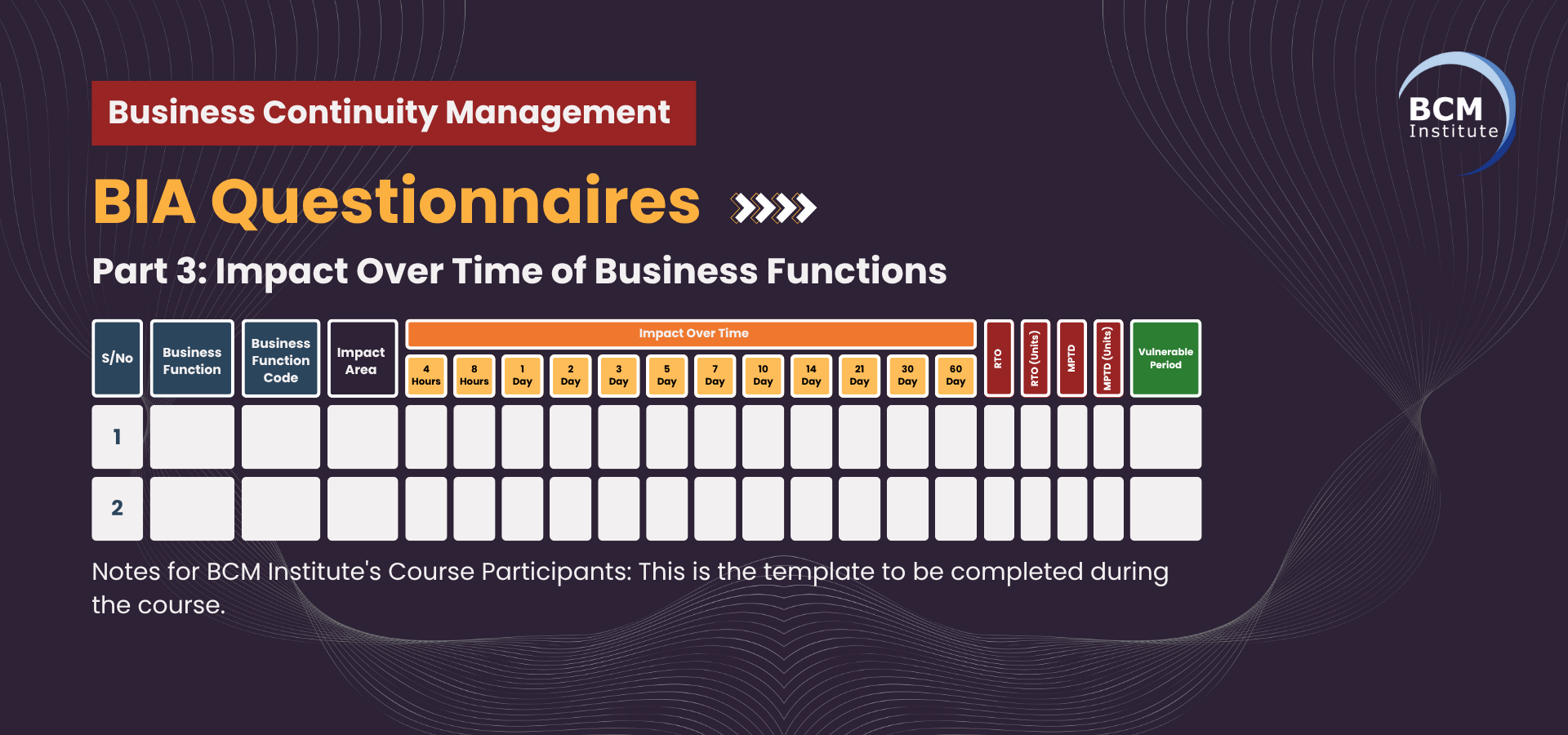
The Impact Over Time framework provides a structured view of how critical operations degrade over predefined time intervals, ranging from the initial 4 hours to 60 days.
Using a standardised impact rating scale from 1 (minimal impact) to 5 (catastrophic impact), each business function is assessed for its effects on operational continuity, financial performance, legal obligations, reputational standing, and health and safety.
[![Banner \[BCM\] \[E3\] \[BIA\] \[Summing Up\] \[P3\] Impact Over Time of Business Functions \[BIAQ\]](https://no-cache.hubspot.com/cta/default/3893111/987f8ca5-0ba4-4281-be57-5221186733d0.png)](https://cta-redirect.hubspot.com/cta/redirect/3893111/987f8ca5-0ba4-4281-be57-5221186733d0)
[Dr Goh Moh Heng](https://blog.bcm-institute.org/ebook/author/dr-goh-moh-heng) Dec 27, 2025
###### Business Continuity Management Certified Planner-Specialist-Expert
### [](https://cta-redirect.hubspot.com/cta/redirect/3893111/1a235d79-3b86-4019-9cfa-860b22849fab)
[](https://cta-redirect.hubspot.com/cta/redirect/3893111/a1b4b4e2-f0aa-44df-a197-431397a7927c)
[](https://cta-redirect.hubspot.com/cta/redirect/3893111/326c85d5-f1af-4a99-9f0e-0072cfcad36a)
### [![Banner \[BCM\] \[E3\] \[BIA\] \[P3\] Impact Over Time of Business Functions](https://no-cache.hubspot.com/cta/default/3893111/bc131ed6-ca92-4253-8940-2f98dad34599.png)](https://cta-redirect.hubspot.com/cta/redirect/3893111/bc131ed6-ca92-4253-8940-2f98dad34599)Consolidated Report for Impact Over Time of Business Functions for CBF-1 to CBF-12 \[Part P3-1\]
[![\[BCM\] \[SHINE\] E4\] \[BIA\] \[CR\] \[P3\] Impact Over Time of Business Functions for CBF](https://no-cache.hubspot.com/cta/default/3893111/fb5aa1d6-202c-499c-8c3d-460fb90ec5ff.png)](https://cta-redirect.hubspot.com/cta/redirect/3893111/fb5aa1d6-202c-499c-8c3d-460fb90ec5ff)The table above presents a consolidated view of the Impact Over Time of Business Functions (Part 3 of the BIAQ) for SHINE Children and Youth Services.
This assessment captures the potential operational impact across 12 critical business functions (CBFs) in the event of a disruption, highlighting the severity of impact at various time intervals ranging from 4 hours to 60 days.
Each sub-CBF has been evaluated with respect to its highest-impact area, enabling SHINE to identify which processes and functions are most critical for sustaining organisational operations, safeguarding stakeholders, and maintaining service delivery.
This structured approach supports informed business continuity planning, resource prioritisation, and proactive crisis management.
The Impact Over Time framework provides a structured view of how critical operations degrade over predefined time intervals, ranging from the initial 4 hours to 60 days.
Using a standardised impact rating scale from 1 (minimal impact) to 5 (catastrophic impact), each business function is assessed for its effects on operational continuity, financial performance, legal obligations, reputational standing, and health and safety.
This time-based impact assessment enables organisations to:
- Prioritise recovery activities and allocate resources appropriately.
- Determine accurate Recovery Time Objectives (RTO) and Maximum Tolerable Periods of Disruption (MTPD).
- Identify vulnerable periods that could compound the effects of a disruption.
By integrating this analysis into the broader Business Continuity Management (BCM) process, organisations such as Bandtree can better ensure the resilience of operations and infrastructure across various functions and sub-functions.
[](https://cta-redirect.hubspot.com/cta/redirect/3893111/4aefbd04-254a-4943-ae02-01465d10aab9)
###### Table P3-1: Impact Over Time of Business Functions for CBF-1 to CBF-12
| Sub-CBF Code | Sub-CBF | Highest Impact Area | 4 hr | 8 hr | 1 Day | 2 Day | 3 Day | 5 Day | 7 Day | 10 Day | 14 Day | 21 Day | 30 Day | 60 Day |
| --- | --- | --- | --- | --- | --- | --- | --- | --- | --- | --- | --- | --- | --- | --- |
| 1.1 | Psycho-educational Assessment & Diagnosis | Immediate intervention for students in need of educational support | 4 | 4 | 5 | 5 | 5 | 4 | 4 | 3 | 2 | 2 | 2 | 1 |
| 1.2 | Reassessment & Educational Needs Review | Assessment outcomes are used to adjust programmes | 3 | 3 | 4 | 4 | 4 | 3 | 2 | 2 | 2 | 1 | 1 | 2 |
| 1.3 | Learning Intervention Programmes | The progress of learning intervention is critical to students' development | 4 | 5 | 5 | 5 | 5 | 5 | 4 | 3 | 3 | 2 | 1 | 2 |
| 1.4 | Consultation & Stakeholder Engagement | Parent, school, and volunteer coordination for continuous support | 3 | 4 | 4 | 4 | 4 | 4 | 3 | 2 | 2 | 2 | 1 | 2 |
| 1.5 | Intake & Referral Management | Efficient case intake and referrals for timely support | 3 | 4 | 5 | 5 | 4 | 3 | 2 | 2 | 1 | 1 | 1 | 3 |
| 1.6 | Progress Monitoring, Review & Exit Planning | Tracking of student progress for smooth transitions | 4 | 4 | 5 | 5 | 5 | 4 | 3 | 3 | 2 | 2 | 2 | 2 |
| 1.7 | Documentation, Reporting & Compliance | Legal and regulatory requirements for maintaining records | 2 | 3 | 3 | 4 | 4 | 4 | 4 | 3 | 2 | 2 | 1 | 1 |
| 1.8 | Capacity Building & Volunteer / Community Programmes | Training programmes and volunteer coordination to support families | 2 | 3 | 3 | 4 | 3 | 3 | 3 | 2 | 2 | 1 | 1 | 3 |
| 2.1 | Community Engagement & Development | Community impact, reputational | 1 | 1 | 2 | 2 | 3 | 3 | 3 | 4 | 4 | 4 | 5 | 5 |
| 2.2 | Family Support & Coaching | Client safety, psychosocial well‑being | 2 | 2 | 3 | 4 | 4 | 5 | 5 | 5 | 5 | 5 | 5 | 5 |
| 2.3 | In-School Social Work & Student Support | Child safety, safeguarding, partner expectations | 2 | 3 | 4 | 4 | 5 | 5 | 5 | 5 | 5 | 5 | 5 | 5 |
| 2.4 | Preventive & Developmental Programmes | Service continuity, stakeholder expectations | 1 | 2 | 2 | 3 | 3 | 4 | 4 | 4 | 4 | 5 | 5 | 5 |
| 2.5 | Casework & Counselling Support | Client well‑being, crisis intervention | 3 | 4 | 5 | 5 | 5 | 5 | 5 | 5 | 5 | 5 | 5 | 5 |
| 2.6 | Collaboration & Partnership Management | Stakeholder trust, funding relationships | 1 | 1 | 2 | 2 | 2 | 3 | 3 | 4 | 4 | 4 | 5 | 5 |
| 2.7 | Volunteer & Youth Engagement / Capacity Building | Service delivery capacity, programme commitments | 1 | 1 | 1 | 2 | 2 | 3 | 3 | 4 | 4 | 4 | 4 | 5 |
| 2.8 | Monitoring, Evaluation & Research‑informed Practice | Reporting deadlines, grant compliance | 1 | 1 | 1 | 2 | 2 | 2 | 3 | 3 | 4 | 4 | 4 | 5 |
| 3.1 | Case Identification and Assessment | Client Safety & Well‑being | 3 | 3 | 4 | 4 | 4 | 5 | 5 | 5 | 5 | 5 | 5 | 5 |
| 3.2 | Individualised Intervention Planning | Service Continuity & Youth Stability | 2 | 3 | 3 | 4 | 4 | 4 | 5 | 5 | 5 | 5 | 5 | 5 |
| 3.3 | Program Delivery and Monitoring | Client Safety, Developmental Outcomes | 3 | 4 | 4 | 5 | 5 | 5 | 5 | 5 | 5 | 5 | 5 | 5 |
| 3.4 | Stakeholder Collaboration & Coordination | Multi‑Agency Case Management | 2 | 3 | 3 | 4 | 4 | 4 | 5 | 5 | 5 | 5 | 5 | 5 |
| 3.5 | Crisis Management & Emergency Support | Immediate Client Safety & Risk Mitigation | 4 | 5 | 5 | 5 | 5 | 5 | 5 | 5 | 5 | 5 | 5 | 5 |
| 3.6 | Evaluation & Adjustment of Intervention Plans | Service Quality & Case Progression | 1 | 2 | 3 | 3 | 4 | 4 | 4 | 5 | 5 | 5 | 5 | 5 |
| 3.7 | Post‑Intervention Follow‑Up | Long‑Term Youth Outcomes & Relapse Prevention | 1 | 1 | 2 | 2 | 3 | 3 | 3 | 4 | 4 | 5 | 5 | 5 |
| 4.1 | Assessment and Intake Services | Service Delivery / Client Risk | 2 | 3 | 4 | 4 | 5 | 5 | 5 | 5 | 5 | 5 | 5 | 5 |
| 4.2 | Individual Counselling Sessions | Client Well-Being | 2 | 3 | 4 | 4 | 4 | 5 | 5 | 5 | 5 | 5 | 5 | 5 |
| 4.3 | Group Therapy Sessions | Therapeutic Progress | 1 | 2 | 3 | 3 | 4 | 4 | 4 | 5 | 5 | 5 | 5 | 5 |
| 4.4 | Crisis Intervention and Immediate Support | Safety / Risk Escalation | 3 | 4 | 5 | 5 | 5 | 5 | 5 | 5 | 5 | 5 | 5 | 5 |
| 4.5 | Therapeutic Program Development | Service Quality / Programme Continuity | 1 | 1 | 2 | 2 | 3 | 3 | 3 | 4 | 4 | 4 | 5 | 5 |
| 4.6 | Family Therapy and Support | Family Stability / Safety | 2 | 3 | 4 | 4 | 5 | 5 | 5 | 5 | 5 | 5 | 5 | 5 |
| 4.7 | Referrals & Collaboration with External Agencies | Service Continuity / Partner Coordination | 1 | 2 | 3 | 3 | 4 | 4 | 4 | 4 | 5 | 5 | 5 | 5 |
| 4.8 | Monitoring & Evaluation of Therapy Effectiveness | Compliance / Service Quality | 1 | 1 | 2 | 2 | 2 | 3 | 3 | 3 | 4 | 4 | 5 | 5 |
| 4.9 | Case Documentation & Record-Keeping | Legal / Confidentiality / Service Continuity | 3 | 3 | 4 | 4 | 4 | 5 | 5 | 5 | 5 | 5 | 5 | 5 |
| 5.1 | Client Intake & Assessment | Client Safety & Service Delay | 2 | 3 | 3 | 4 | 4 | 4 | 5 | 5 | 5 | 5 | 5 | 5 |
| 5.2 | Case Management Planning | Service Delivery Quality | 1 | 2 | 3 | 3 | 4 | 4 | 4 | 5 | 5 | 5 | 5 | 5 |
| 5.3 | Coordination of Support Services | Client Well-being & Service Disruption | 2 | 3 | 4 | 4 | 4 | 5 | 5 | 5 | 5 | 5 | 5 | 5 |
| 5.4 | Monitoring & Follow-up | Safeguarding & Risk Escalation | 1 | 2 | 3 | 4 | 4 | 4 | 5 | 5 | 5 | 5 | 5 | 5 |
| 5.5 | Documentation & Reporting | Compliance & Audit Requirements | 1 | 1 | 2 | 2 | 3 | 3 | 3 | 4 | 4 | 5 | 5 | 5 |
| 5.6 | Client Discharge & Transition | Continuity of Care & External Coordination | 1 | 2 | 2 | 3 | 3 | 4 | 4 | 5 | 5 | 5 | 5 | 5 |
| 6.1 | Client Information Collection | Service Delivery, Client Safety | 2 | 3 | 4 | 4 | 5 | 5 | 5 | 5 | 5 | 5 | 5 | 5 |
| 6.2 | Client Records Maintenance | Service Continuity, Case Management | 2 | 3 | 3 | 4 | 4 | 5 | 5 | 5 | 5 | 5 | 5 | 5 |
| 6.3 | Confidentiality & Privacy | Legal, Regulatory, Reputation | 3 | 4 | 5 | 5 | 5 | 5 | 5 | 5 | 5 | 5 | 5 | 5 |
| 6.4 | Document Management | Operational Efficiency | 2 | 2 | 3 | 3 | 4 | 4 | 4 | 4 | 5 | 5 | 5 | 5 |
| 6.5 | Record Retrieval & Access Control | Service Delivery, Decision-Making | 3 | 4 | 4 | 5 | 5 | 5 | 5 | 5 | 5 | 5 | 5 | 5 |
| 6.6 | Record Disposal | Compliance, Data Protection | 1 | 1 | 2 | 2 | 2 | 3 | 3 | 3 | 4 | 4 | 4 | 4 |
| 6.7 | Compliance Monitoring | Regulatory, Governance | 2 | 2 | 3 | 3 | 4 | 4 | 4 | 5 | 5 | 5 | 5 | 5 |
| 7.1 | Stakeholder Identification | Stakeholder Database | 3 | 3 | 4 | 4 | 4 | 4 | 3 | 2 | 2 | 1 | 1 | 1 |
| 7.2 | Communication Planning | Communication Strategy | 4 | 4 | 5 | 5 | 5 | 4 | 4 | 3 | 3 | 2 | 1 | 1 |
| 7.3 | Crisis Communication Execution | Crisis Response Messaging | 5 | 5 | 5 | 5 | 5 | 4 | 4 | 3 | 2 | 1 | 1 | 1 |
| 7.4 | Internal Communications | Staff Coordination | 3 | 3 | 4 | 4 | 3 | 3 | 3 | 2 | 2 | 1 | 1 | 1 |
| 7.5 | External Communications | Public Relations | 4 | 5 | 5 | 5 | 4 | 3 | 3 | 2 | 2 | 1 | 1 | 1 |
| 7.6 | Stakeholder Feedback Collection | Feedback Gathering | 2 | 3 | 3 | 4 | 4 | 4 | 3 | 2 | 2 | 1 | 1 | 1 |
| 7.7 | Stakeholder Coordination | Partnership Engagement | 3 | 3 | 4 | 4 | 4 | 4 | 3 | 3 | 2 | 2 | 1 | 1 |
| 7.8 | Post-Crisis Communication Review | Crisis Assessment | 2 | 3 | 3 | 4 | 4 | 4 | 3 | 2 | 2 | 1 | 1 | 1 |
| 8.1 | Talent Acquisition & Recruitment | Staffing Levels | 2 | 2 | 3 | 3 | 3 | 4 | 4 | 4 | 4 | 5 | 5 | 5 |
| 8.2 | Staff Training & Development | Staff Competency | 1 | 2 | 3 | 3 | 3 | 4 | 4 | 4 | 5 | 5 | 5 | 5 |
| 8.3 | Performance Management & Appraisal | Employee Motivation | 1 | 1 | 2 | 2 | 3 | 3 | 3 | 4 | 4 | 4 | 5 | 5 |
| 8.4 | Succession Planning | Leadership Continuity | 1 | 1 | 2 | 3 | 3 | 4 | 4 | 4 | 4 | 5 | 5 | 5 |
| 8.5 | Employee Well-being & Support | Staff Morale | 2 | 3 | 3 | 3 | 4 | 4 | 4 | 4 | 5 | 5 | 5 | 5 |
| 8.6 | Workforce Planning | Resource Allocation | 2 | 2 | 3 | 3 | 4 | 4 | 4 | 5 | 5 | 5 | 5 | 5 |
| 9.1 | Fundraising & Grant Applications | Funding Pipeline | 3 | 3 | 4 | 4 | 4 | 4 | 5 | 5 | 5 | 5 | 5 | 5 |
| 9.2 | Donor Management | Donor Relations | 2 | 3 | 4 | 4 | 4 | 5 | 5 | 5 | 5 | 5 | 5 | 5 |
| 9.3 | Resource Allocation & Budgeting | Operational Funding | 3 | 4 | 4 | 4 | 5 | 5 | 5 | 5 | 5 | 5 | 5 | 5 |
| 9.4 | Financial Reporting & Accountability | Compliance & Transparency | 4 | 4 | 5 | 5 | 5 | 5 | 5 | 5 | 5 | 5 | 5 | 5 |
| 9.5 | Partnership Engagement | Strategic Partnerships | 2 | 3 | 3 | 4 | 4 | 4 | 5 | 5 | 5 | 5 | 5 | 5 |
| 9.6 | Emergency Fund Management | Rapid Response Capability | 5 | 5 | 5 | 5 | 5 | 5 | 5 | 5 | 5 | 5 | 5 | 5 |
| 10.1 | Partnership Development | Strategic Growth | 1 | 1 | 2 | 2 | 3 | 3 | 4 | 4 | 5 | 5 | 5 | 5 |
| 10.2 | Stakeholder Engagement | Reputation & Trust | 2 | 2 | 3 | 3 | 4 | 4 | 4 | 5 | 5 | 5 | 5 | 5 |
| 10.3 | Community Outreach | Beneficiary Reach | 2 | 3 | 3 | 4 | 4 | 4 | 5 | 5 | 5 | 5 | 5 | 5 |
| 10.4 | Network Coordination | Service Coordination | 2 | 3 | 3 | 4 | 4 | 5 | 5 | 5 | 5 | 5 | 5 | 5 |
| 10.5 | Resource Sharing | Operational Capacity | 1 | 2 | 2 | 3 | 3 | 4 | 4 | 4 | 5 | 5 | 5 | 5 |
| 10.6 | Partnership Evaluation | Governance | 1 | 1 | 2 | 2 | 2 | 3 | 3 | 4 | 4 | 4 | 5 | 5 |
| 10.7 | Conflict Resolution | Relationship Stability | 2 | 3 | 3 | 4 | 4 | 5 | 5 | 5 | 5 | 5 | 5 | 5 |
| 11.1 | Facility Management | Service Availability | 3 | 4 | 4 | 4 | 4 | 5 | 5 | 5 | 5 | 5 | 5 | 5 |
| 11.2 | IT Systems Management | IT System Uptime | 4 | 5 | 5 | 5 | 5 | 5 | 5 | 5 | 5 | 5 | 5 | 5 |
| 11.3 | Telecommunication Services | Communication Channels | 3 | 4 | 5 | 5 | 5 | 5 | 5 | 5 | 5 | 5 | 5 | 5 |
| 11.4 | Data Centre Management | Data Accessibility | 4 | 5 | 5 | 5 | 5 | 5 | 5 | 5 | 5 | 5 | 5 | 5 |
| 11.5 | Vendor Management | External Service Continuity | 2 | 3 | 4 | 4 | 4 | 4 | 4 | 4 | 4 | 4 | 4 | 4 |
| 11.6 | IT BCM Planning | Resilience Planning | 2 | 3 | 3 | 3 | 3 | 4 | 4 | 4 | 4 | 4 | 4 | 4 |
| 12.1 | Compliance Monitoring | Regulatory & Reputation | 1 | 1 | 2 | 2 | 3 | 3 | 4 | 4 | 5 | 5 | 5 | 5 |
| 12.2 | Regulatory Reporting | Legal Compliance | 1 | 2 | 2 | 3 | 3 | 4 | 4 | 5 | 5 | 5 | 5 | 5 |
| 12.3 | Governance Oversight | Board Effectiveness | 1 | 1 | 2 | 2 | 3 | 3 | 3 | 4 | 4 | 4 | 5 | 5 |
| 12.4 | Policy Development | Operational Alignment | 1 | 1 | 1 | 2 | 2 | 2 | 3 | 3 | 4 | 4 | 4 | 5 |
| 12.5 | Audit & Risk Management | Organisational Risk | 1 | 1 | 2 | 2 | 3 | 3 | 4 | 4 | 5 | 5 | 5 | 5 |
[![Banner \[BCM\] \[E3\] \[BIA\] \[P3\] Impact Over Time of Business Functions](https://no-cache.hubspot.com/cta/default/3893111/bc131ed6-ca92-4253-8940-2f98dad34599.png)](https://cta-redirect.hubspot.com/cta/redirect/3893111/bc131ed6-ca92-4253-8940-2f98dad34599)
### Consolidated Report for Impact Over Time of Business Functions for CBF-1 to CBF-12 \[Part P3-2\]
The following table presents a detailed analysis of the temporal impact of critical business functions (CBFs) for SHINE Children and Youth Services across 12 core operational areas.
Each Sub-Critical Business Function (Sub-CBF) has been identified and assessed based on its highest-impact area, Recovery Time Objective (RTO), Maximum Tolerable Period of Disruption (MTPD), and vulnerable periods, which are time windows during which disruption would have the most significant operational and client impact.
This consolidated overview is designed to support SHINE in **business continuity planning**, ensuring that essential services to clients, students, and families remain uninterrupted or can be rapidly restored in the event of operational disruptions.
The structured information provides clear priorities for resource allocation, recovery strategies, and risk mitigation across all critical functions.
[](https://cta-redirect.hubspot.com/cta/redirect/3893111/4aefbd04-254a-4943-ae02-01465d10aab9)
###### Table P3-2: Impact Over Time of Business Functions for CBF-1 to CBF-12
| Sub-CBF Code | Sub-Critical Business Function | Highest Impact Area | RTO | MTPD | Vulnerable Period |
| --- | --- | --- | --- | --- | --- |
| 1.1 | Psycho-educational Assessment & Diagnosis | Timely identification of learning and developmental needs | 8 hours | 2 days | First 4–8 hours after disruption |
| 1.2 | Reassessment & Educational Needs Review | Accuracy of intervention planning and student placement | 1 day | 4 days | 12–24 hours |
| 1.3 | Learning Intervention Programmes | Continuity of learning support and student progress | 12 hours | 3 days | First 6–12 hours |
| 1.4 | Consultation & Stakeholder Engagement (Parents, Schools, Volunteers) | Stakeholder confidence and coordinated support | 8 hours | 2 days | Active school engagement periods |
| 1.5 | Intake & Referral Management | Timely access to educational psychology services | 24 hours | 5 days | High referral intake periods |
| 1.6 | Progress Monitoring, Review & Exit Planning | Continuity of care and transition outcomes | 12 hours | 3 days | Review and transition milestones |
| 1.7 | Documentation, Reporting & Compliance | Regulatory, funding, and audit compliance | 24 hours | 5 days | Reporting and audit cycles |
| 1.8 | Capacity Building & Volunteer / Community Programmes | Programme sustainability and outreach capability | 12 hours | 4 days | Training and outreach cycles |
| 2.1 | Community Social Work – Community Engagement & Development | Community trust and organisational reputation | 5 days | 30 days | Community crisis or outreach periods |
| 2.2 | Community Social Work – Family Support & Coaching | Client safety and psychosocial well-being | 2 days | 7 days | Family crisis escalation periods |
| 2.3 | School Social Work – In-School Social Work & Student Support | Child safeguarding and welfare | 1 day | 3 days | School term and examination periods |
| 2.4 | School Social Work – Preventive & Developmental Programmes | Programme delivery commitments | 5 days | 30 days | Programme implementation cycles |
| 2.5 | Casework & Counselling Support (Community & School) | Immediate client well-being and crisis prevention | 8 hours | 2 days | High-risk case windows |
| 2.6 | Collaboration & Partnership Management | Stakeholder confidence and funding continuity | 7 days | 30 days | Partnership renewal cycles |
| 2.7 | Volunteer & Youth Engagement / Capacity Building | Service delivery capacity | 10 days | 30 days | Peak volunteer engagement seasons |
| 2.8 | Monitoring, Evaluation & Research-informed Practice | Grant compliance and performance reporting | 14 days | 60 days | Reporting and evaluation deadlines |
| 3.1 | Case Identification and Assessment | Early detection of high-risk youth | 1 day | 3 days | Intake surge periods |
| 3.2 | Individualised Intervention Planning | Continuity of targeted intervention | 2 days | 5 days | Assessment-to-intervention transition |
| 3.3 | Program Delivery and Monitoring | Youth safety and developmental outcomes | 1 day | 2 days | Scheduled programme sessions |
| 3.4 | Stakeholder Collaboration and Coordination | Multi-agency case effectiveness | 3 days | 7 days | Inter-agency coordination windows |
| 3.5 | Crisis Management and Emergency Support | Immediate life safety and risk containment | 4 hours | 1 day | Acute crisis events |
| 3.6 | Evaluation and Adjustment of Intervention Plans | Intervention effectiveness and quality | 5 days | 14 days | Review and evaluation milestones |
| 3.7 | Post-Intervention Follow-Up | Long-term youth stability and relapse prevention | 7 days | 21 days | Reintegration periods |
| 4.1 | Assessment and Intake Services | Accurate therapeutic assessment | 8 hours | 2 days | Intake and triage periods |
| 4.2 | Individual Counselling Sessions | Client's mental and emotional well-being | 8 hours | 2 days | High-risk therapy schedules |
| 4.3 | Group Therapy Sessions | Group therapeutic continuity | 1 day | 3 days | Scheduled group sessions |
| 4.4 | Crisis Intervention and Immediate Support | Client safety and emotional stabilisation | 4 hours | 1 day | Acute emotional crisis events |
| 4.5 | Therapeutic Program Development | Quality and relevance of therapy programmes | 5 days | 14 days | Programme design cycles |
| 4.6 | Family Therapy and Support | Family stability and systemic support | 1 day | 3 days | Family crisis escalation periods |
| 4.7 | Referrals and Collaboration with External Agencies | Continuity of specialised care | 2 days | 5 days | Referral coordination periods |
| 4.8 | Monitoring and Evaluation of Therapy Effectiveness | Clinical governance and outcomes tracking | 7 days | 21 days | Evaluation cycles |
| 4.9 | Case Documentation and Record-Keeping | Legal, clinical, and funding compliance | 24 hours | 5 days | Audit and reporting periods |
| 5.1 | Client Intake & Assessment | Accurate identification of client needs | 1 day | 3 days | Intake surge periods |
| 5.2 | Case Management Planning | Coordinated service delivery | 2 days | 5 days | Plan approval windows |
| 5.3 | Coordination of Support Services | Continuity of integrated care | 1 day | 3 days | Active service coordination periods |
| 5.4 | Monitoring & Follow-up | Ongoing client progress | 2 days | 5 days | Review checkpoints |
| 5.5 | Documentation & Reporting | Regulatory and funding compliance | 24 hours | 5 days | Reporting deadlines |
| 5.6 | Client Discharge & Transition | Safe and effective service transition | 2 days | 7 days | Discharge planning windows |
| 6.1 | Client Information Collection | Data accuracy and completeness | 4 hours | 1 day | Intake and update periods |
| 6.2 | Client Records Maintenance | Data integrity and availability | 8 hours | 2 days | Ongoing operational hours |
| 6.3 | Confidentiality & Privacy | Legal and reputational protection | 4 hours | 1 day | Data access events |
| 6.4 | Document Management | Availability of official records | 1 day | 3 days | Filing and archival cycles |
| 6.5 | Record Retrieval & Access Control | Operational efficiency and compliance | 8 hours | 2 days | Audit and enquiry periods |
| 6.6 | Record Disposal | Regulatory and legal compliance | 5 days | 14 days | Scheduled disposal cycles |
| 6.7 | Compliance Monitoring | Regulatory adherence and audit readiness | 7 days | 30 days | Audit and inspection periods |
The table highlights the interdependencies and criticality of each Sub-CBF within SHINE’s operations, demonstrating the varying degrees of urgency and impact across service areas.
By mapping the RTO, MTPD, and vulnerable periods, SHINE can effectively prioritise recovery efforts, allocate resources, and maintain continuity of care for children, youth, families, and the wider community.
This structured assessment provides a foundation for robust business continuity and crisis management strategies, enabling SHINE to maintain service excellence, safeguard client well-being, and uphold compliance with regulatory and funding requirements.
Ultimately, this framework ensures that SHINE can respond proactively to disruptions while sustaining its mission-critical activities across all operational domains.
##### Legend – Impact Scores
- 1 = Negligible Impact (Very Low)
- 2 = Minor Impact (Low)
- 3 = Moderate Impact (Medium)
- 4 = Major Impact (High)
- 5 = Critical/Catastrophic Impact (Very High)
##### Key Notes
- **RTO (Recovery Time Objective):** Indicates the acceptable downtime before severe impact begins.
- **MTPD (Maximum Tolerable Period of Disruption):**Maximum allowable time the sub-function can be disrupted before irrecoverable consequences occur.
- **Vulnerable Period:**Timeframes in which disruption has amplified effects (e.g., audits, contract renewals, public reporting).
### [![Banner \[BCM\] \[E3\] \[BIA\] \[Summing Up\] \[P3\] Impact Over Time of Business Functions \[BIAQ\]](https://no-cache.hubspot.com/cta/default/3893111/987f8ca5-0ba4-4281-be57-5221186733d0.png)](https://cta-redirect.hubspot.com/cta/redirect/3893111/987f8ca5-0ba4-4281-be57-5221186733d0)
The Impact Over Time analysis provides a powerful lens for viewing the dynamic effects of business disruptions.
By mapping how impact severity escalates across specific timeframes, organisations can gain actionable insights to support continuity planning, resource allocation, and risk mitigation strategies.
This structured assessment helps define realistic recovery priorities and enhances communication across departments and stakeholders.
When paired with clearly defined RTOs and MTPDs, it serves as a cornerstone for resilient and informed decision-making during crises.
Ultimately, understanding the time-sensitive nature of operational impacts enables organisations such as SHINE to maintain service excellence, meet stakeholder expectations, and fulfil their mandates—even in the face of unforeseen disruptions.
[](https://cta-redirect.hubspot.com/cta/redirect/3893111/e58ac134-028b-48aa-8c19-c78eb59b6fc2)
| **Continuity of Care: Ensuring SHINE’s Mission Through Effective BCM** | | | |
| --- | --- | --- | --- |
| **eBook 4: Consolidate and Report Your BCM Implementation** | | | |
| **Consolidated Report for BIAQ (Part 1 to Part 6) for CBF-1 to CBF-12** | | | |
| **PM: BIA** | **BIAQ T1 P1** | **BIAQ T1 P2** | **BIAQ T2 P3** |
| **Consolidated Report for BIAQ (Part 1 to Part 6)** | [](https://cta-redirect.hubspot.com/cta/redirect/3893111/ece46d49-7dfc-4bc7-8e9f-54f540c2339c) | [![\[BCM\] \[SHINE\] E4\] \[BIA\] \[CR\] \[P2\] Impact Area of Business Functions for CBF](https://no-cache.hubspot.com/cta/default/3893111/8f041b8f-e767-4b52-9509-e528a10b8f5f.png)](https://cta-redirect.hubspot.com/cta/redirect/3893111/8f041b8f-e767-4b52-9509-e528a10b8f5f) | [![\[BCM\] \[SHINE\] E4\] \[BIA\] \[CR\] \[P3\] Impact Over Time of Business Functions for CBF](https://no-cache.hubspot.com/cta/default/3893111/fb5aa1d6-202c-499c-8c3d-460fb90ec5ff.png)](https://cta-redirect.hubspot.com/cta/redirect/3893111/fb5aa1d6-202c-499c-8c3d-460fb90ec5ff) |
| **CBF** | **BIAQ T2 P4** | **BIAQ T3 P5** | **BIAQ T3 P6** |
| [![\[BCM\] \[SHINE\] \[E1\] \[C10\] Identifying Critical Business Functions](https://no-cache.hubspot.com/cta/default/3893111/6fba5a23-5e02-4368-aa88-65a252d4edd7.png)](https://cta-redirect.hubspot.com/cta/redirect/3893111/6fba5a23-5e02-4368-aa88-65a252d4edd7) | [![\[BCM\] \[SHINE\] \[E4\] \[BIA\] \[CR\] \[P4\] Supporting IT Systems and Applications for CBF](https://no-cache.hubspot.com/cta/default/3893111/0823b5f1-b57d-48f5-86d0-90b8eb6b851a.png)](https://cta-redirect.hubspot.com/cta/redirect/3893111/0823b5f1-b57d-48f5-86d0-90b8eb6b851a) | [![\[BCM\] \[SHINE\] \[E4\] \[BIA\] \[CR\] \[P5\] Inter-dependencies for CBF](https://no-cache.hubspot.com/cta/default/3893111/74cebdbc-3526-40b8-b3d4-de6f6e25296d.png)](https://cta-redirect.hubspot.com/cta/redirect/3893111/74cebdbc-3526-40b8-b3d4-de6f6e25296d) | [![\[BCM\] \[SHINE\] \[E4\] \[BIA\] \[CR\] \[P6\] Vital Records for CBF](https://no-cache.hubspot.com/cta/default/3893111/e860a0ec-3363-4333-8cf1-86ee7e4bcccc.png)](https://cta-redirect.hubspot.com/cta/redirect/3893111/e860a0ec-3363-4333-8cf1-86ee7e4bcccc) |
#### More Information About Business Continuity Management Courses
To learn more about the course and schedule, click the buttons below for the BCM-300 Business Continuity Management Implementer \[BCM-3\] and the BCM-5000 Business Continuity Management Expert Implementer \[BCM-5\].
| [](https://cta-redirect.hubspot.com/cta/redirect/3893111/f3922b80-e96a-46d6-8993-dc150a5de2d5) | [](https://cta-redirect.hubspot.com/cta/redirect/3893111/9ff8a3dc-e39a-465b-929f-72e232cdd5fb) | [![Register \[BL-B-3\]\*](https://no-cache.hubspot.com/cta/default/3893111/ac6cf073-4cdd-4541-91ed-889f731d5076.png)](https://cta-redirect.hubspot.com/cta/redirect/3893111/ac6cf073-4cdd-4541-91ed-889f731d5076) |
| --- | --- | --- |
| [](https://cta-redirect.hubspot.com/cta/redirect/3893111/21525c10-4003-4934-95fc-fe218174bc5b) | [](https://cta-redirect.hubspot.com/cta/redirect/3893111/46460171-c91a-4936-9bb2-8dc5928a0e02) | [](https://cta-redirect.hubspot.com/cta/redirect/3893111/1cb17ac7-50b2-4f88-bc4b-c7444e4b57b5) |
| [![FAQ \[BL-B-3\]](https://no-cache.hubspot.com/cta/default/3893111/b3824ba1-7aa1-4eb6-bef8-94f57121c5ae.png)](https://cta-redirect.hubspot.com/cta/redirect/3893111/b3824ba1-7aa1-4eb6-bef8-94f57121c5ae) | Please feel free to send us a note if you have any questions. [![Email to Sales Team \[BCM Institute\]](https://no-cache.hubspot.com/cta/default/3893111/3c53daeb-2836-4843-b0e0-645baee2ab9e.png)](https://cta-redirect.hubspot.com/cta/redirect/3893111/3c53daeb-2836-4843-b0e0-645baee2ab9e) | [](https://cta-redirect.hubspot.com/cta/redirect/3893111/9c199ae8-c470-4bb7-9612-73c7a084e94c) |
| [](https://cta-redirect.hubspot.com/cta/redirect/3893111/8999211a-2c51-4be7-bf49-c393f6c67974) | [](https://cta-redirect.hubspot.com/cta/redirect/3893111/5c1aa95d-f6dd-4067-a95c-5cc0c32d7ed8) | [](https://cta-redirect.hubspot.com/cta/redirect/3893111/086ab3b9-4d66-4a95-b2f7-1148e9803a9c) |
#### **Your Comments Here:**
### More Posts
[](https://cta-redirect.hubspot.com/cta/redirect/3893111/839787f4-a4fd-456f-accf-54c947026558)

All rights reserved. Copyright 2026
```json
{
"@context" : "https://schema.org",
"@type" : "BlogPosting",
"author" : {
"@type" : "Person",
"name" : "Dr Goh Moh Heng",
"url" : "https://blog.bcm-institute.org/ebook/author/dr-goh-moh-heng"
},
"dateModified" : "2025-12-27T15:02:47.800Z",
"datePublished" : "2025-12-27T11:59:42.000Z",
"headline" : "[BCM] [SHINE] [E4] [CR] [BIA] [P3] Impact Over Time of Business Functions for CBF-1 to CBF-12",
"mainEntityOfPage" : {
"@id" : "https://blog.bcm-institute.org/ebook/bcm-shine-e4-cr-bia-p3-impact-over-time-of-business-functions-for-cbf-1-to-cbf-12",
"@type" : "WebPage"
},
"publisher" : {
"@type" : "Organization",
"logo" : {
"@type" : "ImageObject",
"url" : "https://blog.bcm-institute.org/hubfs/BCMI%20Logo.png"
},
"name" : "BCMI Pte Ltd"
}
}
```