

![Banner [BCM] [E3] [BIA] [P5] Inter-dependencies](https://no-cache.hubspot.com/cta/default/3893111/c7d00b8b-77c0-43ee-a2cf-76ea43b26fe8.png)


CBF-7 Communications & Stakeholder Coordination
![[BCM] [SHINE] [E3] [BIA] [T3] [CBF] [7] Communications & Stakeholder Coordination](https://no-cache.hubspot.com/cta/default/3893111/5c950935-f094-437a-95d4-c0f4515cfba2.png) Effective communications and stakeholder coordination are highly interdependent functions within SHINE, particularly during incidents, crises, and service disruptions involving children, youths, families, schools, funders, and regulators.
Effective communications and stakeholder coordination are highly interdependent functions within SHINE, particularly during incidents, crises, and service disruptions involving children, youths, families, schools, funders, and regulators.
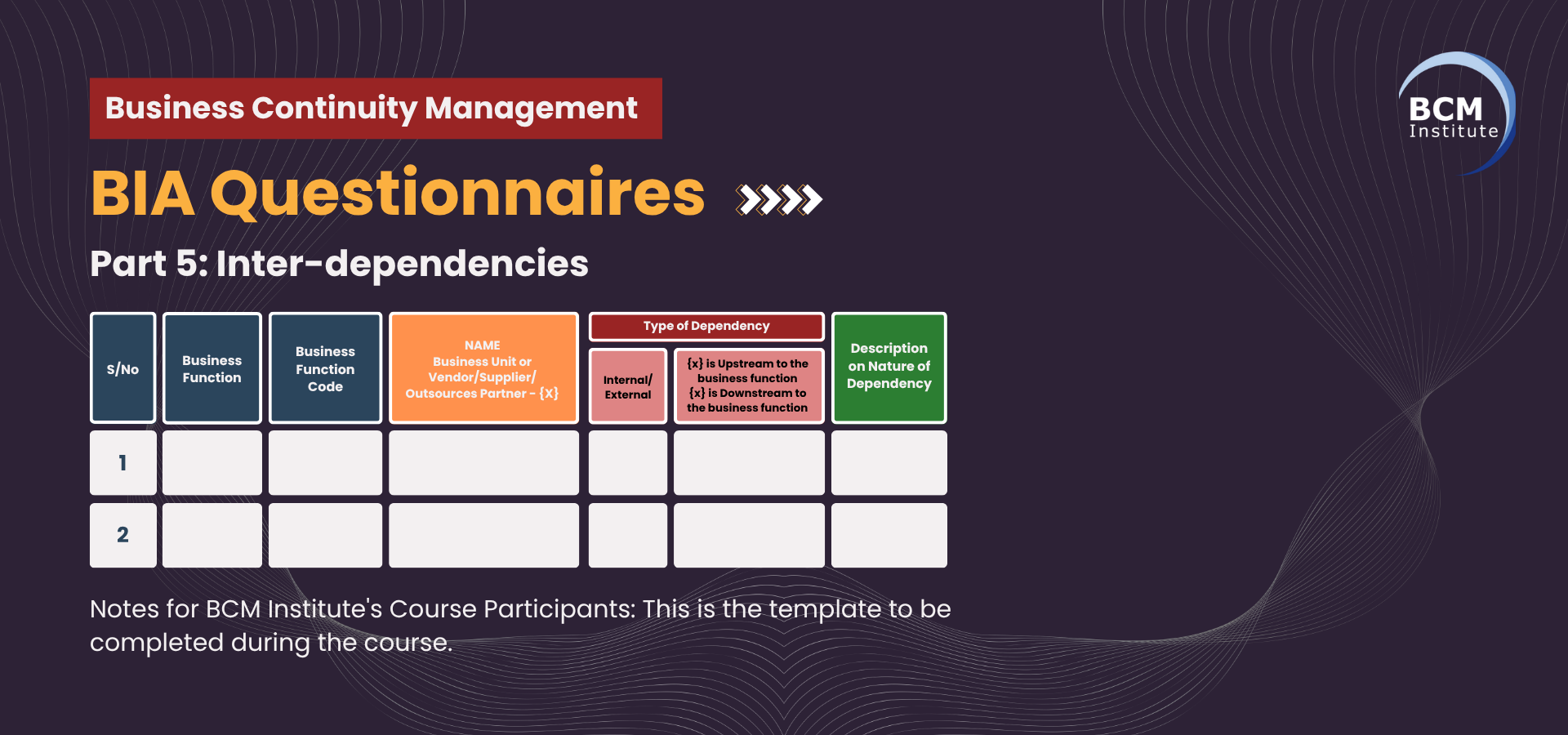
This section identifies and analyses the internal and external dependencies associated with the detailed business processes (Sub-CBFs) under CBF-7 Communications & Stakeholder Coordination.
Understanding these inter-dependencies enables SHINE to anticipate cascading impacts, prioritise recovery actions, and ensure that timely, accurate, and coordinated messages are delivered to all stakeholders during disruptions.
This aligns with BCM good practices for managing upstream, downstream, and mutual dependencies across people, processes, technology, and third-party relationships.
![Banner [Table] [BCM] [E3] [BIA] [P5] Inter-dependencies [BIAQ]](https://no-cache.hubspot.com/cta/default/3893111/ed6152ff-4926-4fae-bd6b-ba572bcc781b.png)
Table P5: Inter‑dependencies for CBF-7
|
Sub-CBF Code |
Sub-CBF |
Name of Business Unit / Vendor / Partner |
Internal Dependency |
External Dependency |
Dependency Type (Upstream / Downstream / Mutual) |
Description of the Nature of Dependency |
|
7.1 |
Stakeholder Identification |
Senior Management, Programme Heads |
✔ |
|
Upstream |
Programme heads and management provide authoritative stakeholder lists (clients, schools, partners, funders) required before communication planning can begin. |
|
7.1 |
Stakeholder Identification |
Ministry of Social and Family Development (MSF), Schools, Community Partners |
|
✔ |
Mutual |
External stakeholders provide updates to contact points and engagement expectations, while SHINE maintains stakeholder records for coordination. |
|
7.2 |
Communication Planning |
Crisis Management Team (CMT), Programme Management |
✔ |
|
Upstream |
Communication strategies depend on incident details, operational priorities, and response decisions defined by internal crisis and programme teams. |
|
7.2 |
Communication Planning |
Communications Consultants / Media Advisors (if engaged) |
|
✔ |
Mutual |
External advisors support message framing and media strategy while relying on SHINE for accurate information and approvals. |
|
7.3 |
Crisis Communication Execution |
IT & Systems Support |
✔ |
|
Upstream |
Availability of email systems, messaging platforms, websites, and collaboration tools is required to disseminate crisis communications. |
|
7.3 |
Crisis Communication Execution |
Media Outlets, Social Media Platforms |
|
✔ |
Downstream |
Media channels and digital platforms are used to broadcast SHINE’s messages to the public and stakeholders during crises. |
|
7.4 |
Internal Communications |
Human Resources, Programme Teams |
✔ |
|
Mutual |
HR and programme teams both provide and receive internal updates to ensure staff are informed, aligned, and able to continue service delivery. |
|
7.4 |
Internal Communications |
Internal Collaboration Platforms (e.g. email, messaging tools) |
|
✔ |
Upstream |
Internal communication relies on third-party communication platforms to function effectively during normal and disrupted conditions. |
|
7.5 |
External Communications |
Management, Legal / Governance Function |
✔ |
|
Upstream |
External messages require management approval and legal or governance input to ensure accuracy, compliance, and reputational protection. |
|
7.5 |
External Communications |
Donors, Funders, Schools, Community Partners |
|
✔ |
Downstream |
External stakeholders depend on SHINE for timely and transparent updates that affect funding, collaboration, and service continuity. |
|
7.6 |
Stakeholder Feedback Collection |
Programme Teams, Case Management |
✔ |
|
Upstream |
Programme and case teams collect frontline feedback from clients and partners, feeding into communication refinement and decision-making. |
|
7.6 |
Stakeholder Feedback Collection |
Clients, Families, Volunteers, Community Partners |
|
✔ |
Mutual |
Stakeholders provide feedback while expecting acknowledgement, follow-up, and communication improvements from SHINE. |
|
7.7 |
Stakeholder Coordination |
Case Management, Community Outreach Teams |
✔ |
|
Mutual |
Coordination activities rely on operational teams to align actions, schedules, and responsibilities with stakeholder expectations. |
|
7.7 |
Stakeholder Coordination |
Schools, Social Service Agencies, Healthcare Providers |
|
✔ |
Mutual |
Ongoing coordination ensures aligned responses, shared information, and continuity of care for children and youths during disruptions. |
|
7.8 |
Post-Crisis Communication Review |
Crisis Management Team, Quality & Governance |
✔ |
|
Downstream |
Lessons learned and post-incident reviews depend on inputs from crisis teams to assess communication effectiveness and gaps. |
|
7.8 |
Post-Crisis Communication Review |
External Auditors, Regulators (where applicable) |
|
✔ |
Downstream |
Findings may be shared with external parties to demonstrate accountability, compliance, and continuous improvement. |
![Banner [BCM] [E3] [BIA] [Summing Up] [P5] Inter-dependencies [BIAQ]](https://no-cache.hubspot.com/cta/default/3893111/117996e6-4a68-4449-880f-d8a48ff3071d.png)
The interdependencies associated with CBF-7 Communications & Stakeholder Coordination demonstrate that effective communication at SHINE is not a standalone activity but a highly interconnected function that relies on internal governance, operational teams, IT capabilities, and trusted external stakeholders.
Clear identification of upstream, downstream, and mutual dependencies enables SHINE to anticipate failure points, establish prioritised recovery actions, and strengthen coordination mechanisms during crises.
By proactively managing these interdependencies, SHINE enhances its organisational resilience, safeguards stakeholder trust, and ensures the continuity of critical services for children, youth, and families under all operating conditions.

![Banner [BCM] [E3] [BIA] [P6] Vital Records](https://no-cache.hubspot.com/cta/default/3893111/6d3e4359-14f4-4816-b274-3f61b92be858.png)
CBF-7 Communications & Stakeholder Coordination
Vital records are records that are essential for SHINE Children and Youth Services (“SHINE”) to continue critical communications, meet legal and regulatory obligations, protect its reputation, and maintain stakeholder trust during and after a disruption or crisis.
For CBF-7 Communications & Stakeholder Coordination, these records enable SHINE to identify key stakeholders, execute timely and accurate communications, coordinate internally and externally, and review communication effectiveness post-incident.
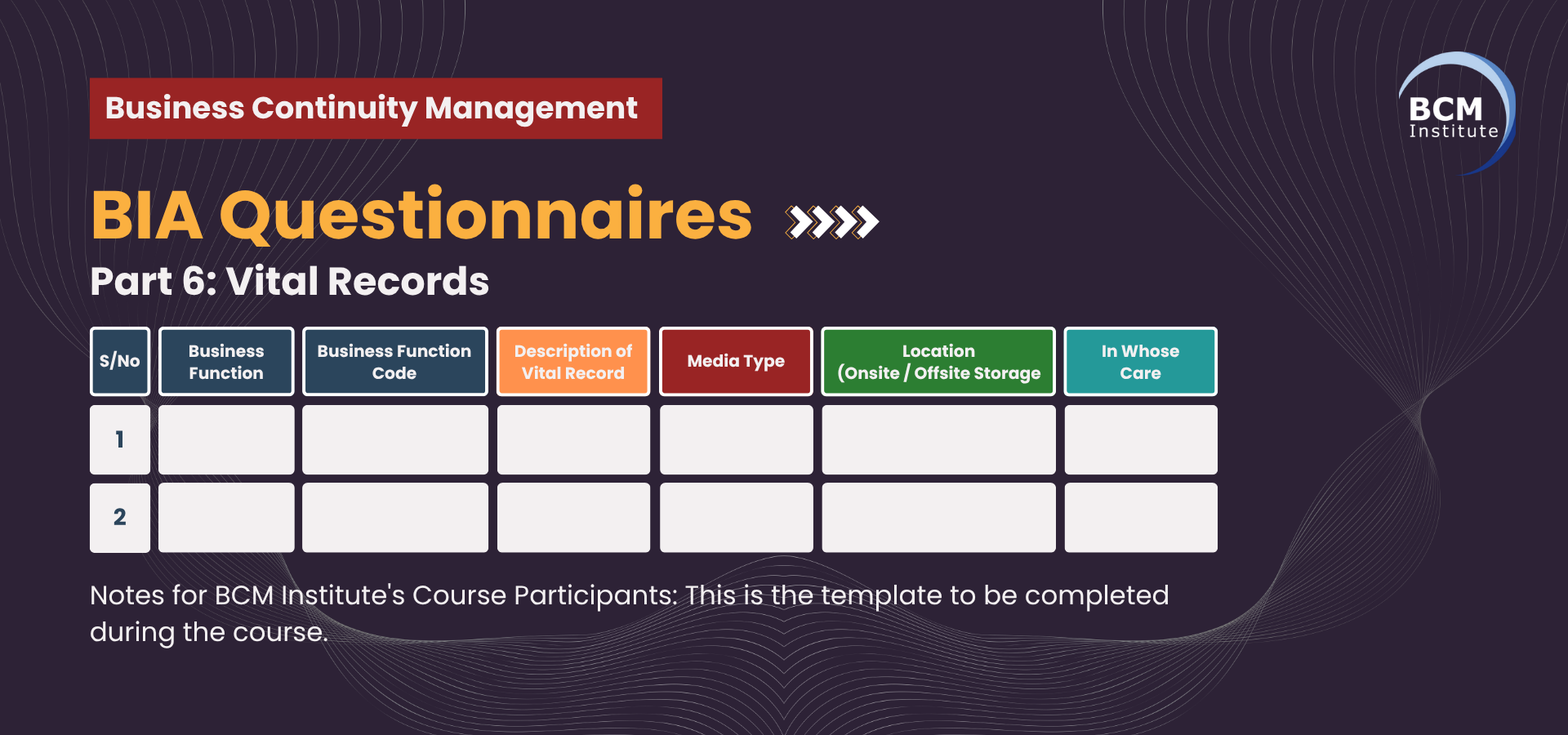
In accordance with BCM good practice, vital records must be accurate, accessible, protected, and recoverable within the required timeframe to support crisis and continuity response. This section identifies the vital records associated with each Sub-Critical Business Function (Sub-CBF), their media types, locations, and custodians.
![Banner [Table] [BCM] [E3] [BIA] [P6] Vital Records [BIAQ]](https://no-cache.hubspot.com/cta/default/3893111/b44d6d49-dfb5-42a1-bc91-c0c701fc0724.png)
Table P6: Vital Records for CBF-7
|
Sub-CBF Code |
Sub-CBF |
Description of Vital Records |
Media Type |
Location |
In Whose Care |
|
7.1 |
Stakeholder Identification |
Master stakeholder registry including internal staff, volunteers, partners, donors, schools, government agencies (e.g. MSF), emergency contacts, and media contacts |
Electronic (database, spreadsheet); limited hardcopy |
SHINE shared drive / secure cloud system; hardcopy in Admin office |
Management Team; Communications Lead |
|
7.2 |
Communication Planning |
Crisis communication plans, stakeholder communication matrices, message templates, escalation and approval workflows |
Electronic documents (Word/PDF); hardcopy backup |
SHINE shared drive / BCM repository; hardcopy in Crisis Management File |
Communications Lead; Crisis Management Team |
|
7.3 |
Crisis Communication Execution |
Approved crisis messages, media statements, press releases, social media posts, communication logs, time-stamped dissemination records |
Electronic (email system, CMS, social media platforms); screenshots |
Email servers, social media accounts, shared drive |
Communications Lead; Authorised Spokesperson |
|
7.4 |
Internal Communications |
Staff advisories, internal announcements, emergency contact trees, staff communication logs |
Electronic (email, messaging platforms); limited hardcopy |
Email system, internal messaging platforms, shared drive |
Human Resources; Management Team |
|
7.5 |
External Communications |
Communications with families, schools, donors, partners, regulators, and public stakeholders; media enquiry logs |
Electronic (email, CRM, media tracking tools) |
Email system, CRM platform, shared drive |
Communications Lead; Programme Heads |
|
7.6 |
Stakeholder Feedback Collection |
Feedback forms, complaint records, post-incident surveys, hotline or email feedback logs |
Electronic (online forms, spreadsheets); scanned documents |
Secure cloud system; shared drive |
Programme Heads; Communications Lead |
|
7.7 |
Stakeholder Coordination |
Coordination records with partners and agencies, meeting minutes, action trackers, and agreements during crisis response |
Electronic documents; meeting recordings (if applicable) |
Shared drive; secure cloud storage |
Management Team; Programme Heads |
|
7.8 |
Post-Crisis Communication Review |
Post-incident communication review reports, lessons learned, corrective action plans, audit and compliance evidence. |
Electronic documents (Word/PDF); signed hardcopy |
BCM repository; shared drive; hardcopy in Admin office |
BCM Coordinator; Senior Management |
![Banner [BCM] [E3] [BIA] [Summing Up] [P6] Vital Records [BIAQ]](https://no-cache.hubspot.com/cta/default/3893111/06d76589-ebcf-4c9f-8e5b-c27f02938eed.png)
The identification and protection of vital records for CBF-7 Communications & Stakeholder Coordination are critical to SHINE’s ability to manage information flow effectively during crises, maintain stakeholder confidence, and comply with governance and accountability requirements.
These records support timely decision-making, consistent messaging, and coordinated engagement with both internal and external stakeholders.
By ensuring that vital records are correctly classified, securely stored, regularly reviewed, and accessible within defined recovery timeframes, SHINE strengthens its overall crisis management and business continuity capability.
Regular testing, access control reviews, and updates to these records should be incorporated into SHINE’s ongoing BCM and crisis communication programme to ensure continued relevance and resilience.

| DP | BIAQ T1 | BIAQ T2 | BIAQ T3 | BCS T2 | BCS T3 | PD |
![[BCM] [SHINE] [E3] [BIA] MBCO Corporate MBCO](https://no-cache.hubspot.com/cta/default/3893111/8a4c1bad-b882-4431-9db9-564f8d734724.png)
![[BCM] [SHINE] [E3] [BIA] [PS] Key Product and Services](https://no-cache.hubspot.com/cta/default/3893111/5e23190b-1be3-4bd9-b9f4-ea90013c9628.png)
![[BCM] [SHINE] [E3] [RAR] [T1] List of Threats](https://no-cache.hubspot.com/cta/default/3893111/999fd75b-6269-41c1-b833-e44ec6e1be72.png)
![[BCM] [SHINE] [E3] [RAR] [T2] Treatment and Control](https://no-cache.hubspot.com/cta/default/3893111/08e6836a-0f79-4ea5-8059-07eaf1cf927c.png)
![[BCM] [SHINE] [E3] [RAR] [T3] Risk Impact and Likelihood Assessment](https://no-cache.hubspot.com/cta/default/3893111/dfeec650-fd4f-4916-b353-f6860d9e4393.png)
![[BCM] [SHINE] [E3] [BCS] [T1] Mitigation Strategies and Justification](https://no-cache.hubspot.com/cta/default/3893111/03fd32a8-7ffe-4c0b-9eef-a32cb67f2e61.png)
![[BCM] [SHINE] [E1] [C10] Identifying Critical Business Functions](https://no-cache.hubspot.com/cta/default/3893111/6fba5a23-5e02-4368-aa88-65a252d4edd7.png)
![[BCM] [SHINE] [E3] [BIA] [DP] [CBF] [7] Communications & Stakeholder Coordination](https://no-cache.hubspot.com/cta/default/3893111/bd413bfe-356c-4d35-92dc-33afa6dd0f6a.png)
![[BCM] [SHINE] [E3] [BIA] [T1] [CBF] [7] Communications & Stakeholder Coordination](https://no-cache.hubspot.com/cta/default/3893111/91959899-2c1b-41eb-8cd9-972ce18d0b00.png)
![[BCM] [SHINE] [E3] [BIA] [T2] [CBF] [7] Communications & Stakeholder Coordination](https://no-cache.hubspot.com/cta/default/3893111/51959d3c-5ea5-41a7-9741-590ad4a08d01.png)
![[BCM] [SHINE] [E3] [BCS] [T2] [CBF] [7] BCS Recovery Strategy](https://no-cache.hubspot.com/cta/default/3893111/c4baa13b-5b6a-48a1-b971-7877019e51cc.png)
![[BCM] [SHINE] [E3] [BCS] [T3] [CBF] [7] Minimum Resources Required during a Disaster](https://no-cache.hubspot.com/cta/default/3893111/c03d7a6c-4d30-485b-92aa-82f52ff87d4f.png)
![[BCM] [SHINE] [E3] [PD] [CBF] [7] Communications & Stakeholder Coordination](https://no-cache.hubspot.com/cta/default/3893111/d677da0d-cfa9-4830-a106-b33e20ff588f.png)
More Information About Business Continuity Management Courses
To learn more about the course and schedule, click the buttons below for the BCM-300 Business Continuity Management Implementer [BCM-3] and the BCM-5000 Business Continuity Management Expert Implementer [BCM-5].


![Register [BL-B-3]*](https://no-cache.hubspot.com/cta/default/3893111/ac6cf073-4cdd-4541-91ed-889f731d5076.png)



![FAQ [BL-B-3]](https://no-cache.hubspot.com/cta/default/3893111/b3824ba1-7aa1-4eb6-bef8-94f57121c5ae.png)
![Email to Sales Team [BCM Institute]](https://no-cache.hubspot.com/cta/default/3893111/3c53daeb-2836-4843-b0e0-645baee2ab9e.png)


