



![Banner [BCM] [E3] [BIA] [P5] Inter-dependencies](https://no-cache.hubspot.com/cta/default/3893111/c7d00b8b-77c0-43ee-a2cf-76ea43b26fe8.png)
CBF-3 Targeted Interventions for At-Risk Youth
![[BCM] [SHINE] [E3] [BIA] [T3] [CBF] [3] Targeted Interventions for At-Risk Youth](https://no-cache.hubspot.com/cta/default/3893111/6bb2d27c-a270-49fd-ae9e-1d0c7cfa7f31.png)
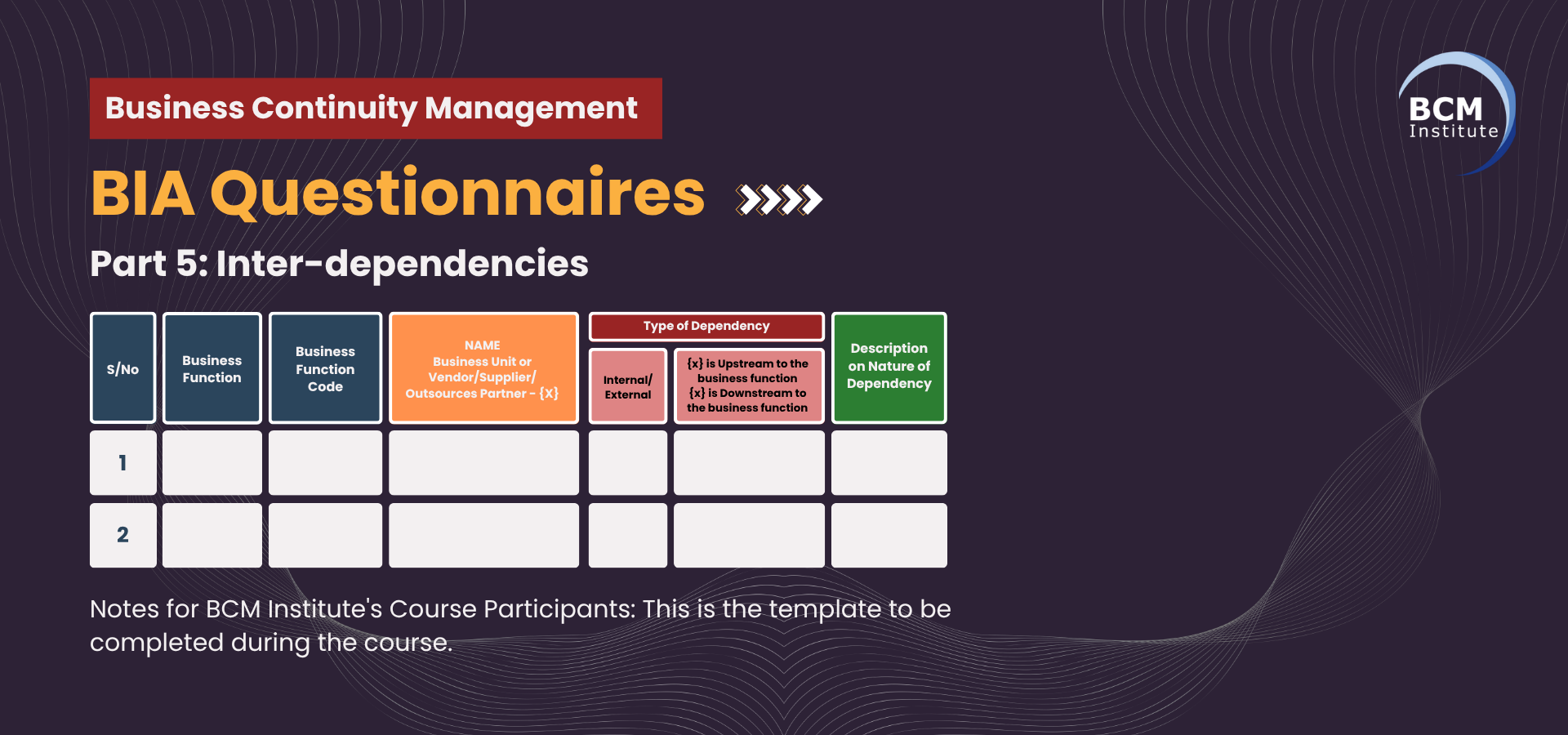
The ability of SHINE Children and Youth Services (SHINE) to deliver Targeted Interventions for At-Risk Youth relies significantly on a network of interconnected internal departments, external partners, government agencies, technology systems, and community stakeholders.
These inter-dependencies ensure that case identification, intervention design, programme delivery, crisis response, and post-intervention monitoring can be carried out seamlessly and safely.
Understanding these inter-dependencies is vital to strengthening SHINE’s overall business continuity capability.
By mapping upstream, downstream, and mutual dependencies, SHINE can anticipate how disruptions might affect service delivery pathways, stakeholder coordination, and youth outcomes.
This section identifies the critical dependencies for each Sub-CBF within CBF-3. It provides a structured view of how SHINE collaborates with internal units and external partners to maintain the resilience of service provision.
![Banner [Table] [BCM] [E3] [BIA] [P5] Inter-dependencies [BIAQ]](https://no-cache.hubspot.com/cta/default/3893111/ed6152ff-4926-4fae-bd6b-ba572bcc781b.png)
Table P5: Inter‑dependencies for CBF-3
|
Sub-CBF Code |
Sub-CBF |
Name of Business Unit / Vendor / Partner |
Internal Dependency |
External Dependency |
Dependency Type (Upstream / Downstream / Mutual) |
Description of the Nature of Dependency |
|
3.1 |
Case Identification and Assessment |
Intake Team, Social Work Teams, Schools, MSF Child Protective Service, Family Service Centres |
Yes |
Yes |
Upstream (information sources), Mutual (assessment feedback) |
Receives referrals, case alerts, behavioural reports, and risk assessments; collaborates with schools and agencies to validate case information. |
|
3.2 |
Individualised Intervention Planning |
Case Workers, Programme Specialists, Psychologists, External Counsellors |
Yes |
Yes |
Mutual |
Requires multidisciplinary input to design intervention plans; relies on external specialists for psychological or behavioural assessments. |
|
3.3 |
Program Delivery and Monitoring |
Programme Delivery Unit, Volunteers, Community Centres, Partner NGOs |
Yes |
Yes |
Downstream (programme execution), Mutual (joint delivery) |
Depends on internal staff and volunteers to conduct sessions; relies on partner agencies for venue support, co-facilitation, and youth engagement activities. |
|
3.4 |
Stakeholder Collaboration and Coordination |
Schools, Parents/Guardians, MSF Agencies, Police (when relevant), Community Partners |
No |
Yes |
Mutual |
Requires ongoing communication and coordination with families, schools, and government agencies to ensure safety, progress monitoring, and intervention alignment. |
|
3.5 |
Crisis Management and Emergency Support |
Crisis Team, Emergency Services, MSF, Hospitals |
Yes |
Yes |
Upstream (incident activation), Downstream (execution), Mutual (information flow) |
Depends on emergency services for urgent response; coordinated actions required with MSF and crisis teams for youth safety and immediate intervention. |
|
3.6 |
Evaluation and Adjustment of Intervention Plans |
Programme Evaluation Team, Data Management Team, External Evaluators |
Yes |
Yes |
Downstream (data provision), Upstream (evaluation requirements) |
Relies on accurate data from programme delivery teams; external evaluators may support outcome assessments; feedback loops refine intervention plans. |
|
3.7 |
Post-Intervention Follow-Up |
Case Workers, Community Support Networks, Schools, Family Service Centres |
Yes |
Yes |
Downstream (follow-up execution), Mutual (youth support ecosystem) |
Requires collaboration with community partners to monitor youths’ progress after intervention; ongoing support is shared between SHINE and external agencies. |
![Banner [BCM] [E3] [BIA] [Summing Up] [P5] Inter-dependencies [BIAQ]](https://no-cache.hubspot.com/cta/default/3893111/117996e6-4a68-4449-880f-d8a48ff3071d.png)
The interdependencies mapped in this section illustrate the complex, collaborative ecosystem required to effectively support at-risk youth.
Each Sub-CBF interacts with a network of internal departments and external partners, resulting in a highly interconnected service model.
Disruptions affecting any key dependency—such as schools, government agencies, technology systems, or emergency services—can directly impact the continuity of youth intervention activities.
By identifying upstream, downstream, and mutual dependencies, SHINE can enhance its preparedness for disruptions, strengthen communication pathways, and establish alternative service arrangements.
This systematic understanding ultimately supports SHINE’s mission to provide uninterrupted, high-quality care and targeted interventions to youths who need them most.

![Banner [BCM] [E3] [BIA] [P6] Vital Records](https://no-cache.hubspot.com/cta/default/3893111/6d3e4359-14f4-4816-b274-3f61b92be858.png)
CBF-3 Targeted Interventions for At-Risk Youth
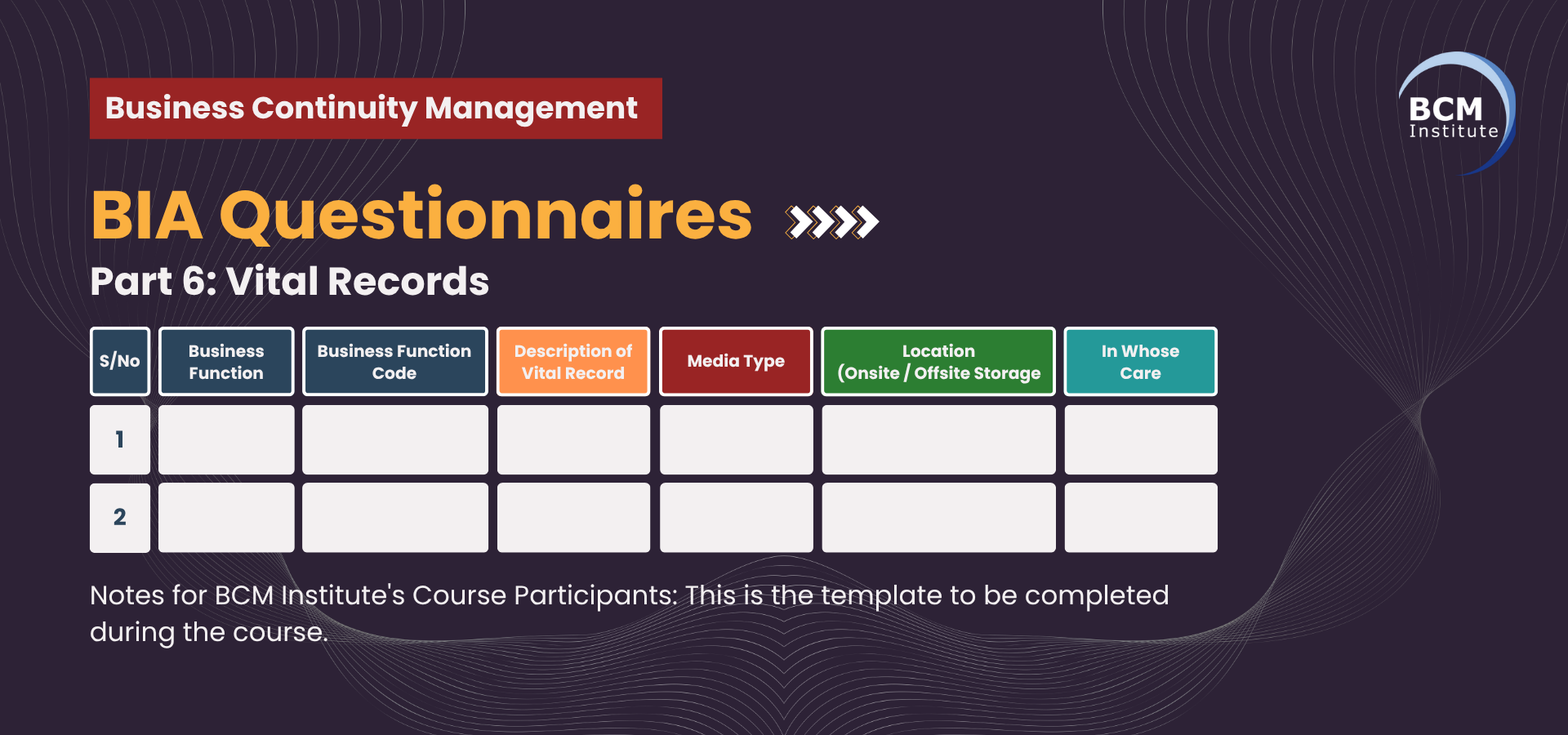
Vital records are essential documents and data that enable SHINE to continue critical operations in supporting at-risk youth, even during disruptions.
These records provide legal, regulatory, financial, and operational evidence of interventions and decisions, ensuring continuity of care and compliance with reporting obligations.
For CBF-3, vital records support the identification, assessment, intervention, and monitoring of at-risk youth, as well as communication and collaboration with key stakeholders.
This chapter identifies the vital records associated with each Sub-CBF and provides details on their media type, location, and custodian to facilitate proper protection, recovery, and continuity planning.
![Banner [Table] [BCM] [E3] [BIA] [P6] Vital Records [BIAQ]](https://no-cache.hubspot.com/cta/default/3893111/b44d6d49-dfb5-42a1-bc91-c0c701fc0724.png)
Table P6: Vital Records for CBF-3
|
Sub-CBF Code |
Sub-CBF |
Description of Vital Records |
Media Type |
Location |
In Whose Care |
|
3.1 |
Case Identification and Assessment |
Intake forms, assessment reports, risk profiles, referral letters |
Digital & Paper |
SHINE HQ, Client Services Office |
Case Workers / Intake Officers |
|
3.2 |
Individualised Intervention Planning |
Personalised care plans, goal-setting documents, and consent forms |
Digital & Paper |
SHINE HQ, Secure Server, Client Files |
Intervention Planners / Case Managers |
|
3.3 |
Program Delivery and Monitoring |
Attendance records, session reports, progress notes, activity logs |
Digital & Paper |
SHINE HQ, Program Offices |
Program Coordinators / Case Workers |
|
3.4 |
Stakeholder Collaboration and Coordination |
Meeting minutes, MOUs, partnership agreements, correspondence with schools/NGOs |
Digital & Paper |
SHINE HQ, Shared Drive |
Collaboration Team / Program Managers |
|
3.5 |
Crisis Management and Emergency Support |
Incident reports, safety plans, emergency contact records |
Digital & Paper |
SHINE HQ, Crisis Response Folder |
Crisis Response Team / Case Workers |
|
3.6 |
Evaluation and Adjustment of Intervention Plans |
Review reports, assessment updates, and feedback forms |
Digital & Paper |
SHINE HQ, Program Offices |
Case Managers / Program Coordinators |
|
3.7 |
Post-Intervention Follow-Up |
Outcome reports, follow-up records, and closure documentation |
Digital & Paper |
SHINE HQ, Client Records Archive |
Case Managers / Follow-Up Officers |
![Banner [BCM] [E3] [BIA] [Summing Up] [P6] Vital Records [BIAQ]](https://no-cache.hubspot.com/cta/default/3893111/06d76589-ebcf-4c9f-8e5b-c27f02938eed.png)
Maintaining accurate and accessible vital records is a cornerstone of SHINE’s continuity planning for targeted interventions.
These records ensure that staff can deliver uninterrupted, high-quality care to at-risk youth and provide verifiable documentation for audits, regulatory compliance, and program evaluation.
By clearly identifying custodians, media types, and storage locations, SHINE ensures its critical information assets are adequately safeguarded, thereby enhancing resilience in day-to-day operations and during disruptive events.
Protecting these records supports the organisation’s mission of providing consistent, effective, and safe interventions for at-risk youth.

| DP | BIAQ T1 | BIAQ T2 | BIAQ T3 | BCS T2 | BCS T3 | PD |
![[BCM] [SHINE] [E3] [BIA] [DP] [CBF] [3] Targeted Interventions for At-Risk Youth](https://no-cache.hubspot.com/cta/default/3893111/1d96bce6-a1d5-4358-a10a-fbd98c576282.png) |
![[BCM] [SHINE] [E3] [BIA] [T1] [CBF] [3] Targeted Interventions for At-Risk Youth](https://no-cache.hubspot.com/cta/default/3893111/13de6991-364c-4b4f-9d2a-37ac5f9ceb02.png) |
![[BCM] [SHINE] [E3] [BIA] [T2] [CBF] [3] Targeted Interventions for At-Risk Youth](https://no-cache.hubspot.com/cta/default/3893111/f7f4af4a-14f9-489c-b494-5c9397edbe0f.png) |
|
![[BCM] [SHINE] [E3] [BCS] [T2] [CBF] [3] Recovery Strategies](https://no-cache.hubspot.com/cta/default/3893111/824ccd00-d2a4-4631-82c3-b207f0a9de0a.png) |
![[BCM] [SHINE] [E3] [BCS] [T3] [CBF] [3] Minimum Resources Required during a Disaster](https://no-cache.hubspot.com/cta/default/3893111/52faee0e-2a50-482e-b1ec-6335f215d119.png) |
![[BCM] [SHINE] [E3] [PD] [CBF] [3] Targeted Interventions for At-Risk Youth](https://no-cache.hubspot.com/cta/default/3893111/72acd31a-53e5-4dbc-8ac5-fe70add4dacf.png) |
![[BCM] [SHINE] [E3] [BIA] MBCO Corporate MBCO](https://no-cache.hubspot.com/cta/default/3893111/8a4c1bad-b882-4431-9db9-564f8d734724.png)
![[BCM] [SHINE] [E3] [BIA] [PS] Key Product and Services](https://no-cache.hubspot.com/cta/default/3893111/5e23190b-1be3-4bd9-b9f4-ea90013c9628.png)
![[BCM] [SHINE] [E3] [RAR] [T1] List of Threats](https://no-cache.hubspot.com/cta/default/3893111/999fd75b-6269-41c1-b833-e44ec6e1be72.png)
![[BCM] [SHINE] [E3] [RAR] [T2] Treatment and Control](https://no-cache.hubspot.com/cta/default/3893111/08e6836a-0f79-4ea5-8059-07eaf1cf927c.png)
![[BCM] [SHINE] [E3] [RAR] [T3] Risk Impact and Likelihood Assessment](https://no-cache.hubspot.com/cta/default/3893111/dfeec650-fd4f-4916-b353-f6860d9e4393.png)
![[BCM] [SHINE] [E3] [BCS] [T1] Mitigation Strategies and Justification](https://no-cache.hubspot.com/cta/default/3893111/03fd32a8-7ffe-4c0b-9eef-a32cb67f2e61.png)
![[BCM] [SHINE] [E1] [C10] Identifying Critical Business Functions](https://no-cache.hubspot.com/cta/default/3893111/6fba5a23-5e02-4368-aa88-65a252d4edd7.png)
More Information About Business Continuity Management Courses
To learn more about the course and schedule, click the buttons below for the BCM-300 Business Continuity Management Implementer [BCM-3] and the BCM-5000 Business Continuity Management Expert Implementer [BCM-5].


![Register [BL-B-3]*](https://no-cache.hubspot.com/cta/default/3893111/ac6cf073-4cdd-4541-91ed-889f731d5076.png)



![FAQ [BL-B-3]](https://no-cache.hubspot.com/cta/default/3893111/b3824ba1-7aa1-4eb6-bef8-94f57121c5ae.png)
![Email to Sales Team [BCM Institute]](https://no-cache.hubspot.com/cta/default/3893111/3c53daeb-2836-4843-b0e0-645baee2ab9e.png)


