



![Banner [BCM] [E3] [BIA] [P5] Inter-dependencies](https://no-cache.hubspot.com/cta/default/3893111/c7d00b8b-77c0-43ee-a2cf-76ea43b26fe8.png)
CBF-1 Educational Psychology Services (EPS)
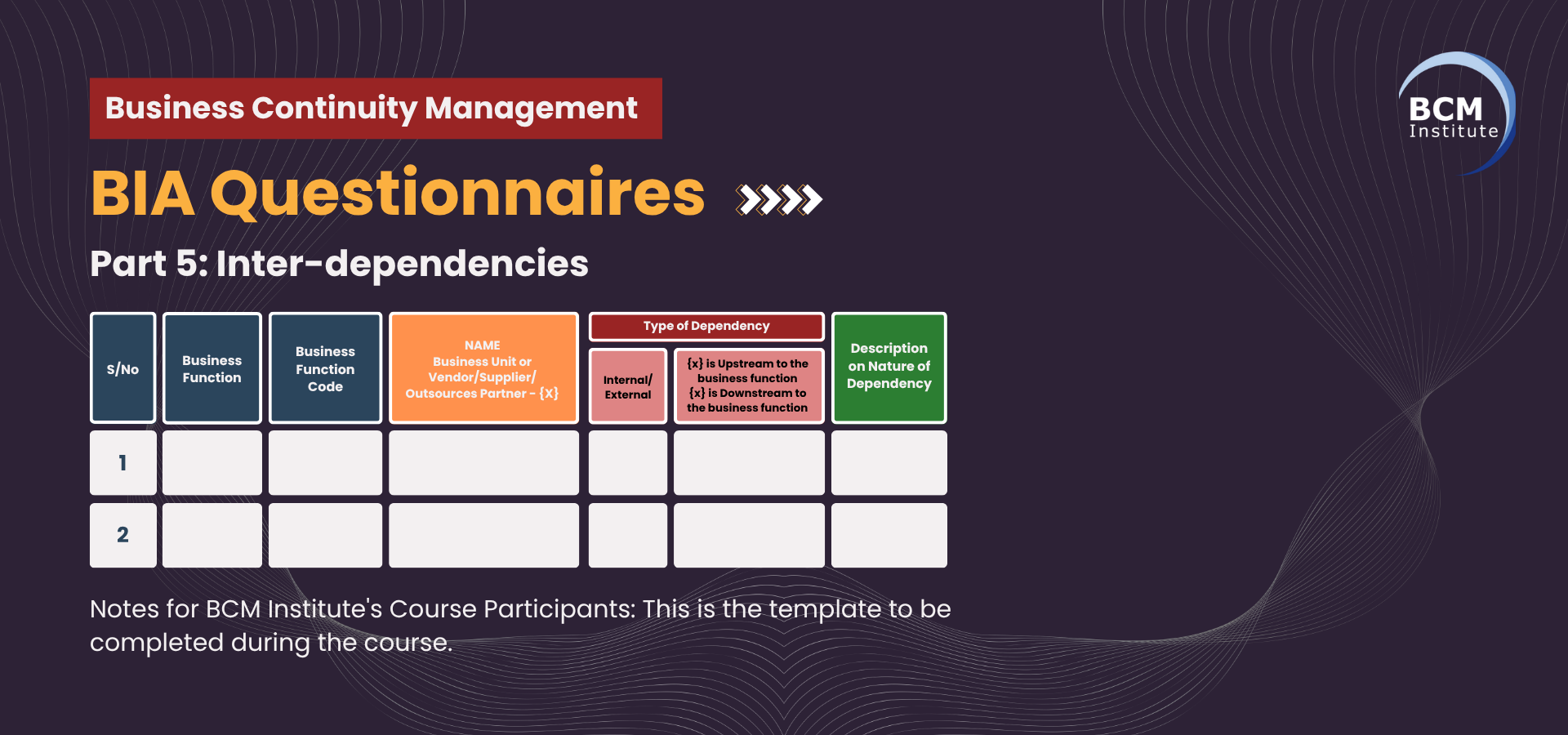
 In the context of CBF-1 Educational Psychology Services (EPS), understanding the interdependencies among business processes, stakeholders, and external entities is crucial to ensuring service continuity during disruptions.
The ability to identify both internal and external dependencies, as well as the upstream and downstream relationships of each process, is essential for effective business continuity management (BCM).
This section analyses the interdependencies among the key sub-processes of Educational Psychology Services, outlining the critical business units, vendors, suppliers, and outsourced partners required to sustain each activity.
By examining these dependencies, SHINE Children and Youth Services (SHINE) can better understand the risks of interrupting these key relationships and develop appropriate mitigation strategies to minimise service disruptions.
![Banner [Table] [BCM] [E3] [BIA] [P5] Inter-dependencies [BIAQ]](https://no-cache.hubspot.com/cta/default/3893111/ed6152ff-4926-4fae-bd6b-ba572bcc781b.png)
Table P5: Inter‑dependencies for CBF-1
|
Sub-CBF Code |
Sub-CBF |
Name of Business Unit or Vendor/ Supplier/ Outsource Partner |
Type of Dependency - Internal |
Type of Dependency - External |
Type of Dependency (Upstream/ Downstream/ Mutual) |
Description of the Nature of Dependency |
|
1.1 |
Psycho-educational Assessment & Diagnosis |
Educational Psychologists, Clinical Psychologists, Assessment Tool Vendors |
Internal: Educational Psychologists |
External: Assessment Tool Vendors, Schools |
Upstream |
The Psycho-educational Assessment relies on internal staff to conduct assessments and on external suppliers for diagnostic tools. Schools are key stakeholders in ensuring students have access to assessments. |
|
1.2 |
Reassessment & Educational Needs Review |
Educational Psychologists, Teachers, School Administrators |
Internal: Educational Psychologists |
External: Teachers, Schools, Parents |
Mutual |
This process involves a review conducted by internal psychologists in consultation with teachers, school administrators, and parents to reassess educational needs. All parties are mutually dependent on each other’s inputs. |
|
1.3 |
Learning Intervention Programmes |
Educational Psychologists, Teachers, Specialist Educators |
Internal: Educational Psychologists, Teachers |
External: Specialist Educators, NGOs, Educational Content Providers |
Downstream |
Intervention programs are developed by internal staff but may rely on external educators or content providers for specialised materials or methods. Teachers also depend on the intervention programs for student support. |
|
1.4 |
Consultation & Stakeholder Engagement (Parents, Schools, Volunteers) |
Educational Psychologists, School Staff, Parents, Volunteers, Community Partners |
Internal: Educational Psychologists, School Staff |
External: Parents, Volunteers, Community Partners |
Mutual |
Consultation and engagement involve both internal (psychologists and school staff) and external (parents and volunteers) parties working together to address student needs. There is a mutual dependency in this process. |
|
1.5 |
Intake & Referral Management |
Intake Coordinators, Educational Psychologists, Schools, Healthcare Providers |
Internal: Intake Coordinators |
External: Schools, Healthcare Providers |
Upstream |
The referral process relies on internal coordinators managing case intake and on external schools and healthcare providers for referrals. |
|
1.6 |
Progress Monitoring, Review & Exit Planning |
Educational Psychologists, Teachers, Parents |
Internal: Educational Psychologists, Teachers |
External: Parents |
Mutual |
Monitoring and reviews involve close coordination between internal educational psychologists and teachers and require regular updates and feedback from parents. |
|
1.7 |
Documentation, Reporting & Compliance |
Administrative Staff, Educational Psychologists |
Internal: Administrative Staff, Educational Psychologists |
External: Regulatory Authorities, External Auditors |
Upstream |
Compliance and reporting require accurate documentation from internal staff, with potential oversight and external audits from regulatory bodies. |
|
1.8 |
Capacity Building & Volunteer / Community Programmes |
Trainers, Volunteers, Community Partners, Educational Psychologists |
Internal: Educational Psychologists, Trainers |
External: Volunteers, Community Partners |
Downstream |
Capacity building relies on internal educational psychologists and trainers developing training programs for volunteers and community partners, whose engagement is critical to delivering these programs. |
![Banner [BCM] [E3] [BIA] [Summing Up] [P5] Inter-dependencies [BIAQ]](https://no-cache.hubspot.com/cta/default/3893111/117996e6-4a68-4449-880f-d8a48ff3071d.png)
The interdependencies outlined above highlight the complex network of relationships between SHINE Children and Youth Services and its internal and external partners involved in delivering Educational Psychology Services (EPS).
The effective functioning of each sub-CBF relies heavily on a mix of internal expertise and external collaboration, making it essential for SHINE to continuously monitor and manage these dependencies as part of its business continuity planning.
Disruptions to any of these relationships could significantly impact service delivery, underscoring the need for a proactive approach to managing both upstream and downstream dependencies.
By ensuring clear communication, establishing robust contingency plans, and building strong partnerships with key stakeholders, SHINE can maintain the resilience of its Educational Psychology Services and continue to support the children and youth it serves.

![Banner [BCM] [E3] [BIA] [P6] Vital Records](https://no-cache.hubspot.com/cta/default/3893111/6d3e4359-14f4-4816-b274-3f61b92be858.png)
CBF-1 Educational Psychology Services (EPS)
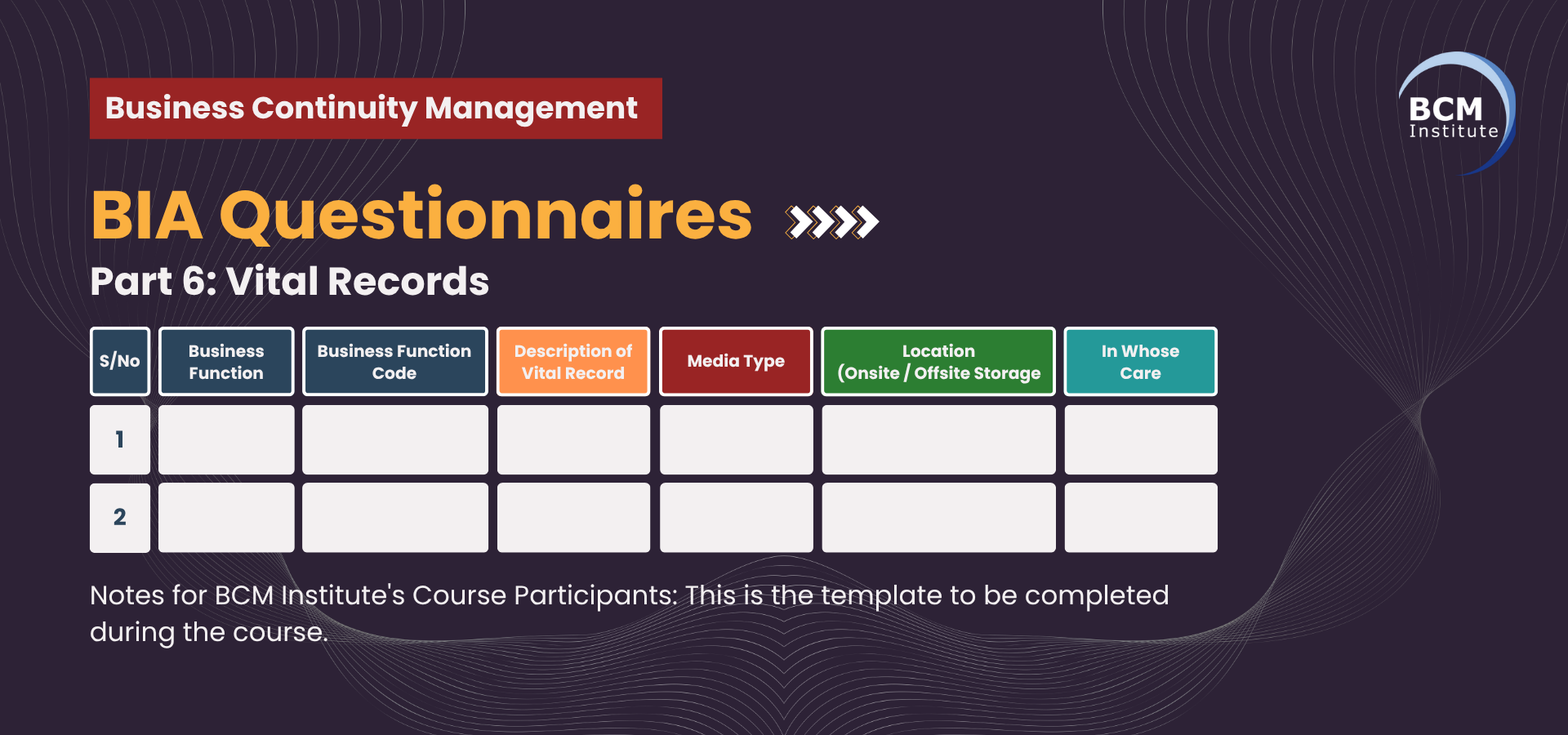
In the context of Educational Psychology Services (EPS) provided by SHINE Children and Youth Services, vital records are the essential documents and data that support the delivery of educational and psychological services.
These records are crucial for ensuring the continuity of care, regulatory compliance, and ongoing service provision. They also play a key role in supporting stakeholders, including parents, schools, and community organisations.
The management, storage, and protection of these vital records are essential to maintain operational resilience in the event of disruptions. This section will identify and categorise the vital records associated with each Sub-CBF within CBF-1 Educational Psychology Services.
The following table outlines the vital records for each Sub-CBF within this critical business function. These records may include client assessments, intervention plans, progress reports, and other documentation that ensure proper case management and service delivery.
![Banner [Table] [BCM] [E3] [BIA] [P6] Vital Records [BIAQ]](https://no-cache.hubspot.com/cta/default/3893111/b44d6d49-dfb5-42a1-bc91-c0c701fc0724.png)
Table P6: Vital Records for CBF-1
|
Sub-CBF Code |
Sub-CBF |
Description of Vital Records |
Media Type |
Location |
In Whose Care |
|
1.1 |
Psycho-educational Assessment & Diagnosis |
Client psychological assessments, diagnostic reports, and evaluation summaries |
Digital, Physical |
Client files, cloud storage |
Educational Psychologist, Admin Staff |
|
1.2 |
Reassessment & Educational Needs Review |
Reassessment reports, educational needs analysis, and progress updates |
Digital, Physical |
Client files, cloud storage |
Educational Psychologist, Admin Staff |
|
1.3 |
Learning Intervention Programmes |
Individualised intervention plans, learning strategies, and session records |
Digital, Physical |
Client files, cloud storage |
Educational Psychologist, Admin Staff |
|
1.4 |
Consultation & Stakeholder Engagement |
Consultation notes, stakeholder communication records (parents, schools, volunteers) |
Digital, Physical |
Client files, cloud storage |
Educational Psychologist, Admin Staff |
|
1.5 |
Intake & Referral Management |
Intake forms, referral documents, consent forms, and initial assessments |
Digital, Physical |
Client files, cloud storage |
Intake Coordinator, Admin Staff |
|
1.6 |
Progress Monitoring, Review & Exit Planning |
Progress monitoring reports, exit plans, and follow-up documentation |
Digital, Physical |
Client files, cloud storage |
Educational Psychologist, Admin Staff |
|
1.7 |
Documentation, Reporting & Compliance |
Regulatory compliance documents, reporting forms, and audit logs |
Digital, Physical |
Compliance archives, cloud storage |
Educational Psychologist, Admin Staff |
|
1.8 |
Capacity Building & Volunteer / Community Programmes |
Training materials, volunteer engagement records, program participation logs |
Digital, Physical |
Volunteer database, cloud storage |
Program Coordinators, Admin Staff |
![Banner [BCM] [E3] [BIA] [Summing Up] [P6] Vital Records [BIAQ]](https://no-cache.hubspot.com/cta/default/3893111/06d76589-ebcf-4c9f-8e5b-c27f02938eed.png)
The management and protection of vital records are integral to the success of Educational Psychology Services (EPS) provided by SHINE Children and Youth Services.
These records not only support the service's day-to-day operations but also ensure continuity of care, regulatory compliance, and effective collaboration with stakeholders.
As such, it is critical to establish clear policies and practices for the secure storage, access, and transfer of these records.
By doing so, SHINE can maintain the resilience of its EPS operations, safeguard client information, and provide high-quality services despite disruptions.

| DP | BIAQ T1 | BIAQ T2 | BIAQ T3 | BCS T2 | BCS T3 | PD |
![[BCM] [SHINE] [E3] [BIA] MBCO Corporate MBCO](https://no-cache.hubspot.com/cta/default/3893111/8a4c1bad-b882-4431-9db9-564f8d734724.png)
![[BCM] [SHINE] [E3] [BIA] [PS] Key Product and Services](https://no-cache.hubspot.com/cta/default/3893111/5e23190b-1be3-4bd9-b9f4-ea90013c9628.png)
![[BCM] [SHINE] [E3] [RAR] [T1] List of Threats](https://no-cache.hubspot.com/cta/default/3893111/999fd75b-6269-41c1-b833-e44ec6e1be72.png)
![[BCM] [SHINE] [E3] [RAR] [T2] Treatment and Control](https://no-cache.hubspot.com/cta/default/3893111/08e6836a-0f79-4ea5-8059-07eaf1cf927c.png)
![[BCM] [SHINE] [E3] [RAR] [T3] Risk Impact and Likelihood Assessment](https://no-cache.hubspot.com/cta/default/3893111/dfeec650-fd4f-4916-b353-f6860d9e4393.png)
![[BCM] [SHINE] [E3] [BCS] [T1] Mitigation Strategies and Justification](https://no-cache.hubspot.com/cta/default/3893111/03fd32a8-7ffe-4c0b-9eef-a32cb67f2e61.png)
![[BCM] [SHINE] [E1] [C10] Identifying Critical Business Functions](https://no-cache.hubspot.com/cta/default/3893111/6fba5a23-5e02-4368-aa88-65a252d4edd7.png)
![[BCM] [SHINE] [E3] [BIA] [DP] [CBF] [1] Educational Psychology Services (EPS)](https://no-cache.hubspot.com/cta/default/3893111/95df4fb3-96e3-44a9-b0bc-b1f199811c68.png)
![[BCM] [SHINE] [E3] [BIA] [T1] [CBF] [1] Educational Psychology Services (EPS)](https://no-cache.hubspot.com/cta/default/3893111/688d20b8-daa8-4aba-ae1b-196599d62131.png)

![[BCM] [SHINE] [E3] [BCS] [T2] [CBF] [1] Recovery Strategies](https://no-cache.hubspot.com/cta/default/3893111/03fc11f2-5d8a-4939-9baf-f66338cef6d7.png)
![[BCM] [SHINE] [E3] [BCS] [T3] [CBF] [1] Minimum Resources Required during a Disaster](https://no-cache.hubspot.com/cta/default/3893111/531f0a10-a091-44a6-84b3-89bc31bb5fd9.png)

More Information About Business Continuity Management Courses
To learn more about the course and schedule, click the buttons below for the BCM-300 Business Continuity Management Implementer [BCM-3] and the BCM-5000 Business Continuity Management Expert Implementer [BCM-5].


![Register [BL-B-3]*](https://no-cache.hubspot.com/cta/default/3893111/ac6cf073-4cdd-4541-91ed-889f731d5076.png)



![FAQ [BL-B-3]](https://no-cache.hubspot.com/cta/default/3893111/b3824ba1-7aa1-4eb6-bef8-94f57121c5ae.png)
![Email to Sales Team [BCM Institute]](https://no-cache.hubspot.com/cta/default/3893111/3c53daeb-2836-4843-b0e0-645baee2ab9e.png)


