


![Banner [BCM] [E3] [BIA] [P1] Identification of Business Functions](https://no-cache.hubspot.com/cta/default/3893111/206ddd7e-615a-42c8-aa2a-3416a1ad06b3.png)
CBF-3 Targeted Interventions for At-Risk Youth
![[BCM] [SHINE] [E3] [BIA] [T1] [CBF] [3] Targeted Interventions for At-Risk Youth](https://no-cache.hubspot.com/cta/default/3893111/13de6991-364c-4b4f-9d2a-37ac5f9ceb02.png)
Targeted interventions for at-risk youth form a core service pillar of SHINE Children and Youth Services (SHINE), directly supporting its mission to empower children, youth, and their families.
As these services involve high-risk cases, multi-agency collaboration, crisis intervention, and sustained follow-up, their continuity is essential to safeguarding vulnerable young persons and preventing escalation of harm or disengagement.
Within the Business Continuity Management (BCM) framework, identifying Critical Business Functions (CBFs) and defining their associated Minimum Business Continuity Objectives (MBCOs) helps ensure SHINE can maintain essential support during disruptions.
MBCO reflects the minimum level of service that must continue to prevent significant impact on client safety, well-being, and legal or regulatory obligations.
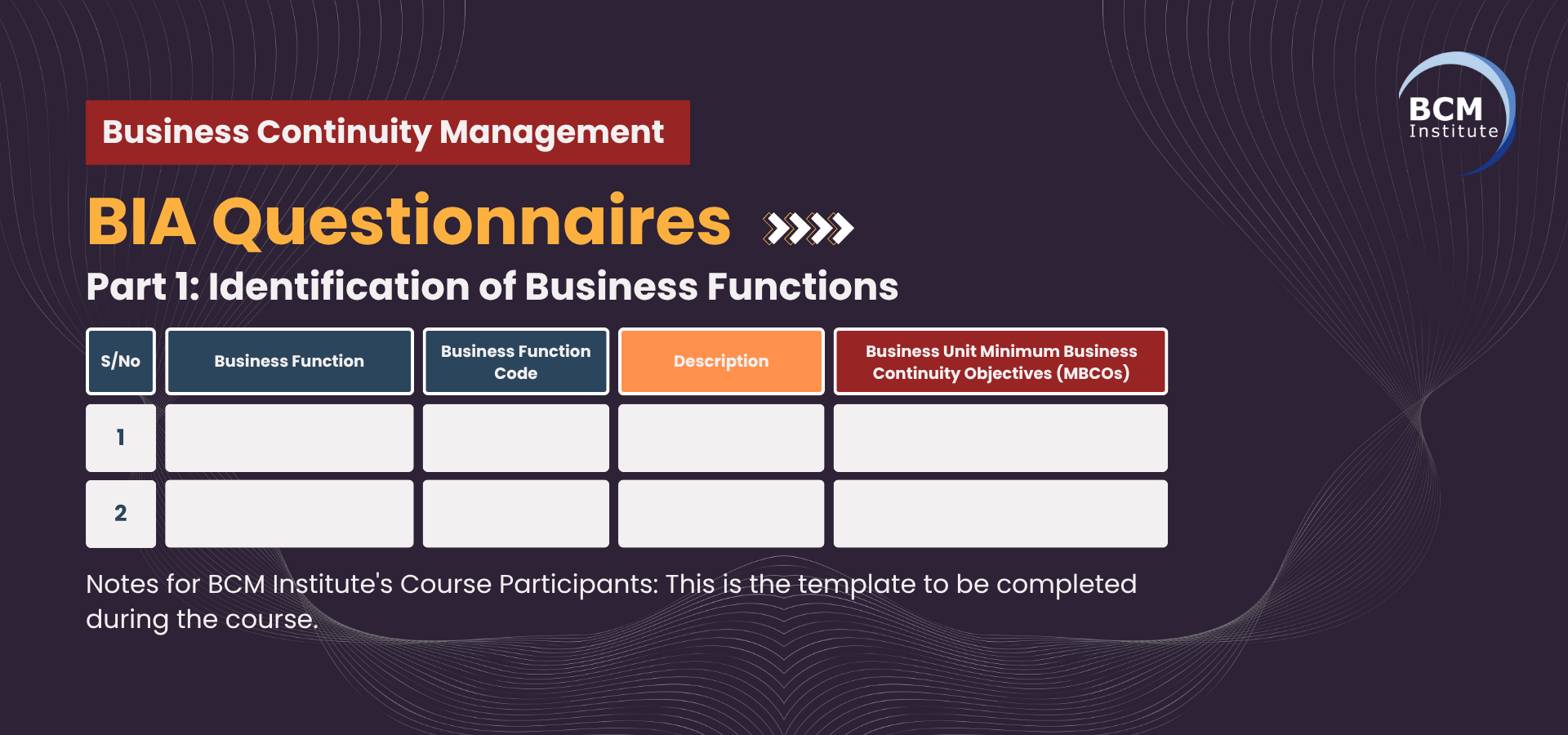
The following table outlines the Sub-CBFs under CBF-3: Targeted Interventions for At-Risk Youth, with descriptions and recommended Business Unit MBCO levels for each function.
![Banner [Table] [BCM] [E3] [BIA] [P1] Identification of Critical Business Functions](https://no-cache.hubspot.com/cta/default/3893111/4fe499c9-0c19-46b4-8b6f-75450dba07d8.png)
Table P1: Critical Business Functions for CBF-3
|
Sub-CBF Code |
Sub-CBF |
Description of CBF |
Business Unit Minimum Business Continuity Objective (MBCO) |
|
3.1 |
Case Identification and Assessment |
Activities to receive referrals, screen cases, assess risk, determine immediate safety needs, and prioritise urgency of intervention. |
At least 60–70% operational capability within 24 hours to ensure that high-risk youth are not left unassessed, preventing escalation of harm. |
|
3.2 |
Individualised Intervention Planning |
Development of tailored intervention plans, including goal setting, safety planning, resource allocation, and coordination with relevant partners. |
40–50% capability within 48 hours, as delays can affect youth safety and engagement, but initial critical assessments (CBF-3.1) mitigate immediate risks. |
|
3.3 |
Program Delivery and Monitoring |
Execution of intervention services such as counselling, mentorship, skill-building activities, and ongoing case monitoring. |
50–60% capability within 48–72 hours to sustain ongoing cases and avoid setbacks in progress, especially for moderate- to high-risk youth. |
|
3.4 |
Stakeholder Collaboration and Coordination |
Engagement with schools, social service agencies, law enforcement, families, and community partners to ensure consistent support structures. |
40–50% capability within 72 hours, as inter-agency continuity prevents service gaps and maintains trust with partners. |
|
3.5 |
Crisis Management and Emergency Support |
Immediate response to youth in crises, including mediation, urgent safety needs, or escalation to emergency services. |
80–100% capability within 4 hours; failure to respond poses a significant risk to youth safety and welfare. |
|
3.6 |
Evaluation and Adjustment of Intervention Plans |
Regular review of youth progress, reassessment of risk factors, and modification of intervention strategies. |
30–40% capability within 3–5 days, as short delays are manageable but should not accumulate to compromise the quality of care. |
|
3.7 |
Post-Intervention Follow-Up |
Aftercare, assessment of sustained progress, and ensuring reintegration into stable environments post-intervention. |
20–30% capability within 5–7 days, as this supports long-term outcomes and continuity, but is less time-critical during short-term disruptions. |
![Banner [BCM] [E3] [BIA] [Summing Up] [P1] Identification of Critical Business Functions](https://no-cache.hubspot.com/cta/default/3893111/22330ab3-0a0f-4efd-9da7-43032e1e6573.png)
CBF-3 represents a mission-critical component of SHINE’s service delivery, directly influencing the safety, stability, and developmental outcomes of at-risk youth.
By defining clear Sub-CBFs and establishing appropriate MBCO levels, SHINE strengthens its capacity to maintain essential intervention services under adverse conditions.
This structured approach ensures:
- Timely identification and management of high-risk cases
- Sustained support for ongoing intervention programmes
- Coordinated action with multi-agency partners
- Continuity of care that minimises harm, disengagement, or regression
Incorporating these MBCO thresholds into SHINE’s Business Continuity Plan enhances operational resilience and reinforces the organisation’s commitment to protecting vulnerable youth—regardless of the disruptions it may face.

![Banner [BCM] [E3] [BIA] [P2] Impact Area of Business Functions](https://no-cache.hubspot.com/cta/default/3893111/182e67c2-aa89-4b0b-b3e9-144293680ea4.png)
CBF-03 Targeted Interventions for At-Risk Youth
As part of the ISO 22301 Business Continuity Management (BCM) framework, understanding how disruptions affect SHINE’s critical business functions—particularly its Targeted Interventions for At-Risk Youth—is vital for safeguarding client well-being, maintaining regulatory compliance, and ensuring smooth service delivery even during crises.
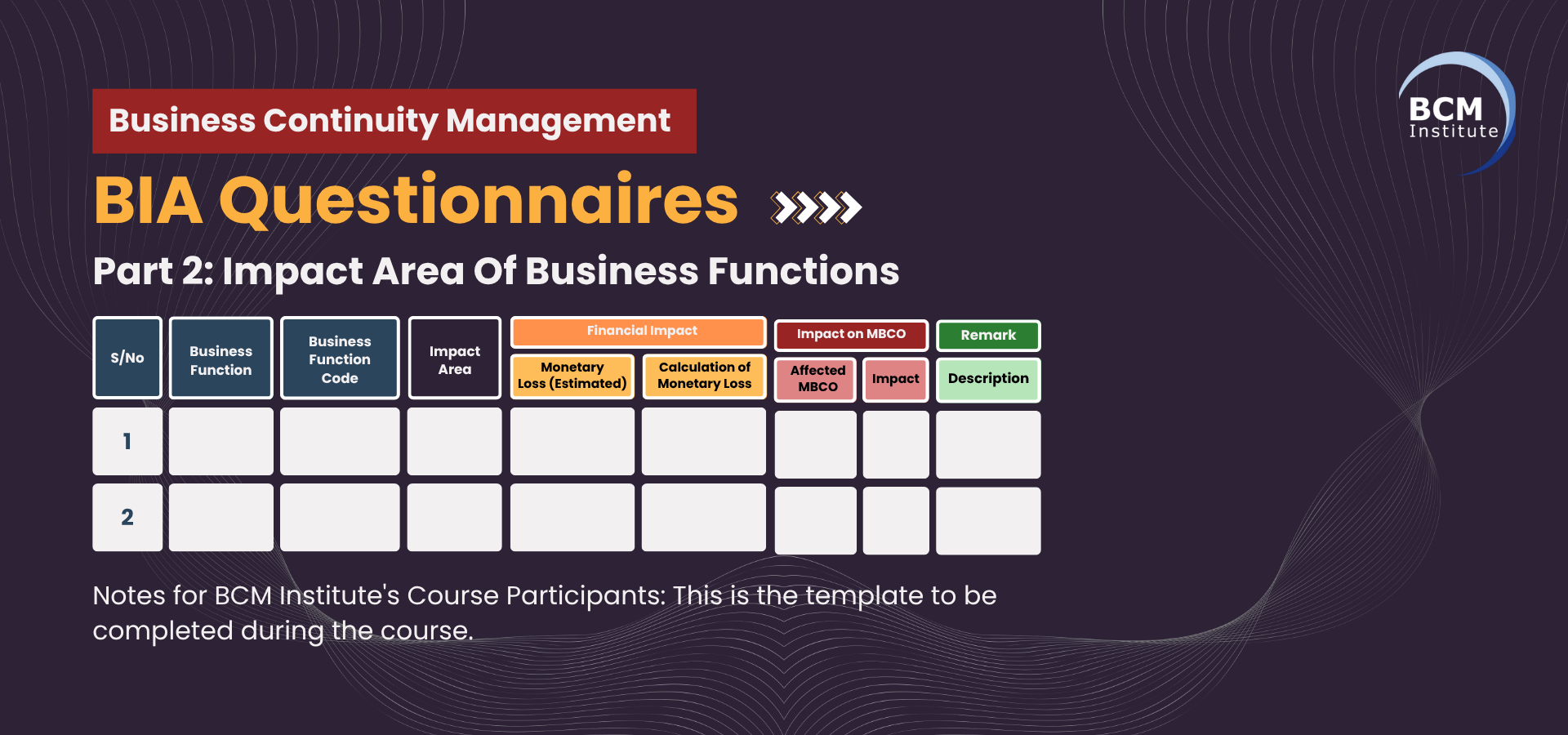
This chapter, Part 2: Impact Area of Business Functions, expands SHINE’s Business Impact Analysis (BIA) by detailing the potential operational, service, reputational, and financial consequences of disruptions to each Sub-Critical Business Function (Sub-CBF).
By quantifying financial exposure, analysing service delivery impacts, and assessing how each Sub-CBF affects the organisation’s Minimum Business Continuity Objective (MBCO), SHINE can better prioritise recovery measures, allocate resources efficiently, and strengthen its overall resilience framework.
![Banner [Table] [BCM] [E3] [BIA] [P2] Impact Areas of Business Functions [BIAQ]](https://no-cache.hubspot.com/cta/default/3893111/91582408-03ad-40e1-90e8-43ce62079aa6.png)
Table P2: Impact Area Assessment for CBF-3
|
Sub-CBF Code |
Sub-CBF |
Impact Area |
Financial Impact - Monetary Loss (Estimated) |
Financial Impact - Calculation of Monetary Loss (State Formula for Calculations) |
Impact on MBCO - Affect MBCO |
Impact on MBCO - Impact |
Remarks - Description |
|
3.1 |
Case Identification and Assessment |
Service Delivery, Client Well-Being, Compliance |
SGD 2,000 – 8,000 per week |
(No. of delayed assessments × cost per assessment) + potential funding penalties |
High |
Delays result in unmet needs for at-risk youth and reputational impact |
Initial intake and triage are foundational; disruption delays all downstream interventions |
|
3.2 |
Individualised Intervention Planning |
Service Delivery, Well-Being, Stakeholder Confidence |
SGD 3,000 – 10,000 per week |
(No. of pending plans × staff hours × hourly rate) |
High |
Causes a backlog that prevents timely youth support |
Disruption compromises the timeliness and quality of intervention plans |
|
3.3 |
Program Delivery and Monitoring |
Client Safety, Service Delivery, Reputational |
SGD 5,000 – 20,000 per week |
(Cancelled sessions × cost per session) + potential grant clawbacks |
Very High |
Directly impacts youth support, safety, and mandated interventions |
Core service delivery; most visible and regulated function |
|
3.4 |
Stakeholder Collaboration and Coordination |
Stakeholder Relationships, Compliance |
SGD 1,000 – 5,000 per week |
(No. of delayed coordination meetings × administrative cost) |
Medium |
Impacts the ability to execute cross-agency plans |
Involves schools, partners, and social service agencies |
|
3.5 |
Crisis Management and Emergency Support |
Client Safety, Legal/Compliance |
SGD 8,000 – 30,000 per incident |
(Emergency cases × escalation cost per case) |
Critical |
Failure may endanger youth and result in liability exposure |
Highest-risk Sub-CBF; requires rapid response |
|
3.6 |
Evaluation and Adjustment of Intervention Plans |
Service Quality, Outcome Management |
SGD 2,000 – 7,000 per cycle |
(Plans requiring review × staff hours × hourly rate) |
Medium |
Impacts long-term outcomes but may withstand short delays |
Used to measure effectiveness and optimise care plans |
|
3.7 |
Post-Intervention Follow-Up |
Client Well-Being, Relationship Management |
SGD 1,500 – 6,000 per week |
(No. of clients requiring follow-up × cost per follow-up) |
Medium-High |
Missed follow-ups may lead to regression in youth behaviour |
Important for sustained positive outcomes and donor reporting |
![Banner [BCM] [E3] [BIA] [Summing Up] [P2] Impact Areas of Business Functions [BIAQ]](https://no-cache.hubspot.com/cta/default/3893111/76188041-e1c9-43d9-8efa-e550f46ad04d.png)
Understanding the impact areas of SHINE’s critical business functions is a central component of an effective Business Continuity Management (BCM) programme.
For CBF-3 Targeted Interventions for At-Risk Youth, disruptions can have both immediate and long-term consequences on client safety, service delivery, organisational reputation, and financial sustainability.
By analysing financial exposure, identifying dependencies, and determining how each Sub-CBF affects the Minimum Business Continuity Objective (MBCO), SHINE is better equipped to develop practical recovery strategies, allocate resources efficiently, and ensure uninterrupted support to vulnerable youth even during crises.
This chapter lays the foundation for the subsequent BCM phases, strengthening SHINE’s resilience and reinforcing its mission to empower at-risk children and youth through timely, effective, and compassionate intervention.

| DP | BIAQ T1 | BIAQ T2 | BIAQ T3 | BCS T2 | BCS T3 | PD |
![[BCM] [SHINE] [E3] [BIA] [DP] [CBF] [3] Targeted Interventions for At-Risk Youth](https://no-cache.hubspot.com/cta/default/3893111/1d96bce6-a1d5-4358-a10a-fbd98c576282.png) |
|
![[BCM] [SHINE] [E3] [BIA] [T2] [CBF] [3] Targeted Interventions for At-Risk Youth](https://no-cache.hubspot.com/cta/default/3893111/f7f4af4a-14f9-489c-b494-5c9397edbe0f.png) |
![[BCM] [SHINE] [E3] [BIA] [T3] [CBF] [3] Targeted Interventions for At-Risk Youth](https://no-cache.hubspot.com/cta/default/3893111/6bb2d27c-a270-49fd-ae9e-1d0c7cfa7f31.png) |
![[BCM] [SHINE] [E3] [BCS] [T2] [CBF] [3] Recovery Strategies](https://no-cache.hubspot.com/cta/default/3893111/824ccd00-d2a4-4631-82c3-b207f0a9de0a.png) |
![[BCM] [SHINE] [E3] [BCS] [T3] [CBF] [3] Minimum Resources Required during a Disaster](https://no-cache.hubspot.com/cta/default/3893111/52faee0e-2a50-482e-b1ec-6335f215d119.png) |
![[BCM] [SHINE] [E3] [PD] [CBF] [3] Targeted Interventions for At-Risk Youth](https://no-cache.hubspot.com/cta/default/3893111/72acd31a-53e5-4dbc-8ac5-fe70add4dacf.png) |
![[BCM] [SHINE] [E3] [BIA] MBCO Corporate MBCO](https://no-cache.hubspot.com/cta/default/3893111/8a4c1bad-b882-4431-9db9-564f8d734724.png)
![[BCM] [SHINE] [E3] [BIA] [PS] Key Product and Services](https://no-cache.hubspot.com/cta/default/3893111/5e23190b-1be3-4bd9-b9f4-ea90013c9628.png)
![[BCM] [SHINE] [E3] [RAR] [T1] List of Threats](https://no-cache.hubspot.com/cta/default/3893111/999fd75b-6269-41c1-b833-e44ec6e1be72.png)
![[BCM] [SHINE] [E3] [RAR] [T2] Treatment and Control](https://no-cache.hubspot.com/cta/default/3893111/08e6836a-0f79-4ea5-8059-07eaf1cf927c.png)
![[BCM] [SHINE] [E3] [RAR] [T3] Risk Impact and Likelihood Assessment](https://no-cache.hubspot.com/cta/default/3893111/dfeec650-fd4f-4916-b353-f6860d9e4393.png)
![[BCM] [SHINE] [E3] [BCS] [T1] Mitigation Strategies and Justification](https://no-cache.hubspot.com/cta/default/3893111/03fd32a8-7ffe-4c0b-9eef-a32cb67f2e61.png)
![[BCM] [SHINE] [E1] [C10] Identifying Critical Business Functions](https://no-cache.hubspot.com/cta/default/3893111/6fba5a23-5e02-4368-aa88-65a252d4edd7.png)
More Information About Business Continuity Management Courses
To learn more about the course and schedule, click the buttons below for the BCM-300 Business Continuity Management Implementer [BCM-3] and the BCM-5000 Business Continuity Management Expert Implementer [BCM-5].


![Register [BL-B-3]*](https://no-cache.hubspot.com/cta/default/3893111/ac6cf073-4cdd-4541-91ed-889f731d5076.png)



![FAQ [BL-B-3]](https://no-cache.hubspot.com/cta/default/3893111/b3824ba1-7aa1-4eb6-bef8-94f57121c5ae.png)
![Email to Sales Team [BCM Institute]](https://no-cache.hubspot.com/cta/default/3893111/3c53daeb-2836-4843-b0e0-645baee2ab9e.png)


