


![Banner [BCM] [E3] [BCS] [T1] Mitigation Strategies](https://no-cache.hubspot.com/cta/default/3893111/fdc7087d-c996-4bf1-9dbb-59f7d2ba89c5.png)
Introduction
![[BCM] [SHINE] [E3] [BCS] [T1] Mitigation Strategies and Justification](https://no-cache.hubspot.com/cta/default/3893111/03fd32a8-7ffe-4c0b-9eef-a32cb67f2e61.png)
In any organisation, managing and mitigating risks is a crucial component of Business Continuity Management (BCM).
For SHINE Children and Youth Services (SHINE), ensuring the continuity of its mission to support vulnerable children and youth requires a proactive approach to identifying and managing threats that could disrupt its operations.
In this chapter, we will explore the mitigation strategies in place to address these threats and ensure the resilience of SHINE's services. These strategies are key to minimising potential risks and ensuring that SHINE can continue to provide its essential services even in the face of crises.
The mitigation process involves evaluating each identified threat, applying existing controls, and determining the risk level for each threat.
By employing additional strategies to address residual risks, SHINE strengthens its preparedness and reduces the potential impact of disruptive events.
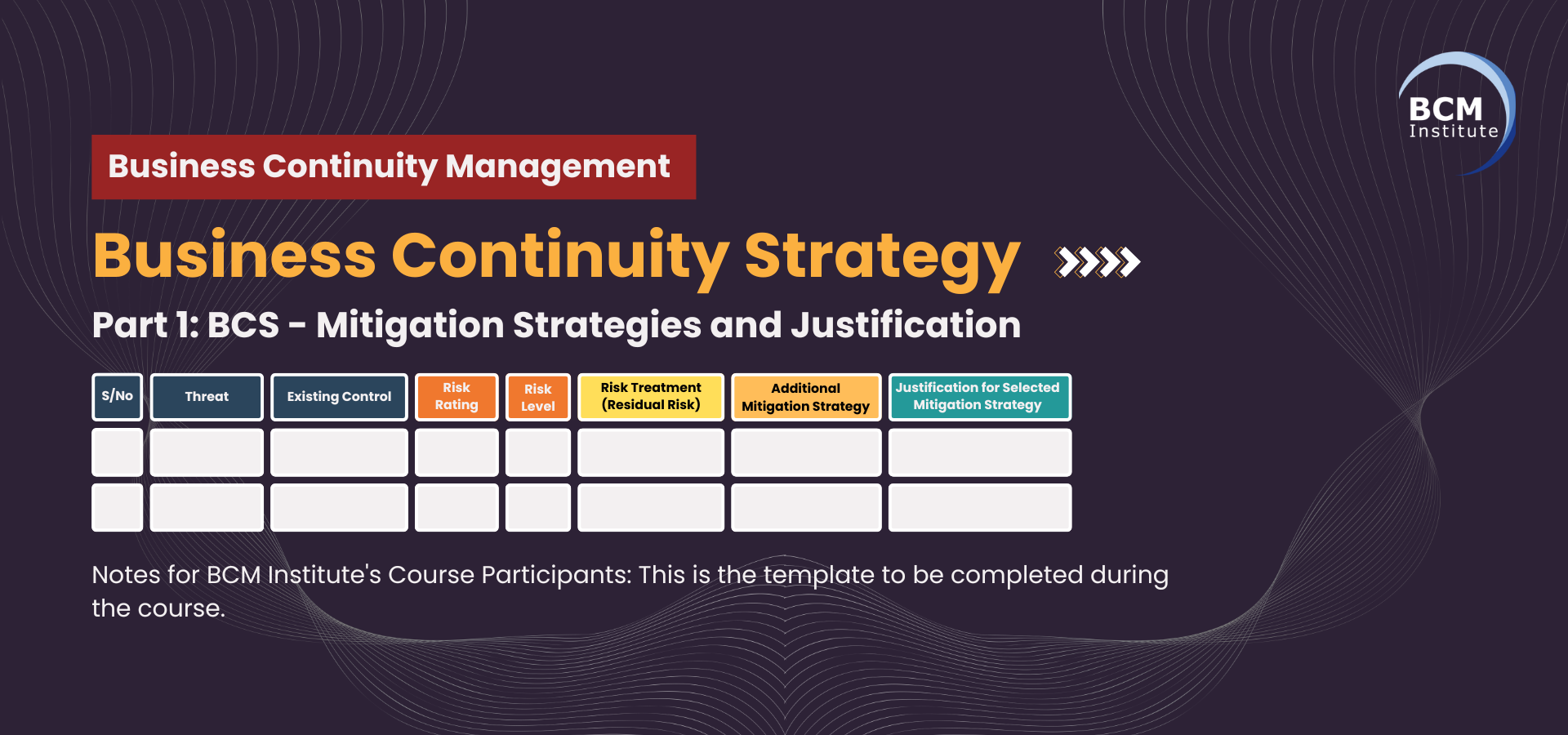
Table S1: Mitigation Strategies
![Banner [Table] [BCM] [E3] [BCS] [T1] Mitigation Strategies](https://no-cache.hubspot.com/cta/default/3893111/126d86fd-4977-4d69-8e44-fe000291f236.png)
|
Threat |
Existing Controls |
Risk Rating |
Risk Level |
Risk Treatment (Residual Risk) |
Additional Mitigation Strategy |
Justification for Selected Mitigation Strategy |
|
Cybersecurity Breaches |
Firewalls, encryption, staff training, and regular vulnerability assessments |
High |
Critical |
Medium |
Enhanced cybersecurity infrastructure (e.g., multi-factor authentication, regular system updates) |
Strengthening defences through multi-layered security measures helps ensure that sensitive information is protected against breaches. |
|
Natural Disasters (Floods, Earthquakes) |
Emergency response plans, evacuation drills, and secure building infrastructure |
Medium |
High |
Medium |
Regular disaster preparedness training and community outreach |
Preparedness and community engagement are crucial to ensuring swift responses and reducing panic during natural disasters. |
|
Loss of Key Staff |
Cross-training programs, succession planning |
High |
Critical |
High |
Implement job rotation and knowledge transfer programs |
These measures ensure continuity in leadership and critical functions if key staff members are unavailable. |
|
Financial Shortfalls |
Diversified funding sources, financial reserves |
Medium |
High |
Low |
Strengthen partnerships with donors and grant agencies, and increase fundraising initiatives. |
Diversifying funding sources mitigates financial risks, ensuring economic stability during crises. |
|
Public Health Crises (Pandemics) |
Health and safety protocols, remote work arrangements, and health screenings |
High |
Critical |
Medium |
Develop contingency plans for remote operations, and collaborate with health authorities for real-time guidance. |
Proactive engagement with health authorities and remote work planning ensures minimal disruption to operations during pandemics. |
|
Supply Chain Disruptions |
Vendor contracts, inventory management systems |
Medium |
Medium |
Medium |
Develop alternative supply chain routes and diversify suppliers |
This ensures that operations are not significantly affected by supply chain disruptions. |
|
Social Unrest |
Crisis communication protocols, media monitoring, and staff safety protocols |
Medium |
Medium |
Low |
Strengthen relationships with local communities and engage in social responsibility initiatives |
Building strong community relationships helps mitigate risks from social unrest by fostering trust and understanding. |
![Banner [BCM] [E3] [BCS] [Summing Up] [T1] Mitigation Strategies](https://no-cache.hubspot.com/cta/default/3893111/c2542a7f-6d92-4371-93ba-348e87d8c1ce.png)
Identifying potential threats and developing appropriate mitigation strategies are vital to ensuring the resilience of SHINE Children and Youth Services.
Through a detailed analysis of each threat, the organisation can evaluate its existing controls, risk ratings, and potential residual risks. By applying additional mitigation strategies, SHINE can significantly reduce the likelihood and impact of these risks on its operations.
Ultimately, the purpose of these strategies is to safeguard SHINE's mission of supporting children and youth, ensuring that the services it provides continue to have a positive impact, even in the face of unforeseen challenges.
By continuing to strengthen its risk management practices, SHINE can maintain its ability to deliver high-quality services and respond effectively to crises, securing its place as a trusted organisation in the community.
![[BCM] [SHINE] [E3] [BIA] MBCO Corporate MBCO](https://no-cache.hubspot.com/cta/default/3893111/8a4c1bad-b882-4431-9db9-564f8d734724.png)
![[BCM] [SHINE] [E3] [BIA] [PS] Key Product and Services](https://no-cache.hubspot.com/cta/default/3893111/5e23190b-1be3-4bd9-b9f4-ea90013c9628.png)
![[BCM] [SHINE] [E3] [RAR] [T1] List of Threats](https://no-cache.hubspot.com/cta/default/3893111/999fd75b-6269-41c1-b833-e44ec6e1be72.png)
![[BCM] [SHINE] [E3] [RAR] [T2] Treatment and Control](https://no-cache.hubspot.com/cta/default/3893111/08e6836a-0f79-4ea5-8059-07eaf1cf927c.png)
![[BCM] [SHINE] [E3] [RAR] [T3] Risk Impact and Likelihood Assessment](https://no-cache.hubspot.com/cta/default/3893111/dfeec650-fd4f-4916-b353-f6860d9e4393.png)
![[BCM] [SHINE] [E1] [C10] Identifying Critical Business Functions](https://no-cache.hubspot.com/cta/default/3893111/6fba5a23-5e02-4368-aa88-65a252d4edd7.png)
More Information About Business Continuity Management Courses
To learn more about the course and schedule, click the buttons below for the BCM-300 Business Continuity Management Implementer [BCM-3] and the BCM-5000 Business Continuity Management Expert Implementer [BCM-5].


![Register [BL-B-3]*](https://no-cache.hubspot.com/cta/default/3893111/ac6cf073-4cdd-4541-91ed-889f731d5076.png)



![FAQ [BL-B-3]](https://no-cache.hubspot.com/cta/default/3893111/b3824ba1-7aa1-4eb6-bef8-94f57121c5ae.png)
![Email to Sales Team [BCM Institute]](https://no-cache.hubspot.com/cta/default/3893111/3c53daeb-2836-4843-b0e0-645baee2ab9e.png)


