



eBook 2: Chapter 7
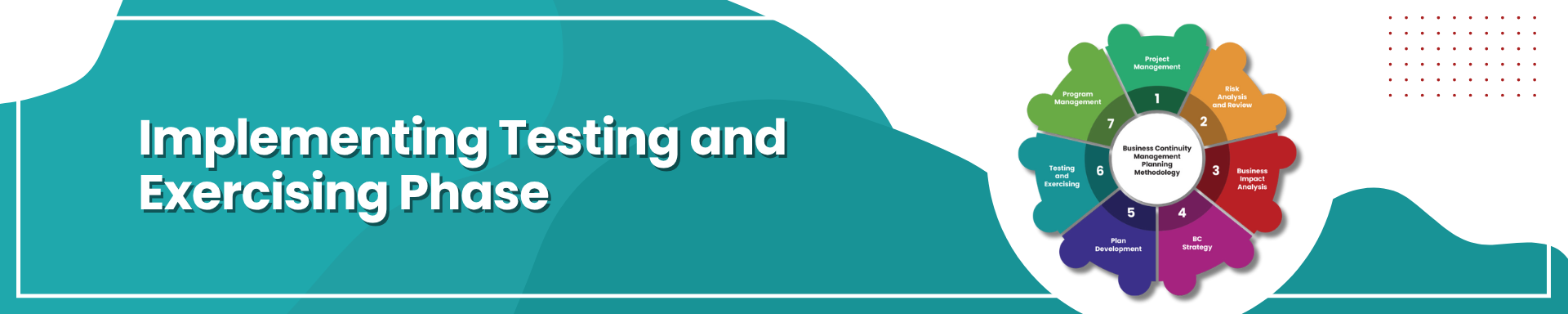
Testing and Exercising Phase as Part of the Business Continuity Management Planning Methodology for SHINE Children and Youth Services
Introduction
![[BCM] [SHINE] [E2] [C7] Testing and Exercising](https://no-cache.hubspot.com/cta/default/3893111/f4a49829-b26c-426b-b12a-6828196f7662.png)
Testing and exercising are critical components in the Business Continuity Management (BCM) methodology for ensuring that SHINE Children and Youth Services (SHINE) can maintain its mission and operations during disruptions.
Through testing, SHINE can evaluate the effectiveness of its business continuity plan, identify weaknesses, and improve response capabilities.
This phase allows the organisation to validate its readiness, ensure key personnel are trained, and refine operational procedures in the face of potential crises.
Testing is typically structured in two stages: initial (basic) tests and advanced tests, each progressively building on the prior stage to ensure comprehensive readiness.
(a) Initial Tests
Initial tests are designed to assess the basic functionality of the business continuity plan and familiarise staff with the procedures involved. These tests are typically less complex and allow SHINE to verify the operational capability of critical systems and processes.
Component Tests
Call Notification Tests
Walkthrough Exercises
(b) Advanced Tests
Once SHINE has mastered the basic tests, more advanced exercises can be carried out to simulate real-world disruptions and assess the organisation’s capacity to manage larger-scale incidents.
Integrated Tests
Simulation Tests
Live Tests
![Banner [Summary] [BCM] [E2] [C7] Testing and Exercising](https://no-cache.hubspot.com/cta/default/3893111/af76bb57-f906-4422-8548-3912930c76a7.png)
The Testing and Exercising Phase is crucial for ensuring that SHINE Children and Youth Services is prepared to handle any potential crisis while maintaining its mission of providing care and support to vulnerable children and youth.
By progressing through initial to advanced tests, SHINE can identify weaknesses in its BCM plan, enhance staff readiness, and strengthen its operational resilience. This continuous process of testing, learning, and improving ensures that SHINE remains ready to meet the needs of its clients, even in the face of adversity, and continues delivering its essential services with minimal disruption.
Testing and exercises are not one-time events, but an ongoing process of improvement and validation that must be woven into SHINE's BCM strategy to provide continuous care, no matter the circumstance.
![[BCM] [SHINE] [E2] [C1] Business Continuity Management Planning Methodology](https://no-cache.hubspot.com/cta/default/3893111/d65fbada-a07c-44d3-a932-e6b74b77f610.png)
![[BCM] [SHINE] [E2] [C2] Project Management](https://no-cache.hubspot.com/cta/default/3893111/03d8427a-9706-4f3d-a8a0-9a9de56455b1.png)
![[BCM] [SHINE] [E2] [C3] Risk Analysis and Review](https://no-cache.hubspot.com/cta/default/3893111/0df268b4-d8f2-4ae9-9cb9-2eb0ab4ac808.png)
![[BCM] [SHINE] [E2] [C4] Business Impact Analysis](https://no-cache.hubspot.com/cta/default/3893111/0499e267-48d8-4c80-8fae-d0cfe997e70d.png)
![[BCM] [SHINE] [E2] [C5] Business Continuity Strategy](https://no-cache.hubspot.com/cta/default/3893111/c2dbeaf6-54cd-4468-ad97-f0c460f9c430.png)
![[BCM] [SHINE] [E2] [C6] BCM Plan Development](https://no-cache.hubspot.com/cta/default/3893111/215f489e-fb2d-4053-a760-d142f8b4c364.png)
![[BCM] [SHINE] [E2] [C8] Program Management](https://no-cache.hubspot.com/cta/default/3893111/5d18b31a-a54f-474c-a705-f3b6524d4524.png)
![[BCM] [SHINE] [E2] [C9] Summary](https://no-cache.hubspot.com/cta/default/3893111/8642de14-5077-4bd6-a477-2436835a4e10.png)
![[BCM] [SHINE] [E2] [C10] Back Cover](https://no-cache.hubspot.com/cta/default/3893111/35916527-3f64-4214-95f7-3dfc7d6646b5.png)
More Information About Business Continuity Management Courses
To learn more about the course and schedule, click the buttons below for the BCM-300 Business Continuity Management Implementer [BCM-3] and the BCM-5000 Business Continuity Management Expert Implementer [BCM-5].


![Register [BL-B-3]*](https://no-cache.hubspot.com/cta/default/3893111/ac6cf073-4cdd-4541-91ed-889f731d5076.png)



![FAQ [BL-B-3]](https://no-cache.hubspot.com/cta/default/3893111/b3824ba1-7aa1-4eb6-bef8-94f57121c5ae.png)
![Email to Sales Team [BCM Institute]](https://no-cache.hubspot.com/cta/default/3893111/3c53daeb-2836-4843-b0e0-645baee2ab9e.png)


