



eBook 1: Chapter 8
![[BCM] [SHINE] [E1] [C8] Implementing the BCM Planning Methodology](https://no-cache.hubspot.com/cta/default/3893111/e999ac05-faa5-4a64-b741-927d27817681.png)
 In today’s fast-paced, unpredictable environment, organisations like SHINE Children and Youth Services (SHINE) must be prepared for disruptions to their operations.
Business Continuity Management (BCM) is a critical discipline that ensures organisations can continue their essential functions during crises.
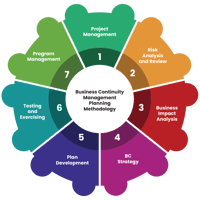
This article will guide SHINE Children and Youth Services through the seven-phase BCM planning methodology, tailored to its unique context.
1. Project Management (PM)
The Project Management phase sets the foundation for the entire BCM process. For SHINE, the first step is to form a dedicated Business Continuity Management (BCM) team with representatives from different departments.
This ensures a collaborative approach, especially given SHINE's multidisciplinary services (e.g., educational psychology, social work, and counselling).
A crucial requirement for SHINE is to align the BCM program with the organisation’s mission of supporting at-risk children and youth.
This includes establishing clear objectives that reflect SHINE's core values, such as ensuring the continuity of essential educational and therapeutic services during a crisis.
Key tasks in this phase include:
- Defining the scope and objectives of the BCM program.
- Appointing a BCM coordinator and team members.
- Developing a project plan with timelines and milestones.
- Engaging key stakeholders, such as the Ministry of Social and Family Development (MSF), which oversees social services in Singapore.
2. Risk Analysis and Review (RAR)
The Risk Analysis and Review (RAR) phase identifies potential threats and vulnerabilities that may disrupt SHINE’s operations.
Given SHINE’s focus on children and youth services, the risks could include disruptions to physical facilities, cybersecurity threats, or challenges in continuing mental health support and counselling services.
For SHINE, it is essential to conduct a thorough assessment of both internal and external risks. The organisation should focus on risks that could impact:
- Educational and therapeutic services.
- Client data privacy and security.
- Staff availability and safety.
- Relationships with external stakeholders such as schools, social service providers, and funding agencies.
A key requirement for SHINE is to use the findings from this phase to prioritise risks by likelihood and potential impact, which will inform the next steps in the BCM methodology.
3. Business Impact Analysis (BIA)
The Business Impact Analysis (BIA) helps SHINE identify the critical business functions (CBFs) that must continue without disruption to maintain the organisation’s mission. For SHINE, these CBFs include:
- CBF-1: Educational and psychological support services.
- CBF-2: Counselling and therapy services.
- CBF-3: Case management and crisis intervention.
For each CBF, SHINE should assess the impact of disruptions over time.
For example, a disruption to educational services might have an immediate effect on the children’s mental and emotional well-being. At the same time, delays in case management could result in prolonged crises for at-risk youth.
Key tasks include:
- Identifying and mapping critical processes and their dependencies.
- Assessing the potential impact of disruptions on these processes over time (e.g., 4 hours, 1 day, 2 days).
- Determining Recovery Time Objectives (RTOs) and Recovery Point Objectives (RPOs) for each critical function.
4. Business Continuity Strategy (BCS)
The Business Continuity Strategy (BCS) phase focuses on developing strategies to minimise the impact of identified risks and ensure the continuity of critical services.
SHINE should explore various continuity strategies, such as:
- Remote Service Delivery: In the event of facility disruptions, SHINE can continue delivering educational and therapy services via digital platforms.
- Staff Resilience: Implementing flexible staffing arrangements, including the use of temporary staff or volunteers during emergencies.
- Alternative Facilities: Identifying alternate locations or service delivery channels if physical sites become unavailable.
In this phase, SHINE must also prioritise its recovery strategies based on the outcomes of the BIA and RAR phases.
5. Plan Development (PD)
The Plan Development (PD) phase involves creating specific plans for each business unit, focusing on how to continue operations during disruptions.
SHINE must develop detailed continuity plans for each CBF identified during the BIA phase. These plans should cover:
- Response Actions: What steps need to be taken when a disruption occurs, including communication with stakeholders, mobilising resources, and continuing critical services.
- Recovery Procedures: How to restore normal operations, with clearly defined RTOs and RPOs.
- Roles and Responsibilities: Assigning specific tasks to staff members to ensure swift response during a crisis.
SHINE's BCM plans should also integrate government and regulatory requirements, particularly the Ministry of Social and Family Development's (MSF) policies on social service continuity.
6. Testing and Exercising (TE)
The Testing and Exercising (TE) phase is essential for ensuring that the BCM plans are practical and effective.
SHINE should conduct regular drills and exercises to test the efficacy of its continuity strategies.
For SHINE, these tests should focus on:
- Virtual simulations of service disruptions (e.g., IT system failures).
- Tabletop exercises with key staff to assess decision-making and coordination during crises.
- Practical exercises, such as evacuations or virtual counselling, are used to ensure preparedness for various disaster scenarios.
SHINE must involve stakeholders such as government agencies, local schools, and partner organisations in these exercises to ensure a coordinated response during actual crises.
7. Program Management (PgM)
The Program Management (PgM) phase ensures that the BCM program remains effective over time.
For SHINE, this phase involves the continuous improvement of the BCM program by regularly reviewing and updating the plans to reflect changes in the organisation’s operations, services, and external environment.
Key activities in this phase include:
- Regular BCM Audits: Periodically assessing the BCM program’s effectiveness and alignment with SHINE’s strategic goals.
- Ongoing Training: Providing ongoing training for all staff members on BCM policies, emergency procedures, and their roles in a crisis.
- Continuous Improvement: Analysing lessons learned from exercises, actual disruptions, and changes in the risk landscape to improve the BCM program.
The success of the Program Management phase hinges on SHINE’s commitment to integrating BCM into its organisational culture, ensuring it becomes a core part of everyday operations.
![Banner [Summary] [BCM] [E1] [C8] Implementing the BCM Planning Methodology](https://no-cache.hubspot.com/cta/default/3893111/e44be53e-a156-4a00-b518-a7714cf21ce3.png)
By following the seven-phase BCM methodology, SHINE Children and Youth Services can effectively manage disruptions and continue to provide critical services to vulnerable children and youth.
This proactive approach ensures that SHINE's mission—providing a safe, supportive environment for at-risk youth—is upheld even in times of crisis.
![[BCM] [SHINE] [E1] [C1] Overview of BCM Implementation](https://no-cache.hubspot.com/cta/default/3893111/011ae09c-87e0-4185-a120-c84d90e3daa2.png)
![[BCM] [SHINE] [E1] [C2] Understanding Your Organisation](https://no-cache.hubspot.com/cta/default/3893111/9947c960-61f4-4dfe-a80e-66b1e76c4994.png)
![[BCM] [SHINE] [E1] [C3] Establishing Organisational Goals](https://no-cache.hubspot.com/cta/default/3893111/971c32b0-414e-412c-8f16-d1e39519ffcb.png)
![[BCM] [SHINE] [E1] [C4] Establishing Business Continuity Objectives](https://no-cache.hubspot.com/cta/default/3893111/a80d5d18-5d7b-4185-8bd3-29dd25b25862.png)
![[BCM] [SHINE] [E1] [C5] Determining BC Assumptions](https://no-cache.hubspot.com/cta/default/3893111/20740bd7-cef6-42bf-a6f9-6b255b192c30.png)
![[BCM] [SHINE] [E1] [C6] Composing BCM Team](https://no-cache.hubspot.com/cta/default/3893111/26eb0c4e-34c6-4a4a-800e-13ffaaf15a5c.png)
![[BCM] [SHINE] [E1] [C7] Analysing Operating Environment](https://no-cache.hubspot.com/cta/default/3893111/7eb3a76c-1a97-463f-a093-117ef05e33d7.png)
![[BCM] [SHINE] [E1] [C9] Assessing Risks and Threats](https://no-cache.hubspot.com/cta/default/3893111/e0d77059-f6f7-42a1-b305-9f671d64ae0c.png)
![[BCM] [SHINE] [E1] [C10] Identifying Critical Business Functions](https://no-cache.hubspot.com/cta/default/3893111/6fba5a23-5e02-4368-aa88-65a252d4edd7.png)
![[BCM] [SHINE] [E1] [C11] Summary of Understanding Your Organisation](https://no-cache.hubspot.com/cta/default/3893111/753d02a0-7f47-4c5e-8898-0f49988f02c3.png)
![[BCM] [SHINE] [E1] [C12] [Back Cover] eBook 1](https://no-cache.hubspot.com/cta/default/3893111/d4f6ac75-f22f-4d68-b264-693367ca4bef.png)
More Information About Business Continuity Management Courses
To learn more about the course and schedule, click the buttons below for the BCM-300 Business Continuity Management Implementer [BCM-3] and the BCM-5000 Business Continuity Management Expert Implementer [BCM-5].


![Register [BL-B-3]*](https://no-cache.hubspot.com/cta/default/3893111/ac6cf073-4cdd-4541-91ed-889f731d5076.png)



![FAQ [BL-B-3]](https://no-cache.hubspot.com/cta/default/3893111/b3824ba1-7aa1-4eb6-bef8-94f57121c5ae.png)
![Email to Sales Team [BCM Institute]](https://no-cache.hubspot.com/cta/default/3893111/3c53daeb-2836-4843-b0e0-645baee2ab9e.png)


