---
title: [BCM] [PF] Business Continuity Management Policy
description: [BCM] [PF] What Is a Business Continuity Management Policy
image: https://blog.bcm-institute.org/hubfs/BCM%20Series%20Graphic/BCM%20Series%20Morepost/%5BBCM%20Series%5D%20%5BMorepost%5D%20BCM%20Policy.jpg
---
.
[](http://www.bcm-institute.org/)
- [Home](https://www.bcm-institute.org/)
- [About Us](https://www.bcm-institute.org/about-us-3/)
- [A President’s Perspective](https://www.bcm-institute.org/about-us/a-presidents-perspective/)
- [Our History](https://www.bcm-institute.org/about-us/our-history/)
- [Our Advisory Council](https://www.bcm-institute.org/about-us/our-advisory-council/)
- [Customers’ Testimonials](https://www.bcm-institute.org/about-us/customers-testimonials/)
- [Credential Verification](https://www.bcm-institute.org/about-us/credential-verification/)
- [Courses](https://blog.bcm-institute.org/blog/course-fees-for-blended-learning-courses-master-catalog)
- [ISO 22301 Business Continuity Management System Audit](https://blog.bcm-institute.org/audit/business-continuity-management-audit-courses)
- [ISO 22301 Business Continuity Management](https://blog.bcm-institute.org/bcm/business-continuity-management-courses)
- [Crisis Communication](https://blog.bcm-institute.org/crisis-communication/crisis-communication-courses)
- [Crisis Management](https://blog.bcm-institute.org/en/crisis-management/courses)
- [IT Disaster Recovery](https://blog.bcm-institute.org/it-disaster-recovery/courses)
- [Operational Resilience](https://blog.bcm-institute.org/operational-resilience/courses)
- [Operational Resilience Audit](https://blog.bcm-institute.org/operational-resilience-audit/courses)
- [Certification](https://blog.bcm-institute.org/certification/types-of-certifications-offered)
- [ISO 22301 BCMS Audit Certification](https://blog.bcm-institute.org/certification/business-continuity-management-audit-certification)
- [ISO22301 Business Continuity Management Certification](https://blog.bcm-institute.org/bcm/business-continuity-management-certification)
- [Crisis Communication Certification](https://blog.bcm-institute.org/crisis-communication/crisis-communication-certification)
- [Crisis Management Certification](https://blog.bcm-institute.org/en/crisis-management/crisis-management-certification)
- [IT Disaster Recovery Planning Certification](https://blog.bcm-institute.org/it-disaster-recovery/it-disaster-recovery-certification)
- [Operational Resilience Certification](https://blog.bcm-institute.org/operational-resilience/operational-resilience-certification)
- [Operational Resilience Audit Certification](https://blog.bcm-institute.org/operational-resilience-audit)
- [Seminars](https://blog.bcm-institute.org/meet-the-expert/mte-webinar-mainpage)
- [Store](https://www.bcm-institute.org/store-2/)
- [Contact Us](http://www.bcm-institute.org/about-us/contact-us/)
-
-
##### Business Continuity Management Policy and Framework Series
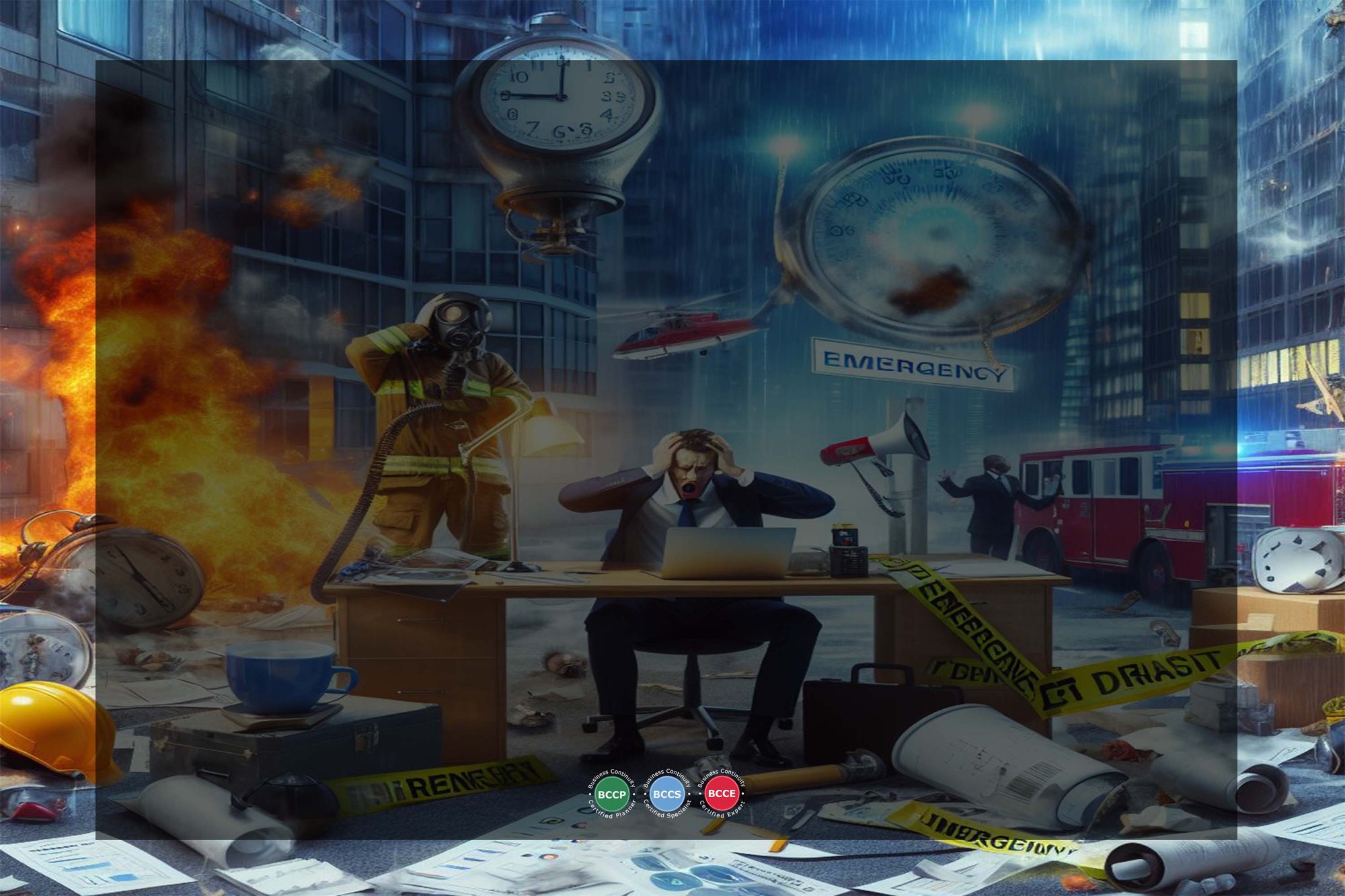
# \[BCM\] \[PF\] Business Continuity Management Policy
[![\[BCM Series\] \[Banner\] BCM Policy](https://no-cache.hubspot.com/cta/default/3893111/da7a26a3-99a5-43e7-9f2e-6c6aca372603.png)](https://cta-redirect.hubspot.com/cta/redirect/3893111/da7a26a3-99a5-43e7-9f2e-6c6aca372603)
Every organisation faces disruptions that can threaten its ability to deliver products, services, and critical operations.
These disruptions may arise from cyberattacks, natural disasters, pandemics, supply chain failures, utility outages, or human error.
While organisations invest in technology, facilities, and emergency response capabilities, long-term resilience depends on a structured approach to business continuity.
A **Business Continuity Management (BCM) Policy** provides that foundation.
It is the organisation's highest-level statement of intent and commitment towards ensuring business continuity.
Approved by senior management or the Board of Directors, the policy establishes the direction, governance, and authority required to implement, maintain, and continually improve a Business Continuity Management System (BCMS).
Unlike operational plans that describe how to respond to specific incidents, a BCM Policy defines **why** business continuity is important, **what** the organisation expects to achieve, and **who** is responsible for ensuring its success.
[![\[3\_4\] \[BCM Series\] \[Thin Banner\] BCM Policy vs BCM Framework](https://no-cache.hubspot.com/cta/default/3893111/3116340b-f682-458b-84b8-022b8c7719f5.png)](https://cta-redirect.hubspot.com/cta/redirect/3893111/3116340b-f682-458b-84b8-022b8c7719f5)
[Moh Heng Goh](https://blog.bcm-institute.org/ebook/author/moh-heng-goh) Jun 28, 2026
###### Business Continuity Management Certified Planner-Specialist-Expert
### [![\[BCM Series\] \[Banner\] BCM Policy](https://no-cache.hubspot.com/cta/default/3893111/da7a26a3-99a5-43e7-9f2e-6c6aca372603.png)](https://cta-redirect.hubspot.com/cta/redirect/3893111/da7a26a3-99a5-43e7-9f2e-6c6aca372603)
### What Is a Business Continuity Management (BCM) Policy?
#### Introduction
[![\[BCM Series\] \[Morepost\] BCM Policy](https://no-cache.hubspot.com/cta/default/3893111/c7956efb-9a49-41d6-ae42-77307a2f4106.png)](https://cta-redirect.hubspot.com/cta/redirect/3893111/c7956efb-9a49-41d6-ae42-77307a2f4106)Every organisation faces disruptions that can threaten its ability to deliver products, services, and critical operations.
These disruptions may arise from cyberattacks, natural disasters, pandemics, supply chain failures, utility outages, or human error.
While organisations invest in technology, facilities, and emergency response capabilities, long-term resilience depends on a structured approach to business continuity.
A **Business Continuity Management (BCM) Policy** provides that foundation.
It is the organisation's highest-level statement of intent and commitment towards ensuring business continuity.
Approved by senior management or the Board of Directors, the policy establishes the direction, governance, and authority required to implement, maintain, and continually improve a Business Continuity Management System (BCMS).
Unlike operational plans that describe how to respond to specific incidents, a BCM Policy defines **why** business continuity is important, **what** the organisation expects to achieve, and **who** is responsible for ensuring its success.
#### Definition of a BCM Policy
A **Business Continuity Management Policy** is a formal document that communicates the organisation's commitment to protecting its critical business functions, maintaining essential products and services during disruptions, and recovering within acceptable timeframes.
It serves as the governing document that authorises the implementation of the Business Continuity Management programme throughout the organisation.
The BCM Policy typically reflects the organisation's:
- Strategic objectives
- Risk appetite
- Regulatory obligations
- Governance requirements
- Commitment to resilience
- Continual improvement philosophy
The policy provides the mandate for every subsequent BCM activity, including risk assessment, business impact analysis, continuity strategy development, business continuity planning, exercising, maintenance, and programme management.
#### Purpose of a BCM Policy
The primary purpose of a BCM Policy is to establish a common understanding of how the organisation manages disruptions.
Specifically, the policy aims to:
- Demonstrate executive commitment to organisational resilience
- Define the scope of the BCM programme
- Assign responsibilities and accountability
- Establish governance and reporting structures
- Define BCM objectives
- Ensure compliance with legal and regulatory requirements
- Provide authority to implement BCM across all business units
- Promote continual improvement
Without a policy, BCM activities often become isolated projects rather than an integrated management system.
#### Why a BCM Policy Is Important
A BCM Policy is important because it transforms business continuity from an operational activity into a strategic management responsibility.
An effective policy enables organisations to:
##### Provide Executive Direction
The policy demonstrates visible leadership commitment and ensures BCM receives adequate resources, funding, and management attention.
##### Establish Organisational Consistency
Different departments may have varying perceptions of resilience. The policy creates a common framework and consistent expectations across the organisation.
#### Support Regulatory Compliance
Many industries require documented BCM policies to demonstrate governance and preparedness.
Examples include:
- Financial institutions
- Healthcare organisations
- Critical infrastructure operators
- Government agencies
- Telecommunications providers
##### Clarify Accountability
The policy identifies who is responsible for:
- Executive oversight
- BCM programme management
- Departmental implementation
- Plan ownership
- Testing and exercising
- Continuous improvement
This reduces ambiguity during both normal operations and crises.
##### Promote Organisational Resilience
The policy ensures business continuity becomes part of organisational culture rather than merely a compliance exercise.
#### Characteristics of an Effective BCM Policy
A good BCM Policy should possess several characteristics.
It should be:
##### Approved by Top Management
The policy must be formally endorsed by senior leadership or the Board to demonstrate commitment and authority.
##### Aligned with Business Objectives
Business continuity should support organisational strategy rather than exist as a standalone initiative.
##### Clear and Understandable
The policy should be written in plain language that all employees can understand.
##### Organisation-Wide
The policy applies across all business units, departments, subsidiaries, and applicable third parties.
##### Practical
It should provide sufficient direction without becoming overly detailed or procedural.
##### Reviewable
The policy should include periodic reviews to ensure continued relevance.
### Typical Contents of a BCM Policy
Although every organisation develops its own policy, most BCM policies include the following sections.
#### Policy Statement
A declaration of management's commitment to business continuity.
#### Purpose
Why has the organisation established the policy?
#### Objectives
The desired outcomes of the BCM programme.
Examples include:
- Protect life and safety
- Maintain critical services
- Minimise operational disruption
- Protect organisational reputation
- Meet regulatory obligations
- Support rapid recovery
#### Scope
Defines what the policy covers.
This may include:
- All business units
- Subsidiaries
- Regional offices
- Critical suppliers
- Outsourced service providers
- Information systems
- Facilities
#### Governance Structure
Defines governance responsibilities for:
- Board of Directors
- Executive Management
- BCM Steering Committee
- BCM Manager
- Department Heads
- Process Owners
- Employees
#### Roles and Responsibilities
Specifies responsibilities for implementing and maintaining BCM activities.
#### BCM Framework
References the organisation's BCM methodology, which may include:
- Programme initiation
- Risk assessment
- Business impact analysis
- Continuity strategies
- Plan development
- Testing and exercising
- Maintenance
- Continuous improvement
#### Compliance Requirements
State compliance with:
- Internal policies
- Applicable legislation
- Industry regulations
- International standards
#### Review and Continuous Improvement
Defines:
- Review frequency
- Audit requirements
- Management review
- Lessons learned
- Policy updates
### Relationship Between BCM Policy and BCM Framework
The BCM Policy establishes **what** the organisation intends to achieve and demonstrates management commitment.
The BCM Framework explains **how** the organisation will implement that commitment.
For example:
| **BCM Policy** | **BCM Framework** |
| --- | --- |
| **States management commitment** | **Describes implementation methodology** |
| **Defines governance** | **Defines processes** |
| **Establishes objectives** | **Defines activities to achieve objectives** |
| **Assigns accountability** | **Assigns operational responsibilities** |
| **Provides authority** | **Provides procedures** |
The policy, therefore, serves as the foundation upon which the BCM Framework is built.
#### Relationship Between BCM Policy and ISO 22301
A BCM Policy is a fundamental requirement of ISO 22301.
The standard requires top management to establish, implement, maintain, and communicate a business continuity policy that:
- Is appropriate to the organisation's purpose
- Provides a framework for setting business continuity objectives
- Includes a commitment to continual improvement
- Supports the BCMS
- Is communicated throughout the organisation
- Is available to relevant interested parties as appropriate
A well-designed BCM Policy therefore demonstrates leadership commitment and supports conformity with internationally recognised business continuity management practices.
#### Common Mistakes When Developing a BCM Policy
Many organisations develop policies that fail to achieve their intended purpose.
Common mistakes include:
- Treating the policy as a compliance document only
- Writing excessive operational detail better suited to procedures
- Failing to obtain executive approval
- Not aligning the policy with organisational strategy
- Defining unclear roles and responsibilities
- Neglecting periodic review and updates
- Failing to communicate the policy to employees
- Developing a policy without supporting governance and implementation mechanisms
Avoiding these pitfalls helps ensure the policy remains relevant, practical, and effective.
#### Best Practices for Developing a BCM Policy
To maximise its effectiveness, organisations should:
1. Secure visible sponsorship from senior management.
2. Align the policy with organisational objectives, risk appetite, and strategic priorities.
3. Keep the policy concise, high-level, and governance-focused.
4. Clearly define accountability for business continuity activities.
5. Align the policy with applicable legal, regulatory, and contractual obligations.
6. Communicate the policy to all employees and relevant stakeholders.
7. Review the policy regularly and update it in response to organisational, regulatory, or risk changes.
8. Integrate the policy with other governance documents, including risk management, crisis management, information security, emergency management, and operational resilience.
# [](https://cta-redirect.hubspot.com/cta/redirect/3893111/0e4a08ff-ad9d-4277-b69d-9916925aafc4)
A Business Continuity Management Policy is the cornerstone of an effective Business Continuity Management System.
It establishes the organisation's commitment to resilience, defines governance and accountability, and provides the strategic direction for protecting critical business functions during disruptions.
More than a compliance requirement, a BCM Policy signals leadership commitment to operational resilience and provides the authority needed to implement business continuity consistently across the organisation.
When supported by a robust BCM framework, well-defined processes, and continual improvement, the policy enables organisations to respond confidently to disruptions, safeguard stakeholder interests, and sustain essential operations in an increasingly uncertain environment.
[![\[3\_4\] \[BCM Series\] \[Thin Banner\] BCM Policy vs BCM Framework](https://no-cache.hubspot.com/cta/default/3893111/3116340b-f682-458b-84b8-022b8c7719f5.png)](https://cta-redirect.hubspot.com/cta/redirect/3893111/3116340b-f682-458b-84b8-022b8c7719f5)
| **BCM Policy vs BCM Framework** | **BCM Policy** | **BCM Framework** |
| --- | --- | --- |
| [![\[BCM Series\] \[Morepost\] BCM Policy vs BCM Framework](https://no-cache.hubspot.com/cta/default/3893111/446509fe-770f-41ae-9f9f-c42b7cbe8a45.png)](https://cta-redirect.hubspot.com/cta/redirect/3893111/446509fe-770f-41ae-9f9f-c42b7cbe8a45) | [![\[BCM Series\] \[Morepost\] BCM Policy](https://no-cache.hubspot.com/cta/default/3893111/c7956efb-9a49-41d6-ae42-77307a2f4106.png)](https://cta-redirect.hubspot.com/cta/redirect/3893111/c7956efb-9a49-41d6-ae42-77307a2f4106) | [![\[BCM Series\] \[Morepost\] BCM Framework](https://no-cache.hubspot.com/cta/default/3893111/ee02f1ca-6c01-4be4-b7d8-7963668ec2ed.png)](https://cta-redirect.hubspot.com/cta/redirect/3893111/ee02f1ca-6c01-4be4-b7d8-7963668ec2ed) |
#### More Information About Business Continuity Management Courses
To learn more about the course and schedule, click the buttons below for BCM-300 Business Continuity Management Implementer \[BCM-3\] and BCM-5000 Business Continuity Management Expert Implementer \[BCM-5\].
| [](https://cta-redirect.hubspot.com/cta/redirect/3893111/f3922b80-e96a-46d6-8993-dc150a5de2d5) | [](https://cta-redirect.hubspot.com/cta/redirect/3893111/9ff8a3dc-e39a-465b-929f-72e232cdd5fb) | [![Register \[BL-B-3\]\*](https://no-cache.hubspot.com/cta/default/3893111/ac6cf073-4cdd-4541-91ed-889f731d5076.png)](https://cta-redirect.hubspot.com/cta/redirect/3893111/ac6cf073-4cdd-4541-91ed-889f731d5076) |
| --- | --- | --- |
| [](https://cta-redirect.hubspot.com/cta/redirect/3893111/21525c10-4003-4934-95fc-fe218174bc5b) | [](https://cta-redirect.hubspot.com/cta/redirect/3893111/46460171-c91a-4936-9bb2-8dc5928a0e02) | [](https://cta-redirect.hubspot.com/cta/redirect/3893111/1cb17ac7-50b2-4f88-bc4b-c7444e4b57b5) |
| [![FAQ \[BL-B-3\]](https://no-cache.hubspot.com/cta/default/3893111/b3824ba1-7aa1-4eb6-bef8-94f57121c5ae.png)](https://cta-redirect.hubspot.com/cta/redirect/3893111/b3824ba1-7aa1-4eb6-bef8-94f57121c5ae) | Please feel free to send us a note if you have any questions. [![Email to Sales Team \[BCM Institute\]](https://no-cache.hubspot.com/cta/default/3893111/3c53daeb-2836-4843-b0e0-645baee2ab9e.png)](https://cta-redirect.hubspot.com/cta/redirect/3893111/3c53daeb-2836-4843-b0e0-645baee2ab9e) | [](https://cta-redirect.hubspot.com/cta/redirect/3893111/9c199ae8-c470-4bb7-9612-73c7a084e94c) |
| [](https://cta-redirect.hubspot.com/cta/redirect/3893111/8999211a-2c51-4be7-bf49-c393f6c67974) | [](https://cta-redirect.hubspot.com/cta/redirect/3893111/5c1aa95d-f6dd-4067-a95c-5cc0c32d7ed8) | [](https://cta-redirect.hubspot.com/cta/redirect/3893111/086ab3b9-4d66-4a95-b2f7-1148e9803a9c) |
### Your Comments Here :
### More Posts
[](https://cta-redirect.hubspot.com/cta/redirect/3893111/839787f4-a4fd-456f-accf-54c947026558)

All rights reserved. Copyright 2026
```json
{
"@context" : "https://schema.org",
"@type" : "BlogPosting",
"author" : {
"@type" : "Person",
"name" : "Moh Heng Goh",
"url" : "https://blog.bcm-institute.org/ebook/author/moh-heng-goh"
},
"dateModified" : "2026-06-28T12:48:20.039Z",
"datePublished" : "2026-06-28T12:48:20.000Z",
"headline" : "[BCM] [PF] Business Continuity Management Policy",
"mainEntityOfPage" : {
"@id" : "https://blog.bcm-institute.org/ebook/bcm-pf-business-continuity-management-policy",
"@type" : "WebPage"
},
"publisher" : {
"@type" : "Organization",
"logo" : {
"@type" : "ImageObject",
"url" : "https://blog.bcm-institute.org/hubfs/BCMI%20Logo.png"
},
"name" : "BCMI Pte Ltd"
}
}
```