


![Banner [BCM] [E3] [BIA] [DP] Identification of Detailed Processes (Sub-CBF)](https://no-cache.hubspot.com/cta/default/3893111/8ab8ec2c-64c6-4853-823a-1de0b8f71737.png)

[Business Impact Analysis] [Detailed Business Processes] [CBF-1]
Part 1: Identification of Detailed Processes (Sub-CBF) of the Critical Business Functions for MSF
CBF-1: Protection and Safeguarding of Children and Vulnerable Adults — Purpose
![[BCM] [MSF] [E3] [BIA] [DP] [CBF] [1] Protection and Safeguarding of Children and Vulnerable Adults](https://no-cache.hubspot.com/cta/default/3893111/9bbef592-8f03-45c7-bfcb-481bb2e511d9.png)
The Protection and Safeguarding of Children and Vulnerable Adults is a critical business function for the Ministry of Social and Family Development (MSF) because disruption to safeguarding activities may expose children, vulnerable adults and families to continuing or escalating harm.
From a Business Continuity Management perspective, it is insufficient to identify safeguarding as a single high-level Critical Business Function (CBF).
The function should be decomposed into its constituent Sub-Critical Business Functions (Sub-CBFs) so that MSF can understand how safeguarding services operate from the initial receipt of a concern through assessment, intervention, protection, case management and eventual case closure.
This detailed process decomposition provides the operational foundation for the Business Impact Analysis (BIA).
It enables MSF to determine which activities are most time-sensitive, establish appropriate recovery requirements, identify the people, information, technology, facilities and external organisations required to perform them, and understand where disruption could result in unacceptable consequences.
For implementation purposes, the following process model assumes an end-to-end safeguarding lifecycle involving case intake → screening → assessment → immediate protection → intervention → ongoing case management → review → transition or closure.
Actual organisational responsibilities, statutory procedures and case-management arrangements should be validated by MSF's relevant business and service owners during the BIA.
Sub-CBFs / Detailed Business Processes for CBF-1 at MSF
Below are suggested sub-critical business functions (sub-CBFs) (i.e. key business processes) under Security & Surveillance, along with their activities, dependencies, risks, and how they support continuity. I include examples drawn from publicly available information about MBS.
![Banner [Table] [BCM] [E3] [BIA] Identification of Detailed Processes (Sub-CBF)](https://no-cache.hubspot.com/cta/default/3893111/e69735a1-32fb-4ea9-945b-9d2a3ef04f93.png)
|
Sub-CBF Code |
Sub-Critical Business Function |
Description of Process / Activity |
Example (MSF Context) |
|
1.1 |
Safeguarding Concern Intake and Referral Receipt |
Receive reports, referrals, notifications or information concerning suspected abuse, neglect, exploitation, family violence or other safeguarding concerns involving a child or vulnerable adult. Capture sufficient information to initiate assessment and determine the appropriate response pathway. |
MSF receives a safeguarding referral concerning a child who may be experiencing serious neglect and records the information for immediate screening. |
|
1.2 |
Initial Information Verification |
Verify essential information associated with the referral, including identity, location, nature of the concern, persons involved, available contact information and known case history where accessible. Resolve critical information gaps where possible. |
The receiving officer confirms the child's identity, household information, and any available previous case information before the case is further assessed. |
|
1.3 |
Initial Safeguarding Screening |
Conduct an initial screening to determine whether the reported concern falls within the relevant safeguarding mandate, identify indicators of harm and establish whether further assessment or referral is required. |
A reported concern is screened to determine whether the circumstances indicate possible abuse or neglect requiring safeguarding intervention. |
|
1.4 |
Urgency and Severity Classification |
Assess the urgency, severity and potential consequences of the reported safeguarding concern. Categorise the case according to established criteria so that time-critical cases receive priority attention. |
A case involving allegations of immediate physical danger is classified as urgent and escalated ahead of lower-risk cases. |
|
1.5 |
Immediate Safety and Harm Assessment |
Determine whether the child or vulnerable adult faces an immediate or imminent threat to safety, health or welfare and whether urgent protective action is necessary. |
An assessment determines that remaining in the current environment could expose the individual to further serious harm. |
|
1.6 |
Emergency Safeguarding Response |
Initiate urgent safeguarding actions where immediate intervention is required. Coordinate emergency measures necessary to reduce the risk of harm and stabilise the situation. |
MSF coordinates urgent intervention with relevant parties when a child is assessed to be in immediate danger. |
|
1.7 |
Case Assignment and Responsibility Allocation |
Assign the safeguarding case to an appropriate officer, team or responsible service based on case type, severity, location, expertise and workload. Establish clear case ownership and accountability. |
A high-risk safeguarding case is allocated to an appropriately qualified team for investigation and case management. |
|
1.8 |
Detailed Safeguarding Assessment |
Conduct a comprehensive assessment of the safeguarding concern, including the nature and extent of potential harm, family or caregiving circumstances, vulnerability factors, protective factors and immediate and longer-term needs. |
Officers assess the circumstances surrounding alleged neglect, including the child's living conditions, caregiver capacity and existing support arrangements. |
|
1.9 |
Information and Evidence Collection |
Obtain relevant information, records, statements, observations and other evidence necessary to understand the safeguarding concern and support appropriate decisions. Maintain information integrity, confidentiality and traceability. |
Relevant case records and information from authorised parties are consolidated to support assessment of the safeguarding concern. |
|
1.10 |
Multi-Agency Information Coordination |
Coordinate information with relevant government agencies, healthcare providers, schools, social service organisations, law enforcement, or other authorised parties, as required for safeguarding assessment and intervention. |
Information required to understand a child's safety circumstances is coordinated among relevant agencies while maintaining appropriate confidentiality controls. |
|
1.11 |
Risk and Protective-Factor Assessment |
Evaluate factors that increase the likelihood or severity of harm as well as protective factors that may reduce risk. Use the assessment to determine the appropriate level of intervention and monitoring. |
Officers consider caregiver behaviour, household conditions, previous incidents, support networks and the child's immediate circumstances when determining risk. |
|
1.12 |
Safeguarding Decision and Intervention Determination |
Determine the appropriate safeguarding response based on the completed assessment. Decisions may involve monitoring, family intervention, protective measures, referral to specialist services or other appropriate action. |
Following assessment, MSF determines that structured intervention and ongoing monitoring are necessary to protect the individual. |
|
1.13 |
Protection and Safety Planning |
Develop a documented plan specifying the measures required to protect the child or vulnerable adult, including immediate safeguards, responsible parties, monitoring arrangements, escalation triggers and follow-up actions. |
A safety plan identifies protective arrangements, responsible case officers, required support services, and circumstances that require immediate escalation. |
|
1.14 |
Protective Placement or Alternative Care Coordination |
Where continued residence in the existing environment presents unacceptable risk, coordinate appropriate protective placement, alternative care or other safe arrangements in accordance with applicable requirements. |
Temporary safe placement is coordinated for a child when remaining in the existing home environment is assessed as unsafe. |
|
1.15 |
Family and Caregiver Intervention Coordination |
Coordinate interventions intended to address contributing family, caregiver or household factors and strengthen conditions necessary for sustainable safety and welfare. |
Relevant family support services are coordinated to address caregiving difficulties that contribute to the safeguarding concern. |
|
1.16 |
Specialist Service Referral and Coordination |
Refer the affected person or family to appropriate specialist services and coordinate service involvement where required. These may include healthcare, counselling, psychological, social, legal or other specialised support. |
A vulnerable individual requiring specialised psychological support is referred to an appropriate service provider as part of the intervention plan. |
|
1.17 |
Ongoing Case Management |
Manage the safeguarding case following initial intervention. Coordinate actions, maintain case information, track agreed measures and ensure that responsible parties carry out required activities. |
The assigned case officer monitors implementation of the agreed safeguarding and support measures and updates the case record. |
|
1.18 |
Safety and Welfare Monitoring |
Conduct continuing monitoring to determine whether the individual remains safe, whether circumstances have changed and whether existing safeguards remain effective. |
Scheduled follow-ups assess whether previously established safety arrangements continue to adequately protect the child. |
|
1.19 |
Case Escalation and Reassessment |
Escalate and reassess cases when new information emerges, risk increases, agreed interventions fail, or circumstances materially change. Adjust the safeguarding response accordingly. |
New evidence suggesting increased risk triggers immediate reassessment and escalation to the appropriate decision-making authority. |
|
1.20 |
Multi-Agency Case Coordination |
Coordinate ongoing safeguarding activities among relevant agencies and service providers to maintain a coherent response, avoid gaps in responsibility and address interdependent needs. |
MSF coordinates with relevant public agencies and social service partners to ensure that protection, care and support activities remain aligned. |
|
1.21 |
Case Review and Safeguarding Outcome Evaluation |
Periodically review the case to assess progress, continuing risks, effectiveness of interventions and whether protective arrangements should be maintained, strengthened, reduced or changed. |
A formal case review determines whether existing measures have sufficiently reduced the identified safeguarding risks. |
|
1.22 |
Transition and Step-Down Planning |
Plan the transition from intensive safeguarding intervention to lower-intensity monitoring, community support, family support or another appropriate service once risk has been sufficiently reduced. |
Following sustained improvement, a case transitions from intensive safeguarding oversight to community-based family support. |
|
1.23 |
Case Closure Decision |
Determine whether safeguarding objectives have been sufficiently achieved to permit formal case closure. Confirm that residual risks are understood and appropriate continuing support arrangements are in place where necessary. |
MSF determines that the identified safeguarding risks have been adequately addressed and that the case can be formally closed. |
|
1.24 |
Case Closure Documentation and Records Management |
Complete required case documentation, record the basis for closure, preserve relevant records and ensure information is retained and protected according to applicable requirements. |
The case officer completes closure documentation and ensures safeguarding records remain appropriately secured and retrievable. |
|
1.25 |
Post-Case Learning and Improvement |
Identify significant lessons from complex, serious or unusual cases and use these insights to improve procedures, controls, training, coordination arrangements and safeguarding capabilities. |
Lessons from a complex multi-agency case are reviewed to identify opportunities to strengthen future coordination and escalation arrangements. |
The Sub-CBF decomposition establishes the following operational sequence for CBF-1 Protection and Safeguarding of Children and Vulnerable Adults:
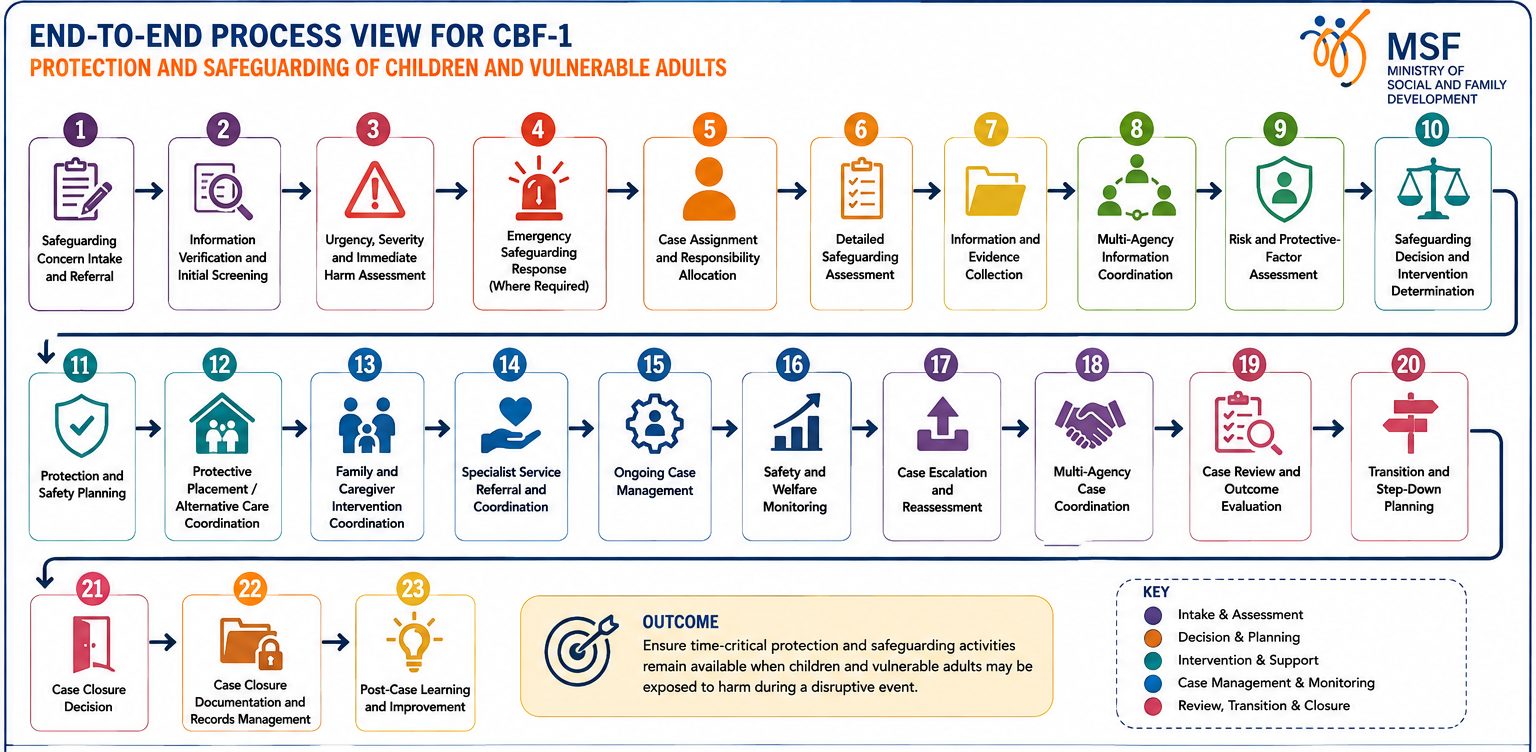
This end-to-end view is particularly important for BCM because the criticality of individual Sub-CBFs may differ significantly.
For example, Immediate Safety and Harm Assessment [1.5] and Emergency Safeguarding Response [1.6] may require near-immediate continuity during a disruption, whereas Post-Case Learning and Improvement [1.25] may tolerate a longer period of deferment.
BCM and BIA Application
The decomposition should next be used as the baseline for assessing each Sub-CBF individually. MSF should determine, among other considerations:

This prevents the BIA from treating the entire safeguarding function as though every activity has the same recovery priority.
![Banner [BCM] [E3] [BIA] [Summing Up] [P1] Identification of Critical Business Functions](https://no-cache.hubspot.com/cta/default/3893111/22330ab3-0a0f-4efd-9da7-43032e1e6573.png)
Decomposing CBF-1 Protection and Safeguarding of Children and Vulnerable Adults into Sub-Critical Business Functions provides MSF with a more precise understanding of how the critical function is delivered operationally and where continuity is most important.
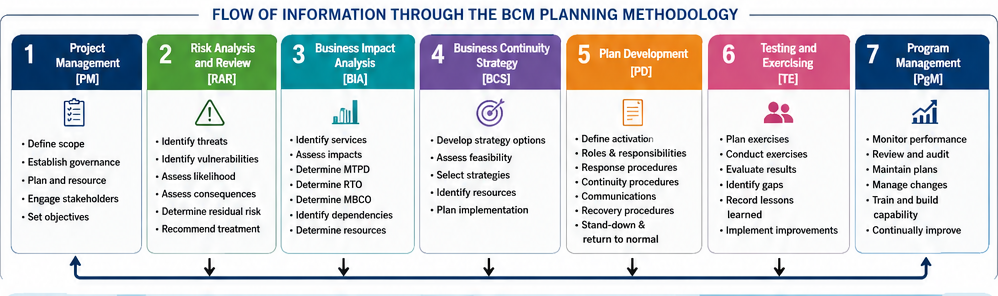
For Risk Analysis and Review (RAR), the decomposition helps identify vulnerabilities at individual process points.
MSF can examine threats such as workforce unavailability, loss of premises, ICT outages, cyber incidents, inaccessible case records, telecommunications failures, or disruptions to critical external partners, and determine which stages of the safeguarding lifecycle would be affected.
For the Business Impact Analysis (BIA), the Sub-CBFs provide the units of analysis for determining the consequences of disruption, assessing impact over time, establishing recovery priorities and defining recovery requirements.
Time-critical safeguarding activities can therefore be distinguished from those that can be temporarily deferred.
For Business Continuity Strategy (BCS) development, the Sub-CBF analysis enables targeted recovery solutions based on operational needs.
These may include alternate work arrangements, remote access, alternative communications, minimum staffing arrangements, manual workarounds, alternative access to critical records and pre-established arrangements with external service partners.
For Business Continuity (BC) Plan Development (PD), the process sequence establishes what must be continued, recovered, or temporarily modified during a disruption. Plans can specify activation priorities, minimum staffing, alternative procedures, escalation requirements, communication arrangements and recovery actions for the most time-sensitive safeguarding processes.
From a BCM and operational resilience perspective, the decomposition also reveals the interconnections among MSF personnel, information, technology, facilities, and external organisations required to deliver safeguarding outcomes end-to-end.
This makes it possible to identify concentration risks, single points of failure and dependencies that may not be apparent when CBF-1 is considered only at the high level.
The Sub-CBF structure should therefore serve as the foundation for subsequent BIA activities:
Detailed Processes → Impact Assessment → Recovery Requirements → Resource Dependencies → Continuity Strategies → Business Continuity Plans → Testing and Exercising → Continuous Improvement
For MSF, this level of analysis is especially important because the ultimate continuity objective is not merely to restore an administrative process. It is to ensure that time-critical protection and safeguarding activities remain available when children and vulnerable adults may be at risk of harm during a disruptive event.

![[BCM] [GEN 3] [3/4 Banner] Implementing Business Continuity Management](https://no-cache.hubspot.com/cta/default/3893111/19e85049-546e-4764-881b-f651277b16aa.png)
![[BCM] [MSF] [E3] [BIA] MBCO Corporate MBCO](https://no-cache.hubspot.com/cta/default/3893111/df142edf-fa83-4b06-a513-205224961dee.png)
![[BCM] [MSF] [E3] [BIA] [PS] Key Product and Services](https://no-cache.hubspot.com/cta/default/3893111/b6991006-bfc5-4675-9e0a-8619556731ae.png)
![[BCM] [MSF] [E3] [RAR] [T1] List of Threats](https://no-cache.hubspot.com/cta/default/3893111/ad5610b8-548a-441d-8050-72e6167b8489.png)
![[BCM] [MSF] [E3] [RAR] [T2] Treatment and Control](https://no-cache.hubspot.com/cta/default/3893111/440589ae-d0f5-498d-b0bd-832613fb7f25.png)
![[BCM] [MSF] [E3] [RAR] [T3] Risk Impact and Likelihood Assessment](https://no-cache.hubspot.com/cta/default/3893111/006518e1-2f11-4933-b5ec-4ef6b5143098.png)
![[BCM] [MSF] [E3] [BCS] [T1] Mitigation Strategies and Justification](https://no-cache.hubspot.com/cta/default/3893111/e8b54c7d-fa44-4b85-ae3a-46d1cde45eab.png)
![eBook Cover [BCM] [MSF] [E1] [2D]](https://no-cache.hubspot.com/cta/default/3893111/5c3ec6c4-2d26-4547-9637-4f25f5e4568b.png)
![[BCM] [MSF] [E3] [BIA] [T1] [CBF] [1] Protection and Safeguarding of Children and Vulnerable Adults](https://no-cache.hubspot.com/cta/default/3893111/160163a7-d47e-48da-a819-fe6f53fd9e15.png)
![[BCM] [MSF] [E3] [BIA] [T2] [CBF] [1] Protection and Safeguarding of Children and Vulnerable Adults](https://no-cache.hubspot.com/cta/default/3893111/c6118fc9-233e-49b1-9cde-a1b641a53363.png)
![[BCM] [MSF] [E3] [BIA] [T3] [CBF] [1] Protection and Safeguarding of Children and Vulnerable Adults](https://no-cache.hubspot.com/cta/default/3893111/d0fa86eb-c620-4a1d-9a08-48347df668e7.png)
![[BCM] [MSF] [E3] [BIA] [T4] [CBF] [1] Protection and Safeguarding of Children and Vulnerable Adults](https://no-cache.hubspot.com/cta/default/3893111/ec46b38e-d1d7-4c74-88d6-3780ffa2cb51.png)
![[BCM] [MSF] [E3] [BIA] [T6] [CBF] [1] Protection and Safeguarding of Children and Vulnerable Adults](https://no-cache.hubspot.com/cta/default/3893111/51b26e26-e899-44c3-b9d2-ef0d3e749ee0.png)
![eBook Cover [BCM] [MSF] [E2] [2D]](https://no-cache.hubspot.com/cta/default/3893111/d020550a-f6fc-4870-a77c-97836c002d89.png)
![[BCM] [MSF] [E3] [BIA] [T6] [CBF] [1] Protection and Safeguarding of Children and Vulnerable Adults](https://no-cache.hubspot.com/cta/default/3893111/4cd6308f-c371-4adf-a519-b59c62ff0287.png)
![[BCM] [MSF] [E3] [BCS] [T2] [CBF] [1] Protection and Safeguarding of Children and Vulnerable Adults](https://no-cache.hubspot.com/cta/default/3893111/f951ffe1-e1db-4961-928b-26d64c38b892.png)
![[BCM] [MSF] [E3] [BCS] [T3] [CBF] [1] Protection and Safeguarding of Children and Vulnerable Adults](https://no-cache.hubspot.com/cta/default/3893111/1c4e21d8-3f9e-4cc4-a00b-b48e6095c423.png)
![[BCM] [MSF] [E3] [PD] [CBF] [1] Protection and Safeguarding of Children and Vulnerable Adults](https://no-cache.hubspot.com/cta/default/3893111/fef99329-31b9-413f-ab49-c15915f01116.png)
![eBook Cover [BCM] [MSF] [E3] [2D]](https://no-cache.hubspot.com/cta/default/3893111/02b299f6-1895-4e59-900e-2dfcf5598c49.png)
More Information About Business Continuity Management Courses
To learn more about the course and schedule, click the buttons below for BCM-300 Business Continuity Management Implementer [BCM-3] and BCM-5000 Business Continuity Management Expert Implementer [BCM-5].


![Register [BL-B-3]*](https://no-cache.hubspot.com/cta/default/3893111/ac6cf073-4cdd-4541-91ed-889f731d5076.png)



![FAQ [BL-B-3]](https://no-cache.hubspot.com/cta/default/3893111/b3824ba1-7aa1-4eb6-bef8-94f57121c5ae.png)
![Email to Sales Team [BCM Institute]](https://no-cache.hubspot.com/cta/default/3893111/3c53daeb-2836-4843-b0e0-645baee2ab9e.png)


