



 eBook 1: Chapter 10
What are the Critical Business Functions for the Ministry of Social and Family Development
Introduction
 Identifying Critical Business Functions (CBFs) is a fundamental component of Business Continuity Management (BCM).
For the Ministry of Social and Family Development (MSF), this activity is particularly important because disruption to certain functions can extend beyond internal operational inconvenience.
It can affect vulnerable individuals, families requiring financial assistance, persons facing abuse or neglect, and other members of the community who depend on timely access to social and family services.
MSF's responsibilities span financial assistance and social support, residential and shelter support, protection from domestic violence, rehabilitation, disability services, support for families and parents, and strengthening of the social service sector.
Its Social Service Offices (SSOs), for example, provide financial and social support to individuals and families in need, while Family Service Centres (FSCs) provide community-based support to vulnerable individuals and families facing social and emotional issues.
The identification of CBFs should therefore answer a central BCM question:
Which MSF functions must be maintained, continued at an acceptable level, or recovered within defined timeframes because prolonged disruption would cause unacceptable consequences?
Under an ISO 22301-aligned Business Continuity Management System (BCMS), simply describing an activity as "important" is insufficient.
MSF should systematically assess the impact of disruption over time, set continuity and recovery priorities, understand dependencies, and establish appropriate recovery requirements.
This chapter provides an illustrative framework for identifying MSF's CBFs. The functions proposed are examples for BCM planning and educational purposes. They should not be interpreted as MSF's formally approved CBFs.
The final designation should result from MSF's own Business Impact Analysis (BIA), governance, and approval processes.
Understanding Critical Business Functions
A Critical Business Function is an activity, process, or function assessed as requiring priority for continuity or recovery because prolonged disruption could result in unacceptable impacts.
For MSF, these impacts could include:
- risk to life, safety or welfare;
- inability to protect vulnerable persons;
- interruption of essential financial assistance;
- inability to perform statutory responsibilities;
- disruption to residential or shelter arrangements;
- inability to access critical case information;
- failure to coordinate interventions with partner agencies;
- significant adverse effects on individuals and families;
- loss of public confidence;
- failure to meet government requirements; or
- significant operational, legal, financial or reputational consequences.
Criticality should therefore be determined through evidence rather than organisational hierarchy.
A large administrative function may have relatively generous recovery requirements, while a small function dealing with an urgent protection case could require extremely rapid continuity arrangements.
ISO 22301 Perspective
ISO 22301 requires an organisation to establish and maintain systematic processes to analyse business impacts and assess disruption risks.
Within an MSF context, the BIA should help determine:
MSF Services and Activities
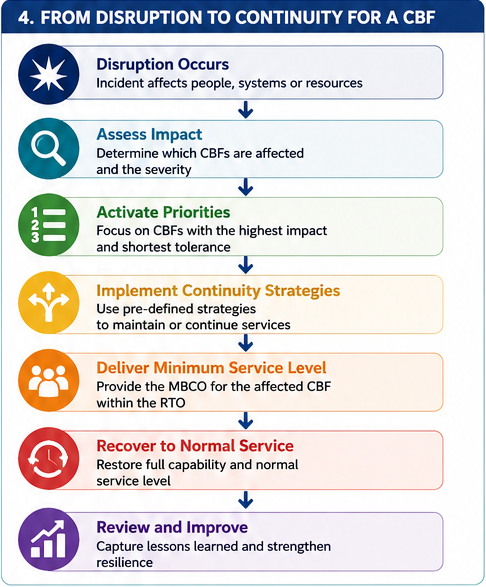
This matters because identifying a CBF should not be treated as a one-time management judgement.
The BIA provides the structured analysis needed to determine what needs to be recovered, by when, to what minimum level, and with which resources and dependencies.
Why Criticality Is Different for MSF
MSF's public-service mandate creates a different criticality profile from many commercial organisations.
For a commercial enterprise, a disruption might primarily be assessed in terms of financial loss, contractual obligations, and customer impact.
For MSF, these remain relevant considerations, but the potential consequences can also include social harm, safety and welfare consequences and interruption to assistance for vulnerable persons.
This is especially evident in protection services. MSF's Protective Service oversees cases involving high safety and risk concerns where statutory intervention may be required. MSF works with community agencies and other partners across a tiered protective system.
The National Anti-Violence and Sexual Harassment Helpline (NAVH), which receives reports relating to child abuse, adult abuse and domestic violence, operates 24 hours a day.
This illustrates an important BCM principle:
Criticality should reflect the consequences of an interruption for the people who depend on the service, not merely the operational importance of the department that provides it.
Criteria for Identifying MSF's Critical Business Functions
MSF could adopt a multidimensional set of impact criteria when evaluating its business functions.
1. Life, Safety and Welfare Impact
Would disruption place children, vulnerable adults, families or other persons at increased risk?
2. Social Impact
Would interruption significantly affect individuals or families requiring essential social assistance or intervention?
3. Statutory and Government Obligations
Would disruption prevent MSF from performing functions required by legislation, government policy or formal responsibilities?
4. Financial Impact on Beneficiaries
Could interruption prevent or delay essential financial assistance to households that depend upon it for basic needs?
ComCare, for example, supports Singaporeans and families who require financial assistance with basic needs.
MSF's SSOs assess applicants' circumstances and provide financial assistance while connecting them with community support where required. (MSF Development)
5. Service Delivery Impact
How many individuals, households or partner organisations would be affected?
6. Reputational and Public Confidence Impact
Could prolonged interruption significantly undermine confidence in MSF or government social-support arrangements?
7. Interdependency Impact
Would failure of the function cause other critical MSF functions or external partner services to fail?
8. Time Sensitivity
How quickly would the impact become unacceptable?
This final question is particularly important. Two functions can both be critical while requiring very different recovery times.
Critical Business Functions for MSF
Based on MSF's publicly described responsibilities, the following functions provide an initial CBF catalogue for subsequent BIA and BCM planning.
|
CBF |
Critical Business Function |
Why It May Be Critical |
Illustrative BCM Priority |
|
CBF-1 |
Protection and Safeguarding of Children and Vulnerable Adults |
Delays in assessment or intervention could expose vulnerable persons to continuing harm |
Very High |
|
CBF-2 |
Anti-Violence, Abuse and Neglect Reporting and Referral |
Reports involving abuse, neglect and family violence may require urgent assessment and escalation |
Very High |
|
CBF-3 |
Emergency Protection and Safety Intervention |
High-risk cases may require immediate coordination, statutory intervention or alternative care |
Very High |
|
CBF-4 |
ComCare Financial Assistance Administration |
Disruption could delay assistance required by lower-income households for basic living needs |
High |
|
CBF-5 |
Social Service Office Case Assessment and Support |
SSOs provide financial and social support and connect clients with community resources |
High |
|
CBF-6 |
Critical Social and Family Case Management |
Interruption could affect ongoing intervention for vulnerable individuals and families |
High |
|
CBF-7 |
Residential, Shelter and Alternative Care Coordination |
Disruption could affect individuals requiring safe accommodation, care or protection |
Very High/High |
|
CBF-8 |
Critical Family Support and Intervention Services |
Selected families may require time-sensitive intervention, counselling, referral or coordination |
High |
|
CBF-9 |
Disability Support and Critical Service Coordination |
Prolonged disruption may affect persons with disabilities and caregivers dependent on coordinated support |
High |
|
CBF-10 |
Critical Case Information and Records Availability |
Protection, financial assistance and case-management decisions depend upon timely access to accurate information |
Very High |
|
CBF-11 |
Critical Digital Social Service Platforms and E-Services |
Digital channels support public access to information, applications and services |
High |
|
CBF-12 |
Social Support Enquiry and Referral Services |
Individuals requiring assistance need continued access to information and referral channels |
High |
|
CBF-13 |
Inter-agency and Social Service Partner Coordination |
Many MSF outcomes depend upon government agencies, Social Service Agencies and community partners |
High |
|
CBF-14 |
Emergency and Crisis Coordination |
Major incidents require prioritisation, escalation, situational awareness and coordinated response |
Very High |
|
CBF-15 |
Public and Stakeholder Crisis Communication |
Service users and partners need accurate information about disruptions and alternative arrangements |
High |
Important: The priority classifications above are illustrative only. MSF should determine actual criticality and recovery requirements through its formal BIA.
Example: Protection and Safeguarding
CBF-1 – Protection and Safeguarding of Children and Vulnerable Adults provides a useful example of how to assess criticality.
MSF's Protective Service handles high-risk child protection cases and has statutory responsibilities regarding serious safety concerns.
For vulnerable adults, MSF describes cases involving significant safety and risk concerns in which statutory intervention may be necessary to protect the individual. (MSF Development)
Consider a disruption affecting:
Protective Service personnel
→ Case management system
→ Case information
→ Communications
→ Police/partner coordination
→ Assessment capability
→ Safety intervention
The BCM issue is therefore not simply whether an MSF office is available.
MSF needs to understand whether protection officers can still:
- receive urgent referrals;
- access essential case information;
- assess safety and risk;
- communicate securely;
- coordinate with the Police and community partners;
- authorise or initiate appropriate interventions; and
- maintain continuity of high-risk cases.
The service outcome—protecting vulnerable persons—should remain the focus of continuity planning.
Example: Anti-Violence and Abuse Reporting
CBF-2 – Anti-Violence, Abuse and Neglect Reporting and Referral may warrant particularly demanding continuity arrangements.
The NAVH operates around the clock for reporting child abuse, adult abuse and domestic violence-related matters. (MSF Development)
A continuity assessment should therefore consider scenarios such as:
Telecommunications Failure
→ Public Cannot Reach Normal Helpline
→ Reports Cannot Be Received Normally
→ Alternative Reporting Channel Activated
→ Reports Triaged and Escalated
→ Critical Cases Referred for Intervention
The BCM strategy may require alternative telecommunications, alternate work locations, remote-access capability, redundant reporting channels, trained backup personnel, and predefined escalation arrangements.
The goal is not merely to restore the telephone system. The goal is to maintain the capability to receive and act upon urgent protection concerns.
Example: ComCare Financial Assistance
CBF-4 – ComCare Financial Assistance Administration demonstrates a different type of criticality.
MSF's SSOs administer assistance and assess households based on their circumstances and needs. (MSF Development) ComCare provides financial assistance for basic needs such as food, transport and household bills. (MSF Development)
Consider a prolonged ICT outage:
ComCare Application/Case System Unavailable
→ Assessment Information Becomes Difficult to Access
→ Applications Cannot Be Processed Normally
→ Assistance May Be Delayed
→ Affected Households May Experience Hardship
Continuity strategies could therefore include:
- prioritisation criteria for urgent cases;
- alternative case-assessment procedures;
- controlled offline documentation;
- alternative authorisation procedures;
- backup access to essential beneficiary information;
- alternative payment-processing arrangements; and
- reconciliation procedures when normal systems are restored.
The appropriate arrangements would need to balance speed, control, privacy, fraud prevention and beneficiary needs.
Understanding Dependencies and Interdependencies
Identifying a CBF is only the beginning.
MSF should determine what each CBF depends upon.
A useful dependency model is:
Critical Business Function
→ People
→ Premises
→ Technology
→ Information and Data
→ Communications
→ Suppliers and Service Providers
→ Government Agencies
→ Social Service Agencies and Community Partners
For example, the continuity of protection services may depend on MSF personnel, secure communications, case records, transport, Police coordination, healthcare providers, Social Service Agencies and alternative-care providers.
MSF's protective system explicitly operates across a network that includes community agencies, schools, hospitals, polyclinics, Social Service Offices, Family Service Centres, disability and eldercare services, and specialist agencies. (MSF Development)
This means that MSF can remain operational internally yet still experience a business continuity failure when a critical external dependency becomes unavailable.
Identifying Single Points of Failure
Dependency mapping should also identify Single Points of Failure (SPOFs).
Examples could include:
- only one system supporting a critical case-management activity;
- only one communication channel for an important service;
- specialist knowledge concentrated in a small number of employees;
- dependence on one location;
- reliance on one service provider;
- absence of an alternative authorisation mechanism;
- dependency on a single data source; or
- a critical external partner without tested continuity arrangements.
A practical question for every MSF CBF is:
If this resource were to become completely unavailable tomorrow, could the critical function still be delivered at an acceptable minimum level?
If the answer is no, MSF has identified a potential continuity vulnerability.
From Critical Business Function to Recovery Requirements
Once MSF identifies CBFs, it should establish recovery requirements through the BIA.
The analysis should progressively determine:
Critical Business Function
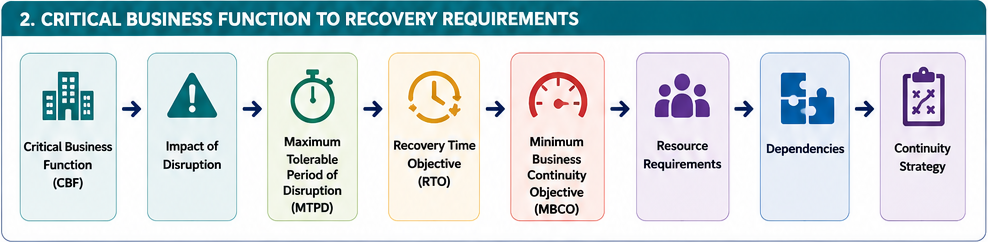
For example, the BIA may determine that a particular protection activity cannot tolerate the same recovery period as a routine administrative reporting process.
Similarly, the required service level during a disruption may differ from that during normal operations. MSF may not need to deliver 100% of normal capacity immediately.
It may instead establish a Minimum Business Continuity Objective that protects the most urgent cases until normal capacity is restored.
Prioritising People, Not Just Processes
An important principle for MSF is that business continuity priorities should reflect beneficiary vulnerability and potential harm, not simply transaction volume.
A function that processes thousands of routine transactions may have a significant operational impact.
However, a function handling relatively few urgent protection cases could have a much greater impact on life, safety, and welfare.
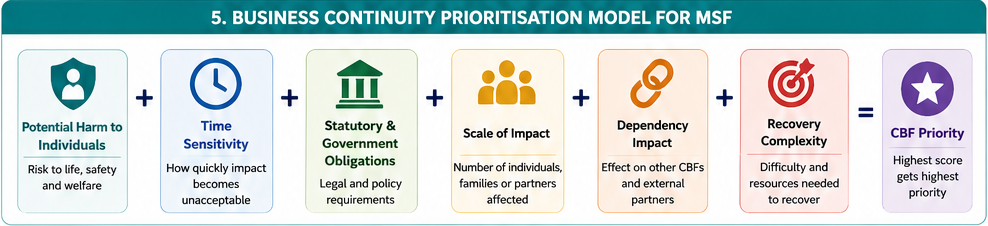
An illustrative prioritisation model could therefore consider:
Potential Harm to Individuals + Time Sensitivity + Statutory Obligation + Scale of Impact + Dependency Impact + Recovery Complexity
This provides a more appropriate basis for a social-sector organisation than prioritising functions primarily according to financial impact.
Critical Business Functions During a Widespread Crisis
Criticality can also vary depending on the nature of the disruption.
During a severe economic disruption, for example, demand for financial assistance may increase.
MSF demonstrated this dynamic in 2026 by temporarily enhancing ComCare assistance for lower-income households affected by higher costs stemming from uncertainties in the global economic environment.
Similarly:
Pandemic
→ workforce availability and community service delivery may become dominant concerns.
Cyberattack
→ case information, digital platforms and communications may become immediate priorities.
Major infrastructure outage
→ premises, telecommunications and technology dependencies may dominate.
Large-scale community emergency
→ social assistance, shelter, protection and partner coordination may experience simultaneous increases in demand.
The CBF catalogue should therefore be sufficiently robust to support multiple severe but plausible disruption scenarios.
Governance and Approval
CBF identification should not remain solely within the BCM team.
Business and service owners should validate:
- function descriptions;
- disruption impacts;
- time sensitivity;
- resource requirements;
- internal dependencies;
- external dependencies;
- minimum operating requirements; and
- proposed recovery priorities.
Senior management should ultimately review and approve the resulting prioritisation in accordance with MSF's governance framework.
This establishes organisational accountability for decisions concerning what must be protected and recovered first.
Maintaining the CBF Catalogue
MSF's CBF catalogue should be treated as a living BCM resource.
It should be reviewed when there are significant changes involving:
- legislation or government policy;
- organisational responsibilities;
- new social programmes;
- service-delivery models;
- digital transformation;
- critical technology;
- outsourcing;
- Social Service Agency arrangements;
- facilities;
- organisational restructuring;
- significant incidents; or
- lessons identified through exercises.
A function that was non-critical several years ago may become critical as public reliance on a digital service increases.
Conversely, process redesign or automation may change an existing function's recovery requirements.
Illustrative MSF CBF Hierarchy
A useful way of organising MSF's criticality analysis is to move from organisational purpose to individual resources:
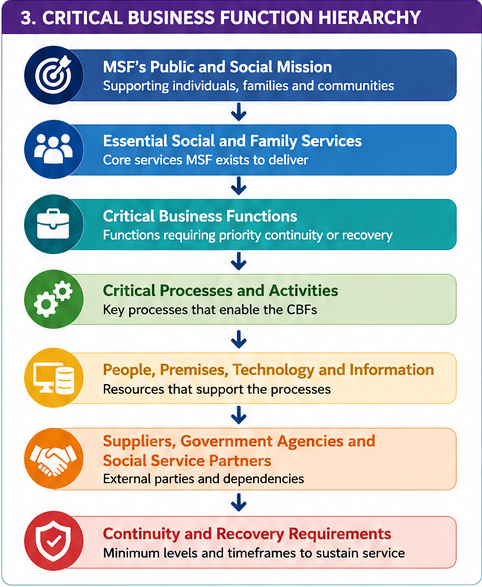
This prevents BCM from beginning at too low a level.
The question should not be, "Which server is critical?" initially.
It should be:
"Which MSF service is critical, which business functions enable it, and which technology—including that server—is required to maintain those functions?"
That distinction is fundamental to effective business continuity planning.
![Banner [Summary] [BCM] [E1] [C10] Identifying Critical Business Functions](https://no-cache.hubspot.com/cta/default/3893111/0e59113c-d17a-48a8-8c28-bb1bcf487857.png)
Identifying Critical Business Functions bridges understanding MSF as an organisation and implementing practical continuity arrangements.
For the Ministry of Social and Family Development, view criticality through a public-service and social-impact lens.
MSF's responsibilities include financial and social assistance, protection, family support, residential and shelter support, disability services and strengthening Singapore's broader social service ecosystem.
The Ministry's operating model also demonstrates significant interdependency. SSOs provide financial and social support, FSCs support vulnerable individuals and families, and MSF's protective system operates through networks of government and community partners.
Consequently, identifying CBFs should not become an exercise in simply producing a list of important departments.
MSF should systematically determine:
What services matter most?
↓
Who could be harmed by their disruption?
↓
Which functions enable those services?
↓
How quickly would disruption become unacceptable?
↓
What resources and dependencies support them?
↓
What minimum level must be maintained?
↓
How quickly must they be recovered?
The illustrative CBF catalogue in this chapter provides a starting point for that analysis.
The final catalogue, priorities and recovery requirements should be validated through MSF's formal Business Impact Analysis and approved through the Ministry's BCM governance arrangements.
For MSF, the ultimate objective is not merely to recover business processes.
It is to preserve the Ministry's ability to support people, protect vulnerable individuals and families, maintain essential social services, and coordinate Singapore's social support ecosystem during disruptions.
Identify what is critical → Understand the impact → Map the dependencies → Establish recovery priorities → Build continuity capability.

![[BCM] [GEN 3] [3/4 Banner] Implementing Business Continuity Management](https://no-cache.hubspot.com/cta/default/3893111/19e85049-546e-4764-881b-f651277b16aa.png)

![[BCM] [MSF] [E1] [C2] Understanding Your Organisation.jpg](https://no-cache.hubspot.com/cta/default/3893111/c0c985ce-2546-402e-85b6-bf956a226577.png)
![[BCM] [MSF] [E1] [C3] Establishing Organisational Goals](https://no-cache.hubspot.com/cta/default/3893111/ceb9435f-b4fd-4949-b6fd-48c33734b06c.png)
![[BCM] [MSF] [E1] [C4] Establishing Business Continuity Objectives](https://no-cache.hubspot.com/cta/default/3893111/1767bd05-6686-4bbb-9d74-59e31cddca29.png)
![[BCM] [MSF] [E1] [C5] Determining BC Assumptions](https://no-cache.hubspot.com/cta/default/3893111/b1a1dade-e918-4e04-9bfd-ea954635d59e.png)
![[BCM] [MSF] [E1] [C6] Composing BCM Team](https://no-cache.hubspot.com/cta/default/3893111/fe457c8c-a047-42cd-85b7-0bb3cdcffcd4.png)
![[BCM] [MSF] [E1] [C7] Analysing Operating Environment](https://no-cache.hubspot.com/cta/default/3893111/e3ba8ba5-4474-4148-88f8-28b38a11c48a.png)
![[BCM] [MSF] [E1] [C8] Implementing the BCM Planning Methodology](https://no-cache.hubspot.com/cta/default/3893111/89151394-7af8-46ab-bae0-89c630c8936c.png)
![[BCM] [MSF] [E1] [C9] Assessing Risks and Threats](https://no-cache.hubspot.com/cta/default/3893111/36bec971-89e7-4abc-86ad-3d51a9082a73.png)
![[BCM] [MSF] [E1] [C11] Summary](https://no-cache.hubspot.com/cta/default/3893111/e279189c-cb31-42a4-9eae-2a6969206af3.png)
![[BCM] [MSF] [E1] [C12] Back Cover](https://no-cache.hubspot.com/cta/default/3893111/fd4a1eb9-49b2-4624-8273-79e71ed6f401.png)
More Information About Business Continuity Management Courses
To learn more about the course and schedule, click the buttons below for BCM-300 Business Continuity Management Implementer [BCM-3] and BCM-5000 Business Continuity Management Expert Implementer [BCM-5].


![Register [BL-B-3]*](https://no-cache.hubspot.com/cta/default/3893111/ac6cf073-4cdd-4541-91ed-889f731d5076.png)



![FAQ [BL-B-3]](https://no-cache.hubspot.com/cta/default/3893111/b3824ba1-7aa1-4eb6-bef8-94f57121c5ae.png)
![Email to Sales Team [BCM Institute]](https://no-cache.hubspot.com/cta/default/3893111/3c53daeb-2836-4843-b0e0-645baee2ab9e.png)


