---
title: [BCM] [MOM] [E4] [CR] [BIA] [P3-1] Impact Over Time of Business Functions
description: [BCM] [MOM] [E4] [CR] [BIA] [P3-1] Impact Over Time of Business Functions
image: https://blog.bcm-institute.org/hubfs/Ministry%20of%20Manpower%20Graphic%20Folder/MOM%20E4%20Consolidate%20Report%20Morepost/%5BBCM%5D%20%5BMOM%5D%20%5BE4%5D%20%5BCR%5D%20%5BBIA%5D%20%5BP3%5D%20Impact%20Over%20Time%20of%20Business%20Function%20for%20CBF.jpg
---
.
[](http://www.bcm-institute.org/)
- [Home](https://www.bcm-institute.org/)
- [About Us](https://www.bcm-institute.org/about-us-3/)
- [A President’s Perspective](https://www.bcm-institute.org/about-us/a-presidents-perspective/)
- [Our History](https://www.bcm-institute.org/about-us/our-history/)
- [Our Advisory Council](https://www.bcm-institute.org/about-us/our-advisory-council/)
- [Customers’ Testimonials](https://www.bcm-institute.org/about-us/customers-testimonials/)
- [Credential Verification](https://www.bcm-institute.org/about-us/credential-verification/)
- [Courses](https://blog.bcm-institute.org/blog/course-fees-for-blended-learning-courses-master-catalog)
- [ISO 22301 Business Continuity Management System Audit](https://blog.bcm-institute.org/audit/business-continuity-management-audit-courses)
- [ISO 22301 Business Continuity Management](https://blog.bcm-institute.org/bcm/business-continuity-management-courses)
- [Crisis Communication](https://blog.bcm-institute.org/crisis-communication/crisis-communication-courses)
- [Crisis Management](https://blog.bcm-institute.org/en/crisis-management/courses)
- [IT Disaster Recovery](https://blog.bcm-institute.org/it-disaster-recovery/courses)
- [Operational Resilience](https://blog.bcm-institute.org/operational-resilience/courses)
- [Operational Resilience Audit](https://blog.bcm-institute.org/operational-resilience-audit/courses)
- [Certification](https://blog.bcm-institute.org/certification/types-of-certifications-offered)
- [ISO 22301 BCMS Audit Certification](https://blog.bcm-institute.org/certification/business-continuity-management-audit-certification)
- [ISO22301 Business Continuity Management Certification](https://blog.bcm-institute.org/bcm/business-continuity-management-certification)
- [Crisis Communication Certification](https://blog.bcm-institute.org/crisis-communication/crisis-communication-certification)
- [Crisis Management Certification](https://blog.bcm-institute.org/en/crisis-management/crisis-management-certification)
- [IT Disaster Recovery Planning Certification](https://blog.bcm-institute.org/it-disaster-recovery/it-disaster-recovery-certification)
- [Operational Resilience Certification](https://blog.bcm-institute.org/operational-resilience/operational-resilience-certification)
- [Operational Resilience Audit Certification](https://blog.bcm-institute.org/operational-resilience-audit)
- [Seminars](https://blog.bcm-institute.org/meet-the-expert/mte-webinar-mainpage)
- [Store](https://www.bcm-institute.org/store-2/)
- [Contact Us](http://www.bcm-institute.org/about-us/contact-us/)
-
-
##### Ebook Series

# \[BCM\] \[MOM\] \[E4\] \[CR\] \[BIA\] \[P3-1\] Impact Over Time of Business Functions
[](https://cta-redirect.hubspot.com/cta/redirect/3893111/8c9d094e-b019-4313-b949-b3f9b287beb1)
Part 3-1: Impact Over Time of Business Functions for CBF-1 to CBF-6 for the Ministry of Manpower (MOM) presents a structured, time-based analysis of how incident duration affects MOM’s critical business functions.
By examining impact levels across defined time horizons—from the first four hours through sixty days—this chapter shows that the consequences of service unavailability are not static but intensify over time.
The consolidated assessment across CBF-1 to CBF-6 highlights how regulatory, operational, strategic, and reputational impacts manifest differently depending on the function and the duration of disruption.
The purpose of this chapter is to provide decision-makers, BCM practitioners, and operational leaders with a common, evidence-based understanding of when and why specific MOM functions must be prioritised for recovery
[![Banner \[BCM\] \[E3\] \[BIA\] \[P3\] Impact Over Time of Business Functions](https://no-cache.hubspot.com/cta/default/3893111/bc131ed6-ca92-4253-8940-2f98dad34599.png)](https://cta-redirect.hubspot.com/cta/redirect/3893111/bc131ed6-ca92-4253-8940-2f98dad34599)
[Dr Goh Moh Heng](https://blog.bcm-institute.org/ebook/author/dr-goh-moh-heng) Jan 11, 2026
###### Business Continuity Management Certified Planner-Specialist-Expert
[](https://cta-redirect.hubspot.com/cta/redirect/3893111/b6d9d894-8ae4-44fb-8bac-fc8128f9c44d)
[](https://cta-redirect.hubspot.com/cta/redirect/3893111/a1b4b4e2-f0aa-44df-a197-431397a7927c)
[](https://cta-redirect.hubspot.com/cta/redirect/3893111/326c85d5-f1af-4a99-9f0e-0072cfcad36a)
### [![Banner \[BCM\] \[E3\] \[BIA\] \[P3\] Impact Over Time of Business Functions](https://no-cache.hubspot.com/cta/default/3893111/bc131ed6-ca92-4253-8940-2f98dad34599.png)](https://cta-redirect.hubspot.com/cta/redirect/3893111/bc131ed6-ca92-4253-8940-2f98dad34599)Consolidated Report
### BIAQ Part 3-1: Impact Over Time of Business Functions for CBF-1 to CBF-6
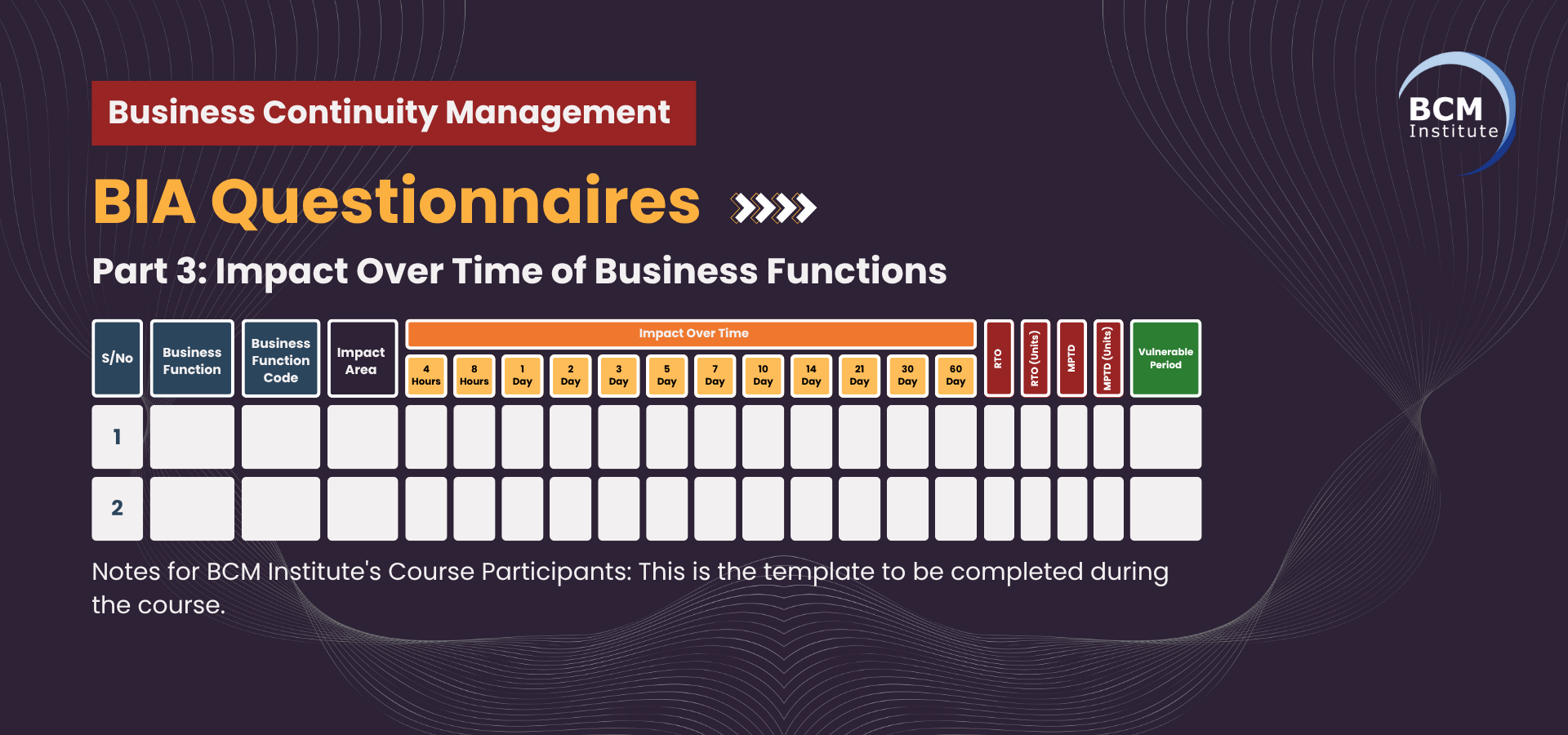
[![\[BCM\] \[MOM\] \[E4\] \[CR\] \[BIA\] \[P3-1\] Impact Over Time of Business Function for CBF](https://no-cache.hubspot.com/cta/default/3893111/c236049e-9639-402a-ad16-fa0a21b2d979.png)](https://cta-redirect.hubspot.com/cta/redirect/3893111/c236049e-9639-402a-ad16-fa0a21b2d979) presents a structured, time-based analysis of how disruptions affect MOM’s critical business functions as incident duration increases.
By examining impact levels across defined time horizons—from the first four hours through sixty days—this chapter shows that the consequences of service unavailability are not static but intensify over time.
The consolidated assessment across CBF-1 to CBF-6 highlights how regulatory, operational, strategic, and reputational impacts manifest differently depending on the nature of the function and the length of disruption.
The purpose of this chapter is to provide decision-makers, BCM practitioners, and operational leaders with a common, evidence-based understanding of when and why specific MOM functions must be prioritised for recovery.
Before proceeding to the subsequent sections on recovery strategies and continuity planning, readers are expected to understand the rationale for time-criticality, impact escalation, and tolerance thresholds for each Sub-CBF.
This chapter, therefore, establishes the analytical foundation for setting recovery time objectives (RTOs), allocating resources effectively, and justifying continuity investments based on measured operational and strategic risk.
[](https://cta-redirect.hubspot.com/cta/redirect/3893111/4aefbd04-254a-4943-ae02-01465d10aab9)
###### Table P3-1: Impact Over Time of Business Functions for CBF-1 to CBF-6
| Sub-CBF Code | Sub-CBF | Highest Impact Area | 4 hr | 8 hr | 1 Day | 2 Day | 3 Day | 5 Day | 7 Day | 10 Day | 14 Day | 21 Day | 30 Day | 60 Day |
| --- | --- | --- | --- | --- | --- | --- | --- | --- | --- | --- | --- | --- | --- | --- |
| 1.1 | Policy & Regulation Design | National Labour Policy Integrity | 1 | 1 | 2 | 2 | 3 | 3 | 3 | 4 | 4 | 4 | 5 | 5 |
| 1.2 | Licensing & Permits | Employer & Worker Compliance | 2 | 3 | 3 | 4 | 4 | 5 | 5 | 5 | 5 | 5 | 5 | 5 |
| 1.3 | Inspections, Monitoring & Investigation | Employment Standards & Safety | 2 | 3 | 4 | 4 | 4 | 5 | 5 | 5 | 5 | 5 | 5 | 5 |
| 1.4 | Adjudication & Dispute Resolution | Industrial Harmony | 2 | 2 | 3 | 3 | 4 | 4 | 4 | 5 | 5 | 5 | 5 | 5 |
| 1.5 | Enforcement Actions & Sanctions | Compliance Credibility | 3 | 3 | 4 | 4 | 5 | 5 | 5 | 5 | 5 | 5 | 5 | 5 |
| 1.6 | Stakeholder Engagement & Education | Public Confidence | 1 | 2 | 2 | 3 | 3 | 3 | 4 | 4 | 4 | 5 | 5 | 5 |
| 1.7 | Regulatory Intelligence & Risk Management | Labour Market Stability | 1 | 2 | 2 | 3 | 3 | 4 | 4 | 4 | 5 | 5 | 5 | 5 |
| 2.1 | Policy & Planning | Workforce Policy Integrity | 2 | 3 | 4 | 4 | 4 | 4 | 4 | 4 | 3 | 3 | 3 | 3 |
| 2.2 | Work Pass Application & Issuance | Processing & Issuance Delays | 3 | 4 | 5 | 5 | 5 | 5 | 5 | 5 | 4 | 4 | 3 | 3 |
| 2.3 | Arrival, Onboarding & Deployment | Workforce Supply Continuity | 4 | 5 | 5 | 5 | 5 | 5 | 5 | 5 | 4 | 4 | 3 | 3 |
| 2.4 | Monitoring, Compliance & Enforcement | Regulatory Compliance | 3 | 4 | 5 | 5 | 5 | 5 | 5 | 5 | 4 | 4 | 4 | 3 |
| 2.5 | Renewal, Transfer & Exit Management | Worker Status Continuity | 3 | 3 | 4 | 5 | 5 | 5 | 5 | 5 | 4 | 3 | 3 | 2 |
| 2.6 | Support Services & Well-being | Worker Welfare & Health | 2 | 3 | 4 | 4 | 4 | 4 | 4 | 4 | 3 | 3 | 2 | 1 |
| 3.1 | Policy & Standards Development | Legal & Reputational | 1 | 1 | 2 | 2 | 2 | 3 | 3 | 3 | 4 | 4 | 4 | 5 |
| 3.2 | Legislative & Regulatory Oversight | Legal Compliance | 1 | 2 | 2 | 3 | 3 | 4 | 4 | 4 | 5 | 5 | 5 | 5 |
| 3.3 | Risk-Based Inspections & Enforcement | Safety & Legal | 2 | 3 | 3 | 4 | 4 | 5 | 5 | 5 | 5 | 5 | 5 | 5 |
| 3.4 | Monitoring & Surveillance Programmes | Safety & Operations | 1 | 2 | 2 | 3 | 3 | 4 | 4 | 4 | 5 | 5 | 5 | 5 |
| 3.5 | Accident Reporting & Investigation | Safety & Reputation | 3 | 4 | 4 | 5 | 5 | 5 | 5 | 5 | 5 | 5 | 5 | 5 |
| 3.6 | Stakeholder Engagement & Education | Social & Reputational | 1 | 1 | 2 | 2 | 3 | 3 | 3 | 4 | 4 | 4 | 4 | 5 |
| 3.7 | Certification & Registration | Operational & Legal | 1 | 2 | 2 | 3 | 3 | 4 | 4 | 4 | 4 | 5 | 5 | 5 |
| 3.8 | Performance Monitoring & Reporting | Governance & Reputation | 1 | 1 | 2 | 2 | 2 | 3 | 3 | 3 | 4 | 4 | 5 | 5 |
| 4.1 | Labour Market Analysis & Forecasting | Labour market trends & policy planning | 3 | 3 | 4 | 4 | 4 | 5 | 5 | 5 | 5 | 5 | 5 | 5 |
| 4.2 | Job Matching & Placement Services | Employment outcomes & placement rates | 4 | 4 | 5 | 5 | 5 | 5 | 5 | 5 | 5 | 5 | 5 | 5 |
| 4.3 | Work Pass & Foreign Talent Policy Services | Work pass approvals & compliance | 5 | 5 | 5 | 5 | 5 | 5 | 5 | 5 | 5 | 5 | 5 | 5 |
| 4.4 | Skills Development & Transition Support | Training program delivery & outcomes | 3 | 4 | 4 | 4 | 4 | 5 | 5 | 5 | 5 | 5 | 5 | 5 |
| 4.5 | Incentives & Employment Support Schemes | Timely disbursement & scheme uptake | 4 | 4 | 5 | 5 | 5 | 5 | 5 | 5 | 5 | 5 | 5 | 5 |
| 4.6 | Stakeholder Engagement & Tripartism | Partner coordination & agreements | 3 | 3 | 4 | 4 | 4 | 5 | 5 | 5 | 5 | 5 | 5 | 5 |
| 4.7 | Monitoring & Rapid Response | Labour market interventions & alerts | 5 | 5 | 5 | 5 | 5 | 5 | 5 | 5 | 5 | 5 | 5 | 5 |
| 4.8 | BCM Integration & Continuity Processes | Continuity of employment facilitation | 4 | 4 | 5 | 5 | 5 | 5 | 5 | 5 | 5 | 5 | 5 | 5 |
| 5.1 | Labour Market Analysis | Strategic Decision-Making | 1 | 1 | 2 | 2 | 3 | 3 | 4 | 4 | 4 | 5 | 5 | 5 |
| 5.2 | Policy Development & Formulation | Strategic & Reputational | 1 | 2 | 2 | 3 | 3 | 4 | 4 | 4 | 5 | 5 | 5 | 5 |
| 5.3 | Workforce Planning & Modelling | Strategic Workforce Resilience | 1 | 1 | 2 | 2 | 3 | 3 | 4 | 4 | 4 | 5 | 5 | 5 |
| 5.4 | Stakeholder Consultation | Regulatory Confidence | 1 | 2 | 2 | 3 | 3 | 3 | 4 | 4 | 4 | 5 | 5 | 5 |
| 5.5 | Policy Implementation Planning | Operational Readiness | 1 | 1 | 2 | 2 | 3 | 3 | 4 | 4 | 4 | 5 | 5 | 5 |
| 5.6 | Monitoring & Evaluation | Compliance Assurance | 1 | 1 | 2 | 2 | 2 | 3 | 3 | 4 | 4 | 4 | 5 | 5 |
| 5.7 | BCM Integration & Contingency Policies | Organisational Resilience | 1 | 1 | 1 | 2 | 2 | 3 | 3 | 4 | 4 | 4 | 5 | 5 |
| 6.1 | Governance & Strategic Planning | Leadership Continuity | 3 | 4 | 5 | 5 | 5 | 4 | 4 | 3 | 3 | 2 | 2 | 1 |
| 6.2 | Financial Management | Budget & Resource Control | 4 | 4 | 5 | 5 | 4 | 3 | 3 | 2 | 2 | 1 | 2 | — |
| 6.3 | Human Resource Continuity | Workforce Availability | 2 | 3 | 4 | 4 | 4 | 3 | 2 | 2 | 1 | 1 | 1 | — |
| 6.4 | Procurement & Contract Management | Supply Chain Continuity | 3 | 3 | 4 | 4 | 4 | 3 | 2 | 2 | 2 | 1 | 1 | 4 |
| 6.5 | IT Infrastructure & Digital Services | System Availability | 5 | 5 | 5 | 5 | 4 | 4 | 3 | 2 | 2 | 2 | 1 | 5 |
| 6.6 | Administration & Facilities Management | Operational Support | 3 | 3 | 4 | 4 | 3 | 2 | 2 | 2 | 1 | 1 | 2 | — |
##### Legend – Impact Scores
- 1 = Negligible Impact (Very Low)
- 2 = Minor Impact (Low)
- 3 = Moderate Impact (Medium)
- 4 = Major Impact (High)
- 5 = Critical/Catastrophic Impact (Very High)
[![Banner \[BCM\] \[E3\] \[BIA\] \[Summing Up\] \[P3\] Impact Over Time of Business Functions \[BIAQ\]](https://no-cache.hubspot.com/cta/default/3893111/987f8ca5-0ba4-4281-be57-5221186733d0.png)](https://cta-redirect.hubspot.com/cta/redirect/3893111/987f8ca5-0ba4-4281-be57-5221186733d0)In conclusion for Part 3-1, the Impact Over Time analysis for CBF-1 to CBF-6 demonstrates that MOM’s ability to regulate the labour market, manage foreign manpower, safeguard workplace safety, sustain employment facilitation, and support operations through corporate and IT services is highly time-sensitive.
While some functions experience manageable impacts in the initial hours of disruption, prolonged outages rapidly escalate into severe regulatory, safety, economic, and reputational consequences.
This reinforces the importance of understanding not only which functions are critical but also how quickly their disruption becomes unacceptable.
By consolidating and standardising impact assessments across all major business functions, this chapter provides a clear and defensible basis for continuity planning and crisis decision-making.
The insights derived here guide the prioritisation of recovery efforts, inform the design of proportionate continuity strategies, and ensure that MOM remains resilient in fulfilling its mandate to protect workers, employers, and the broader labour market under adverse conditions.
[](https://cta-redirect.hubspot.com/cta/redirect/3893111/e58ac134-028b-48aa-8c19-c78eb59b6fc2)
| **Resilient Support: Implementing Business Continuity Management at the Ministry of Manpower** | | | |
| --- | --- | --- | --- |
| **eBook 4: Consolidate and Report Your BCM Implementation** | | | |
| **Consolidated Report for BIAQ (Part 1 to Part 6) for CBF-1 to CBF-6** | | | |
| **PM: BIA** | **BIAQ T1 P1** | **BIAQ T1 P2** | **BIAQ T2 P3-1** |
| **Consolidated Report for BIAQ (Part 1 to Part 6)** | [![\[BCM\] \[MOM\] \[E4\] \[CR\] \[BIA\] \[P1\] Identification of Business Functions for CBF](https://no-cache.hubspot.com/cta/default/3893111/28dfbd64-fe01-49b2-923b-bbdbce0f239c.png)](https://cta-redirect.hubspot.com/cta/redirect/3893111/28dfbd64-fe01-49b2-923b-bbdbce0f239c) | [![\[BCM\] \[MOM\] \[E4\] \[CR\] \[BIA\] \[P2\] Impact Area of Business Function for CBF](https://no-cache.hubspot.com/cta/default/3893111/de59448f-87b9-413c-a3fb-d412b7bc0073.png)](https://cta-redirect.hubspot.com/cta/redirect/3893111/de59448f-87b9-413c-a3fb-d412b7bc0073) | [![\[BCM\] \[MOM\] \[E4\] \[CR\] \[BIA\] \[P3-1\] Impact Over Time of Business Function for CBF](https://no-cache.hubspot.com/cta/default/3893111/c236049e-9639-402a-ad16-fa0a21b2d979.png)](https://cta-redirect.hubspot.com/cta/redirect/3893111/c236049e-9639-402a-ad16-fa0a21b2d979) |
| **BIAQ T2 P3-2** | **BIAQ T2 P4** | **BIAQ T3 P5** | **BIAQ T3 P6** |
| [![\[BCM\] \[MOM\] \[E4\] \[CR\] \[BIA\] \[P3-2\] Impact Over Time of Business Function for CBF](https://no-cache.hubspot.com/cta/default/3893111/95de5691-1b83-4aa7-b63a-3d40512f7fd6.png)](https://cta-redirect.hubspot.com/cta/redirect/3893111/95de5691-1b83-4aa7-b63a-3d40512f7fd6) | [![\[BCM\] \[MOM\] \[E4\] \[CR\] \[BIA\] \[P4\] Supporting IT Systems and Applications for CBF](https://no-cache.hubspot.com/cta/default/3893111/616a9e4e-50a4-4749-a531-28efa6d3f1be.png)](https://cta-redirect.hubspot.com/cta/redirect/3893111/616a9e4e-50a4-4749-a531-28efa6d3f1be) | [![\[BCM\] \[MOM\] \[E4\] \[CR\] \[BIA\] \[P5\] Inter-dependencies for CBF](https://no-cache.hubspot.com/cta/default/3893111/6276e28c-2ca8-4fef-83bc-43e43e484a7c.png)](https://cta-redirect.hubspot.com/cta/redirect/3893111/6276e28c-2ca8-4fef-83bc-43e43e484a7c) | [![\[BCM\] \[MOM\] \[E4\] \[CR\] \[BIA\] \[P6\] Vital Records for CBF](https://no-cache.hubspot.com/cta/default/3893111/23795ca5-5a6a-4e7c-88ba-8a274a390f45.png)](https://cta-redirect.hubspot.com/cta/redirect/3893111/23795ca5-5a6a-4e7c-88ba-8a274a390f45) |
#### More Information About Business Continuity Management Courses
To learn more about the course and schedule, click the buttons below for the BCM-300 Business Continuity Management Implementer \[BCM-3\] and the BCM-5000 Business Continuity Management Expert Implementer \[BCM-5\].
| [](https://cta-redirect.hubspot.com/cta/redirect/3893111/f3922b80-e96a-46d6-8993-dc150a5de2d5) | [](https://cta-redirect.hubspot.com/cta/redirect/3893111/9ff8a3dc-e39a-465b-929f-72e232cdd5fb) | [![Register \[BL-B-3\]\*](https://no-cache.hubspot.com/cta/default/3893111/ac6cf073-4cdd-4541-91ed-889f731d5076.png)](https://cta-redirect.hubspot.com/cta/redirect/3893111/ac6cf073-4cdd-4541-91ed-889f731d5076) |
| --- | --- | --- |
| [](https://cta-redirect.hubspot.com/cta/redirect/3893111/21525c10-4003-4934-95fc-fe218174bc5b) | [](https://cta-redirect.hubspot.com/cta/redirect/3893111/46460171-c91a-4936-9bb2-8dc5928a0e02) | [](https://cta-redirect.hubspot.com/cta/redirect/3893111/1cb17ac7-50b2-4f88-bc4b-c7444e4b57b5) |
| [![FAQ \[BL-B-3\]](https://no-cache.hubspot.com/cta/default/3893111/b3824ba1-7aa1-4eb6-bef8-94f57121c5ae.png)](https://cta-redirect.hubspot.com/cta/redirect/3893111/b3824ba1-7aa1-4eb6-bef8-94f57121c5ae) | Please feel free to send us a note if you have any questions. [![Email to Sales Team \[BCM Institute\]](https://no-cache.hubspot.com/cta/default/3893111/3c53daeb-2836-4843-b0e0-645baee2ab9e.png)](https://cta-redirect.hubspot.com/cta/redirect/3893111/3c53daeb-2836-4843-b0e0-645baee2ab9e) | [](https://cta-redirect.hubspot.com/cta/redirect/3893111/9c199ae8-c470-4bb7-9612-73c7a084e94c) |
| [](https://cta-redirect.hubspot.com/cta/redirect/3893111/8999211a-2c51-4be7-bf49-c393f6c67974) | [](https://cta-redirect.hubspot.com/cta/redirect/3893111/5c1aa95d-f6dd-4067-a95c-5cc0c32d7ed8) | [](https://cta-redirect.hubspot.com/cta/redirect/3893111/086ab3b9-4d66-4a95-b2f7-1148e9803a9c) |
#### **Your Comments Here:**
### More Posts
[](https://cta-redirect.hubspot.com/cta/redirect/3893111/839787f4-a4fd-456f-accf-54c947026558)

All rights reserved. Copyright 2026
```json
{
"@context" : "https://schema.org",
"@type" : "BlogPosting",
"author" : {
"@type" : "Person",
"name" : "Dr Goh Moh Heng",
"url" : "https://blog.bcm-institute.org/ebook/author/dr-goh-moh-heng"
},
"dateModified" : "2026-01-11T15:34:11.532Z",
"datePublished" : "2026-01-11T07:45:39.000Z",
"headline" : "[BCM] [MOM] [E4] [CR] [BIA] [P3-1] Impact Over Time of Business Functions",
"mainEntityOfPage" : {
"@id" : "https://blog.bcm-institute.org/ebook/bcm-mom-e4-cr-bia-p3-1-impact-over-time-of-business-functions",
"@type" : "WebPage"
},
"publisher" : {
"@type" : "Organization",
"logo" : {
"@type" : "ImageObject",
"url" : "https://blog.bcm-institute.org/hubfs/BCMI%20Logo.png"
},
"name" : "BCMI Pte Ltd"
}
}
```