---
title: [BCM] [MOM] [E4] [CR] [BIA] [P1] Identification of Business Functions for CBF-1 to CBF-6
description: [BCM] [SHINE] [E4] [CR] [BIA] [P1] Identification of Business Functions for CBF-1 to CBF-12
image: https://blog.bcm-institute.org/hubfs/Ministry%20of%20Manpower%20Graphic%20Folder/MOM%20E4%20Consolidate%20Report%20Morepost/%5BBCM%5D%20%5BMOM%5D%20%5BE4%5D%20%5BCR%5D%20%5BBIA%5D%20%5BP1%5D%20Identification%20of%20Business%20Functions%20for%20CBF.jpg
---
.
[](http://www.bcm-institute.org/)
- [Home](https://www.bcm-institute.org/)
- [About Us](https://www.bcm-institute.org/about-us-3/)
- [A President’s Perspective](https://www.bcm-institute.org/about-us/a-presidents-perspective/)
- [Our History](https://www.bcm-institute.org/about-us/our-history/)
- [Our Advisory Council](https://www.bcm-institute.org/about-us/our-advisory-council/)
- [Customers’ Testimonials](https://www.bcm-institute.org/about-us/customers-testimonials/)
- [Credential Verification](https://www.bcm-institute.org/about-us/credential-verification/)
- [Courses](https://blog.bcm-institute.org/blog/course-fees-for-blended-learning-courses-master-catalog)
- [ISO 22301 Business Continuity Management System Audit](https://blog.bcm-institute.org/audit/business-continuity-management-audit-courses)
- [ISO 22301 Business Continuity Management](https://blog.bcm-institute.org/bcm/business-continuity-management-courses)
- [Crisis Communication](https://blog.bcm-institute.org/crisis-communication/crisis-communication-courses)
- [Crisis Management](https://blog.bcm-institute.org/en/crisis-management/courses)
- [IT Disaster Recovery](https://blog.bcm-institute.org/it-disaster-recovery/courses)
- [Operational Resilience](https://blog.bcm-institute.org/operational-resilience/courses)
- [Operational Resilience Audit](https://blog.bcm-institute.org/operational-resilience-audit/courses)
- [Certification](https://blog.bcm-institute.org/certification/types-of-certifications-offered)
- [ISO 22301 BCMS Audit Certification](https://blog.bcm-institute.org/certification/business-continuity-management-audit-certification)
- [ISO22301 Business Continuity Management Certification](https://blog.bcm-institute.org/bcm/business-continuity-management-certification)
- [Crisis Communication Certification](https://blog.bcm-institute.org/crisis-communication/crisis-communication-certification)
- [Crisis Management Certification](https://blog.bcm-institute.org/en/crisis-management/crisis-management-certification)
- [IT Disaster Recovery Planning Certification](https://blog.bcm-institute.org/it-disaster-recovery/it-disaster-recovery-certification)
- [Operational Resilience Certification](https://blog.bcm-institute.org/operational-resilience/operational-resilience-certification)
- [Operational Resilience Audit Certification](https://blog.bcm-institute.org/operational-resilience-audit)
- [Seminars](https://blog.bcm-institute.org/meet-the-expert/mte-webinar-mainpage)
- [Store](https://www.bcm-institute.org/store-2/)
- [Contact Us](http://www.bcm-institute.org/about-us/contact-us/)
-
-
##### Ebook Series

# \[BCM\] \[MOM\] \[E4\] \[CR\] \[BIA\] \[P1\] Identification of Business Functions for CBF-1 to CBF-6
This chapter, Part 1: Identification of Business Functions [](https://cta-redirect.hubspot.com/cta/redirect/3893111/8c9d094e-b019-4313-b949-b3f9b287beb1)for CBF-1 to CBF-6 for the Ministry of Manpower (MOM), establishes the foundational understanding required for a structured and defensible Business Impact Analysis (BIA).
The Ministry of Manpower performs a wide spectrum of regulatory, operational, policy, and enabling functions that are critical to national labour market stability, workforce safety, employment resilience, and public trust.
Before assessing impacts, recovery priorities, or continuity requirements, it is essential to clearly identify and define these business functions consistently and logically.
This chapter, therefore, provides a systematic breakdown of MOM’s Critical Business Functions (CBFs) and their associated sub-functions, ensuring clarity on what must be protected and sustained during disruptions.
[Dr Goh Moh Heng](https://blog.bcm-institute.org/ebook/author/dr-goh-moh-heng) Jan 8, 2026
###### Business Continuity Management Certified Planner-Specialist-Expert
###### [](https://cta-redirect.hubspot.com/cta/redirect/3893111/b6d9d894-8ae4-44fb-8bac-fc8128f9c44d)
[](https://cta-redirect.hubspot.com/cta/redirect/3893111/a1b4b4e2-f0aa-44df-a197-431397a7927c)
[](https://cta-redirect.hubspot.com/cta/redirect/3893111/7ca79bbb-3795-4d02-8291-f7f6c33552b4)
### [![Banner \[BCM\] \[E3\] \[BIA\] \[P1\] Identification of Business Functions](https://no-cache.hubspot.com/cta/default/3893111/206ddd7e-615a-42c8-aa2a-3416a1ad06b3.png)](https://cta-redirect.hubspot.com/cta/redirect/3893111/206ddd7e-615a-42c8-aa2a-3416a1ad06b3)Consolidated Report
### BIAQ Part 1: Identification of Business Functions for CBF-1 to CBF-6
[![\[BCM\] \[MOM\] \[E4\] \[CR\] \[BIA\] \[P1\] Identification of Business Functions for CBF](https://no-cache.hubspot.com/cta/default/3893111/28dfbd64-fe01-49b2-923b-bbdbce0f239c.png)](https://cta-redirect.hubspot.com/cta/redirect/3893111/28dfbd64-fe01-49b2-923b-bbdbce0f239c)
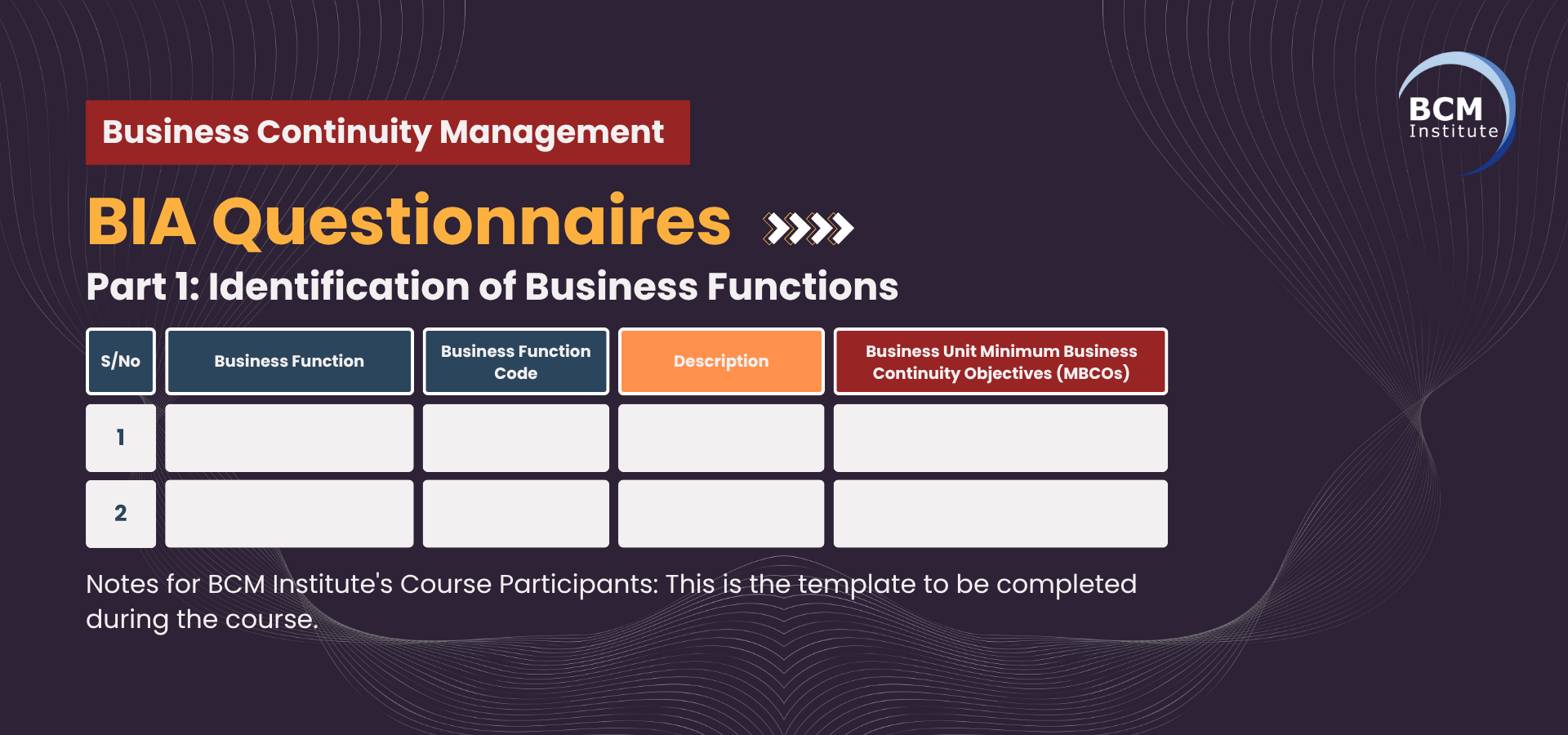
This chapter, Part 1: Identification of Business Functions for CBF-1 to CBF-6 for the Ministry of Manpower (MOM), establishes the foundational understanding required for a structured and defensible Business Impact Analysis (BIA).
The Ministry of Manpower performs a wide spectrum of regulatory, operational, policy, and enabling functions that are critical to national labour market stability, workforce safety, employment resilience, and public trust. Before assessing impacts, recovery priorities, or continuity requirements, it is essential to clearly and consistently define these business functions.
This chapter, therefore, provides a systematic breakdown of MOM’s Critical Business Functions (CBFs) and their associated sub-functions, clarifying what must be protected and sustained during disruptions.
#### Purpose of the Chapter
The purpose of this chapter is to enable readers to understand the scope, boundaries, and intent of each identified business function, and how they collectively support MOM’s statutory responsibilities and strategic outcomes.
By completing this section, the reader is expected to gain a clear, shared view of MOM’s operational landscape across CBF-1 to CBF-6, including:
- CBF-1 Labour Market Regulation and Enforcement
- CBF-2 Foreign Workforce Management
- CBF-3 Workplace Safety and Health (WSH) Oversight
- CBF-4 Employment Facilitation and Labour Market Resilience
- CBF-5 Policy Formulation and Strategic Manpower Planning
- CBF-6 Corporate Services and IT Infrastructure
This clarity is essential to ensure that subsequent BIA stages—such as impact assessment, prioritisation, recovery time objectives, and resource allocation—are conducted consistently, objectively, and aligned with organisational realities.
This section documents the identification of sub-CBF for each of the six critical business functions for MOM as part of the Business Impact Analysis (BIA).
[![Banner \[Table\] \[BCM\] \[E3\] \[BIA\] Identification of Detailed Processes (Sub-CBF)](https://no-cache.hubspot.com/cta/default/3893111/e69735a1-32fb-4ea9-945b-9d2a3ef04f93.png)](https://cta-redirect.hubspot.com/cta/redirect/3893111/e69735a1-32fb-4ea9-945b-9d2a3ef04f93)
###### Table P1: Critical Business Functions and Business Unit Minimum Business Continuity Objective (MBCO)
| Sub-CBF Code | Sub-CBF | Description of Sub-CBF | Business Unit Minimum Business Continuity Objective (MBCO) |
| --- | --- | --- | --- |
| 1.1 | Policy & Regulation Design | Maintain essential policy drafting and advisory capacity to issue interim guidance within 5–10 working days. | Formulation and review of labour policies, regulations, and standards to support labour market governance. |
| 1.2 | Licensing & Permits | Maintain at least 50% processing capacity within 48 hours. | Processing and issuance of employment-related licences and permits. |
| 1.3 | Inspections, Monitoring & Investigation | Sustain critical inspection capability at 30–40% capacity within 72 hours. | Conducts workplace inspections and investigations for labour law compliance. |
| 1.4 | Adjudication & Dispute Resolution | Maintain 20–30% dispute resolution capacity within 3–5 working days. | Resolves employment disputes through mediation, adjudication, and tribunals. |
| 1.5 | Enforcement Actions & Sanctions | Retain essential enforcement capability within 72 hours. | Executes enforcement actions and sanctions against non-compliant entities. |
| 1.6 | Stakeholder Engagement & Education | Maintain 50% communication capacity within 24 hours. | Provides guidance, advisories, and outreach to employers and workers. |
| 1.7 | Regulatory Intelligence & Risk Management | Maintain 20–30% intelligence capability within 5 working days. | Identifies emerging labour market risks and compliance trends. |
| 2.1 | Policy & Planning | Maintain core policy capability to support urgent decision-making within 5 business days. | Develops and reviews foreign workforce policies. |
| 2.2 | Work Pass Application & Issuance | Restore 50% processing capacity within 2 business days. | Processes and issues work passes (EP, S Pass, Work Permit). |
| 2.3 | Arrival, Onboarding & Deployment | Resume essential onboarding within 3 business days. | Coordinates the arrival, orientation, and deployment of foreign workers. |
| 2.4 | Monitoring, Compliance & Enforcement | Maintain 30% operational capability within 1 business day. | Monitors employer and worker compliance with foreign workforce regulations. |
| 2.5 | Renewal, Transfer & Exit Management | Resume 70% processing capacity within 2 business days. | Manages renewals, transfers, and cancellations of work passes. |
| 2.6 | Support Services & Well-being | Restore critical support services within 1 business day. | Provides welfare support and case management for foreign workers. |
| 3.1 | Policy & Standards Development | Maintain ability to issue urgent WSH advisories and standards. | Develops and reviews national Workplace Safety & Health policies. |
| 3.2 | Legislative & Regulatory Oversight | Ensure continuity of regulatory oversight and approvals. | Oversees interpretation and administration of WSH legislation. |
| 3.3 | Risk-Based Inspections & Enforcement | Sustain inspections for high-risk sectors. | Conducts inspections and enforcement in high-risk workplaces. |
| 3.4 | Monitoring & Surveillance Programmes | Maintain minimum data monitoring capability. | Tracks WSH performance trends and emerging risks. |
| 3.5 | Accident Reporting & Investigation | Ensure uninterrupted accident intake and investigation. | Manages reporting and investigation of workplace incidents. |
| 3.6 | Stakeholder Engagement & Education | Maintain essential safety communications. | Engages stakeholders on WSH compliance and education. |
| 3.7 | Competent Person Certification & Registration | Continue core certification services. | Certifies and registers WSH professionals. |
| 3.8 | Performance Monitoring & Reporting | Preserve minimum reporting capability. | Reports on national WSH performance indicators. |
| 4.1 | Labour Market Analysis & Forecasting | Ensure access to labour market data and forecasting tools. | Analyses employment trends and labour demand forecasts. |
| 4.2 | Job Matching & Placement Services | Maintain job-matching system availability. | Matches job seekers with employers. |
| 4.3 | Work Pass & Foreign Talent Policy Services | Ensure continuity of policy and processing services. | Manages foreign talent-related policies and processes. |
| 4.4 | Skills Development & Transition Support | Ensure continued access to training and upskilling services. | Supports workforce skills development and transition programmes. |
| 4.5 | Incentives & Employment Support Schemes | Maintain continuity of support schemes during disruptions. | Administers employment incentives and worker support schemes. |
| 4.6 | Stakeholder Engagement & Tripartism | Maintain coordination with tripartite partners. | Engages employers, unions, and agencies to support employment resilience. |
| 4.7 | Monitoring & Rapid Response | Enable rapid response to labour market shocks. | Monitors employment conditions and activates emergency measures. |
| 4.8 | BCM Integration & Continuity Processes | Ensure BCM plans are current and operational. | Integrates BCM into employment facilitation operations. |
| 5.1 | Environmental Scanning & Labour Market Analysis | Ensure access to strategic labour market intelligence. | Scans economic and demographic trends affecting manpower. |
| 5.2 | Policy Development & Formulation | Maintain continuity of manpower policy formulation. | Develops labour and manpower-related policies. |
| 5.3 | Strategic Workforce Planning & Scenario Modelling | Enable scenario modelling during disruptions. | Develops long-term workforce strategies and scenarios. |
| 5.4 | Stakeholder Engagement & Consultation | Maintain engagement with key stakeholders. | Consults employers, unions, and institutions on manpower planning. |
| 5.5 | Policy Implementation Planning | Ensure policy rollout plans can be reprioritised. | Translates policies into actionable implementation plans. |
| 5.6 | Monitoring, Evaluation & Feedback Loops | Ensure evidence-based evaluation continues. | Tracks policy effectiveness and workforce outcomes. |
| 5.7 | BCM Integration & Contingency Policies | Maintain BCM integration in policy frameworks. | Embeds resilience and continuity into manpower policies. |
| 6.1 | ICT Infrastructure Management | Restore critical ICT infrastructure within 24 hours. | Manages hardware, networks, and core ICT infrastructure. |
| 6.2 | Application & Systems Support | Ensure critical systems are available within 8 hours. | Supports applications essential to MOM operations. |
| 6.3 | Records Management & Archiving | Maintain access to vital records within 12 hours. | Manages records retention and archiving. |
| 6.4 | Data Backup & Recovery | Ensure data recovery within 4 hours. | Performs data backup and recovery operations. |
| 6.5 | Cybersecurity & Access Control | Maintain continuous cybersecurity controls. | Protects systems and data from cyber threats. |
| 6.6 | System Development & Enhancement | Prioritise enhancements for critical systems. | Manages system improvements and development. |
| 6.7 | ICT Vendor & SLA Management | Maintain vendor support and SLAs. | Oversees ICT vendors and third-party service providers. |
| 6.8 | User Support & Training | Deliver essential ICT support services. | Provides ICT helpdesk support and user training. |
| 6.9 | IT Compliance & Governance | Ensure ongoing IT compliance. | Manages ICT governance and regulatory compliance. |
| 6.10 | Physical Records Protection | Ensure secure access to physical records within 24 hours. | Protects and manages physical records and archives. |
[![Banner \[BCM\] \[E3\] \[BIA\] \[Summing Up\] Identification of Detailed Processes (Sub-CBF)](https://no-cache.hubspot.com/cta/default/3893111/4960f7b4-098c-4f68-84dc-aa250b8acd86.png)](https://cta-redirect.hubspot.com/cta/redirect/3893111/4960f7b4-098c-4f68-84dc-aa250b8acd86)
In conclusion, Part 1: Identification of Business Functions serves as the cornerstone of MOM’s Business Impact Analysis.
By clearly defining and documenting the critical business functions and their subcomponents, this chapter ensures a common understanding among stakeholders and provides a structured baseline for assessing the impacts of disruption and continuity requirements.
The outputs of this chapter directly inform subsequent BIA stages and strengthen MOM's overall resilience by ensuring that continuity planning is anchored in clearly articulated, mission-critical services.
Readers should proceed to subsequent chapters with
[](https://cta-redirect.hubspot.com/cta/redirect/3893111/8fd46ef5-5163-4661-8f55-97a925705813)
| **Resilient Support: Implementing Business Continuity Management at Ministry of Manpower** | | | |
| --- | --- | --- | --- |
| **eBook 4: Consolidate and Report Your BCM Implementation** | | | |
| **Consolidated Report for BIAQ (Part 1 to Part 6) for CBF-1 to CBF-6** | | | |
| **PM: BIA** | **BIAQ T1 P1** | **BIAQ T1 P2** | **BIAQ T2 P3-1** |
| **Consolidated Report for BIAQ (Part 1 to Part 6)** | [![\[BCM\] \[MOM\] \[E4\] \[CR\] \[BIA\] \[P1\] Identification of Business Functions for CBF](https://no-cache.hubspot.com/cta/default/3893111/28dfbd64-fe01-49b2-923b-bbdbce0f239c.png)](https://cta-redirect.hubspot.com/cta/redirect/3893111/28dfbd64-fe01-49b2-923b-bbdbce0f239c) | [![\[BCM\] \[MOM\] \[E4\] \[CR\] \[BIA\] \[P2\] Impact Area of Business Function for CBF](https://no-cache.hubspot.com/cta/default/3893111/de59448f-87b9-413c-a3fb-d412b7bc0073.png)](https://cta-redirect.hubspot.com/cta/redirect/3893111/de59448f-87b9-413c-a3fb-d412b7bc0073) | [![\[BCM\] \[MOM\] \[E4\] \[CR\] \[BIA\] \[P3-1\] Impact Over Time of Business Function for CBF](https://no-cache.hubspot.com/cta/default/3893111/c236049e-9639-402a-ad16-fa0a21b2d979.png)](https://cta-redirect.hubspot.com/cta/redirect/3893111/c236049e-9639-402a-ad16-fa0a21b2d979) |
| **BIAQ T2 P3-2** | **BIAQ T2 P4** | **BIAQ T3 P5** | **BIAQ T3 P6** |
| [![\[BCM\] \[MOM\] \[E4\] \[CR\] \[BIA\] \[P3-2\] Impact Over Time of Business Function for CBF](https://no-cache.hubspot.com/cta/default/3893111/95de5691-1b83-4aa7-b63a-3d40512f7fd6.png)](https://cta-redirect.hubspot.com/cta/redirect/3893111/95de5691-1b83-4aa7-b63a-3d40512f7fd6) | [![\[BCM\] \[MOM\] \[E4\] \[CR\] \[BIA\] \[P4\] Supporting IT Systems and Applications for CBF](https://no-cache.hubspot.com/cta/default/3893111/616a9e4e-50a4-4749-a531-28efa6d3f1be.png)](https://cta-redirect.hubspot.com/cta/redirect/3893111/616a9e4e-50a4-4749-a531-28efa6d3f1be) | [![\[BCM\] \[MOM\] \[E4\] \[CR\] \[BIA\] \[P5\] Inter-dependencies for CBF](https://no-cache.hubspot.com/cta/default/3893111/6276e28c-2ca8-4fef-83bc-43e43e484a7c.png)](https://cta-redirect.hubspot.com/cta/redirect/3893111/6276e28c-2ca8-4fef-83bc-43e43e484a7c) | [![\[BCM\] \[MOM\] \[E4\] \[CR\] \[BIA\] \[P6\] Vital Records for CBF](https://no-cache.hubspot.com/cta/default/3893111/23795ca5-5a6a-4e7c-88ba-8a274a390f45.png)](https://cta-redirect.hubspot.com/cta/redirect/3893111/23795ca5-5a6a-4e7c-88ba-8a274a390f45) |
#### More Information About Business Continuity Management Courses
To learn more about the course and schedule, click the buttons below for the BCM-300 Business Continuity Management Implementer \[BCM-3\] and the BCM-5000 Business Continuity Management Expert Implementer \[BCM-5\].
| [](https://cta-redirect.hubspot.com/cta/redirect/3893111/f3922b80-e96a-46d6-8993-dc150a5de2d5) | [](https://cta-redirect.hubspot.com/cta/redirect/3893111/9ff8a3dc-e39a-465b-929f-72e232cdd5fb) | [![Register \[BL-B-3\]\*](https://no-cache.hubspot.com/cta/default/3893111/ac6cf073-4cdd-4541-91ed-889f731d5076.png)](https://cta-redirect.hubspot.com/cta/redirect/3893111/ac6cf073-4cdd-4541-91ed-889f731d5076) |
| --- | --- | --- |
| [](https://cta-redirect.hubspot.com/cta/redirect/3893111/21525c10-4003-4934-95fc-fe218174bc5b) | [](https://cta-redirect.hubspot.com/cta/redirect/3893111/46460171-c91a-4936-9bb2-8dc5928a0e02) | [](https://cta-redirect.hubspot.com/cta/redirect/3893111/1cb17ac7-50b2-4f88-bc4b-c7444e4b57b5) |
| [![FAQ \[BL-B-3\]](https://no-cache.hubspot.com/cta/default/3893111/b3824ba1-7aa1-4eb6-bef8-94f57121c5ae.png)](https://cta-redirect.hubspot.com/cta/redirect/3893111/b3824ba1-7aa1-4eb6-bef8-94f57121c5ae) | Please feel free to send us a note if you have any questions. [![Email to Sales Team \[BCM Institute\]](https://no-cache.hubspot.com/cta/default/3893111/3c53daeb-2836-4843-b0e0-645baee2ab9e.png)](https://cta-redirect.hubspot.com/cta/redirect/3893111/3c53daeb-2836-4843-b0e0-645baee2ab9e) | [](https://cta-redirect.hubspot.com/cta/redirect/3893111/9c199ae8-c470-4bb7-9612-73c7a084e94c) |
| [](https://cta-redirect.hubspot.com/cta/redirect/3893111/8999211a-2c51-4be7-bf49-c393f6c67974) | [](https://cta-redirect.hubspot.com/cta/redirect/3893111/5c1aa95d-f6dd-4067-a95c-5cc0c32d7ed8) | [](https://cta-redirect.hubspot.com/cta/redirect/3893111/086ab3b9-4d66-4a95-b2f7-1148e9803a9c) |
#### **Your Comments Here:**
### More Posts
[](https://cta-redirect.hubspot.com/cta/redirect/3893111/839787f4-a4fd-456f-accf-54c947026558)

All rights reserved. Copyright 2026
```json
{
"@context" : "https://schema.org",
"@type" : "BlogPosting",
"author" : {
"@type" : "Person",
"name" : "Dr Goh Moh Heng",
"url" : "https://blog.bcm-institute.org/ebook/author/dr-goh-moh-heng"
},
"dateModified" : "2026-01-11T07:39:12.280Z",
"datePublished" : "2026-01-08T05:51:21.000Z",
"headline" : "[BCM] [MOM] [E4] [CR] [BIA] [P1] Identification of Business Functions for CBF-1 to CBF-6",
"mainEntityOfPage" : {
"@id" : "https://blog.bcm-institute.org/ebook/bcm-mom-e4-cr-bia-p1-identification-of-business-functions-for-cbf-1-to-cbf-6",
"@type" : "WebPage"
},
"publisher" : {
"@type" : "Organization",
"logo" : {
"@type" : "ImageObject",
"url" : "https://blog.bcm-institute.org/hubfs/BCMI%20Logo.png"
},
"name" : "BCMI Pte Ltd"
}
}
```