



eBook 2: Chapter 8
Program Management Phase for BCM Planning Methodology for the Ministry of Manpower
Introduction
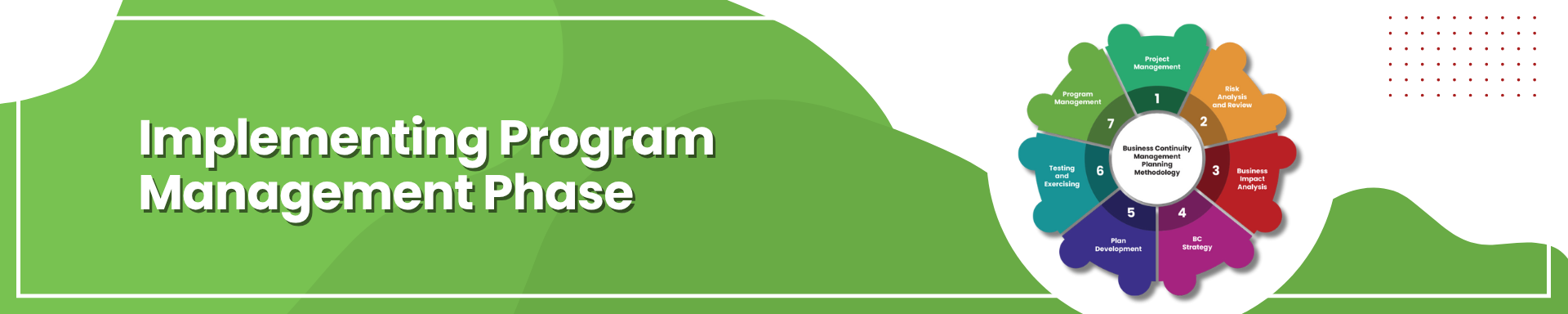
![[BCM] [MOM] [E2] [C8] Program Management](https://no-cache.hubspot.com/cta/default/3893111/8f25db36-e21c-4d40-90c0-f3d28a6c2a84.png) In the Business Continuity Management (BCM) lifecycle, the Program Management Phase is the foundational stage that establishes momentum and a sustainable structure for effective business continuity planning across the organisation.
In the Business Continuity Management (BCM) lifecycle, the Program Management Phase is the foundational stage that establishes momentum and a sustainable structure for effective business continuity planning across the organisation.
For the Ministry of Manpower (MOM), which is charged with shaping Singapore’s labour landscape, supporting employers and workers, ensuring workplace safety, and enabling businesses to thrive
This phase is especially critical given the complexity of its operational footprint, the diversity of stakeholder groups, and the need to maintain essential services during disruptions.
This chapter presents a tailored exploration of the program management phase within MOM’s BCM planning methodology, including key objectives, governance requirements, strategic alignment, and roles specific to MOM’s organisational mandate.
Program Management Phase Overview
At MOM, successful BCM begins with solid governance that defines authority, accountability, and cross-departmental coordination.
Key Requirements
- Executive Sponsorship: Secure support from MOM senior leadership (e.g., Permanent Secretary / Deputy Secretary level), signalling organisation-wide commitment to BCM and enabling allocation of authority and resources.
- BCM Steering Committee: Form a committee comprising representatives from key departments (e.g., Policy, Operations, ICT, Human Resources, Security & Preparedness Department) to provide oversight, guidance, and decision-making on continuity priorities.
- Mandated BCM Policy: Develop and formalise a BCM policy that:
- Aligns with MOM’s mission of empowering workers and ensuring workplace resilience.
- Sets expectations for business continuity practices, from risk identification to plan maintenance.
- Embeds BCM into organisational culture and performance metrics.
Defining Scope and Strategic Alignment
The BCM program at MOM must account for the breadth of services delivered and the regulatory functions upheld daily.
This requires clarity on which MOM considers critical business functions and on the frequency and types of disruptions that might affect continuity.
Key Requirements
- Scope of BCM Coverage: Include key operational domains such as:
- Labour policy administration
- Work pass processing and compliance functions
- Workplace safety enforcement
- Customer service operations (contact centre and e-services)
- Workforce support programmes (e.g., job facilitation initiatives)
- Internal administrative and support functions
- Criticality and Dependency Mapping: Establish service impact criteria (e.g., minimum service levels, recovery time objectives) that reflect MOM’s public service commitments and regulatory obligations.
- Linkage with Strategic Objectives: Align BCM goals to MOM’s refreshed mission and vision (e.g., safeguarding an empowered workforce and thriving workplaces) so that continuity preparedness supports organisational resilience and public trust.
Roles, Responsibilities, and Organisational Coordination
Effective BCM requires clear role definitions that leverage MOM’s organisational structure and existing functions such as crisis preparedness within the Security and Preparedness Department (SPD).
Key Requirements
- BCM Program Manager: Appoint a senior leader responsible for overall BCM program coordination, resource allocation, and progress monitoring.
- Departmental Continuity Leads: Assign BCM champions in each division who will:
- Liaise with the BCM Program Manager.
- Coordinate business impact analysis (BIA) and risk assessment activities.
- Report on continuity readiness and capability gaps.
- Integration with SPD and Crisis Preparedness Units
Leverage existing crisis preparedness and manpower resilience units to align BCM planning with broader whole-of-government (WOG) crisis frameworks.
Resource Allocation and Capability Building
For BCM to be sustainable, MOM must invest in the people, technology, and processes that empower effective continuity outcomes.
Key Requirements
- Training and Awareness
Conduct targeted training for BCM practitioners and broader awareness sessions for all staff to foster understanding and ensure roles are understood well before a disruption. - BCM Tools and Technology
Equip teams with platforms that support risk registers, BIA outputs, plan documentation, and exercise tracking. - Service Continuity Metrics
Establish measurable indicators that guide continuous improvement — for example, recovery time objectives for mission-critical functions or response times for continuity incident activation.
Stakeholder Engagement and Communication Protocols
Given MOM’s wide interactions with employers, employees, tripartite partners, unions, and other government agencies, proactive engagement and clear communication channels are essential.
Key Requirements
- Internal Communication Plans: Define structured processes for disseminating information to MOM officers during the activation of continuity plans, including leadership updates, operational priorities, and escalation channels.
- External Stakeholder Messaging: Prepare pre-approved templates and communication strategies for use during disruptions that could impact public services, ensuring consistency, clarity, and confidence among external partners.
Continual Program Monitoring and Review
The BCM program must be dynamic to remain relevant as risks evolve and organisational priorities shift.
Key Requirements
- Performance Assurance: Establish regular checkpoints at which continuity intelligence, risk landscapes, and operational dependencies are reviewed.
- Testing and Exercises: Implement scheduled drills (e.g., tabletop exercises, plan walkthroughs) that test MOM’s readiness to respond to identified scenarios. Lessons learned should be documented and integrated into plan revisions.
- Feedback Loops: Facilitate post-exercise and real-world incident after-action reviews to inform policy updates, training enhancements, and capability development.
![Banner [Summary] [BCM] [E2] [C8] Program Management](https://no-cache.hubspot.com/cta/default/3893111/9ab836f6-9d8f-4673-9d57-5729a3c8d644.png)
The Program Management Phase is the cornerstone of MOM’s Business Continuity Management planning methodology.
It prepares the organisation not only to withstand disruptions but also to strengthen its resilience as a public service agency trusted by Singaporeans and businesses alike.
By establishing BCM governance, aligning continuity priorities with MOM’s strategic mission, building capability, and fostering cross-agency integration, MOM can ensure that key functions — such as workplace safety enforcement, manpower policy administration, and employment facilitation — are maintained even under stress.
This approach reinforces MOM’s commitment to an empowered workforce and thriving workplaces in Singapore’s dynamic social and economic landscape.
![[BCM] [MOM] [E2] [C1] Business Continuity Management Planning Methodology](https://no-cache.hubspot.com/cta/default/3893111/c61b9602-b529-466a-8e50-1ecafcecf3c2.png)
![[BCM] [MOM] [E2] [C2] Project Management](https://no-cache.hubspot.com/cta/default/3893111/135e6f92-2d77-4b8a-8cde-fb9d2334d138.png)
![[BCM] [MOM] [E2] [C3] Risk Analysis and Review](https://no-cache.hubspot.com/cta/default/3893111/d90d6411-35a1-4c8d-84df-8a750fcd2132.png)
![[BCM] [MOM] [E2] [C4] Business Impact Analysis](https://no-cache.hubspot.com/cta/default/3893111/db8894ff-5924-44d3-a069-0bcd5d76fa56.png)
![[BCM] [MOM] [E2] [C5] Business Continuity Strategy](https://no-cache.hubspot.com/cta/default/3893111/9d56ef8b-f7b5-4011-abb4-de897b3cb9f3.png)
![[BCM] [MOM] [E2] [C6] BCM Plan Development](https://no-cache.hubspot.com/cta/default/3893111/4263c96d-afac-4848-9ae1-d7f4de5991a6.png)
![[BCM] [MOM] [E2] [C7] Testing and Exercising](https://no-cache.hubspot.com/cta/default/3893111/a49b6ccf-0c3a-4edb-a860-5e9ad3bfb253.png)
![[BCM] [MOM] [E2] [C9] Summary](https://no-cache.hubspot.com/cta/default/3893111/1ef7f4d6-ba8a-440f-931d-35517cd29fa9.png)
![[BCM] [MOM] [E2] [C10] Back Cover for BCM](https://no-cache.hubspot.com/cta/default/3893111/b21681d9-63d8-4ca6-9e2d-d87b27398714.png)
More Information About Business Continuity Management Courses
To learn more about the course and schedule, click the buttons below for the BCM-300 Business Continuity Management Implementer [BCM-3] and the BCM-5000 Business Continuity Management Expert Implementer [BCM-5].


![Register [BL-B-3]*](https://no-cache.hubspot.com/cta/default/3893111/ac6cf073-4cdd-4541-91ed-889f731d5076.png)



![FAQ [BL-B-3]](https://no-cache.hubspot.com/cta/default/3893111/b3824ba1-7aa1-4eb6-bef8-94f57121c5ae.png)
![Email to Sales Team [BCM Institute]](https://no-cache.hubspot.com/cta/default/3893111/3c53daeb-2836-4843-b0e0-645baee2ab9e.png)


