



eBook 2: Chapter 7
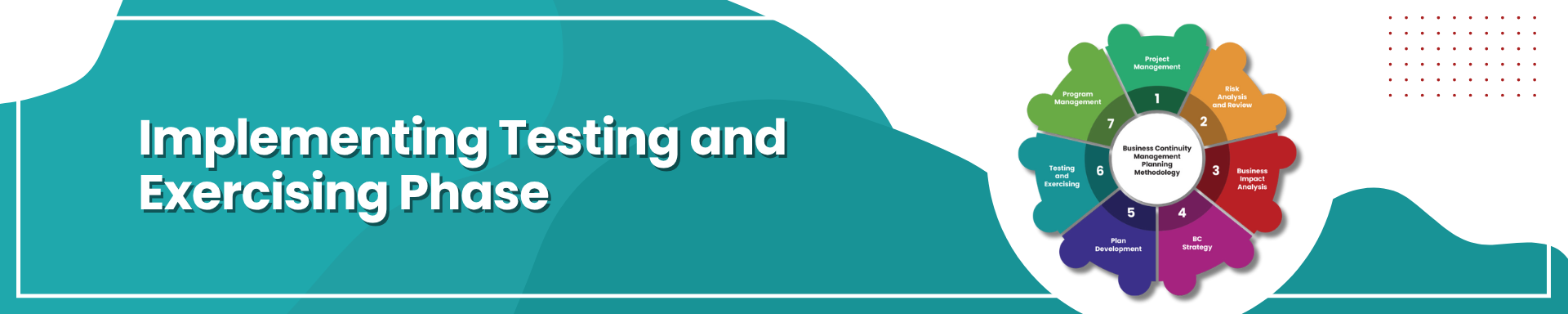
Testing and Exercising Phase as Part of the BCM Planning Methodology for the Ministry of Manpower
Introduction
The Testing and Exercising Phase is a critical component of the Business Continuity![[BCM] [MOM] [E2] [C7] Testing and Exercising](https://no-cache.hubspot.com/cta/default/3893111/a49b6ccf-0c3a-4edb-a860-5e9ad3bfb253.png) Management (BCM) Planning Methodology for the Ministry of Manpower (MOM).
Management (BCM) Planning Methodology for the Ministry of Manpower (MOM).
While business continuity plans may be comprehensive on paper, their effectiveness can only be assured through systematic testing and realistic exercises.
For MOM—a key public sector agency responsible for workforce regulation, employment services, and labour market stability—testing ensures that essential services can continue during disruptions such as pandemics, cyber incidents, system outages, or national emergencies.
This phase validates the practicality of MOM’s recovery strategies, assesses staff readiness, identifies procedural gaps, and reinforces coordination across departments and with external stakeholders.
Testing and exercise activities should be progressive, starting with basic tests and progressing to more complex, realistic scenarios.
Objectives of Testing and Exercising at MOM
The primary objectives of the Testing and Exercising Phase include:
- Verifying the effectiveness of MOM’s Business Continuity Plans
- Ensuring staff understand their roles and responsibilities during disruptions
- Assessing communication and escalation procedures
- Validating recovery time objectives (RTOs) for critical business functions
- Strengthening inter-departmental and inter-agency coordination
- Supporting continual improvement of BCM capabilities
To achieve these objectives, tests and exercises at MOM are grouped into Initial (Basic) Tests and Advanced Tests.
Initial Tests
Initial tests are designed to familiarise staff with BCM arrangements and validate individual components of the BCP. These tests are low-risk, cost-effective, and suitable for early stages of BCM maturity.
Component Tests
Component tests verify the functionality and availability of individual elements within MOM’s BCM framework. These elements may include:
- Backup IT systems supporting work pass applications, employment services, or inspection systems
- Access to alternate work locations or work-from-home arrangements
- Availability of critical documents, templates, and contact lists
- Redundancy of communication tools such as email, messaging platforms, and hotlines
For MOM, component tests help ensure that essential systems supporting employers, migrant workers, and the general public remain operational during disruptions.
Call Notification Tests
Call notification tests are conducted to verify the effectiveness of MOM’s emergency communication and staff notification procedures. These tests typically involve:
- Activating emergency contact lists
- Testing SMS, email, or automated notification systems
- Confirming response times and acknowledgement rates
- Ensuring accurate escalation to crisis management and business unit leaders
Such tests are vital for MOM, given its large workforce and the need for rapid mobilisation during incidents that may affect national employment or labour stability.
Walkthrough Exercises
Walkthrough exercises, also known as tabletop reviews, involve guided discussions where participants review BCM procedures step by step. These exercises:
- Validate the clarity and completeness of BCP documentation
- Confirm staff understanding of roles, decision-making authority, and dependencies
- Identify inconsistencies or outdated assumptions
- Encourage cross-functional alignment among MOM departments
Walkthrough exercises are beneficial for onboarding new staff, refreshing knowledge, and validating plans following organisational or policy changes.
Advanced Tests
Once MOM has established confidence in basic BCM capabilities, more advanced tests can be conducted. These tests simulate realistic disruption scenarios and require higher levels of coordination, resources, and executive involvement.
Integrated Tests
Integrated tests assess the combined performance of multiple business functions, systems, and teams operating together under a single scenario. At MOM, this may involve:
- Coordinated recovery of IT systems and business operations
- Activation of crisis management, communications, and operational teams
- Testing interdependencies between departments such as policy, operations, enforcement, and communications
- Coordination with other government agencies or service providers
Integrated tests provide a holistic view of MOM’s organisational resilience and readiness.
Simulation Tests
Simulation tests introduce time-pressured and dynamic scenarios that closely mirror real-world incidents. These tests typically include:
- Scenario-based injects, such as media queries, policy decisions, or system failures
- Simulated disruptions affecting multiple services simultaneously
- Real-time decision-making by senior management
- Evaluation of situational awareness and command-and-control structures
For MOM, simulation tests are particularly valuable for preparing for complex national-level incidents, such as large-scale workforce disruptions, pandemics, or cyberattacks.
Live Tests
Live tests represent the most comprehensive and demanding form of BCM testing. They involve actual execution of recovery strategies, such as:
- Operating from alternate work locations
- Switching to backup IT systems in real time
- Implementing work-from-home or split-team arrangements
- Running critical services under simulated disruption conditions
While live tests require careful planning to avoid service disruption, they provide the highest level of assurance that MOM’s BCM arrangements are effective and sustainable.
![Banner [Summary] [BCM] [E2] [C7] Testing and Exercising](https://no-cache.hubspot.com/cta/default/3893111/af76bb57-f906-4422-8548-3912930c76a7.png)
The Testing and Exercising Phase is essential to ensuring that the Ministry of Manpower’s Business Continuity Management framework is practical, resilient, and fit for purpose.
By adopting a structured progression from initial tests to advanced exercises, MOM can build organisational confidence, enhance staff preparedness, and continuously strengthen its ability to deliver essential services during disruptions.
Regular testing, supported by post-exercise reviews and improvement actions, enables MOM to meet ISO 22301 expectations and uphold public trust through reliable and resilient service delivery—reinforcing Singapore’s broader national resilience objectives.
![[BCM] [MOM] [E2] [C1] Business Continuity Management Planning Methodology](https://no-cache.hubspot.com/cta/default/3893111/c61b9602-b529-466a-8e50-1ecafcecf3c2.png)
![[BCM] [MOM] [E2] [C2] Project Management](https://no-cache.hubspot.com/cta/default/3893111/135e6f92-2d77-4b8a-8cde-fb9d2334d138.png)
![[BCM] [MOM] [E2] [C3] Risk Analysis and Review](https://no-cache.hubspot.com/cta/default/3893111/d90d6411-35a1-4c8d-84df-8a750fcd2132.png)
![[BCM] [MOM] [E2] [C4] Business Impact Analysis](https://no-cache.hubspot.com/cta/default/3893111/db8894ff-5924-44d3-a069-0bcd5d76fa56.png)
![[BCM] [MOM] [E2] [C5] Business Continuity Strategy](https://no-cache.hubspot.com/cta/default/3893111/9d56ef8b-f7b5-4011-abb4-de897b3cb9f3.png)
![[BCM] [MOM] [E2] [C6] BCM Plan Development](https://no-cache.hubspot.com/cta/default/3893111/4263c96d-afac-4848-9ae1-d7f4de5991a6.png)
![[BCM] [MOM] [E2] [C8] Program Management](https://no-cache.hubspot.com/cta/default/3893111/8f25db36-e21c-4d40-90c0-f3d28a6c2a84.png)
![[BCM] [MOM] [E2] [C9] Summary](https://no-cache.hubspot.com/cta/default/3893111/1ef7f4d6-ba8a-440f-931d-35517cd29fa9.png)
![[BCM] [MOM] [E2] [C10] Back Cover for BCM](https://no-cache.hubspot.com/cta/default/3893111/b21681d9-63d8-4ca6-9e2d-d87b27398714.png)
More Information About Business Continuity Management Courses
To learn more about the course and schedule, click the buttons below for the BCM-300 Business Continuity Management Implementer [BCM-3] and the BCM-5000 Business Continuity Management Expert Implementer [BCM-5].


![Register [BL-B-3]*](https://no-cache.hubspot.com/cta/default/3893111/ac6cf073-4cdd-4541-91ed-889f731d5076.png)



![FAQ [BL-B-3]](https://no-cache.hubspot.com/cta/default/3893111/b3824ba1-7aa1-4eb6-bef8-94f57121c5ae.png)
![Email to Sales Team [BCM Institute]](https://no-cache.hubspot.com/cta/default/3893111/3c53daeb-2836-4843-b0e0-645baee2ab9e.png)


