



eBook 2: Chapter 6
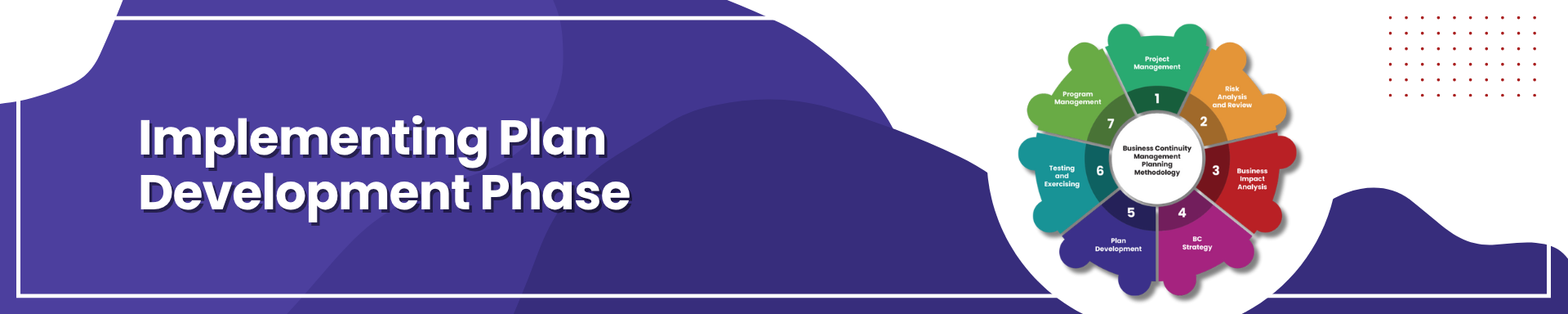
BC Plan Development Phase as part of the BCM Planning Methodology for the Ministry of Manpower
Introduction
The Business Continuity Plan Development Phase is a critical step in ensuring that the Ministry of Manpower (MOM) is operationally prepared to respond effectively to disruptions of varying scales and complexities.
Building on the outcomes of earlier Business Continuity Management (BCM) phases—such as risk analysis, business impact analysis, and continuity strategy formulation—this phase focuses on translating strategy into clear, actionable, and well-documented plans.
For MOM, whose responsibilities include safeguarding employment standards, managing foreign manpower, and delivering essential digital and frontline services to employers and workers, a well-developed BCM Plan is crucial in maintaining service reliability and public confidence during crises.
This chapter examines the development of BCM plans, highlighting how MOM structures its plans, equips business units to document continuity arrangements, and ensures that plans are validated and endorsed at the appropriate management levels.
Through this disciplined approach, MOM strengthens its organisational resilience and readiness to support Singapore’s workforce, even during periods of significant disruption.
What Does Plan Development Entail?
The Business Continuity Plan (BC Plan) Development Phase translates the outcomes of earlier BCM activities—such as risk assessment, business impact analysis, and continuity strategy selection—into practical, actionable plans that can be activated during disruptions.
For the Ministry of Manpower (MOM), this phase is critical to ensuring that essential services, including work pass processing, employment facilitation, workplace safety enforcement, and foreign manpower regulation, can continue during crises.
Plan development at MOM is a structured, collaborative process involving policy owners, operational units, and BCM coordinators.
-It ensures that continuity arrangements are aligned with MOM’s governance framework, Whole-of-Government (WOG) emergency response structures, and public service delivery obligations.
In summary, the BCM Plan Development Phase at MOM comprises the following key stages.
Determination of the Organisation of the BC Plan Document
The first stage focuses on establishing a clear, consistent structure for MOM’s BC Plan documents.
A standardised approach ensures that plans across different divisions and departments are coherent, easy to understand, and readily executable during an incident.
Designing and Developing the BC Plan Template
MOM develops a standard BC Plan template aligned with ISO 22301 requirements and public sector BCM guidelines. The template typically includes:
- Purpose, scope, and assumptions of the plan
- Activation and escalation criteria
- Roles and responsibilities during disruption
- Step-by-step continuity and recovery procedures
- Communication protocols (internal, inter-agency, and public-facing)
- Resource requirements and dependencies
For example, the Work Pass Division’s BC Plan would include specific procedures for maintaining access to digital systems such as EP Online and WP Online.
At the same time, the Occupational Safety and Health Division’s plan would ensure continuity of inspection and incident-response functions.
Determining the Recovery Organisation
MOM defines a clear recovery organisation structure to support crisis decision-making and operational recovery. This includes:
- A central Crisis Management Team (CMT) at the ministry level
- Business Unit (BU) Recovery Teams are responsible for executing continuity actions
- Pre-identified deputies to ensure coverage if key personnel are unavailable
For instance, in a significant system outage affecting MOM’s e-services, the recovery organisation would specify who authorises manual workarounds, who liaises with GovTech and other agencies, and who communicates service updates to employers and the public.
Conducting a BC Plan Writing Workshop to Guide Plan Writers
- A crucial part of the BC Plan development phase is organising a writing workshop for all relevant stakeholders.
- This workshop serves to align understanding and expectations, clarify the template structure, and provide guidance on completing the plan effectively.
- For MOM, this workshop could involve team leaders and coordinators from various units, equipping them with the skills and knowledge to complete their respective sections of the BCM Plan template.
- The workshop also helps ensure that all business unit plans align with MOM’s broader continuity goals, ensuring that recovery strategies are consistent and practical across the organisation.
Completion of the Plan Template by Individual BU BCM Coordinators
The second stage focuses on capability building and consistency through the guided development of plans.
BC Plan Writing Workshops
MOM conducts structured BC Plan writing workshops facilitated by the BCM team. These workshops bring together BU BCM Coordinators and relevant functional representatives to:
- Explain the intent and requirements of each section of the BC Plan template
- Translate Business Impact Analysis (BIA) results into practical recovery actions
- Clarify assumptions, dependencies, and inter-departmental linkages
Workshops also provide a forum for sharing best practices across MOM, such as how frontline service centres manage reduced manpower scenarios or how policy units continue regulatory functions during prolonged disruptions.
Completion of the Plan Template by Individual BU BCM Coordinators
Following the workshops, BU BCM Coordinators are responsible for completing their respective plans. They tailor the standard template to reflect their unit’s specific operations, systems, and stakeholders.
Example
- The Employment Services Division may document remote working arrangements and alternative service channels for job matching services.
- The Foreign Manpower Management Division may outline priority processing rules for critical sectors during a pandemic or border disruption.
This decentralised approach ensures ownership while maintaining alignment with MOM’s overall BCM framework.
Finalisation of the BC Plan Production
The final stage ensures that BC Plans are accurate, comprehensive, and fit for purpose before formal adoption.
Validation by BU BCM Coordinators
BU BCM Coordinators conduct internal reviews to confirm that:
- All critical business functions are covered
- Recovery Time Objectives (RTOs) and recovery strategies are consistent with approved BCM strategies
- Roles, contact details, and escalation paths are current
Endorsement by Heads of Business Units
Heads of Business Units review and endorse the BC Plans to ensure they reflect operational realities and policy priorities.
Their endorsement signifies management commitment and confirms that the unit is prepared to activate the plan when required.
For MOM, this validation and endorsement process is fundamental given the ministry’s public-facing role.
It ensures that continuity plans support timely communication with employers, workers, and partner agencies, even during national-level emergencies.
![Banner [Summary] [BCM] [E2] [C6] BCM Plan Development](https://no-cache.hubspot.com/cta/default/3893111/a8cffab8-99ea-4a3b-8755-e4196a5d5b95.png)
The BCM Plan Development Phase represents the point at which preparedness becomes tangible for the Ministry of Manpower.
By systematically organising BC Plan documentation, guiding business units through structured plan writing, and rigorously validating the completed plans, MOM ensures that its continuity arrangements are practical, comprehensive, and aligned with its operational realities.
This phase reinforces accountability across business units, embeds BCM responsibilities within day-to-day management structures, and ensures that recovery actions can be executed decisively under pressure.
Ultimately, well-developed and management-endorsed BCM Plans enable MOM to sustain critical manpower services, coordinate effectively with Whole-of-Government partners, and continue serving employers and workers with confidence during disruptions.
As part of MOM’s broader BCM lifecycle, this phase lays a strong foundation for ongoing testing, maintenance, and continuous improvement of organisational resilience.
![[BCM] [MOM] [E2] [C1] Business Continuity Management Planning Methodology](https://no-cache.hubspot.com/cta/default/3893111/c61b9602-b529-466a-8e50-1ecafcecf3c2.png)
![[BCM] [MOM] [E2] [C2] Project Management](https://no-cache.hubspot.com/cta/default/3893111/135e6f92-2d77-4b8a-8cde-fb9d2334d138.png)
![[BCM] [MOM] [E2] [C3] Risk Analysis and Review](https://no-cache.hubspot.com/cta/default/3893111/d90d6411-35a1-4c8d-84df-8a750fcd2132.png)
![[BCM] [MOM] [E2] [C4] Business Impact Analysis](https://no-cache.hubspot.com/cta/default/3893111/db8894ff-5924-44d3-a069-0bcd5d76fa56.png)
![[BCM] [MOM] [E2] [C5] Business Continuity Strategy](https://no-cache.hubspot.com/cta/default/3893111/9d56ef8b-f7b5-4011-abb4-de897b3cb9f3.png)
![[BCM] [MOM] [E2] [C6] BCM Plan Development](https://no-cache.hubspot.com/cta/default/3893111/4263c96d-afac-4848-9ae1-d7f4de5991a6.png)
![[BCM] [MOM] [E2] [C7] Testing and Exercising](https://no-cache.hubspot.com/cta/default/3893111/a49b6ccf-0c3a-4edb-a860-5e9ad3bfb253.png)
![[BCM] [MOM] [E2] [C8] Program Management](https://no-cache.hubspot.com/cta/default/3893111/8f25db36-e21c-4d40-90c0-f3d28a6c2a84.png)
![[BCM] [MOM] [E2] [C9] Summary](https://no-cache.hubspot.com/cta/default/3893111/1ef7f4d6-ba8a-440f-931d-35517cd29fa9.png)
![[BCM] [MOM] [E2] [C10] Back Cover for BCM](https://no-cache.hubspot.com/cta/default/3893111/b21681d9-63d8-4ca6-9e2d-d87b27398714.png)
More Information About Business Continuity Management Courses
To learn more about the course and schedule, click the buttons below for the BCM-300 Business Continuity Management Implementer [BCM-3] and the BCM-5000 Business Continuity Management Expert Implementer [BCM-5].


![Register [BL-B-3]*](https://no-cache.hubspot.com/cta/default/3893111/ac6cf073-4cdd-4541-91ed-889f731d5076.png)



![FAQ [BL-B-3]](https://no-cache.hubspot.com/cta/default/3893111/b3824ba1-7aa1-4eb6-bef8-94f57121c5ae.png)
![Email to Sales Team [BCM Institute]](https://no-cache.hubspot.com/cta/default/3893111/3c53daeb-2836-4843-b0e0-645baee2ab9e.png)


