



eBook 2: Chapter 4
Business Impact Analysis (BIA) Phase of the BCM Planning Methodology for the Ministry of Manpower
Introduction
The Ministry of Manpower (MOM) of Singapore ![[BCM] [MOM] [E2] [C4] Business Impact Analysis](https://no-cache.hubspot.com/cta/default/3893111/db8894ff-5924-44d3-a069-0bcd5d76fa56.png) plays a central role in shaping and safeguarding the nation’s labour market, workplace practices, and manpower policies.
plays a central role in shaping and safeguarding the nation’s labour market, workplace practices, and manpower policies.
Its remit includes workforce planning, labour relations, employment standards, foreign manpower management, workplace safety and health, and income security policies — all critical to Singapore’s economic and social stability.
Given this extensive mandate, disruptions to MOM operations — whether due to cyber incidents, pandemics, IT outages, extreme weather, or infrastructure failures — could severely impair essential national services, regulatory functions, and employment-related services.
In support of organisational resilience, Business Continuity Management (BCM) enables MOM to prepare for, respond to, recover from, and adapt to disruptions efficiently and methodically.
A key component of BCM is the Business Impact Analysis (BIA). It is a structured process that identifies critical business functions, quantifies the impact of disruptions, and informs continuity strategies and resource allocation.
Purpose of the Business Impact Analysis
The Business Impact Analysis phase is a core component of the BCM planning methodology. It serves to:
- Identify and prioritise MOM’s critical business functions and services, such as work pass processing, workplace safety enforcement, labour market reporting, and customer engagement.
- Determine the impact of disruptions — both quantitative (e.g., financial penalties, operational delays) and qualitative (e.g., reputational damage or regulatory non-compliance).
- Establish recovery objectives — including Recovery Time Objectives (RTOs), Maximum Tolerable Period of Disruption (MTPD), and resource requirements.
- Provide a sound basis for continuity strategies and plans that ensure resilient operations aligned with MOM’s mission and public service commitments.
- Support compliance with recognised BCM frameworks, such as ISO 22301, and best practice standards applicable to public sector organisations.
3. Scope of the BIA for MOM
The BIA for MOM must encompass all divisions and departments that contribute to its statutory functions, such as:
- Work Pass Division — processing and issuing work passes.
- Occupational Safety and Health Division — workplace inspection and safety enforcement.
- Labour Relations and Workplaces Division — policy formulation and dispute resolution.
- Information Systems & Technology Dept — digital service delivery and IT continuity.
- Customer Experience Dept — service excellence across online portals and contact centres.
- Corporate and Administrative functions — HR, Finance, Legal Services, and Communications.
Additionally, interdependencies with statutory boards under MOM’s purview — for example, Workforce Singapore and the Central Provident Fund Board — should be considered in the analysis.
The analysis will span all operational domains and include supporting functions (e.g., IT infrastructure, data management, premises, third-party service providers).
4. BIA Methodology
A robust BIA process follows a structured approach tailored to MOM’s context, utilising international guidance, including ISO 22317 and ISO 22301 requirements.
4.1 Preparation and Governance
- Define BIA objectives, scope, and expected outcomes.
- Secure leadership sponsorship and BIA governance from the BCM Steering Committee.
- Appoint a BIA team comprised of representatives from key divisions, including risk, operations, IT, HR, and corporate support.
- Establish data collection templates and confidentiality protocols.
4.2 Data Collection & Functional Analysis
- Conduct interviews, workshops, and surveys with business owners and process leads to document:
- Critical activities and services
- Process inputs and outputs
- Dependencies (people, technology, suppliers, facilities)
- Legal and regulatory obligations
4.3 Impact Assessment
For each identified business function, evaluate:
- Operational Impacts: Disruption to processing times, enforcement actions, or public services.
- Financial Impacts: Loss from service delays, contractual penalties, or workforce management costs.
- Regulatory & Compliance Impacts: Breaches of service obligations under Singapore’s regulatory framework.
- Reputational Impact: Negative public perceptions or diminished trust among stakeholders.
- Societal Impact: Effects on employment services or worker welfare in the broader economy.
4.4 Prioritisation and Recovery Objectives
- Determine acceptable downtime for each function, resulting in Recovery Time Objectives (RTOs) and, if applicable, Recovery Point Objectives (RPOs).
- Define the Maximum Tolerable Period of Disruption (MTPD) — the most extended period a function can be unavailable before severe consequences occur.
- Rank functions by criticality to prioritise continuity efforts.
4.5 Resource and Dependency Mapping
- Identify resources (personnel, systems, infrastructure, vendors) required to support critical functions.
- Document internal and external dependencies, including digital platforms (e.g., MOM’s online services), data repositories, and collaboration tools.
- Map cross-departmental linkages to ensure coordinated recovery planning.
4.6 Reporting and Validation
- Compile the BIA findings into a formal report that summarises key impacts, priorities, and recommendations.
- Validate findings with executive sponsors and division heads.
- Integrate results into MOM’s overarching Business Continuity Plan framework.
5. Specific Requirements for MOM’s BIA
Because MOM serves multiple critical national functions, its BIA must address the following specific requirements:
5.1 Regulatory Compliance and Legal Obligations
- Include an inventory of statutory obligations (e.g., labour regulations, work pass processing deadlines) that cannot be deferred without risk of legal breach.
5.2 Public Service Continuity
- Assess impacts on essential public services, such as work pass issuance and employment support channels, and plan for alternative delivery arrangements.
5.3 IT and Digital Services Resilience
- Given MOM’s reliance on digital service platforms (e.g., EP Online, myMOM Portal), the BIA must integrate IT system dependencies and data recovery constraints.
- Identify critical data assets and acceptable RPOs for key databases.
5.4 Stakeholder Communication
- Evaluate the communication requirements necessary to maintain stakeholder confidence during disruptions (employers, workers, unions, partner agencies).
- Plan for resilient communication channels to disseminate timely updates.
5.5 Third-Party Dependencies
- Document critical vendors, outsourced services (e.g., contact centres), and interagency links that are required for continuous operations.
6. BIA Outputs for MOM
The Business Impact Analysis will produce the following:
- List of Critical Functions and Services with impact assessments.
- Prioritisation Matrix mapping functions to recovery priorities.
- Recovery Objectives (RTO, RPO, MTPD) for each critical operation.
- Resource and Dependency Register covering personnel, systems, and suppliers.
- BIA Report & Executive Summary for BCM Steering Committee review.
- Inputs to Continuity Strategy Development guiding investment and planning decisions.
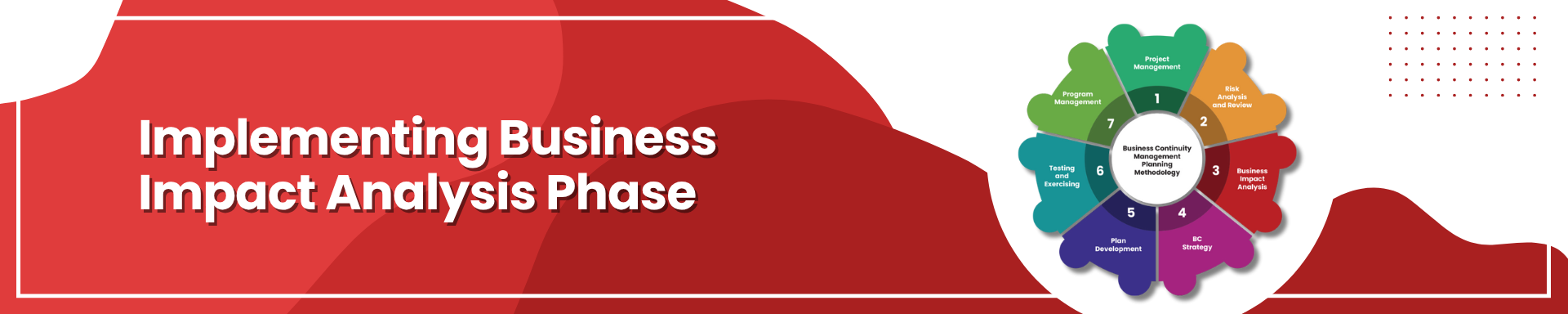
![Banner [Summary] [BCM] [E2] [C4] Business Impact Analysis](https://no-cache.hubspot.com/cta/default/3893111/3d259877-5780-4502-9473-1129f6d08a8c.png)
The BIA phase lays the foundation for a resilient Business Continuity Management system at the Ministry of Manpower.
It enables the Ministry to clearly understand how disruptions affect its ability to deliver vital services, comply with statutory obligations, and maintain stakeholder trust.
By implementing a structured BIA — guided by international best practices and tailored to MOM’s mission and operational context — the Ministry strengthens its capacity to anticipate, respond to, and recover from disruptions, ensuring continuity of services critical to Singapore’s workforce and economy.
![[BCM] [MOM] [E2] [C1] Business Continuity Management Planning Methodology](https://no-cache.hubspot.com/cta/default/3893111/c61b9602-b529-466a-8e50-1ecafcecf3c2.png)
![[BCM] [MOM] [E2] [C2] Project Management](https://no-cache.hubspot.com/cta/default/3893111/135e6f92-2d77-4b8a-8cde-fb9d2334d138.png)
![[BCM] [MOM] [E2] [C3] Risk Analysis and Review](https://no-cache.hubspot.com/cta/default/3893111/d90d6411-35a1-4c8d-84df-8a750fcd2132.png)
![[BCM] [MOM] [E2] [C5] Business Continuity Strategy](https://no-cache.hubspot.com/cta/default/3893111/9d56ef8b-f7b5-4011-abb4-de897b3cb9f3.png)
![[BCM] [MOM] [E2] [C6] BCM Plan Development](https://no-cache.hubspot.com/cta/default/3893111/4263c96d-afac-4848-9ae1-d7f4de5991a6.png)
![[BCM] [MOM] [E2] [C7] Testing and Exercising](https://no-cache.hubspot.com/cta/default/3893111/a49b6ccf-0c3a-4edb-a860-5e9ad3bfb253.png)
![[BCM] [MOM] [E2] [C8] Program Management](https://no-cache.hubspot.com/cta/default/3893111/8f25db36-e21c-4d40-90c0-f3d28a6c2a84.png)
![[BCM] [MOM] [E2] [C9] Summary](https://no-cache.hubspot.com/cta/default/3893111/1ef7f4d6-ba8a-440f-931d-35517cd29fa9.png)
![[BCM] [MOM] [E2] [C10] Back Cover for BCM](https://no-cache.hubspot.com/cta/default/3893111/b21681d9-63d8-4ca6-9e2d-d87b27398714.png)
More Information About Business Continuity Management Courses
To learn more about the course and schedule, click the buttons below for the BCM-300 Business Continuity Management Implementer [BCM-3] and the BCM-5000 Business Continuity Management Expert Implementer [BCM-5].


![Register [BL-B-3]*](https://no-cache.hubspot.com/cta/default/3893111/ac6cf073-4cdd-4541-91ed-889f731d5076.png)



![FAQ [BL-B-3]](https://no-cache.hubspot.com/cta/default/3893111/b3824ba1-7aa1-4eb6-bef8-94f57121c5ae.png)
![Email to Sales Team [BCM Institute]](https://no-cache.hubspot.com/cta/default/3893111/3c53daeb-2836-4843-b0e0-645baee2ab9e.png)


