


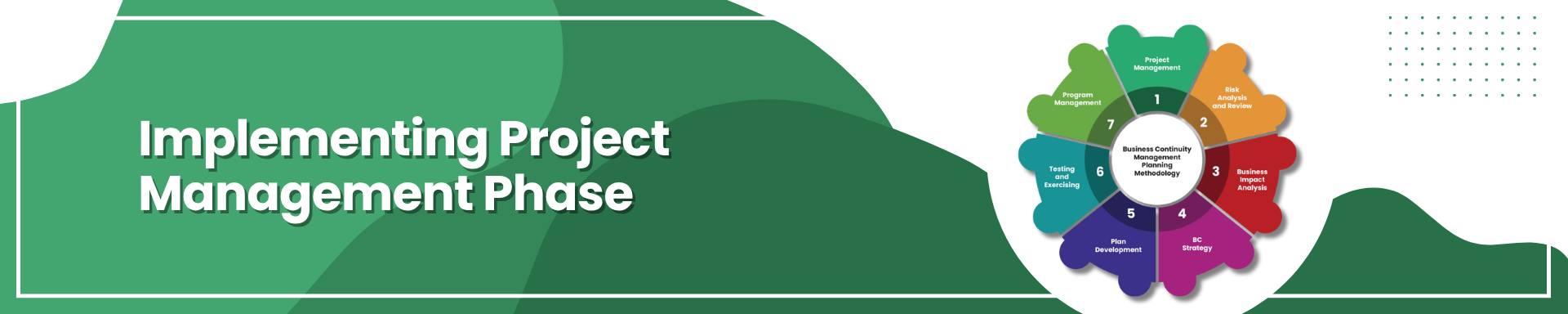

eBook 2: Chapter 2
Project Management Phase for BCM Planning Methodology for the Ministry of Manpower
![[BCM] [MOM] [E2] [C2] Project Management](https://no-cache.hubspot.com/cta/default/3893111/135e6f92-2d77-4b8a-8cde-fb9d2334d138.png) The Business Continuity Management (BCM) Planning Methodology is an essential component of the ISO 22301 framework, which ensures an organisation’s resilience in the face of disruptions.
The Business Continuity Management (BCM) Planning Methodology is an essential component of the ISO 22301 framework, which ensures an organisation’s resilience in the face of disruptions.This chapter outlines how the Ministry of Manpower (MOM) in Singapore initiates, plans, and governs the implementation of BCM in alignment with ISO 22301 requirements and supports MOM’s mission to secure the welfare and work prospects of Singapore’s workforce.
The Project Management Phase provides MOM with a structured approach for defining BCM objectives, securing leadership commitment, conducting stakeholder engagement, allocating resources, and establishing governance mechanisms to ensure successful BCM implementation.
Objective and Scope of the Project Management Phase
The primary objective of the Project Management Phase is to establish a solid project foundation that enables MOM to:
- Define the purpose and goals of BCM, aligned with MOM’s strategic outcomes.
- Identify the scope of BCM planning across MOM’s key functions (e.g., Employment Practices, Workplace Safety, and Foreign Workforce Operations).
- Ensure the right governance structures and leadership sponsorship are in place.
- Lay out a work plan and schedule for subsequent BCM phases.
The scope of this phase at MOM includes all core departments that impact operational continuity, particularly those responsible for frontline services such as work pass issuance, compliance enforcement, and workforce support.
Leadership Commitment and Governance
Strong leadership commitment is a cornerstone of the Project Management Phase. At MOM, the Permanent Secretary or Deputy Secretary typically acts as the Project Sponsor for BCM implementation. Their role includes:
- Endorsing the BCM initiative as a national priority within MOM.
- Approving project objectives, financial resources, and timelines.
- Championing BCM culture across all departments.
A Business Continuity Steering Committee (BCSC) is established to provide governance and oversight. Key members may include:
- Representatives from the Strategic Planning & Policy Division.
- Heads from critical operational divisions (e.g., Work Pass Policy, Workplace Safety & Health).
- IT, Human Resources, Corporate Communications, and Legal representatives.
Example
In response to the challenges posed by the COVID-19 pandemic, MOM’s leadership may prioritise BCM planning to ensure the continuity of e-services, such as the online work pass application system (e.g., MOM’s e-Services).
Project Team Formation and Roles
MOM forms a dedicated Business Continuity Project (BCP) Team responsible for planning and driving the BCM implementation. Typical roles include:
|
Role |
Responsibility |
|
Project Manager |
Oversees all BCM planning activities, coordinates stakeholders, and tracks progress against the project plan. |
|
BCM Lead |
Ensures compliance with ISO 22301 methodology and drives BCM deliverables. |
|
Departmental Coordinators |
Act as key points of contact for each division, ensuring local continuity needs are reflected. |
|
Subject Matter Experts (SMEs) |
Provide expertise on risks, critical services, IT systems, and compliance matters. |
Example
An IT SME would provide critical input on data replication and backup requirements for MOM’s key digital portals, such as the Work Permit Online System (WPOL).
Project Planning and Work-Plan Development
The Project Management Phase requires detailed project planning, including development of a project charter and work breakdown structure (WBS). At MOM, this would involve:
A formally documented charter that includes:- Project objectives (e.g., BCM implementation across all critical services by FY 2027).
- Scope boundaries (in-scope units, services, interdependencies).
- Key milestones (e.g., BCM Policy approval, Risk Assessment completion).
- Resource and budget allocation.
- Initial risk assessment for the BCM project itself.
Work Breakdown Structure (WBS) and Timeline
The BCP Team creates a WBS that includes major activities such as:
- Project initiation and kick-off.
- BCM policy and governance framework development.
- Stakeholder engagement strategies.
- Risk assessment and business impact analysis (BIA).
- Continuity strategy formulation.
- Documentation, training, and exercising.
A Gantt chart may be used to sequence tasks, allocate responsibilities, and set deadlines.
Example
MOM schedules its BCM project kickoff in Q1, followed by policy development and stakeholder workshops in Q2 and Q3, culminating in risk assessments in Q4.
Stakeholder Engagement and Communication Planning
Effective stakeholder engagement is critical in the Project Management Phase. MOM identifies internal and external stakeholders whose buy-in is necessary for successful BCM implementation. These include:
- Internal: Divisional heads, IT, HR, Finance, Legal.
- External: Employers, tripartite partners (e.g., unions and industry associations), service vendors.
A communication plan is established to maintain transparency and keep stakeholders informed of BCM milestones and expectations. Communication methods may include:
- Monthly BCM updates at Management Committee meetings.
- Newsletters or intranet bulletins.
- Workshops and feedback sessions.
Example
Engaging frontline officers from MOM’s Employment Standards Compliance division early can ensure that their continuity requirements (such as remote inspection capabilities during disruptions) are captured and planned for.
Resource and Budget Planning
The Project Management Phase outlines the financial and human resources required to execute BCM planning. At MOM, resource considerations may include:
- Allocation of part-time BCM responsibilities to existing staff.
- Budget for BCM software tools (for risk assessment, incident management, documentation).
- Training and professional certification costs (e.g., ISO 22301 lead implementer training).
- Expenditure for conducting exercises and simulation drills.
Documentation and Approval
All key outputs from the Project Management Phase are documented and presented for approval to MOM’s senior leadership, including:
- BCM Project Charter.
- Governance and organisational structure.
- Communication and stakeholder engagement plan.
- Resource and budget plan.
Formal approval ensures alignment between BCM objectives and MOM’s organisational priorities and compliance with ISO 22301 requirements for documented project initiation.
Key Success Factors and Challenges
Success Factors
- Visible support from senior leadership.
- Clear articulation of BCM objectives tied to MOM’s strategic goals.
- Early stakeholder engagement across the Ministry.
- Adequate allocation of resources and time.
Challenges
- Balancing operational workload with BCM planning activities.
- Coordinating multiple departments with varying priorities.
- Identifying dependencies across digital services and external partners.
![Banner [Summary] [BCM] [E2] [C2] Project Management](https://no-cache.hubspot.com/cta/default/3893111/a27bdcb3-7e9b-40ec-8a47-a1c06d8688ca.png)
The Project Management Phase sets the stage for sustainable BCM planning at the Ministry of Manpower.
By establishing robust governance, clear roles, structured planning, and stakeholder engagement, MOM can transition effectively to subsequent phases, such as risk assessment and business impact analysis, with a solid foundation for resilience and continuity.
![[BCM] [MOM] [E2] [C1] Business Continuity Management Planning Methodology](https://no-cache.hubspot.com/cta/default/3893111/c61b9602-b529-466a-8e50-1ecafcecf3c2.png)
![[BCM] [MOM] [E2] [C3] Risk Analysis and Review](https://no-cache.hubspot.com/cta/default/3893111/d90d6411-35a1-4c8d-84df-8a750fcd2132.png)
![[BCM] [MOM] [E2] [C4] Business Impact Analysis](https://no-cache.hubspot.com/cta/default/3893111/db8894ff-5924-44d3-a069-0bcd5d76fa56.png)
![[BCM] [MOM] [E2] [C5] Business Continuity Strategy](https://no-cache.hubspot.com/cta/default/3893111/9d56ef8b-f7b5-4011-abb4-de897b3cb9f3.png)
![[BCM] [MOM] [E2] [C6] BCM Plan Development](https://no-cache.hubspot.com/cta/default/3893111/4263c96d-afac-4848-9ae1-d7f4de5991a6.png)
![[BCM] [MOM] [E2] [C7] Testing and Exercising](https://no-cache.hubspot.com/cta/default/3893111/a49b6ccf-0c3a-4edb-a860-5e9ad3bfb253.png)
![[BCM] [MOM] [E2] [C8] Program Management](https://no-cache.hubspot.com/cta/default/3893111/8f25db36-e21c-4d40-90c0-f3d28a6c2a84.png)
![[BCM] [MOM] [E2] [C9] Summary](https://no-cache.hubspot.com/cta/default/3893111/1ef7f4d6-ba8a-440f-931d-35517cd29fa9.png)
![[BCM] [MOM] [E2] [C10] Back Cover for BCM](https://no-cache.hubspot.com/cta/default/3893111/b21681d9-63d8-4ca6-9e2d-d87b27398714.png)
More Information About Business Continuity Management Courses
To learn more about the course and schedule, click the buttons below for the BCM-300 Business Continuity Management Implementer [BCM-3] and the BCM-5000 Business Continuity Management Expert Implementer [BCM-5].


![Register [BL-B-3]*](https://no-cache.hubspot.com/cta/default/3893111/ac6cf073-4cdd-4541-91ed-889f731d5076.png)



![FAQ [BL-B-3]](https://no-cache.hubspot.com/cta/default/3893111/b3824ba1-7aa1-4eb6-bef8-94f57121c5ae.png)
![Email to Sales Team [BCM Institute]](https://no-cache.hubspot.com/cta/default/3893111/3c53daeb-2836-4843-b0e0-645baee2ab9e.png)


