



![Banner [BCM] [E3] [RAR] [T1] List of Threats](https://no-cache.hubspot.com/cta/default/3893111/65957ea5-03c3-451d-aabe-bbf23d32c897.png)
Introduction
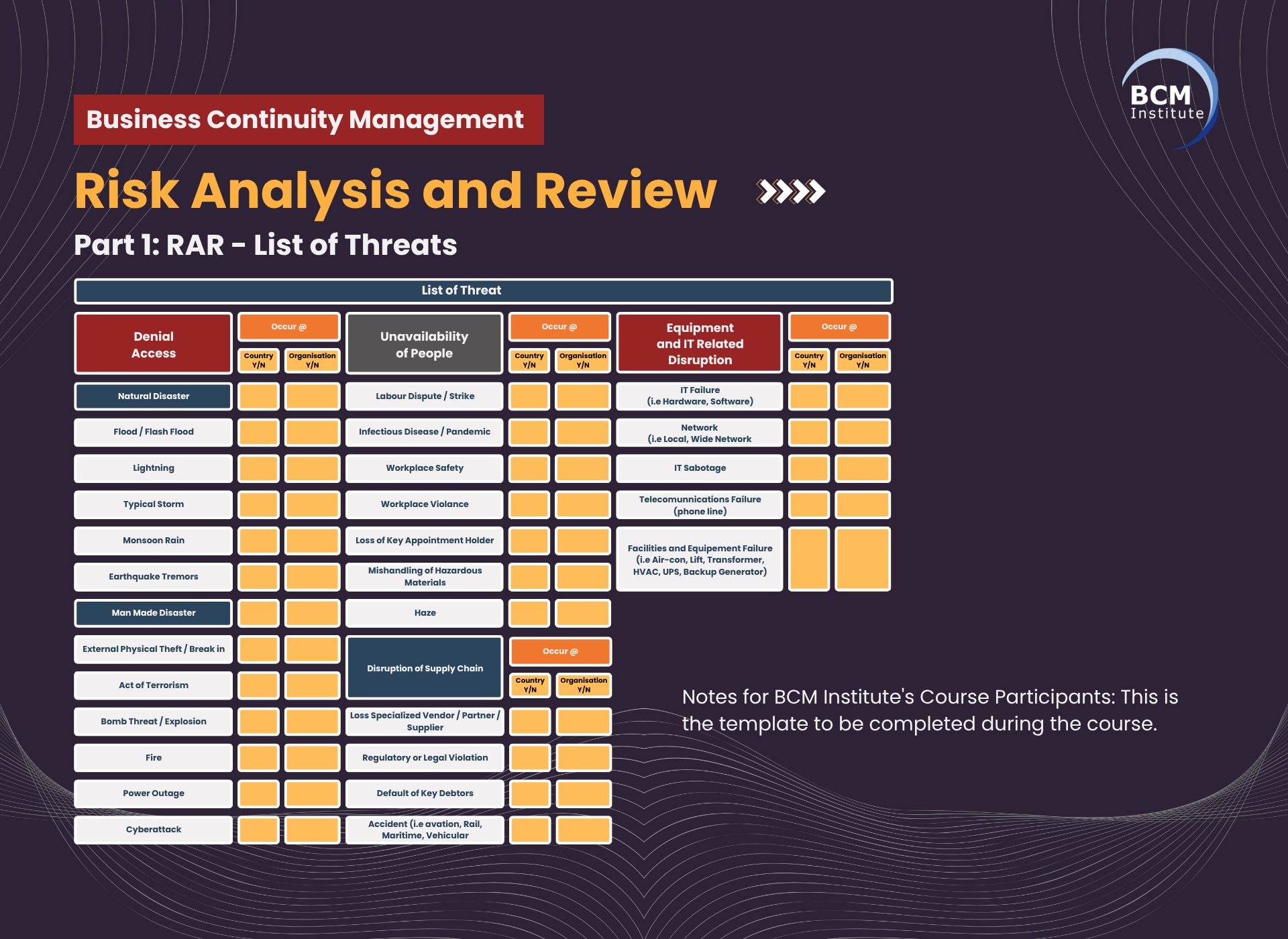
![[BCM] [MINDS] [E3] [RAR] [T1] List of Threats](https://no-cache.hubspot.com/cta/default/3893111/3262c956-93e2-45d4-850e-fa4cb7fab302.png)
Risk Assessment and Risk Analysis (RAR) is a foundational component of Business Continuity Management (BCM).
For an organisation such as MINDS, which provides essential education, training, residential, and community-based services to persons with intellectual disabilities, understanding potential threats is critical to safeguarding service continuity, client well-being, staff safety, and regulatory compliance.
This chapter identifies and categorises threats that could disrupt MINDS’ operations, facilities, people, supply chains, and supporting systems.
The threats are analysed at both country level (Singapore-wide or external environment) and organisation level (specific to MINDS’ operations, centres, and stakeholders), in line with good BCM practice and guidance referenced from BCMpedia.

Table R1: List of Threats
|
Category of Threats |
Types of Threats |
Description of Threats |
Country Level (C) |
Organisation Level (O) |
|
Denial of Access – Natural Disaster |
Flooding |
Heavy rainfall leading to flash floods affecting access to buildings and transport routes |
Urban flooding in low-lying areas across Singapore |
Inaccessibility of MINDS schools, training centres, or residential homes; delays in transporting clients |
|
Fire (Natural causes) |
Fires caused by lightning strikes or extreme heat conditions |
Risk during prolonged dry or hot weather periods |
Evacuation of residents or students; temporary closure of affected facilities |
|
|
Pandemics / Infectious Disease Outbreaks |
Widespread infectious diseases causing movement restrictions |
Nationwide public health emergencies (e.g. COVID-19-type events) |
Suspension of programmes, reduced face-to-face services, infection risk to vulnerable clients |
|
|
Haze / Air Pollution |
Transboundary haze affecting air quality |
Regional haze incidents affecting Singapore |
Health risks to clients; outdoor activities cancelled; centres may close temporarily |
|
|
Denial of Access – Man-made Disaster |
Building Fire (Accidental/Deliberate) |
Fire caused by electrical faults, human error, or arson |
Fire incidents affecting public or private buildings |
Evacuation of MINDS facilities; loss of specialised equipment and learning materials |
|
Terrorist Attack |
Acts of terrorism impacting public spaces |
National security threat in Singapore |
Restricted access to centres; heightened security requirements; programme disruption |
|
|
Civil Disorder / Public Unrest |
Riots, protests, or large-scale disturbances |
Rare but possible public order incidents |
Transport disruption affecting staff and clients travelling to centres |
|
|
Utility Failure (External cause) |
Power, water, or gas outages due to accidents or sabotage |
Nationwide or regional utility disruption |
Loss of essential services in residential homes and training centres |
|
|
Unavailability of People |
Staff Shortage (Illness) |
High absenteeism due to illness or outbreaks |
Widespread illness affecting workforce availability |
Insufficient trained caregivers, teachers, or therapists to run programmes safely |
|
Industrial Action |
Strike action affecting essential services |
Disruption in transport, healthcare, or public services |
Staff unable to reach workplaces; delayed services |
|
|
Skills Dependency |
Reliance on specialised or key personnel |
National shortage of trained care professionals |
Loss of critical knowledge if key MINDS staff are unavailable |
|
|
Volunteer Unavailability |
Reduced availability of volunteers |
Volunteer participation declines during crises |
Impact on enrichment programmes and community engagement |
|
|
Disruption to the Supply Chain |
Medical & Care Supplies Shortage |
Disruption in supply of PPE, medication, or care items |
Global or regional supply chain disruptions |
Insufficient supplies for residential and day-care services |
|
Food Supply Disruption |
Delays or shortages from food suppliers |
National logistics or import disruptions |
Meal provision issues in residential homes and day activity centres |
|
|
Transport Services Disruption |
Failure of outsourced transport providers |
Public transport or vendor disruption |
Clients unable to attend schools, training, or community programmes |
|
|
Vendor Dependency |
Over-reliance on single suppliers |
Supplier insolvency or service failure |
Delays in repairs, maintenance, or programme delivery |
|
|
Equipment and IT-Related Disruption |
IT System Failure |
Breakdown of servers, networks, or applications |
National ICT infrastructure issues |
Inaccessibility of client records, case management, and reporting systems |
|
Cyberattack (Ransomware, Malware) |
Malicious attacks compromising systems or data |
Increasing cyber threats in Singapore |
Exposure of sensitive client data; service disruption |
|
|
Power Failure (Internal) |
Electrical faults within buildings |
Isolated or localised outages |
Shutdown of assistive devices, lifts, and IT systems |
|
|
Equipment Breakdown |
Failure of specialised care or training equipment |
Normal wear and tear |
Disruption to therapy sessions, vocational training, or daily living support |
![Banner [Table] [BCM] [E3] [RAR] [Summing Up] [T1] List of Threats](https://no-cache.hubspot.com/cta/default/3893111/d4dc8faf-623d-4f0d-acf8-26776beec0f4.png)
The threats identified in this RAR reflect both the external operating environment of Singapore and the unique operational realities of MINDS as a social service organisation supporting persons with intellectual disabilities.
Many of these threats—such as pandemics, staff shortages, IT disruptions, and supply chain failures—can have immediate and severe impacts on client safety, service continuity, and regulatory obligations.
By systematically identifying these threats, MINDS can better prioritise risk mitigation strategies, define Minimum Business Continuity Objectives (MBCO), and develop robust business continuity and recovery plans.
This proactive approach strengthens organisational resilience and ensures that MINDS remains capable of delivering essential services to its beneficiaries, even during disruptive events.
![[BCM] [MINDS] [E3] [BIA] MBCO Corporate MBCO](https://no-cache.hubspot.com/cta/default/3893111/47babf68-4665-40bc-8db7-f34c7a717f49.png)
![[BCM] [MINDS] [E3] [BIA] [PS] Key Product and Services](https://no-cache.hubspot.com/cta/default/3893111/1d6fd982-7a1c-4245-a1f0-bdd7a3155cc7.png)
![[BCM] [MINDS] [E3] [RAR] [T2] Treatment and Control](https://no-cache.hubspot.com/cta/default/3893111/32464d64-b115-41e7-98be-850950580336.png)
![[BCM] [MINDS] [E3] [RAR] [T3] Risk Impact and Likelihood Assessment](https://no-cache.hubspot.com/cta/default/3893111/cf5354bd-6256-4a23-ac6d-14bacb075337.png)
![BCM] [MINDS] [E3] [BCS] [T1] Mitigation Strategies and Justification](https://no-cache.hubspot.com/cta/default/3893111/0bada7ae-abc1-4a42-bcd7-35ea2895a4d7.png)
![[BCM] [MINDS] [E1] [C10] Identifying Critical Business Functions](https://no-cache.hubspot.com/cta/default/3893111/cfa9c1eb-7960-4442-8ef7-3ae5faeb4c8b.png)
More Information About Business Continuity Management Courses
To learn more about the course and schedule, click the buttons below for the BCM-300 Business Continuity Management Implementer [BCM-3] and the BCM-5000 Business Continuity Management Expert Implementer [BCM-5].


![Register [BL-B-3]*](https://no-cache.hubspot.com/cta/default/3893111/ac6cf073-4cdd-4541-91ed-889f731d5076.png)



![FAQ [BL-B-3]](https://no-cache.hubspot.com/cta/default/3893111/b3824ba1-7aa1-4eb6-bef8-94f57121c5ae.png)
![Email to Sales Team [BCM Institute]](https://no-cache.hubspot.com/cta/default/3893111/3c53daeb-2836-4843-b0e0-645baee2ab9e.png)


