



![Banner [BCM] [E3] [BIA] [P5] Inter-dependencies](https://no-cache.hubspot.com/cta/default/3893111/c7d00b8b-77c0-43ee-a2cf-76ea43b26fe8.png)
CBF-8 ICT Systems Supporting Care and Operations
![[BCM] [MINDS] [E3] [BIA] [T3] [CBF] [8] ICT Systems Supporting Care and Operations](https://no-cache.hubspot.com/cta/default/3893111/89d637b4-f6fb-4eec-9f83-5496e1328766.png)
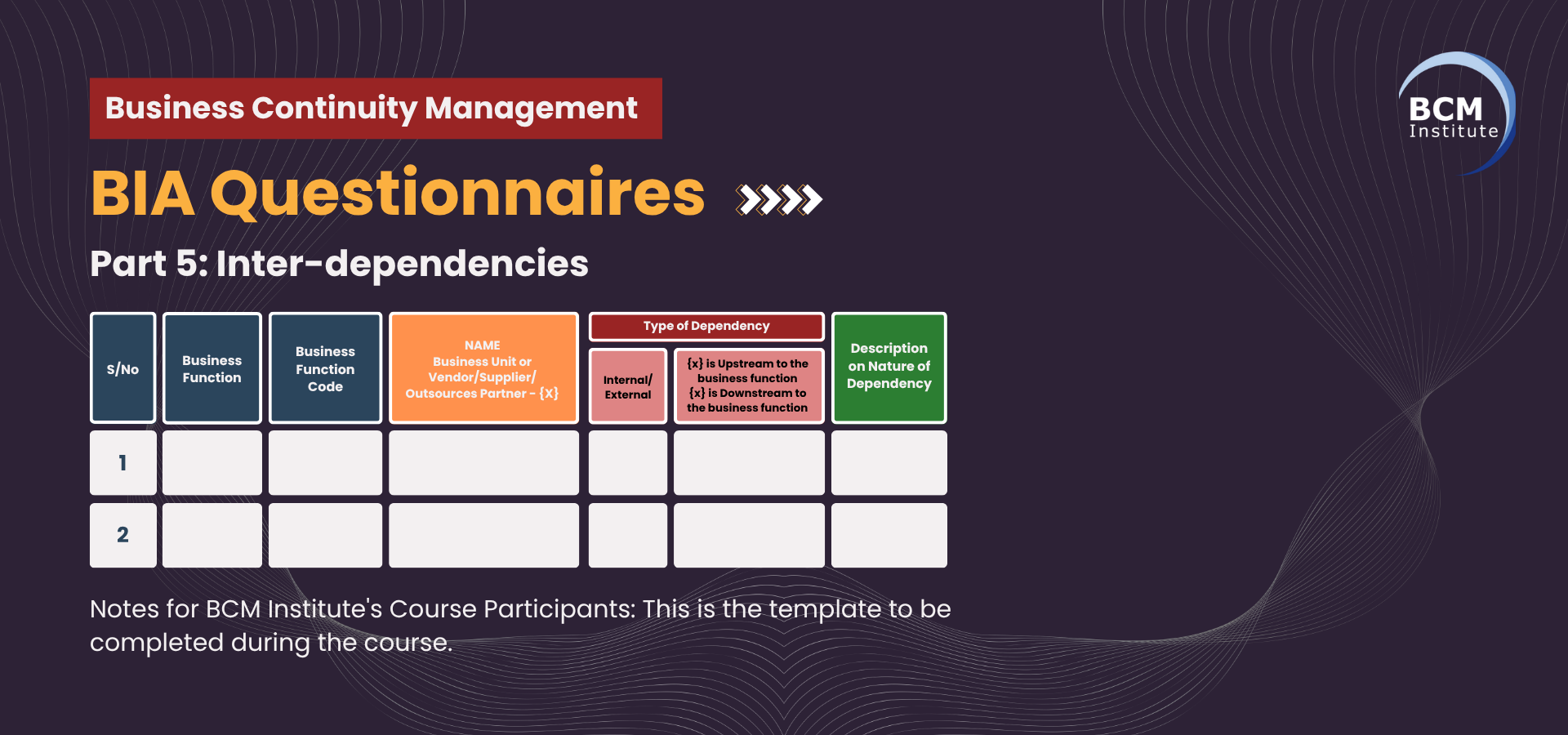
Part 5 of this chapter focuses on the inter-dependencies associated with CBF-8, ICT Systems Supporting Care and Operations, within MINDS.
ICT systems form the backbone of the organisation’s care delivery and operational processes, enabling seamless communication, accurate clinical management, secure data handling, and effective support services.
The inter-dependencies outlined here highlight the critical linkages between each ICT sub-CBF, internal business units, and external vendors or service providers.
Understanding these inter-dependencies is essential for identifying potential points of failure, planning business continuity measures, and ensuring that disruptions in one area do not cascade into broader operational impacts.
By systematically mapping both upstream and downstream relationships, MINDS can enhance resilience, optimise collaboration, and ensure uninterrupted support for its care and operational functions.
![Banner [Table] [BCM] [E3] [BIA] [P5] Inter-dependencies [BIAQ]](https://no-cache.hubspot.com/cta/default/3893111/ed6152ff-4926-4fae-bd6b-ba572bcc781b.png)
Table P5: Inter‑dependencies for CBF-1
|
Sub-CBF Code |
Sub-CBF |
Name of Business Unit or Vendor / Supplier / Outsource Partner |
Type of Dependency – Internal |
Type of Dependency – External |
Dependency Direction (Upstream / Downstream / Mutual) |
Description of Nature of Dependency |
|
8.1 |
ICT Infrastructure Management |
MINDS IT Department |
Yes |
No |
Upstream |
Provides the foundational network, servers, and hardware needed for all other ICT sub-CBFs; other functions rely on stable infrastructure. |
|
8.2 |
Clinical & Care Management Systems |
MINDS Care Team |
Yes |
Yes (Vendor: EMR Software Provider) |
Downstream |
Care teams depend on ICT for system access; vendor provides updates, patches, and support for EMR systems. |
|
8.3 |
Communication & Collaboration Tools |
MINDS Administration |
Yes |
Yes (Microsoft 365 / Zoom) |
Mutual |
Staff communication tools are used daily; ICT ensures uptime while staff provide usage feedback and request support. |
|
8.4 |
Business & Operational Applications |
Finance & HR Units |
Yes |
Yes (Outsourced Payroll & Accounting Software Vendor) |
Downstream |
Finance and HR depend on ICT applications for operations; vendor ensures application availability and updates. |
|
8.5 |
Data Backup & Recovery |
ICT Department |
Yes |
Yes (Cloud Backup Vendor) |
Upstream |
Ensures that all operational and care data are backed up; other units rely on recovery procedures in case of disruption. |
|
8.6 |
Security & Access Controls |
Security & Compliance Team |
Yes |
Yes (External Security Auditors) |
Upstream |
Security team enforces access policies; external auditors review and certify compliance; all ICT sub-CBFs depend on this control. |
|
8.7 |
Helpdesk & User Support Services |
ICT Helpdesk |
Yes |
No |
Downstream |
Provides support to internal staff; dependent on information from other ICT sub-CBFs to resolve incidents. |
|
8.8 |
System Development & Integration |
ICT Development Team |
Yes |
Yes (Third-party Integration Vendors) |
Mutual |
Development team integrates systems across care and operational units; vendors provide APIs and integration support. |
|
8.9 |
Monitoring, Alerts & Incident Response |
ICT Security & Operations |
Yes |
No |
Upstream |
Continuously monitors ICT systems; alerts other units to issues; ensures minimal disruption to care and operations. |
|
8.10 |
Vendor & Third-Party Service Management |
Procurement & ICT Vendor Management Team |
Yes |
Yes (All ICT Vendors) |
Mutual |
Manages contracts, SLAs, and performance of vendors; ICT functions rely on vendor services, vendors rely on MINDS for service requests. |
![Banner [BCM] [E3] [BIA] [Summing Up] [P5] Inter-dependencies [BIAQ]](https://no-cache.hubspot.com/cta/default/3893111/117996e6-4a68-4449-880f-d8a48ff3071d.png)
The inter-dependencies presented in this chapter demonstrate that CBF-8 ICT Systems Supporting Care and Operations operates within a complex ecosystem of internal and external stakeholders.
Each sub-CBF, from infrastructure management to vendor services, relies on a combination of internal coordination and external support to function effectively.
Recognising these dependencies is crucial for risk assessment, incident response planning, and the prioritisation of recovery strategies.
By maintaining clear oversight of these linkages, MINDS can strengthen operational continuity, minimise disruption to care services, and sustain the organisation’s overall mission of supporting individuals with intellectual disabilities.
Effective management of ICT inter-dependencies not only safeguards daily operations but also ensures that MINDS remains agile and resilient in the face of emerging challenges.
![Banner [BCM] [E3] [BIA] [P6] Vital Records](https://no-cache.hubspot.com/cta/default/3893111/6d3e4359-14f4-4816-b274-3f61b92be858.png)
CBF-8 ICT Systems Supporting Care and Operations
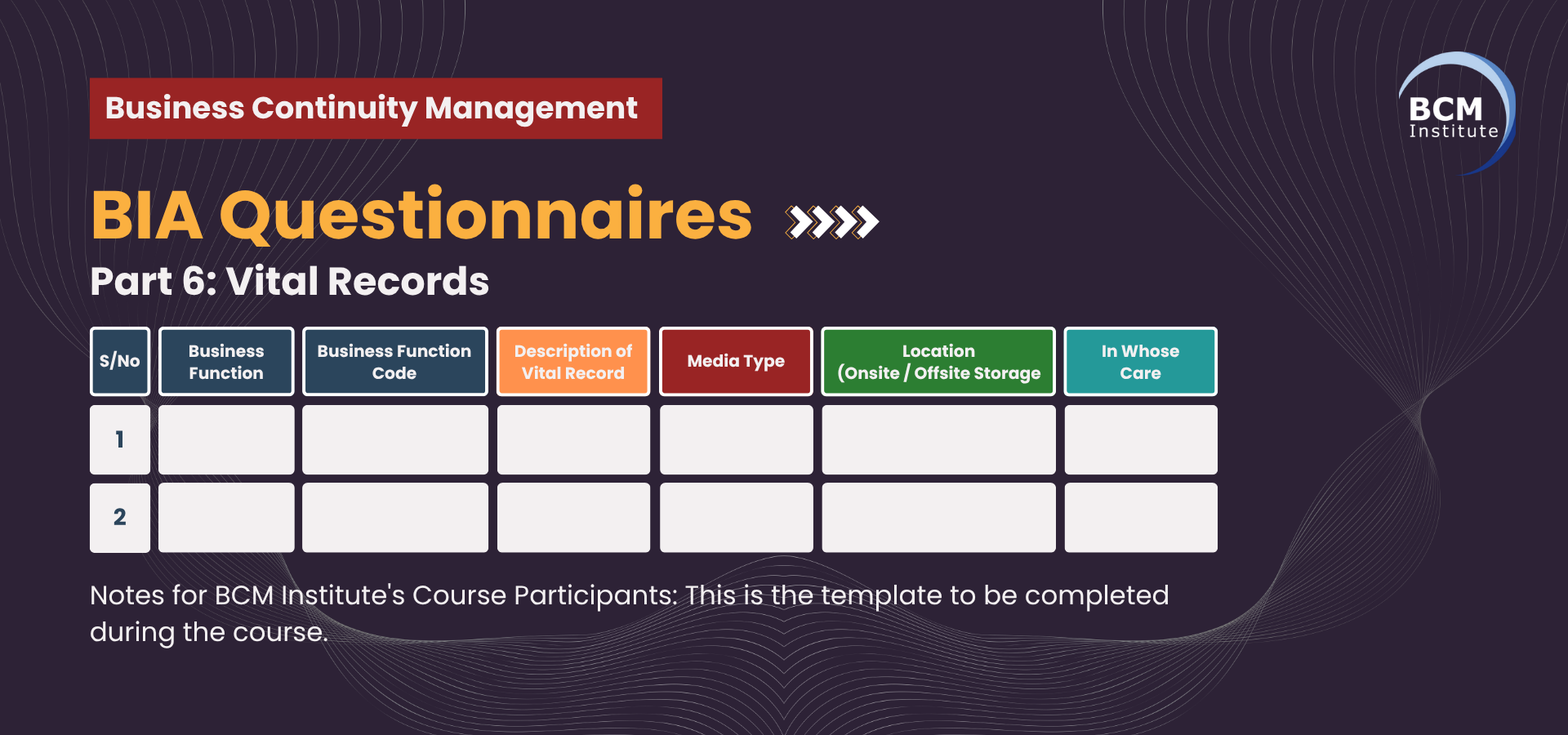
Part 6 of this chapter focuses on the vital records that are essential for the effective operation of CBF-8, ICT Systems Supporting Care and Operations, within MINDS.
Vitalrecords are those documents, data, and system information that are critical to maintaining continuity of care, operational efficiency, and regulatory compliance.
These records support decision-making, ensure accurate service delivery, and enable timely recovery in the event of disruptions.
This section identifies the specific records associated with each ICT sub-CBF, the media types in which they are maintained, their storage locations, and the responsible custodians. By understanding and managing these vital records, MINDS can safeguard its operational knowledge, maintain the integrity of its ICT systems, and support the continuity of care services for its clients.
![Banner [Table] [BCM] [E3] [BIA] [P6] Vital Records [BIAQ]](https://no-cache.hubspot.com/cta/default/3893111/b44d6d49-dfb5-42a1-bc91-c0c701fc0724.png)
Table P6: Vital Records for CBF-1
|
Sub-CBF Code |
Sub-CBF |
Description of Vital Records |
Media Type |
Location |
In Whose Care |
|
8.1 |
ICT Infrastructure Management |
Network diagrams, server configurations, hardware inventory, system architecture documents |
Digital & Hard Copy |
Server room, IT department, cloud repository |
ICT Infrastructure Manager |
|
8.2 |
Clinical & Care Management Systems |
EMR/Client care databases, patient care logs, system access logs, configuration files |
Digital |
Secure servers, cloud-based EMR system |
Care Systems Administrator |
|
8.3 |
Communication & Collaboration Tools |
User account lists, license keys, system configuration files, email and chat records |
Digital |
Cloud platforms (e.g., Microsoft 365, Zoom), IT department |
ICT Support Manager |
|
8.4 |
Business & Operational Applications |
Finance, HR, payroll, inventory, and operational application databases; application licenses |
Digital & Hard Copy |
Application servers, cloud SaaS platforms |
Business Applications Manager |
|
8.5 |
Data Backup & Recovery |
Backup schedules, backup tapes, recovery scripts, cloud backup logs |
Digital & Tape |
Onsite backup storage, offsite secure location, cloud backup |
Backup & Recovery Officer |
|
8.6 |
Security & Access Controls |
User access logs, security policies, incident reports, encryption keys, authentication credentials |
Digital & Hard Copy |
Security server, IT department |
IT Security Officer |
|
8.7 |
Helpdesk & User Support Services |
Helpdesk ticket logs, incident reports, SOPs for user support |
Digital |
IT helpdesk system, IT department |
Helpdesk Manager |
|
8.8 |
System Development & Integration |
Source code repositories, integration scripts, test cases, development documentation |
Digital |
Version control systems, development servers |
System Development Lead |
|
8.9 |
Monitoring, Alerts & Incident Response |
System monitoring logs, alert reports, incident response plans, dashboard configurations |
Digital |
Monitoring servers, IT department |
ICT Operations Manager |
|
8.10 |
Vendor & Third-Party Service Management |
Contracts, SLAs, service reports, vendor contact lists |
Hard Copy & Digital |
Procurement office, secure digital repository |
Vendor Management Officer |
![Banner [BCM] [E3] [BIA] [Summing Up] [P6] Vital Records [BIAQ]](https://no-cache.hubspot.com/cta/default/3893111/06d76589-ebcf-4c9f-8e5b-c27f02938eed.png)
The identification and protection of vital records for CBF-8 underscore their critical role in supporting both daily operations and recovery efforts during incidents. Each sub-CBF, from infrastructure management to vendor coordination, relies on these records to ensure uninterrupted ICT services that underpin care and operational processes.
Proper management—including secure storage, access controls, and regular updates—ensures that vital records are available when needed, reducing the risk of operational disruption and enabling efficient business continuity responses.
By maintaining a clear understanding of the location, media type, and custodianship of these records, MINDS strengthens the resilience of its ICT systems and reinforces its commitment to delivering reliable, high-quality services to individuals with intellectual disabilities.
Implementing Business Continuity Management for MINDS: Ensuring Continuity of Care and Services |
||||||
| eBook 3: Starting Your BCM Implementation |
||||||
![[BCM] [MINDS] [E3] [BIA] MBCO Corporate MBCO](https://no-cache.hubspot.com/cta/default/3893111/47babf68-4665-40bc-8db7-f34c7a717f49.png) |
![[BCM] [MINDS] [E3] [BIA] [PS] Key Product and Services](https://no-cache.hubspot.com/cta/default/3893111/1d6fd982-7a1c-4245-a1f0-bdd7a3155cc7.png) |
![[BCM] [MINDS] [E3] [RAR] [T1] List of Threats](https://no-cache.hubspot.com/cta/default/3893111/3262c956-93e2-45d4-850e-fa4cb7fab302.png) |
![[BCM] [MINDS] [E3] [RAR] [T2] Treatment and Control](https://no-cache.hubspot.com/cta/default/3893111/32464d64-b115-41e7-98be-850950580336.png) |
![[BCM] [MINDS] [E3] [RAR] [T3] Risk Impact and Likelihood Assessment](https://no-cache.hubspot.com/cta/default/3893111/cf5354bd-6256-4a23-ac6d-14bacb075337.png) |
![BCM] [MINDS] [E3] [BCS] [T1] Mitigation Strategies and Justification](https://no-cache.hubspot.com/cta/default/3893111/0bada7ae-abc1-4a42-bcd7-35ea2895a4d7.png) |
![[BCM] [MINDS] [E1] [C10] Identifying Critical Business Functions](https://no-cache.hubspot.com/cta/default/3893111/cfa9c1eb-7960-4442-8ef7-3ae5faeb4c8b.png) |
| CBF-8 ICT Systems Supporting Care and Operations |
||||||
| DP | BIAQ T1 | BIAQ T2 | BIAQ T3 | BCS T2 | BCS T3 | PD |
![[BCM] [MINDS] [E3] [BIA] [DP] [CBF] [8] ICT Systems Supporting Care and Operations](https://no-cache.hubspot.com/cta/default/3893111/28b1ecaf-f078-4703-b31c-dbec2b9f76c4.png) |
![[BCM] [MINDS] [E3] [BIA] [T1] [CBF] [8] ICT Systems Supporting Care and Operations](https://no-cache.hubspot.com/cta/default/3893111/6307f97a-c6d0-417e-a418-6800de302534.png) |
![[BCM] [MINDS] [E3] [BIA] [T2] [CBF] [8] ICT Systems Supporting Care and Operations](https://no-cache.hubspot.com/cta/default/3893111/4dfdf6ff-8282-477a-9f81-12604d058d91.png) |
|
![[BCM] [MINDS] [E3] [BCS] [T2] [CBF] [8] ICT Systems Supporting Care and Operations](https://no-cache.hubspot.com/cta/default/3893111/39f2428c-c4db-498c-9157-61275e345eb0.png) |
|
![[BCM] [MINDS] [E3] [PD] [CBF] [8] ICT Systems Supporting Care and Operations](https://no-cache.hubspot.com/cta/default/3893111/12fbbeab-7abf-4f45-9937-4713c8bd276e.png) |
More Information About Business Continuity Management Courses
To learn more about the course and schedule, click the buttons below for the BCM-300 Business Continuity Management Implementer [BCM-3] and the BCM-5000 Business Continuity Management Expert Implementer [BCM-5].


![Register [BL-B-3]*](https://no-cache.hubspot.com/cta/default/3893111/ac6cf073-4cdd-4541-91ed-889f731d5076.png)



![FAQ [BL-B-3]](https://no-cache.hubspot.com/cta/default/3893111/b3824ba1-7aa1-4eb6-bef8-94f57121c5ae.png)
![Email to Sales Team [BCM Institute]](https://no-cache.hubspot.com/cta/default/3893111/3c53daeb-2836-4843-b0e0-645baee2ab9e.png)


