


![Banner [BCM] [E3] [BIA] [P5] Inter-dependencies](https://no-cache.hubspot.com/cta/default/3893111/c7d00b8b-77c0-43ee-a2cf-76ea43b26fe8.png)
CBF-5 Family, Caregiver, and Stakeholder Engagement
![[BCM] [MINDS] [E3] [BIA] [T3] [CBF] [5] Family, Caregiver, and Stakeholder Engagement](https://no-cache.hubspot.com/cta/default/3893111/9ba81adf-0d1e-488d-8375-ed844fde78de.png)
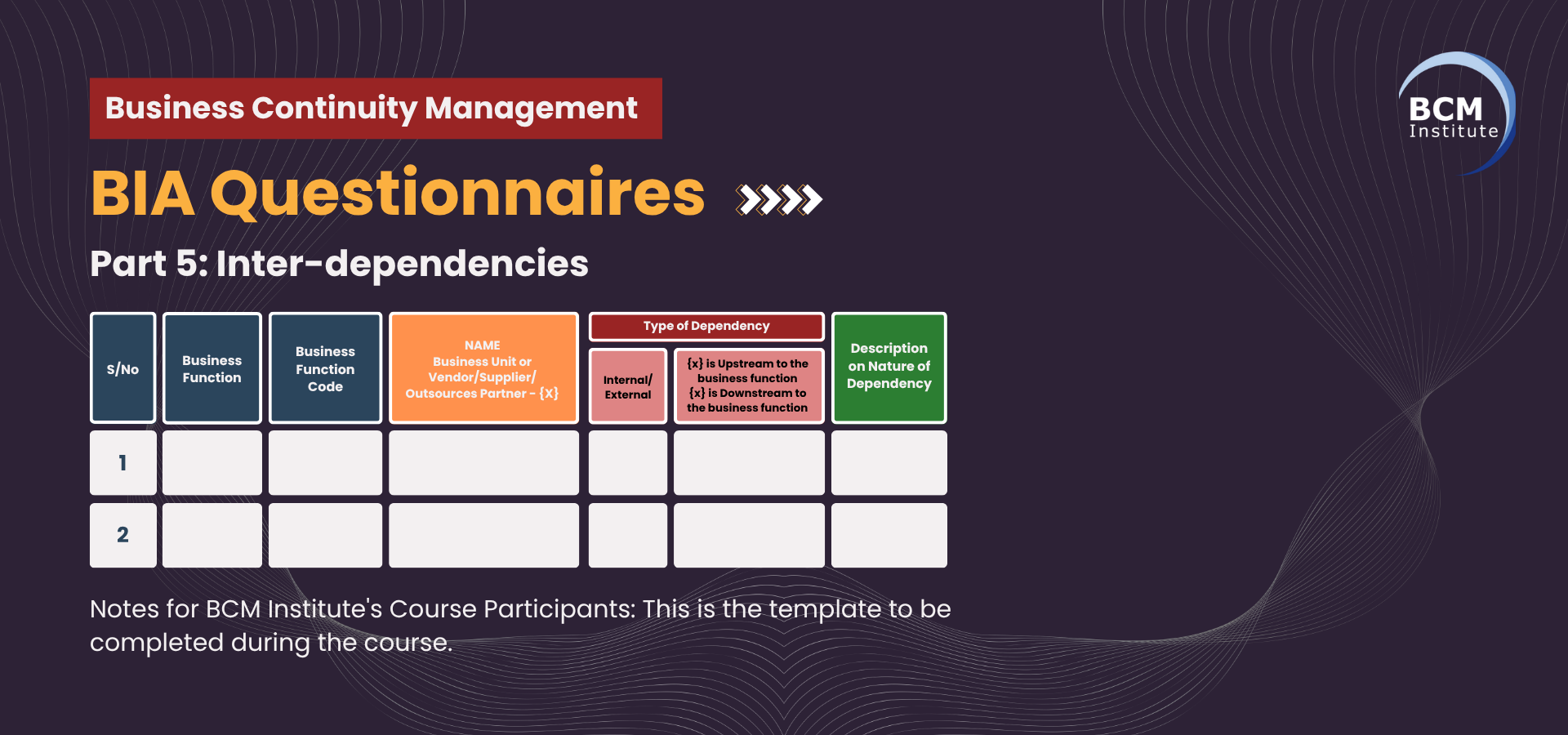
Family, caregiver, and stakeholder engagement at MINDS relies on a network of internal business units, external partners, and supporting service providers to function effectively.
These inter-dependencies directly influence MINDS’ ability to communicate, coordinate care, sustain trust, and deliver inclusive services—particularly during periods of disruption.
This section identifies and analyses the key internal and external inter-dependencies associated with each Sub-Critical Business Function (Sub-CBF) under CBF-5.
Understanding whether these dependencies are upstream, downstream, or mutual enables MINDS to prioritise protection strategies, plan realistic recovery actions, and reduce single points of failure across its family and community engagement ecosystem.
![Banner [Table] [BCM] [E3] [BIA] [P5] Inter-dependencies [BIAQ]](https://no-cache.hubspot.com/cta/default/3893111/ed6152ff-4926-4fae-bd6b-ba572bcc781b.png)
Table P5: Inter‑dependencies for CBF-1
|
Sub-CBF Code |
Sub-CBF |
Name of Business Unit or Vendor / Supplier / Outsource Partner |
Type of Dependency – Internal |
Type of Dependency – External |
Dependency Direction (Upstream / Downstream / Mutual) |
Description of Nature of Dependency |
|
5.1 |
Caregiver Communication & Support Coordination |
Corporate Communications; IT; Centre Operations |
✓ |
|
Mutual |
Relies on internal communication platforms, caregiver databases, and centre inputs; timely information exchange is bidirectional |
|
|
|
Telecom providers; Messaging platform vendors |
|
✓ |
Upstream |
External communication services enable outbound and inbound caregiver communications |
|
5.2 |
Caregiver Training & Education |
Programme Development; Learning & Development |
✓ |
|
Upstream |
Training content and curriculum are developed internally before delivery to caregivers |
|
|
|
External trainers; e-learning vendors |
|
✓ |
Mutual |
External facilitators and platforms support delivery while relying on MINDS for coordination and content |
|
5.3 |
MINDS Care Circle & Peer Network Facilitation |
Social Work & Psychology Services |
✓ |
|
Mutual |
Facilitators depend on professional oversight while feeding insights back into care planning |
|
|
|
Community partners; caregiver peer leaders |
|
✓ |
Mutual |
Peer support networks require mutual participation and coordination |
|
5.4 |
Family Future Care Planning |
Case Management; Legal & Finance Units |
✓ |
|
Upstream |
Care planning depends on internal assessments, financial guidance, and legal frameworks |
|
|
|
External legal advisors; financial planners |
|
✓ |
Upstream |
Specialist expertise supports informed and compliant future care planning |
|
5.5 |
Stakeholder Partnership & Community Engagement |
Senior Management; Corporate Services |
✓ |
|
Mutual |
Partnerships require internal direction and feedback from engagement outcomes |
|
|
|
Government agencies; donors; community organisations |
|
✓ |
Mutual |
Funding, collaboration, and programme support are interdependent |
|
5.6 |
Satellite Hub & Community Service Interface |
Centre Operations; Facilities Management |
✓ |
|
Upstream |
Operational readiness of hubs depends on internal facilities and staffing support |
|
|
|
Community centres; partner organisations |
|
✓ |
Downstream |
Community partners rely on MINDS for service referrals and coordination |
|
5.7 |
Feedback & Quality Assurance Mechanism |
Quality & Risk Management; IT |
✓ |
|
Upstream |
Feedback systems and analytics rely on internal data capture and system availability |
|
|
|
Caregivers; external auditors |
|
✓ |
Downstream |
External feedback informs service improvements and compliance reviews |
|
5.8 |
Volunteer and Youth Engagement Integration |
Volunteer Management; HR |
✓ |
|
Upstream |
Volunteer onboarding, training, and deployment depend on internal governance |
|
|
|
Schools; youth groups; volunteer organisations |
|
✓ |
Mutual |
Engagement relies on reciprocal participation, scheduling, and shared objectives |
![Banner [BCM] [E3] [BIA] [Summing Up] [P5] Inter-dependencies [BIAQ]](https://no-cache.hubspot.com/cta/default/3893111/117996e6-4a68-4449-880f-d8a48ff3071d.png)
The inter-dependencies identified for CBF-5 Family, Caregiver, and Stakeholder Engagement highlight the highly interconnected and relationship-driven nature of MINDS’ engagement ecosystem.
Many Sub-CBFs exhibit mutual dependencies, reflecting continuous information exchange, shared responsibilities, and co-creation of outcomes with families, volunteers, and partners.
By clearly mapping these dependencies, MINDS can better anticipate cascading impacts, prioritise resilience measures, and strengthen collaboration frameworks with both internal units and external stakeholders.
This understanding supports more effective disruption preparedness and reinforces MINDS’ commitment to continuity of care, trust, and community partnership—especially in times of uncertainty.
.
![Banner [BCM] [E3] [BIA] [P6] Vital Records](https://no-cache.hubspot.com/cta/default/3893111/6d3e4359-14f4-4816-b274-3f61b92be858.png)
CBF-5 Family, Caregiver, and Stakeholder Engagement
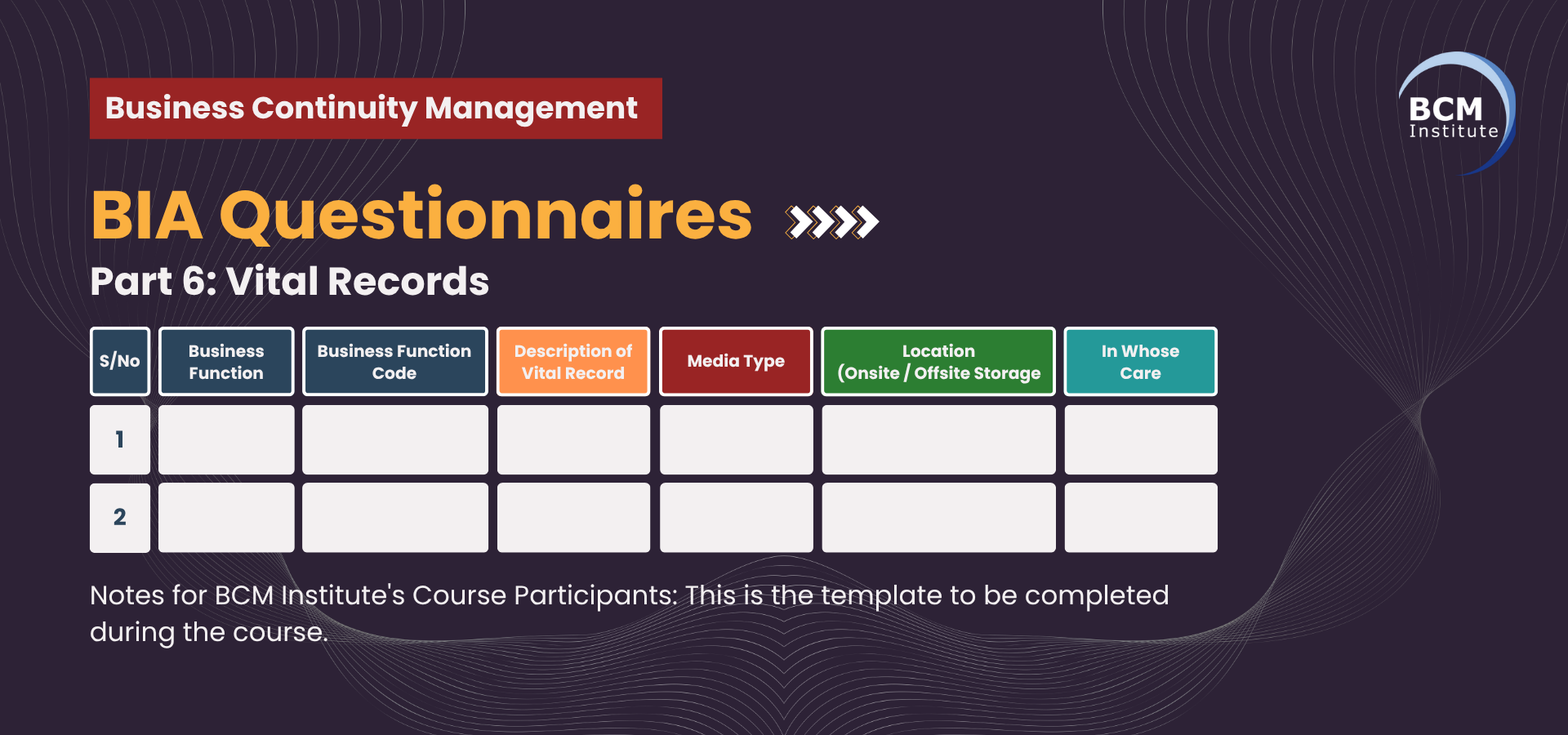
Given the nature of residential and community living services, vital records for CBF-2 are largely resident-centric, care-critical, and regulatory in nature, encompassing admission records, care plans, health information, staffing records, emergency procedures, and partnership agreements.
Loss, inaccessibility, or compromise of these records could severely impact resident safety, service delivery, and compliance with statutory requirements..
![Banner [Table] [BCM] [E3] [BIA] [P6] Vital Records [BIAQ]](https://no-cache.hubspot.com/cta/default/3893111/b44d6d49-dfb5-42a1-bc91-c0c701fc0724.png)
Table P6: Vital Records for CBF-5
|
Sub-CBF Code |
Sub-CBF |
Description of Vital Records |
Media Type |
Location |
In Whose Care |
|
5.1 |
Caregiver Communication & Support Coordination |
Caregiver contact lists, communication protocols, emergency notification templates, support coordination logs |
Electronic; limited hardcopy |
Central database; secure cloud; centre files |
Corporate Communications; Centre Operations |
|
5.2 |
Caregiver Training & Education |
Training curricula, attendance records, learning materials, caregiver competency acknowledgements |
Electronic; hardcopy |
Learning management system; shared drives; training centres |
Learning & Development; Programme Teams |
|
5.3 |
MINDS Care Circle & Peer Network Facilitation |
Care circle membership lists, session schedules, facilitator notes, participation records |
Electronic; controlled hardcopy |
Secure shared drives; case management systems |
Social Work & Psychology Services |
|
5.4 |
Family Future Care Planning |
Family care plans, consent forms, financial and legal planning summaries, risk assessments |
Electronic; hardcopy originals |
Case management system; secure physical files |
Case Management; Legal & Finance Units |
|
5.5 |
Stakeholder Partnership & Community Engagement |
MOUs, partnership agreements, stakeholder contact databases, engagement reports |
Electronic; signed hardcopy |
Corporate shared drives; contract repositories |
Corporate Services; Senior Management |
|
5.6 |
Satellite Hub & Community Service Interface |
Service rosters, referral records, hub operating procedures, community interface logs |
Electronic; limited hardcopy |
Centre systems; satellite hub files |
Centre Operations; Facilities Management |
|
5.7 |
Feedback & Quality Assurance Mechanism |
Feedback forms, complaint logs, investigation records, quality review reports |
Electronic; hardcopy (where required) |
Quality management system; secure drives |
Quality & Risk Management |
|
5.8 |
Volunteer and Youth Engagement Integration |
Volunteer registration data, screening records, training completion logs, deployment schedules |
Electronic; hardcopy (consent forms) |
Volunteer management system; HR records |
Volunteer Management; Human Resources |
![Banner [BCM] [E3] [BIA] [Summing Up] [P6] Vital Records [BIAQ]](https://no-cache.hubspot.com/cta/default/3893111/06d76589-ebcf-4c9f-8e5b-c27f02938eed.png)
The identification and protection of vital records for CBF-5 Family, Caregiver, and Stakeholder Engagement are fundamental to MINDS’ ability to sustain care coordination, uphold governance standards, and recover effectively from disruptions.
These records underpin critical communication, informed decision-making, and continuity of engagement with families, caregivers, volunteers, and partners.
By clearly defining the media type, storage location, and custodianship of each vital record, MINDS strengthens its organisational resilience and reduces the risk of data loss or inaccessibility during crises.
Ongoing review, secure storage practices, and appropriate access controls will further ensure that these records remain reliable and available to support MINDS’ mission of inclusive care and community partnership.
Implementing Business Continuity Management for MINDS: Ensuring Continuity of Care and Services |
||||||
| eBook 3: Starting Your BCM Implementation |
||||||
![[BCM] [MINDS] [E3] [BIA] MBCO Corporate MBCO](https://no-cache.hubspot.com/cta/default/3893111/47babf68-4665-40bc-8db7-f34c7a717f49.png) |
![[BCM] [MINDS] [E3] [BIA] [PS] Key Product and Services](https://no-cache.hubspot.com/cta/default/3893111/1d6fd982-7a1c-4245-a1f0-bdd7a3155cc7.png) |
![[BCM] [MINDS] [E3] [RAR] [T1] List of Threats](https://no-cache.hubspot.com/cta/default/3893111/3262c956-93e2-45d4-850e-fa4cb7fab302.png) |
![[BCM] [MINDS] [E3] [RAR] [T2] Treatment and Control](https://no-cache.hubspot.com/cta/default/3893111/32464d64-b115-41e7-98be-850950580336.png) |
![[BCM] [MINDS] [E3] [RAR] [T3] Risk Impact and Likelihood Assessment](https://no-cache.hubspot.com/cta/default/3893111/cf5354bd-6256-4a23-ac6d-14bacb075337.png) |
![BCM] [MINDS] [E3] [BCS] [T1] Mitigation Strategies and Justification](https://no-cache.hubspot.com/cta/default/3893111/0bada7ae-abc1-4a42-bcd7-35ea2895a4d7.png) |
![[BCM] [MINDS] [E1] [C10] Identifying Critical Business Functions](https://no-cache.hubspot.com/cta/default/3893111/cfa9c1eb-7960-4442-8ef7-3ae5faeb4c8b.png) |
| CBF-5 Family, Caregiver, and Stakeholder Engagement |
||||||
| DP | BIAQ T1 | BIAQ T2 | BIAQ T3 | BCS T2 | BCS T3 | PD |
![[BCM] [MINDS] [E3] [BIA] [DP] [CBF] [5] Family, Caregiver, and Stakeholder Engagement](https://no-cache.hubspot.com/cta/default/3893111/b997e244-b712-4aa8-ac1c-ab122437ece8.png) |
![[BCM] [MINDS] [E3] [BIA] [T1] [CBF] [5] Family, Caregiver, and Stakeholder Engagement](https://no-cache.hubspot.com/cta/default/3893111/0dd4432e-ec79-46c0-b0a8-904942d2f7e8.png) |
![[BCM] [MINDS] [E3] [BIA] [T2] [CBF] [5] Family, Caregiver, and Stakeholder Engagement](https://no-cache.hubspot.com/cta/default/3893111/8d0e760c-2730-4922-81f4-87ad9900d010.png) |
|
![[BCM] [MINDS] [E3] [BCS] [T2] [CBF] [5] Family, Caregiver, and Stakeholder Engagement](https://no-cache.hubspot.com/cta/default/3893111/dc8406c2-dc4b-4613-b199-bb4380c055ce.png) |
![[BCM] [MINDS] [E3] [BCS] [T3] [CBF] [5] Family, Caregiver, and Stakeholder Engagement](https://no-cache.hubspot.com/cta/default/3893111/7727b109-1fb5-4dde-9122-c8c4bebe8967.png) |
![[BCM] [MINDS] [E3] [PD] [CBF] [5] Family, Caregiver, and Stakeholder Engagement](https://no-cache.hubspot.com/cta/default/3893111/ebcdc542-7e31-420a-afee-33375819c5e9.png) |
More Information About Business Continuity Management Courses
To learn more about the course and schedule, click the buttons below for the BCM-300 Business Continuity Management Implementer [BCM-3] and the BCM-5000 Business Continuity Management Expert Implementer [BCM-5].


![Register [BL-B-3]*](https://no-cache.hubspot.com/cta/default/3893111/ac6cf073-4cdd-4541-91ed-889f731d5076.png)



![FAQ [BL-B-3]](https://no-cache.hubspot.com/cta/default/3893111/b3824ba1-7aa1-4eb6-bef8-94f57121c5ae.png)
![Email to Sales Team [BCM Institute]](https://no-cache.hubspot.com/cta/default/3893111/3c53daeb-2836-4843-b0e0-645baee2ab9e.png)


