


![Banner [BCM] [E3] [BIA] [P5] Inter-dependencies](https://no-cache.hubspot.com/cta/default/3893111/c7d00b8b-77c0-43ee-a2cf-76ea43b26fe8.png)
CBF-3 Special Education, Training, and Development Programmes
![[BCM] [MINDS] [E3] [BIA] [T3] [CBF] [3] Special Education, Training, and Development Programmes](https://no-cache.hubspot.com/cta/default/3893111/c0e75c6c-f779-4e99-a590-333f1671de05.png)
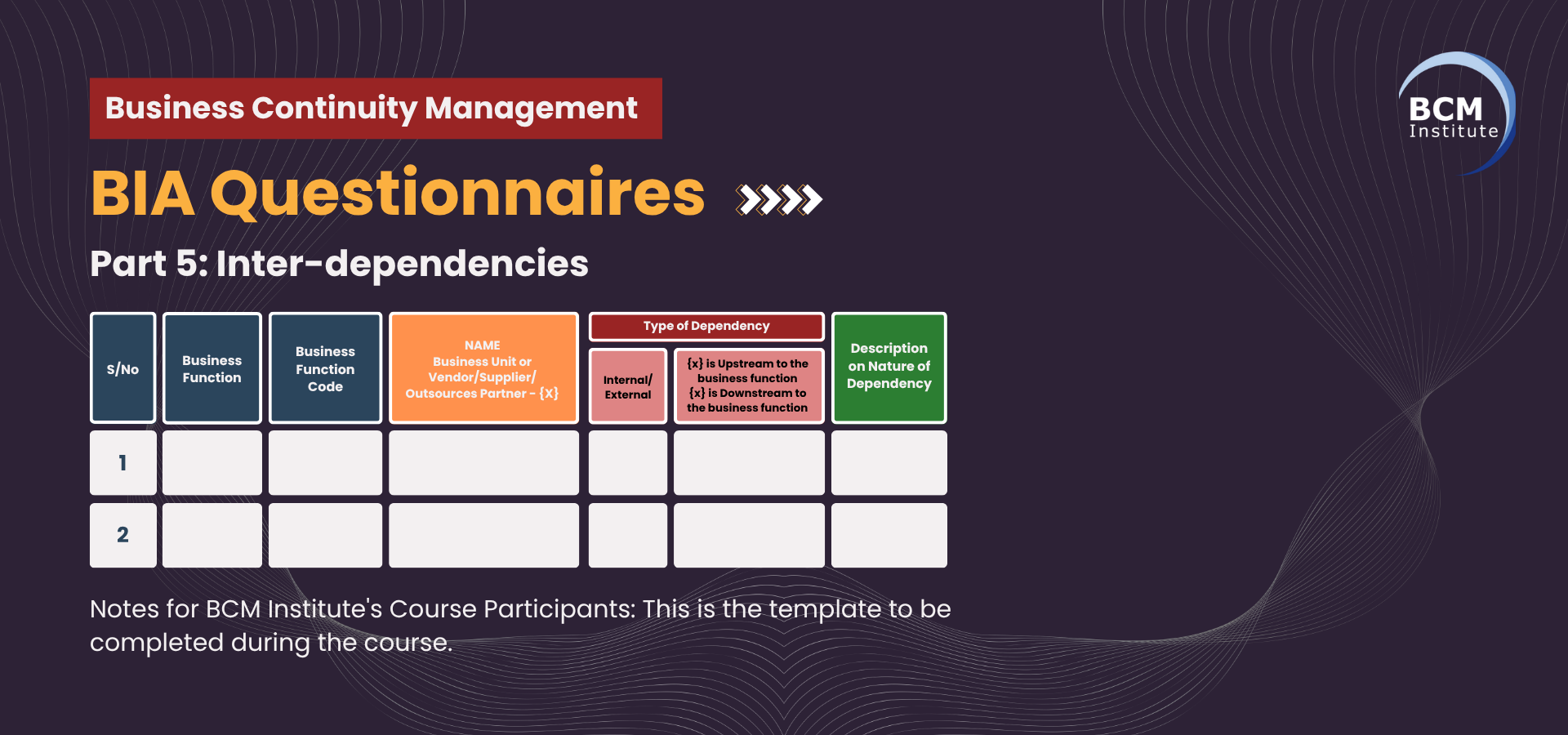
The delivery of special education and development programmes at MINDS relies on multiple internal and external stakeholders. Each Sub-Critical Business Function (Sub-CBF) interacts with other business units, vendors, and partners, creating a network of inter-dependencies that must be understood for effective business continuity management.
Understanding these inter-dependencies is essential to:
- Identify potential points of disruption that may affect multiple Sub-CBFs.
- Prioritize resources and mitigation strategies for high-risk dependencies.
- Ensure seamless service delivery for students, staff, and caregivers.
This chapter outlines the internal and external dependencies for each Sub-CBF under CBF-3, specifying whether the dependency is upstream, downstream, or mutual, and describing the nature of the dependency..
![Banner [Table] [BCM] [E3] [BIA] [P5] Inter-dependencies [BIAQ]](https://no-cache.hubspot.com/cta/default/3893111/ed6152ff-4926-4fae-bd6b-ba572bcc781b.png)
Table P5: Inter‑dependencies for CBF-3
|
Sub-CBF Code |
Sub-CBF |
Name of Business Unit or Vendor / Supplier / Outsource Partner |
Type of Dependency – Internal |
Type of Dependency – External |
Dependency Direction (Upstream / Downstream / Mutual) |
Description of Nature of Dependency |
|
3.1 |
Special Education Delivery |
Academic Staff, Curriculum Team |
Yes |
No |
Downstream |
Delivery of lessons depends on curriculum preparation by internal teams and timely scheduling of resources. |
|
3.2 |
Individualised Learning Planning |
Special Education Team, Case Managers |
Yes |
No |
Upstream |
Learning plans require accurate student data from assessments and collaboration with allied support services. |
|
3.3 |
Life Skills & Independent Living Training |
Training Staff, Occupational Therapy Unit |
Yes |
Yes (External Training Equipment Vendors) |
Downstream |
Programmes depend on internal staff facilitation and specialized equipment sourced externally. |
|
3.4 |
Vocational Preparation & Work Exposure |
Vocational Training Team, Partner Workplaces |
Yes |
Yes (Industry Partners/Workplace Vendors) |
Downstream |
Student vocational readiness depends on internal coordination and external workplaces providing work exposure opportunities. |
|
3.5 |
Allied Support Services Integration |
Allied Health Teams (Speech, OT, PT), External Therapy Providers |
Yes |
Yes (Medical Equipment & Therapy Vendors) |
Mutual |
Integration requires collaboration between internal therapy teams and external service providers to ensure holistic care. |
|
3.6 |
Special Student Care & Enrichment Activities |
Activity Coordinators, Teachers |
Yes |
Yes (External Vendors for Arts, Sports Activities) |
Downstream |
Activities depend on internal coordination and external suppliers for materials, instructors, or venues. |
|
3.7 |
Assessment & Progress Monitoring |
Assessment Team, Data Analytics Unit |
Yes |
No |
Upstream |
Assessment depends on input from teaching staff and allied support services to generate accurate student progress data. |
|
3.8 |
Training Staff Capability & Development |
HR & Training Unit |
Yes |
Yes (External Training Providers) |
Downstream |
Staff development relies on internal HR coordination and external training vendors for courses and certifications. |
|
3.9 |
Parent and Caregiver Engagement |
Family Support Team, Communication Unit |
Yes |
No |
Mutual |
Effective engagement requires coordination with internal teams and feedback from parents; impacts both planning and delivery. |
Notes:
- Internal Dependency: Dependence on other MINDS business units or internal staff.
- External Dependency: Dependence on third-party vendors, partners, or outsourced services.
- Dependency Direction:
- Upstream: Inputs or resources required by the Sub-CBF.
- Downstream: Sub-CBF outputs affect other functions or stakeholders.
- Mutual: Two-way dependence for collaboration or service integration.
- Description of Nature of Dependency: Explains how and why the dependency exists and its importance to operational continuity.
![Banner [BCM] [E3] [BIA] [Summing Up] [P5] Inter-dependencies [BIAQ]](https://no-cache.hubspot.com/cta/default/3893111/117996e6-4a68-4449-880f-d8a48ff3071d.png)
CBF-3 Special Education, Training, and Development Programmes involve a complex web of inter-dependencies. Disruption in one Sub-CBF can have cascading effects across multiple programmes, internal teams, or external partners.
By mapping and understanding these inter-dependencies, MINDS can:
- Identify critical relationships requiring monitoring or backup arrangements.
- Strengthen coordination with vendors and internal teams.
- Ensure that students’ education, development, and well-being continue smoothly despite disruptions.
This inter-dependency analysis is a key input for business continuity planning, helping MINDS maintain resilience and continuity of essential services..
![Banner [BCM] [E3] [BIA] [P6] Vital Records](https://no-cache.hubspot.com/cta/default/3893111/6d3e4359-14f4-4816-b274-3f61b92be858.png)
CBF-3 Special Education, Training, and Development Programmes
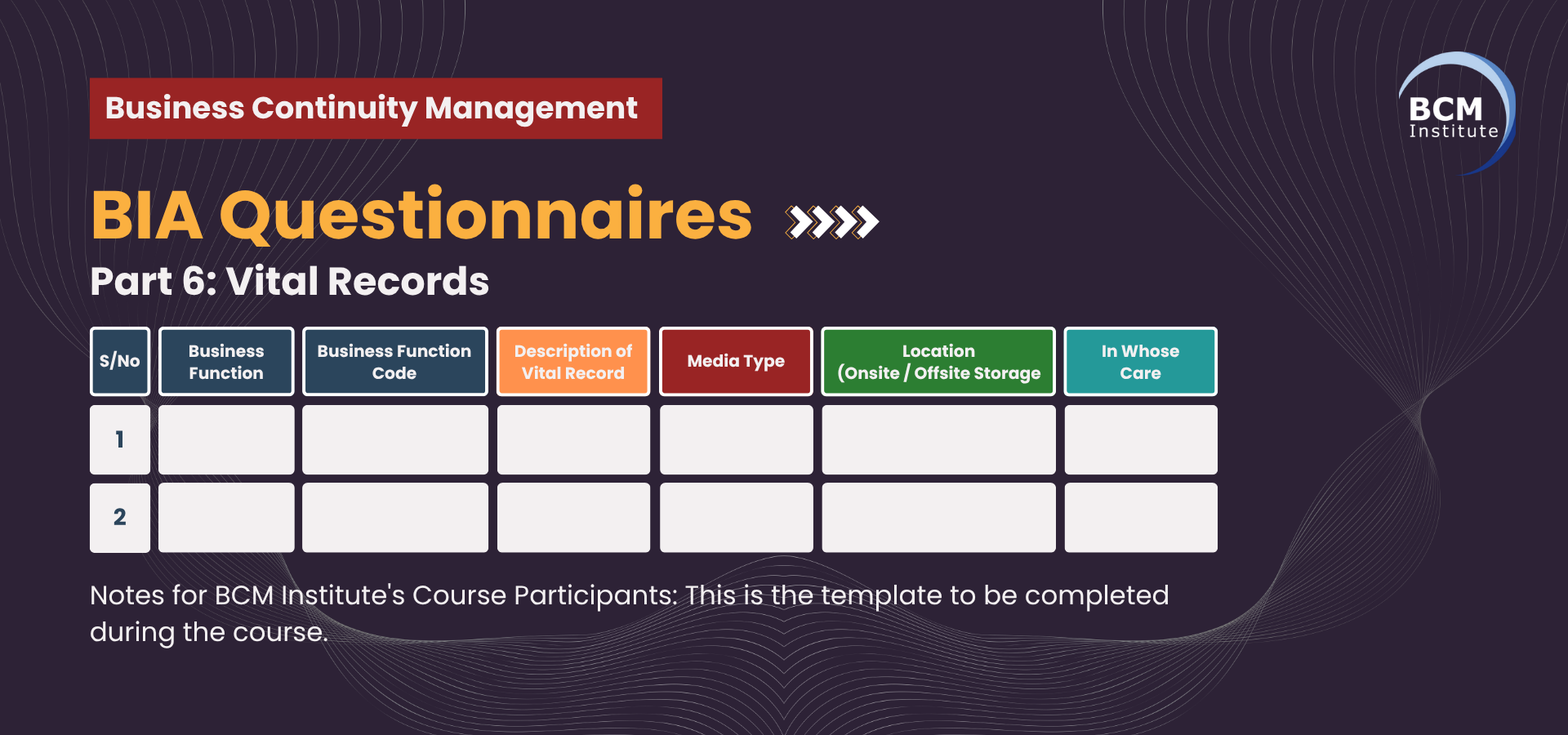
Vital records are essential documents, data, and information that are critical to the operation, legal compliance, and continuity of MINDS’ special education, training, and development programmes.
These records support decision-making, service delivery, student tracking, and regulatory reporting.
This chapter identifies vital records for each Sub-Critical Business Function (Sub-CBF) under CBF-3, including the media type, location, and the person or team responsible for their care. By maintaining proper access and protection of these records, MINDS ensures that programmes can continue with minimal disruption during emergencies, IT failures, or other business continuity events.
![Banner [Table] [BCM] [E3] [BIA] [P6] Vital Records [BIAQ]](https://no-cache.hubspot.com/cta/default/3893111/b44d6d49-dfb5-42a1-bc91-c0c701fc0724.png)
Table P6: Vital Records for CBF-3
|
Sub-CBF Code |
Sub-CBF |
Description of Vital Records |
Media Type |
Location |
In Whose Care |
|
3.1 |
Special Education Delivery |
Lesson plans, curriculum materials, class schedules |
Digital & Hardcopy |
LMS & Academic Office |
Academic Coordinator |
|
3.2 |
Individualised Learning Planning |
Individualised Education Plans (IEPs), student learning profiles |
Digital & Hardcopy |
Student Records System & Special Education Office |
Case Manager |
|
3.3 |
Life Skills & Independent Living Training |
Training modules, session logs, student progress notes |
Digital & Hardcopy |
LMS & Training Room |
Life Skills Trainer |
|
3.4 |
Vocational Preparation & Work Exposure |
Work placement records, vocational assessment reports |
Digital & Hardcopy |
Vocational Unit Database & HR Office |
Vocational Training Coordinator |
|
3.5 |
Allied Support Services Integration |
Therapy reports, medical records, support service documentation |
Digital & Hardcopy |
Allied Services Database & Therapy Rooms |
Allied Health Team Lead |
|
3.6 |
Special Student Care & Enrichment Activities |
Activity plans, participation logs, event reports |
Digital & Hardcopy |
Enrichment Office & LMS |
Activity Coordinator |
|
3.7 |
Assessment & Progress Monitoring |
Assessment results, student performance data, evaluation reports |
Digital & Hardcopy |
Assessment Database & Academic Office |
Assessment Officer |
|
3.8 |
Training Staff Capability & Development |
Staff training records, certification documents, competency reports |
Digital & Hardcopy |
HR Training System & HR Office |
HR Training Officer |
|
3.9 |
Parent and Caregiver Engagement |
Communication logs, meeting notes, consent forms |
Digital & Hardcopy |
Parent Engagement Database & Family Support Office |
Family Support Officer |
![Banner [BCM] [E3] [BIA] [Summing Up] [P6] Vital Records [BIAQ]](https://no-cache.hubspot.com/cta/default/3893111/06d76589-ebcf-4c9f-8e5b-c27f02938eed.png)
Vital records underpin the effective operation of MINDS’ CBF-3 Special Education, Training, and Development Programmes.
From lesson plans and learning profiles to staff development and parent engagement documentation, these records ensure that critical activities can continue uninterrupted, even in the event of IT failures, disasters, or other operational disruptions.
By clearly identifying, safeguarding, and assigning responsibility for vital records, MINDS strengthens its resilience and ensures continuity of high-quality educational and developmental services for students with intellectual disabilities.
Implementing Business Continuity Management for MINDS: Ensuring Continuity of Care and Services |
||||||
| eBook 3: Starting Your BCM Implementation |
||||||
![[BCM] [MINDS] [E3] [BIA] MBCO Corporate MBCO](https://no-cache.hubspot.com/cta/default/3893111/47babf68-4665-40bc-8db7-f34c7a717f49.png) |
![[BCM] [MINDS] [E3] [BIA] [PS] Key Product and Services](https://no-cache.hubspot.com/cta/default/3893111/1d6fd982-7a1c-4245-a1f0-bdd7a3155cc7.png) |
![[BCM] [MINDS] [E3] [RAR] [T1] List of Threats](https://no-cache.hubspot.com/cta/default/3893111/3262c956-93e2-45d4-850e-fa4cb7fab302.png) |
![[BCM] [MINDS] [E3] [RAR] [T2] Treatment and Control](https://no-cache.hubspot.com/cta/default/3893111/32464d64-b115-41e7-98be-850950580336.png) |
![[BCM] [MINDS] [E3] [RAR] [T3] Risk Impact and Likelihood Assessment](https://no-cache.hubspot.com/cta/default/3893111/cf5354bd-6256-4a23-ac6d-14bacb075337.png) |
![BCM] [MINDS] [E3] [BCS] [T1] Mitigation Strategies and Justification](https://no-cache.hubspot.com/cta/default/3893111/0bada7ae-abc1-4a42-bcd7-35ea2895a4d7.png) |
![[BCM] [MINDS] [E1] [C10] Identifying Critical Business Functions](https://no-cache.hubspot.com/cta/default/3893111/cfa9c1eb-7960-4442-8ef7-3ae5faeb4c8b.png) |
| CBF-3 Special Education, Training, and Development Programmes |
||||||
| DP | BIAQ T1 | BIAQ T2 | BIAQ T3 | BCS T2 | BCS T3 | PD |
![[BCM] [MINDS] [E3] [BIA] [DP] [CBF] [3] Special Education, Training, and Development Programmes](https://no-cache.hubspot.com/cta/default/3893111/8e8b48b5-a558-4e6c-ad2e-a04dd8d7378b.png) |
![[BCM] [MINDS] [E3] [BIA] [T1] [CBF] [3] Special Education, Training, and Development Programmes](https://no-cache.hubspot.com/cta/default/3893111/a83ef742-9681-4bc3-a5f4-99c635fbcca6.png) |
![[BCM] [MINDS] [E3] [BIA] [T2] [CBF] [3] Special Education, Training, and Development Programmes](https://no-cache.hubspot.com/cta/default/3893111/0479d9c8-dd2d-46d6-9fa8-ea352d57d17d.png) |
|
![[BCM] [MINDS] [E3] [BCS] [T2] [CBF] [3] Special Education, Training, and Development Programmes](https://no-cache.hubspot.com/cta/default/3893111/a5a8c929-b6f9-4211-8010-f9e998f65cfd.png) |
![[BCM] [MINDS] [E3] [BCS] [T3] [CBF] [3] Special Education, Training, and Development Programmes](https://no-cache.hubspot.com/cta/default/3893111/34c08859-ae14-4af8-b2bb-245c5235055f.png) |
![[BCM] [MINDS] [E3] [PD] [CBF] [3] Special Education, Training, and Development Programmes](https://no-cache.hubspot.com/cta/default/3893111/ddebbdec-874e-4605-9038-318ec6db0ca5.png) |
More Information About Business Continuity Management Courses
To learn more about the course and schedule, click the buttons below for the BCM-300 Business Continuity Management Implementer [BCM-3] and the BCM-5000 Business Continuity Management Expert Implementer [BCM-5].


![Register [BL-B-3]*](https://no-cache.hubspot.com/cta/default/3893111/ac6cf073-4cdd-4541-91ed-889f731d5076.png)


![FAQ [BL-B-3]](https://no-cache.hubspot.com/cta/default/3893111/b3824ba1-7aa1-4eb6-bef8-94f57121c5ae.png)
![Email to Sales Team [BCM Institute]](https://no-cache.hubspot.com/cta/default/3893111/3c53daeb-2836-4843-b0e0-645baee2ab9e.png)


