


![Banner [BCM] [E3] [BIA] [P3] Impact Over Time of Business Functions](https://no-cache.hubspot.com/cta/default/3893111/bc131ed6-ca92-4253-8940-2f98dad34599.png)
CBF-8 ICT Systems Supporting Care and Operations
![[BCM] [MINDS] [E3] [BIA] [T2] [CBF] [8] ICT Systems Supporting Care and Operations](https://no-cache.hubspot.com/cta/default/3893111/4dfdf6ff-8282-477a-9f81-12604d058d91.png)
In today’s care and operational environment, robust Information and Communication Technology (ICT) systems form the backbone of efficient service delivery.
For MINDS, the CBF-8 ICT Systems Supporting Care and Operations ensures that all clinical, operational, and administrative functions are supported by reliable, secure, and integrated IT systems.
This chapter, Part 4: Supporting IT Systems and Applications, provides a detailed overview of the key Sub-Critical Business Functions (Sub-CBFs) that underpin ICT operations. It highlights the specific IT systems and applications used, their Recovery Point Objectives (RPO), System Recovery Time Objectives (RTO), supporting equipment and resources, as well as additional remarks relevant to maintaining system availability and resilience.
By understanding these components, MINDS can ensure uninterrupted support for care delivery, administrative processes, and organisational communication, even in the event of technical disruptions or system failures.
![Banner [Table] [BCM] [E3] [BIA] [[P3] Impact Over Time of Business Functions [BIAQ]](https://no-cache.hubspot.com/cta/default/3893111/b31bbcc9-edc2-4fc8-9cae-5c5797e36f84.png)
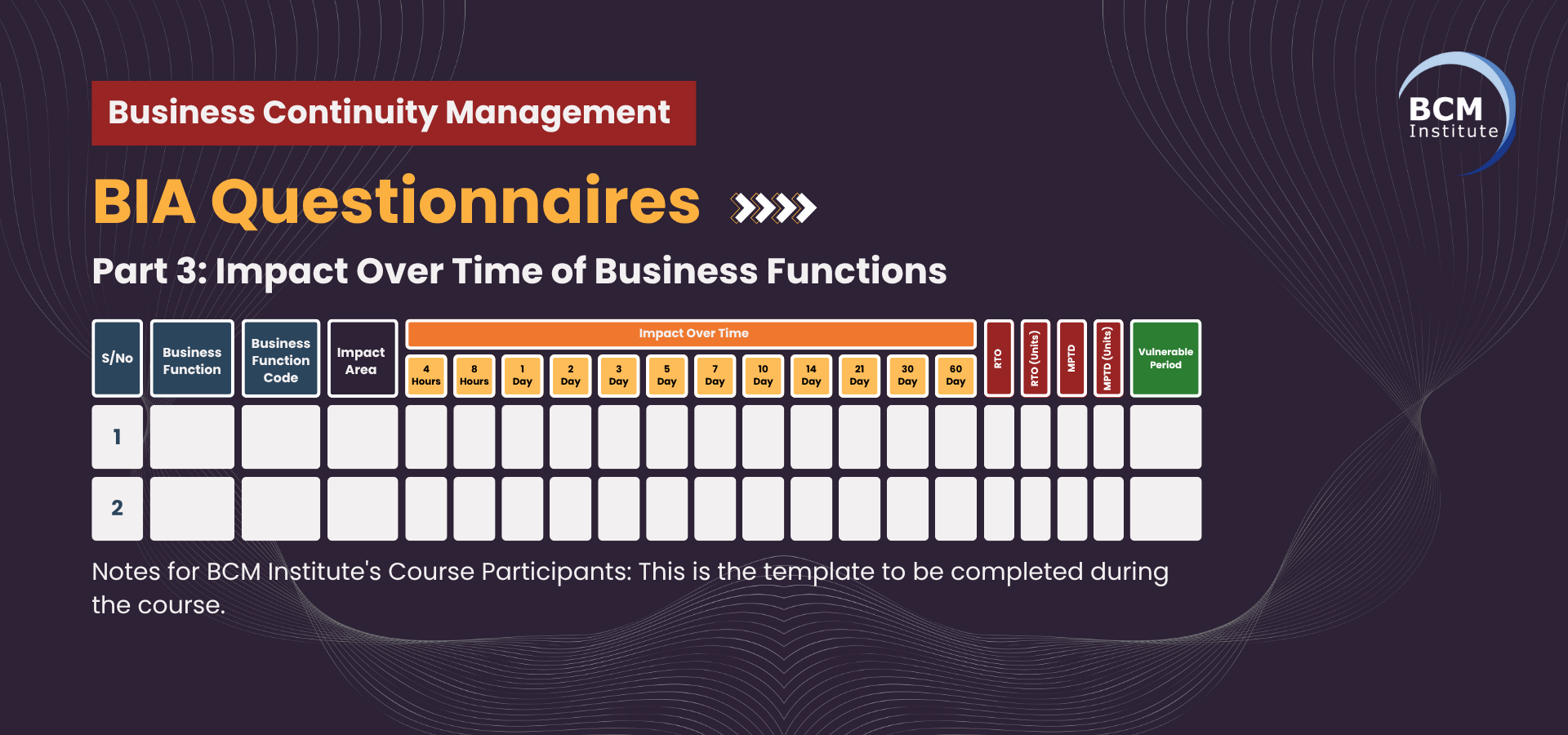
Table P3: Impact Over Time of Business Functions for CBF-1
|
Sub-CBF Code |
Sub-CBF |
Highest-Impact Area |
4 Hr |
8 Hr |
1 Day |
2 Day |
3 Day |
5 Day |
7 Day |
10 Day |
14 Day |
21 Day |
30 Day |
60 Day |
RTO |
MTPD |
Vulnerable Period |
|
8.1 |
ICT Infrastructure Management |
Service Availability |
3 |
3 |
4 |
4 |
5 |
5 |
5 |
5 |
5 |
5 |
5 |
8 hrs |
3 days |
Peak care hours |
Admission peaks |
|
8.2 |
Clinical & Care Management Systems |
Client Care & Safety |
4 |
4 |
5 |
5 |
5 |
5 |
5 |
5 |
5 |
5 |
5 |
4 hrs |
1 day |
Daily care operations |
Plan review cycles |
|
8.3 |
Communication & Collaboration Tools |
Staff Coordination |
3 |
4 |
4 |
4 |
5 |
5 |
5 |
5 |
5 |
5 |
5 |
8 hrs |
3 days |
Working hours |
High caseload periods |
|
8.4 |
Business & Operational Applications |
Operational Continuity |
2 |
3 |
4 |
4 |
4 |
5 |
5 |
5 |
5 |
5 |
5 |
1 day |
5 days |
Month-end |
Therapy schedules |
|
8.5 |
Data Backup & Recovery |
Data Integrity |
2 |
3 |
4 |
4 |
5 |
5 |
5 |
5 |
5 |
5 |
5 |
1 day |
7 days |
Backup cycles |
Academic terms |
|
8.6 |
Security & Access Controls |
Information Security |
3 |
4 |
4 |
5 |
5 |
5 |
5 |
5 |
5 |
5 |
5 |
8 hrs |
2 days |
24/7 |
Job placement cycles |
|
8.7 |
Helpdesk & User Support Services |
Staff Productivity |
2 |
2 |
3 |
3 |
4 |
4 |
5 |
5 |
5 |
5 |
5 |
1 day |
7 days |
Office hours |
24/7 operations |
|
8.8 |
System Development & Integration |
System Reliability |
1 |
2 |
2 |
3 |
3 |
4 |
4 |
5 |
5 |
5 |
5 |
3 days |
14 days |
System go-live |
Care transition periods |
|
8.9 |
Monitoring, Alerts & Incident Response |
Risk & Incident Control |
4 |
4 |
5 |
5 |
5 |
5 |
5 |
5 |
5 |
5 |
5 |
4 hrs |
1 day |
24/7 |
Community events |
|
8.10 |
Vendor & Third-Party Service Management |
External Dependency |
2 |
3 |
3 |
4 |
4 |
5 |
5 |
5 |
5 |
5 |
5 |
1 day |
7 days |
Contract renewal |
Audit cycles |
![Banner [BCM] [E3] [BIA] [Summing Up] [P3] Impact Over Time of Business Functions [BIAQ]](https://no-cache.hubspot.com/cta/default/3893111/987f8ca5-0ba4-4281-be57-5221186733d0.png)
The impact-over-time assessment for CBF-8 highlights the varying levels of criticality across ICT sub-functions and underscores the need for a proactive business continuity strategy.
Sub-CBFs such as Clinical & Care Management Systems, Monitoring & Incident Response, and ICT Infrastructure Management demonstrate immediate high impact in the event of disruption, necessitating rapid recovery efforts. Conversely, areas like System Development & Integration and Helpdesk Support show more gradual impact escalation but remain vital to long-term operational stability.
By clearly defining RTOs, MTPDs, and vulnerable periods, MINDS gains actionable insights into prioritising response and recovery activities, minimising risks to client care, and maintaining operational resilience.
This chapter serves as a foundational tool for strategic planning, resource allocation, and informed decision-making in the face of ICT disruptions, ensuring continuity of care and organisational effectiveness over time.

![Banner [BCM] [E3] [BIA] [P4] Supporting IT Systems and Applications](https://no-cache.hubspot.com/cta/default/3893111/e60ed308-5615-4727-b6c2-5fb4eed933d7.png)
CBF-8 ICT Systems Supporting Care and Operations
Information and Communication Technology (ICT) systems are a critical enabler for MINDS’ care and operational functions.
The effectiveness of services—ranging from clinical care to administrative operations—relies heavily on the availability, reliability, and security of these systems. CBF-8 ICT Systems Supporting Care and Operations ensures that all technological resources are aligned to support both day-to-day operations and continuity of care.
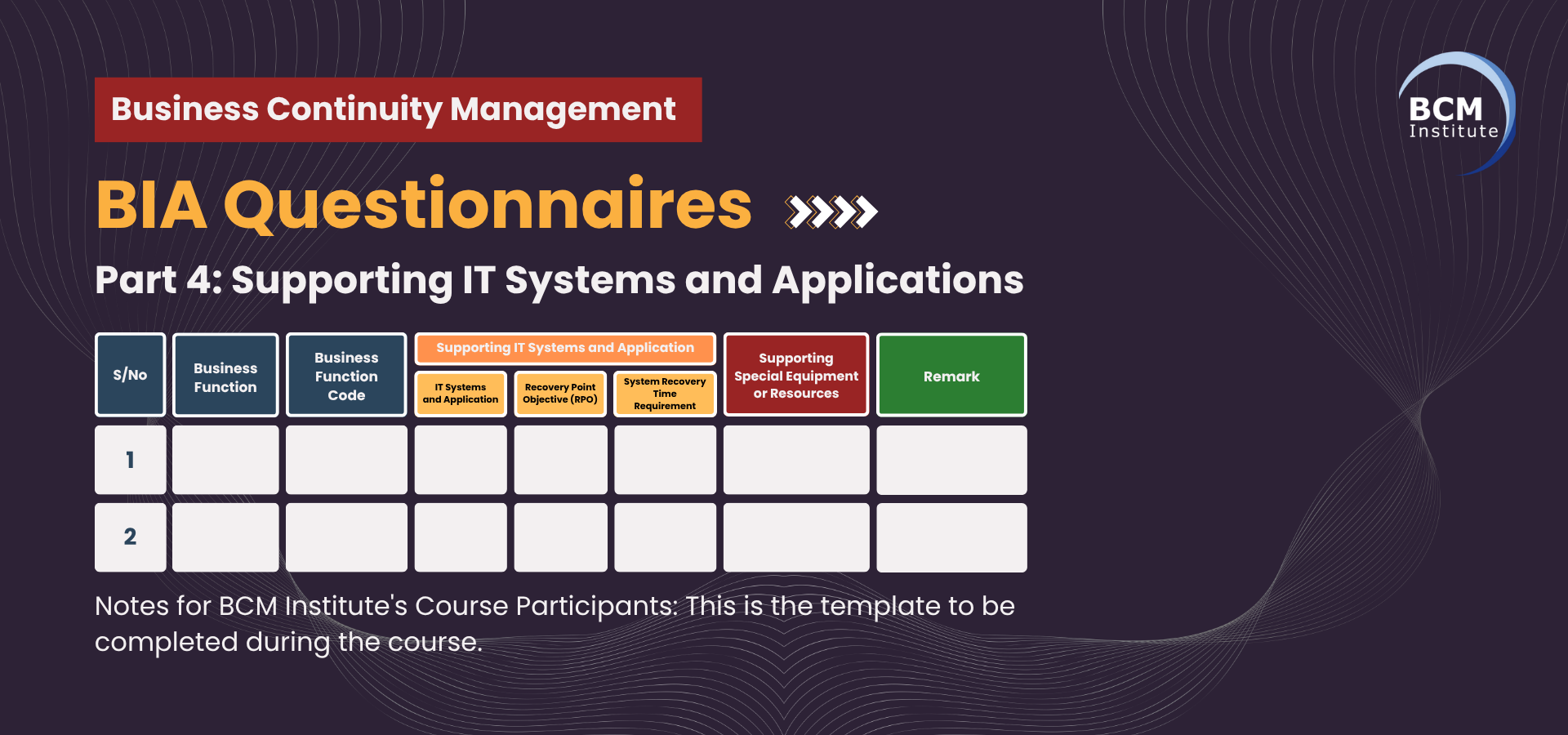
This chapter, Part 4: Supporting IT Systems and Applications, provides a detailed overview of the Sub-Critical Business Functions (Sub-CBFs) that form the foundation of MINDS’ ICT ecosystem.
It outlines the key IT systems and applications in use, Recovery Point Objectives (RPO), System Recovery Time Objectives (RTO), supporting equipment or resources, and other operational remarks. By documenting these elements, MINDS can maintain operational resilience, reduce service disruptions, and enhance readiness for unexpected ICT incidents.
![Banner [Table] [BCM] [E3] [BIA] [P4] Supporting IT Systems and Applications [BIAQ]](https://no-cache.hubspot.com/cta/default/3893111/b0e47631-f680-46d1-b7a9-040fce25e117.png)
Table P4: Supporting IT Systems and Applications for CBF-1
|
Sub-CBF Code |
Sub-CBF |
IT Systems and Applications |
RPO |
System RTO |
Supporting Special Equipment / Resources |
Remarks |
|
8.1 |
ICT Infrastructure Management |
Servers, storage systems, LAN/WAN, virtualisation platforms, cloud services |
4 hours |
8 hours |
Server racks, UPS, network switches, backup power systems |
Ensures the continuous availability of the ICT infrastructure for all operational functions |
|
8.2 |
Clinical & Care Management Systems |
Electronic Medical Records (EMR), Care Scheduling Software, Patient Management Systems |
1 hour |
4 hours |
Tablets, PCs, barcode scanners, monitoring devices |
Supports direct care delivery and clinical workflows |
|
8.3 |
Communication & Collaboration Tools |
Email, instant messaging, video conferencing, and intranet portals |
30 mins |
2 hours |
PCs, mobile devices, headsets |
Enables internal and external communication across teams |
|
8.4 |
Business & Operational Applications |
HR, finance and payroll systems, procurement software |
4 hours |
8 hours |
PCs, printers, scanners |
Supports day-to-day administrative and operational processes |
|
8.5 |
Data Backup & Recovery |
Backup servers, cloud storage, tape libraries, snapshot tools |
15 mins |
2 hours |
Backup drives, network storage, backup software |
Critical for data protection and recovery in case of system failure |
|
8.6 |
Security & Access Controls |
Firewalls, antivirus, multi-factor authentication, and identity management |
N/A |
N/A |
Security tokens, biometric devices |
Protects sensitive data and ensures compliance with IT security policies |
|
8.7 |
Helpdesk & User Support Services |
Ticketing system, remote support tools, knowledge base |
N/A |
4 hours |
Phones, laptops, and remote access software |
Provides first-line support for IT incidents and user queries |
|
8.8 |
System Development & Integration |
APIs, middleware, development and testing platforms |
1 hour |
4 hours |
Development servers, IDEs, testing environments |
Supports the development, integration, and maintenance of ICT systems |
|
8.9 |
Monitoring, Alerts & Incident Response |
Network monitoring tools, server alerts, log management systems |
N/A |
1 hour |
Monitoring consoles, alert systems |
Enables proactive detection of issues and rapid response to incidents |
|
8.10 |
Vendor & Third-Party Service Management |
SLA tracking systems, vendor portals, and procurement platforms |
N/A |
N/A |
Contracts, service dashboards |
Manages relationships and continuity of service from external ICT providers |
![Banner [BCM] [E3] [BIA] [Summing Up] [P4] Supporting IT Systems and Applications [BIAQ]](https://no-cache.hubspot.com/cta/default/3893111/9bde2d75-0c8e-4d9e-a8ca-e8d1655a082c.png)
The Sub-CBFs highlighted in this chapter demonstrate the integral role ICT systems play in sustaining MINDS’ care and operational activities.
From core infrastructure and clinical management systems to communication tools, data backup, and security controls, each system contributes to the organisation’s overall operational continuity and resilience.
By clearly defining the associated RPO, RTO, supporting resources, and operational considerations, MINDS can effectively prioritise recovery efforts, mitigate risks, and ensure minimal disruption to both staff and client services.
Proper management of these ICT systems not only safeguards the organisation’s technological assets but also strengthens the delivery of high-quality care and operational efficiency across all service areas.
Implementing Business Continuity Management for MINDS: Ensuring Continuity of Care and Services |
||||||
| eBook 3: Starting Your BCM Implementation |
||||||
![[BCM] [MINDS] [E3] [BIA] MBCO Corporate MBCO](https://no-cache.hubspot.com/cta/default/3893111/47babf68-4665-40bc-8db7-f34c7a717f49.png) |
![[BCM] [MINDS] [E3] [BIA] [PS] Key Product and Services](https://no-cache.hubspot.com/cta/default/3893111/1d6fd982-7a1c-4245-a1f0-bdd7a3155cc7.png) |
![[BCM] [MINDS] [E3] [RAR] [T1] List of Threats](https://no-cache.hubspot.com/cta/default/3893111/3262c956-93e2-45d4-850e-fa4cb7fab302.png) |
![[BCM] [MINDS] [E3] [RAR] [T2] Treatment and Control](https://no-cache.hubspot.com/cta/default/3893111/32464d64-b115-41e7-98be-850950580336.png) |
![[BCM] [MINDS] [E3] [RAR] [T3] Risk Impact and Likelihood Assessment](https://no-cache.hubspot.com/cta/default/3893111/cf5354bd-6256-4a23-ac6d-14bacb075337.png) |
![BCM] [MINDS] [E3] [BCS] [T1] Mitigation Strategies and Justification](https://no-cache.hubspot.com/cta/default/3893111/0bada7ae-abc1-4a42-bcd7-35ea2895a4d7.png) |
![[BCM] [MINDS] [E1] [C10] Identifying Critical Business Functions](https://no-cache.hubspot.com/cta/default/3893111/cfa9c1eb-7960-4442-8ef7-3ae5faeb4c8b.png) |
| CBF-8 ICT Systems Supporting Care and Operations |
||||||
| DP | BIAQ T1 | BIAQ T2 | BIAQ T3 | BCS T2 | BCS T3 | PD |
![[BCM] [MINDS] [E3] [BIA] [DP] [CBF] [8] ICT Systems Supporting Care and Operations](https://no-cache.hubspot.com/cta/default/3893111/28b1ecaf-f078-4703-b31c-dbec2b9f76c4.png) |
![[BCM] [MINDS] [E3] [BIA] [T1] [CBF] [8] ICT Systems Supporting Care and Operations](https://no-cache.hubspot.com/cta/default/3893111/6307f97a-c6d0-417e-a418-6800de302534.png) |
|
![[BCM] [MINDS] [E3] [BIA] [T3] [CBF] [8] ICT Systems Supporting Care and Operations](https://no-cache.hubspot.com/cta/default/3893111/89d637b4-f6fb-4eec-9f83-5496e1328766.png) |
![[BCM] [MINDS] [E3] [BCS] [T2] [CBF] [8] ICT Systems Supporting Care and Operations](https://no-cache.hubspot.com/cta/default/3893111/39f2428c-c4db-498c-9157-61275e345eb0.png) |
![[BCM] [MINDS] [E3] [BCS] [T3] [CBF] [8] ICT Systems Supporting Care and Operations](https://no-cache.hubspot.com/cta/default/3893111/1f6aa3e0-4538-47d1-8fe3-9ffc77c9825a.png) |
![[BCM] [MINDS] [E3] [PD] [CBF] [8] ICT Systems Supporting Care and Operations](https://no-cache.hubspot.com/cta/default/3893111/12fbbeab-7abf-4f45-9937-4713c8bd276e.png) |
More Information About Business Continuity Management Courses
To learn more about the course and schedule, click the buttons below for the BCM-300 Business Continuity Management Implementer [BCM-3] and the BCM-5000 Business Continuity Management Expert Implementer [BCM-5].


![Register [BL-B-3]*](https://no-cache.hubspot.com/cta/default/3893111/ac6cf073-4cdd-4541-91ed-889f731d5076.png)



![FAQ [BL-B-3]](https://no-cache.hubspot.com/cta/default/3893111/b3824ba1-7aa1-4eb6-bef8-94f57121c5ae.png)
![Email to Sales Team [BCM Institute]](https://no-cache.hubspot.com/cta/default/3893111/3c53daeb-2836-4843-b0e0-645baee2ab9e.png)


