


![Banner [BCM] [E3] [BIA] [P3] Impact Over Time of Business Functions](https://no-cache.hubspot.com/cta/default/3893111/bc131ed6-ca92-4253-8940-2f98dad34599.png)
CBF-4 Health, Safety, and Safeguarding Management
![[BCM] [MINDS] [E3] [BIA] [T2] [CBF] [4] Health, Safety, and Safeguarding Management](https://no-cache.hubspot.com/cta/default/3893111/7b789da1-ea13-49b6-b85a-fe1de0c3267d.png)
CBF-4, Health, Safety, and Safeguarding Management, is a high-priority function for MINDS, as it ensures the wellbeing, safety, and developmental progress of clients.
Disruptions in these services can affect clients, staff, regulatory compliance, and organisational reputation.
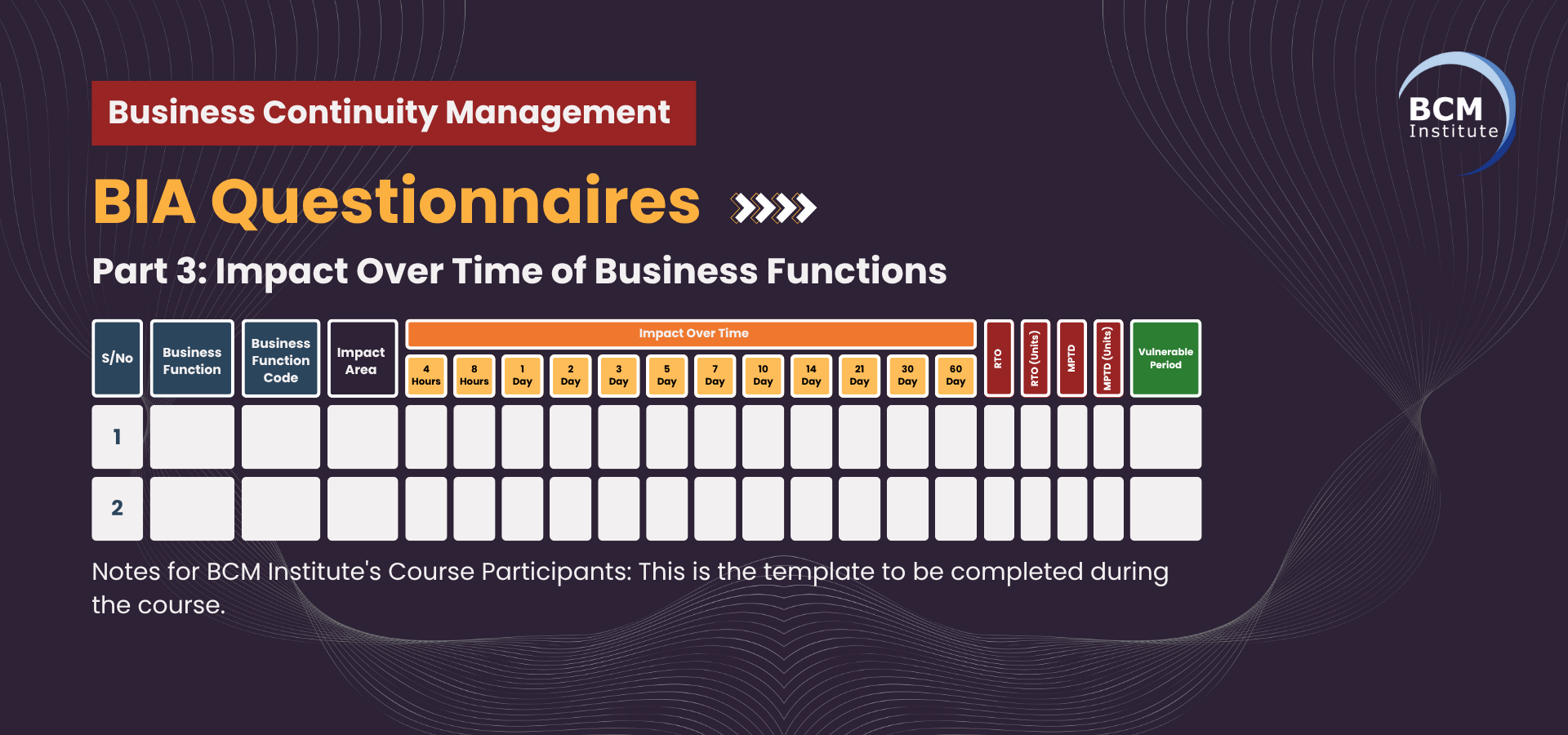
This chapter examines how the impact of service disruptions evolves over time for each sub-critical business function (Sub-CBF).
By scoring the impact on a scale of 1 (lowest) to 5 (highest) at various time intervals, MINDS can identify which functions are most time-sensitive and require immediate attention during a disruption.
Additionally, this analysis defines the Recovery Time Objective (RTO), Maximum Tolerable Period of Disruption (MTPD), and the Vulnerable Period for each Sub-CBF, which are essential for continuity planning and prioritisation of resources.
![Banner [Table] [BCM] [E3] [BIA] [[P3] Impact Over Time of Business Functions [BIAQ]](https://no-cache.hubspot.com/cta/default/3893111/b31bbcc9-edc2-4fc8-9cae-5c5797e36f84.png)
Table P3: Impact Over Time of Business Functions for CBF-4
|
Sub-CBF Code |
Sub-CBF |
Highest-Impact Area |
4 Hr |
8 Hr |
1 Day |
2 Day |
3 Day |
5 Day |
7 Day |
10 Day |
14 Day |
21 Day |
30 Day |
60 Day |
RTO |
MTPD |
Vulnerable Period |
|
4.1 |
Special Education Delivery |
Client Education & Development |
2 |
3 |
4 |
4 |
4 |
5 |
5 |
5 |
5 |
5 |
5 |
5 |
1 Day |
7 Day |
0–7 Days |
|
4.2 |
Individualised Learning Planning |
Personalised Education |
1 |
2 |
3 |
3 |
4 |
4 |
4 |
5 |
5 |
5 |
5 |
5 |
2 Day |
10 Day |
0–10 Days |
|
4.3 |
Life Skills & Independent Living Training |
Client Wellbeing & Independence |
2 |
2 |
3 |
4 |
4 |
4 |
5 |
5 |
5 |
5 |
5 |
5 |
2 Day |
10 Day |
0–10 Days |
|
4.4 |
Vocational Preparation & Work Exposure |
Employability & Community Integration |
1 |
1 |
2 |
3 |
3 |
4 |
4 |
5 |
5 |
5 |
5 |
5 |
3 Day |
14 Day |
0–14 Days |
|
4.5 |
Allied Support Services Integration |
Health & Therapy |
3 |
4 |
4 |
5 |
5 |
5 |
5 |
5 |
5 |
5 |
5 |
5 |
1 Day |
7 Day |
0–7 Days |
|
4.6 |
Special Student Care & Enrichment Activities |
Mental Health & Social Development |
1 |
2 |
3 |
3 |
4 |
4 |
4 |
5 |
5 |
5 |
5 |
5 |
3 Day |
14 Day |
0–14 Days |
|
4.7 |
Assessment & Progress Monitoring |
Quality of Care & Compliance |
2 |
3 |
4 |
4 |
4 |
5 |
5 |
5 |
5 |
5 |
5 |
5 |
2 Day |
10 Day |
0–10 Days |
|
4.8 |
Training Staff Capability & Development |
Staff Competence & Compliance |
1 |
2 |
2 |
3 |
3 |
4 |
4 |
5 |
5 |
5 |
5 |
5 |
5 Day |
21 Day |
0–21 Days |
|
4.9 |
Parent & Caregiver Engagement |
Stakeholder Communication |
1 |
1 |
2 |
2 |
3 |
3 |
4 |
4 |
5 |
5 |
5 |
5 |
5 Day |
21 Day |
0–21 Days |
Legend for Impact Score:
1 = Minimal impact on client service or operational continuity
2 = Low impact; minor disruption, manageable with temporary adjustments
3 = Moderate impact; noticeable disruption affecting some clients or processes
4 = High impact; significant disruption affecting most clients or operations
5 = Critical impact; severe disruption, core services cannot be maintained
![Banner [BCM] [E3] [BIA] [Summing Up] [P3] Impact Over Time of Business Functions [BIAQ]](https://no-cache.hubspot.com/cta/default/3893111/987f8ca5-0ba4-4281-be57-5221186733d0.png)
The impact-over-time analysis for CBF-4 demonstrates that certain functions, such as Special Education Delivery and Allied Support Services Integration, are highly time-sensitive and require rapid recovery to avoid severe client and organisational consequences.
By defining RTO, MTPD, and Vulnerable Periods, MINDS can prioritise resource allocation and response strategies during a disruption. This ensures that critical services continue uninterrupted, client safety and well-being are safeguarded, and regulatory compliance is maintained.
Understanding the time-sensitive nature of each Sub-CBF allows MINDS to focus continuity planning efforts on the functions with the highest immediate and long-term impact.

![Banner [BCM] [E3] [BIA] [P4] Supporting IT Systems and Applications](https://no-cache.hubspot.com/cta/default/3893111/e60ed308-5615-4727-b6c2-5fb4eed933d7.png)
CBF-4 Health, Safety, and Safeguarding Management
CBF-4, Health, Safety, and Safeguarding Management, relies on a combination of IT systems, applications, and specialised equipment to ensure that client care, educational programmes, and staff operations are effectively managed.
Supporting IT systems enable documentation of individualised learning plans, client assessments, therapy records, staff training, and communication with caregivers. Any disruption to these systems can impact service continuity, regulatory compliance, and client safety.
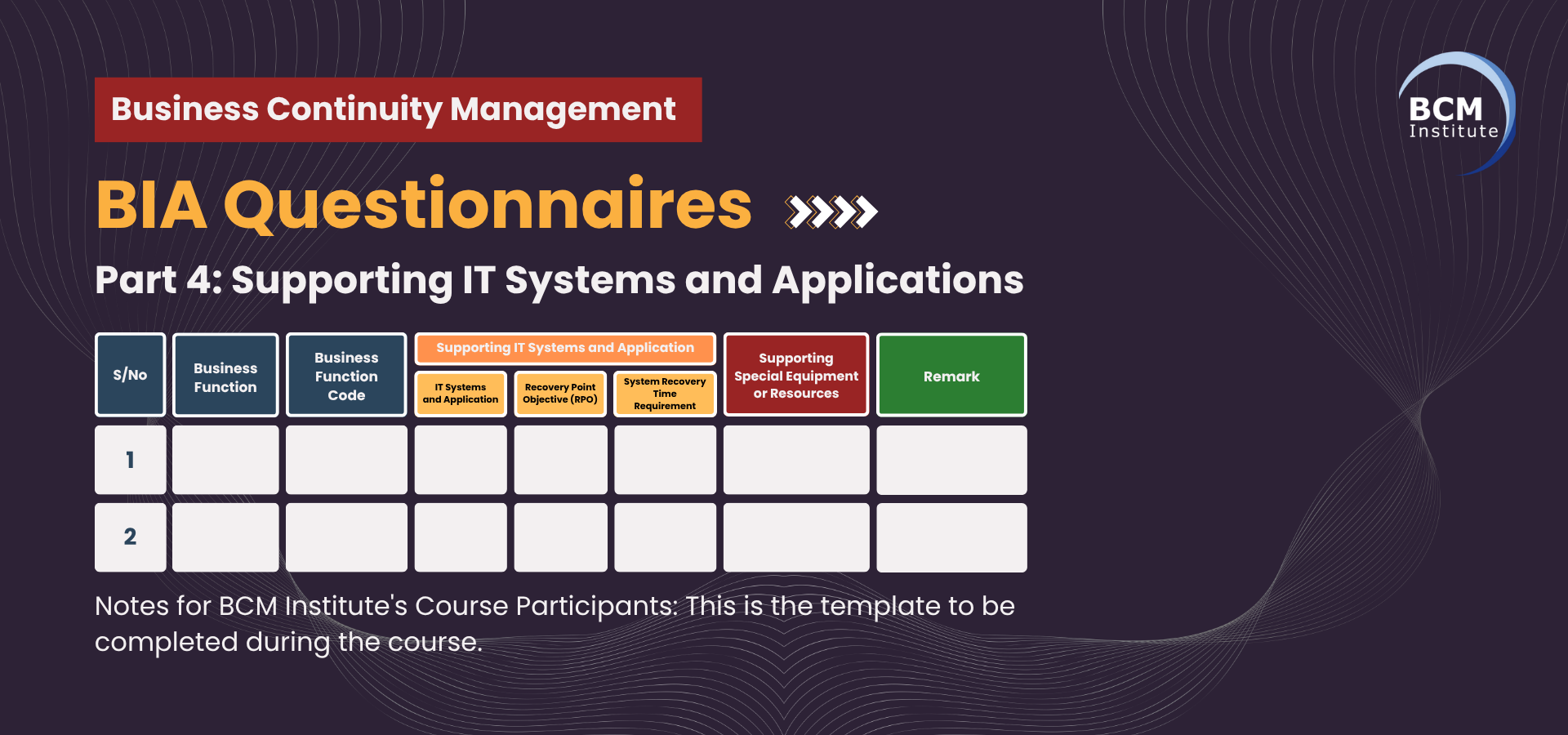
This chapter identifies the key IT systems and applications that support each sub-critical business function (Sub-CBF) under CBF-4, specifying the Recovery Point Objective (RPO), System Recovery Time Objective (RTO), and any special equipment or resources required.
This provides a foundation for IT continuity planning and ensures that MINDS can maintain critical operations during system outages or disruptions.
![Banner [Table] [BCM] [E3] [BIA] [P4] Supporting IT Systems and Applications [BIAQ]](https://no-cache.hubspot.com/cta/default/3893111/b0e47631-f680-46d1-b7a9-040fce25e117.png)
Table P4: Supporting IT Systems and Applications for CBF-4
|
Sub-CBF Code |
Sub-CBF |
IT Systems and Applications |
RPO |
System RTO |
Supporting Special Equipment / Resources |
Remarks |
|
4.1 |
Special Education Delivery |
Learning Management System (LMS), Digital Lesson Platforms |
4 hrs |
8 hrs |
Tablets, interactive whiteboards, projectors |
Enables delivery of structured lessons and online learning. Offline alternatives required if LMS is down. |
|
4.2 |
Individualised Learning Planning |
Student Information System (SIS), Digital Plan Repository |
4 hrs |
12 hrs |
Secure servers, laptops |
Maintains records of client learning plans and progress. Critical for timely updates. |
|
4.3 |
Life Skills & Independent Living Training |
LMS, e-Training Platforms |
8 hrs |
24 hrs |
Tablets, specialised kitchen/life skills equipment |
Supports remote or blended life skills training. Some training may require physical equipment. |
|
4.4 |
Vocational Preparation & Work Exposure |
Vocational Training Platform, LMS |
8 hrs |
24 hrs |
Workstations, vocational tools |
Supports documentation and monitoring of vocational readiness programmes. |
|
4.5 |
Allied Support Services Integration |
Therapy Management System, SIS |
4 hrs |
8 hrs |
Therapy equipment (physio, OT, speech) |
Tracks therapy sessions and client progress. Essential for clinical and developmental records. |
|
4.6 |
Special Student Care & Enrichment Activities |
Activity Management Platform, LMS |
12 hrs |
24 hrs |
Sports/recreational equipment |
Enables planning and documentation of enrichment activities. Critical for mental health and social engagement. |
|
4.7 |
Assessment & Progress Monitoring |
SIS, Assessment Software |
4 hrs |
12 hrs |
Laptops, tablets |
Tracks client assessment results, supports personalised planning, and regulatory reporting. |
|
4.8 |
Training Staff Capability & Development |
Staff Training Portal, LMS |
12 hrs |
24 hrs |
Computers, projectors |
Supports staff skill tracking, competency development, and mandatory training compliance. |
|
4.9 |
Parent & Caregiver Engagement |
Communication Portal, Email Systems, Messaging Apps |
12 hrs |
24 hrs |
Computers, mobile devices |
Maintains communication with caregivers and parents, critical for client safety and coordination. |
Notes:
- RPO (Recovery Point Objective): Maximum tolerable period in which data might be lost due to a disruption.
- System RTO (Recovery Time Objective): Target time to restore system functionality after an outage.
![Banner [BCM] [E3] [BIA] [Summing Up] [P4] Supporting IT Systems and Applications [BIAQ]](https://no-cache.hubspot.com/cta/default/3893111/9bde2d75-0c8e-4d9e-a8ca-e8d1655a082c.png)
The identification of supporting IT systems, applications, and special equipment highlights the dependency of CBF-4 on technology and digital infrastructure.
Maintaining these systems ensures that critical services, such as client care, education, therapy, staff training, and stakeholder communication, can continue uninterrupted during disruptions.
By defining RPO and RTO for each system, MINDS can prioritise IT recovery strategies and allocate resources effectively to minimise service interruption, safeguard client wellbeing, and maintain operational and regulatory compliance.
This analysis forms a key part of the overall Business Continuity Plan for CBF-4, ensuring that both digital and physical resources are accounted for in preparedness and response strategies.
Implementing Business Continuity Management for MINDS: Ensuring Continuity of Care and Services |
||||||
| eBook 3: Starting Your BCM Implementation |
||||||
![[BCM] [MINDS] [E3] [BIA] MBCO Corporate MBCO](https://no-cache.hubspot.com/cta/default/3893111/47babf68-4665-40bc-8db7-f34c7a717f49.png) |
![[BCM] [MINDS] [E3] [BIA] [PS] Key Product and Services](https://no-cache.hubspot.com/cta/default/3893111/1d6fd982-7a1c-4245-a1f0-bdd7a3155cc7.png) |
![[BCM] [MINDS] [E3] [RAR] [T1] List of Threats](https://no-cache.hubspot.com/cta/default/3893111/3262c956-93e2-45d4-850e-fa4cb7fab302.png) |
![[BCM] [MINDS] [E3] [RAR] [T2] Treatment and Control](https://no-cache.hubspot.com/cta/default/3893111/32464d64-b115-41e7-98be-850950580336.png) |
![[BCM] [MINDS] [E3] [RAR] [T3] Risk Impact and Likelihood Assessment](https://no-cache.hubspot.com/cta/default/3893111/cf5354bd-6256-4a23-ac6d-14bacb075337.png) |
![BCM] [MINDS] [E3] [BCS] [T1] Mitigation Strategies and Justification](https://no-cache.hubspot.com/cta/default/3893111/0bada7ae-abc1-4a42-bcd7-35ea2895a4d7.png) |
![[BCM] [MINDS] [E1] [C10] Identifying Critical Business Functions](https://no-cache.hubspot.com/cta/default/3893111/cfa9c1eb-7960-4442-8ef7-3ae5faeb4c8b.png) |
| CBF-4 Health, Safety, and Safeguarding Management |
||||||
| DP | BIAQ T1 | BIAQ T2 | BIAQ T3 | BCS T2 | BCS T3 | PD |
![[BCM] [MINDS] [E3] [BIA] [DP] [CBF] [4] Health, Safety, and Safeguarding Management](https://no-cache.hubspot.com/cta/default/3893111/85dc1f61-c96a-4512-ba95-84bff34e075d.png) |
![[BCM] [MINDS] [E3] [BIA] [T1] [CBF] [4] Health, Safety, and Safeguarding Management](https://no-cache.hubspot.com/cta/default/3893111/6a8cd730-1d27-49ce-b643-57937e31660a.png) |
|
![[BCM] [MINDS] [E3] [BIA] [T3] [CBF] [4] Health, Safety, and Safeguarding Management](https://no-cache.hubspot.com/cta/default/3893111/feec1a3e-0df4-44b2-8fc6-f5e0894fc348.png) |
![[BCM] [MINDS] [E3] [BCS] [T2] [CBF] [4] Health, Safety, and Safeguarding Management](https://no-cache.hubspot.com/cta/default/3893111/5c34dc86-4fab-422a-94ec-8c15991c766e.png) |
![[BCM] [MINDS] [E3] [BCS] [T3] [CBF] [4] Health, Safety, and Safeguarding Management](https://no-cache.hubspot.com/cta/default/3893111/83276c43-7a39-4048-87ce-28da1685684b.png) |
![[BCM] [MINDS] [E3] [PD] [CBF] [4] Health, Safety, and Safeguarding Management](https://no-cache.hubspot.com/cta/default/3893111/0a807d93-089f-41c7-85f3-a93c353a440b.png) |
More Information About Business Continuity Management Courses
To learn more about the course and schedule, click the buttons below for the BCM-300 Business Continuity Management Implementer [BCM-3] and the BCM-5000 Business Continuity Management Expert Implementer [BCM-5].


![Register [BL-B-3]*](https://no-cache.hubspot.com/cta/default/3893111/ac6cf073-4cdd-4541-91ed-889f731d5076.png)



![FAQ [BL-B-3]](https://no-cache.hubspot.com/cta/default/3893111/b3824ba1-7aa1-4eb6-bef8-94f57121c5ae.png)
![Email to Sales Team [BCM Institute]](https://no-cache.hubspot.com/cta/default/3893111/3c53daeb-2836-4843-b0e0-645baee2ab9e.png)


