


![Banner [BCM] [E3] [BIA] [P3] Impact Over Time of Business Functions](https://no-cache.hubspot.com/cta/default/3893111/bc131ed6-ca92-4253-8940-2f98dad34599.png)
CBF-2 Residential and Community Living Services
![[BCM] [MINDS] [E3] [BIA] [T2] [CBF] [2] Residential and Community Living Services](https://no-cache.hubspot.com/cta/default/3893111/cda64d6f-899e-46f5-b504-92139884d87a.png)
Residential and Community Living Services are highly time-sensitive due to their direct impact on the safety, health, and well-being of persons with intellectual disabilities (PWIDs).
Unlike purely administrative functions, many activities under this Critical Business Function (CBF-2) have rapidly escalating consequences when disrupted, particularly those related to accommodation, care, health, and safety.
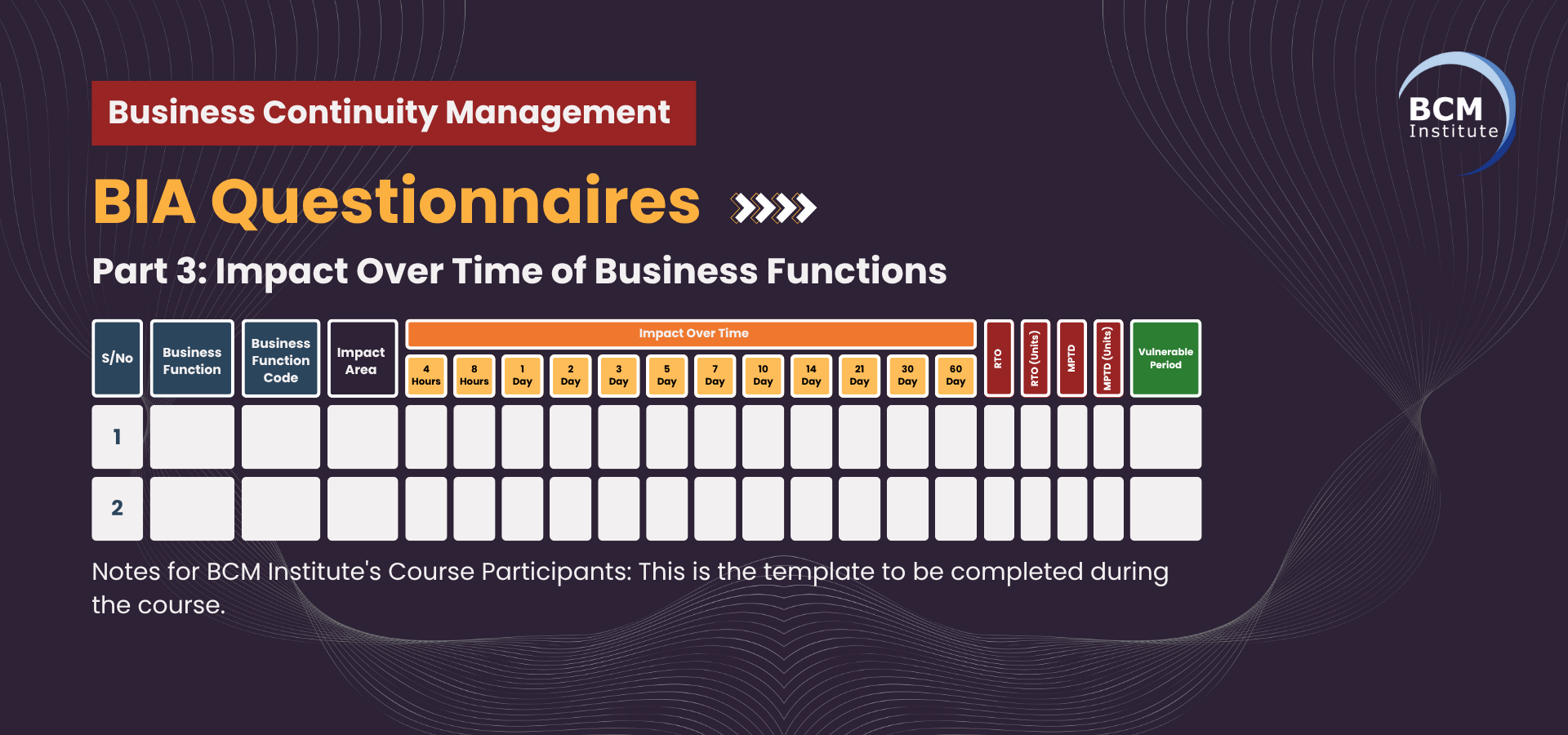
This chapter evaluates the impact over time for each Sub-Critical Business Function (Sub-CBF) under CBF-2, using a standardised 1 to 5 impact scoring scale, where 1 represents minimal impact and 5 represents catastrophic impact.
The analysis identifies the Recovery Time Objective (RTO), Maximum Tolerable Period of Disruption (MTPD), and Vulnerable Period, providing essential inputs for recovery prioritisation and continuity strategy design.
![Banner [Table] [BCM] [E3] [BIA] [[P3] Impact Over Time of Business Functions [BIAQ]](https://no-cache.hubspot.com/cta/default/3893111/b31bbcc9-edc2-4fc8-9cae-5c5797e36f84.png)
Table P3: Impact Over Time of Business Functions for CBF-2
|
Sub-CBF Code |
Sub-CBF |
Highest-Impact Area |
4 Hr |
8 Hr |
1 Day |
2 Day |
3 Day |
5 Day |
7 Day |
10 Day |
14 Day |
21 Day |
30 Day |
60 Day |
RTO |
MTPD |
Vulnerable Period |
|
2.1 |
Residential Admission & Intake |
Client welfare, regulatory compliance |
1 |
2 |
3 |
3 |
4 |
4 |
4 |
4 |
4 |
4 |
4 |
4 |
3 Days |
5 Days |
Periods of urgent placement or hospital discharge |
|
2.2 |
Accommodation & Daily Care |
Life, health, dignity of residents |
3 |
4 |
5 |
5 |
5 |
5 |
5 |
5 |
5 |
5 |
5 |
5 |
4 Hours |
1 Day |
24/7, especially nights & weekends |
|
2.3 |
Health & Allied Health Services |
Medical safety, continuity of care |
2 |
3 |
4 |
4 |
4 |
5 |
5 |
5 |
5 |
5 |
5 |
5 |
8 Hours |
2 Days |
Medication cycles, therapy schedules |
|
2.4 |
Safety, Security & Emergency Preparedness |
Resident life safety |
3 |
4 |
5 |
5 |
5 |
5 |
5 |
5 |
5 |
5 |
5 |
5 |
Immediate |
< 1 Day |
Emergencies, severe weather, outbreaks |
|
2.5 |
Staffing & Workforce Management |
Care quality, burnout risk |
2 |
3 |
4 |
4 |
4 |
5 |
5 |
5 |
5 |
5 |
5 |
5 |
1 Day |
3 Days |
Peak leave periods, outbreaks |
|
2.6 |
Community Integration & Day Programmes |
Client development, wellbeing |
1 |
2 |
3 |
3 |
3 |
4 |
4 |
4 |
4 |
4 |
4 |
4 |
5 Days |
14 Days |
School terms, programme cycles |
|
2.7 |
Family & Caregiver Engagement |
Trust, emotional wellbeing |
1 |
2 |
3 |
3 |
3 |
4 |
4 |
4 |
4 |
4 |
4 |
4 |
5 Days |
14 Days |
Admission, incidents, care transitions |
|
2.8 |
Home-Based Support Continuity |
Client independence, safety |
2 |
3 |
4 |
4 |
4 |
5 |
5 |
5 |
5 |
5 |
5 |
5 |
1 Day |
3 Days |
High-dependency clients |
|
2.9 |
Community Hub Partnership & Outreach |
Social inclusion, reputation |
1 |
1 |
2 |
2 |
3 |
3 |
3 |
3 |
3 |
3 |
3 |
3 |
7 Days |
30 Days |
Community events, joint programmes |
Key Observations
- Life-critical Sub-CBFs (2.2, 2.4) escalate to Impact Level 5 within 8–24 hours, justifying very short RTOs.
- Health, staffing, and home-based support functions reach intolerable impact within 1–3 days, highlighting workforce and clinical resilience as priority areas.
- Community and engagement functions have longer MTPDs, but prolonged disruption still causes reputational damage and client regression.
![Banner [BCM] [E3] [BIA] [Summing Up] [P3] Impact Over Time of Business Functions [BIAQ]](https://no-cache.hubspot.com/cta/default/3893111/987f8ca5-0ba4-4281-be57-5221186733d0.png)
The Impact Over Time assessment for CBF-2 Residential and Community Living Services highlights a clear distinction between immediate-life-safety functions and supporting or developmental services.
Sub-CBFs related to Accommodation & Daily Care, Health & Allied Health Services, and Safety, Security & Emergency Preparedness reach maximum impact levels within hours, resulting in very short RTOs and MTPDs.
Conversely, functions such as Residential Admission & Intake, Community Integration & Day Programmes, and Community Hub Partnership & Outreach show slower impact escalation, allowing for longer recovery windows without breaching organisational tolerances.
This time-based impact analysis enables MINDS to prioritise recovery sequencing, allocate resources effectively, and design proportionate continuity strategies that protect life, meet regulatory obligations, and sustain stakeholder confidence during disruptions.

![Banner [BCM] [E3] [BIA] [P4] Supporting IT Systems and Applications](https://no-cache.hubspot.com/cta/default/3893111/e60ed308-5615-4727-b6c2-5fb4eed933d7.png)
CBF-2 Residential and Community Living Services
This chapter identifies the key IT systems, applications, and supporting resources that enable the effective delivery of Client Care and Support Services at the Movement for the Intellectually Disabled of Singapore (MINDS).
As client-facing services form the core mission of MINDS, the availability, integrity, and timely recovery of these systems are essential to ensuring continuity of care, safeguarding client wellbeing, and maintaining regulatory and stakeholder confidence.
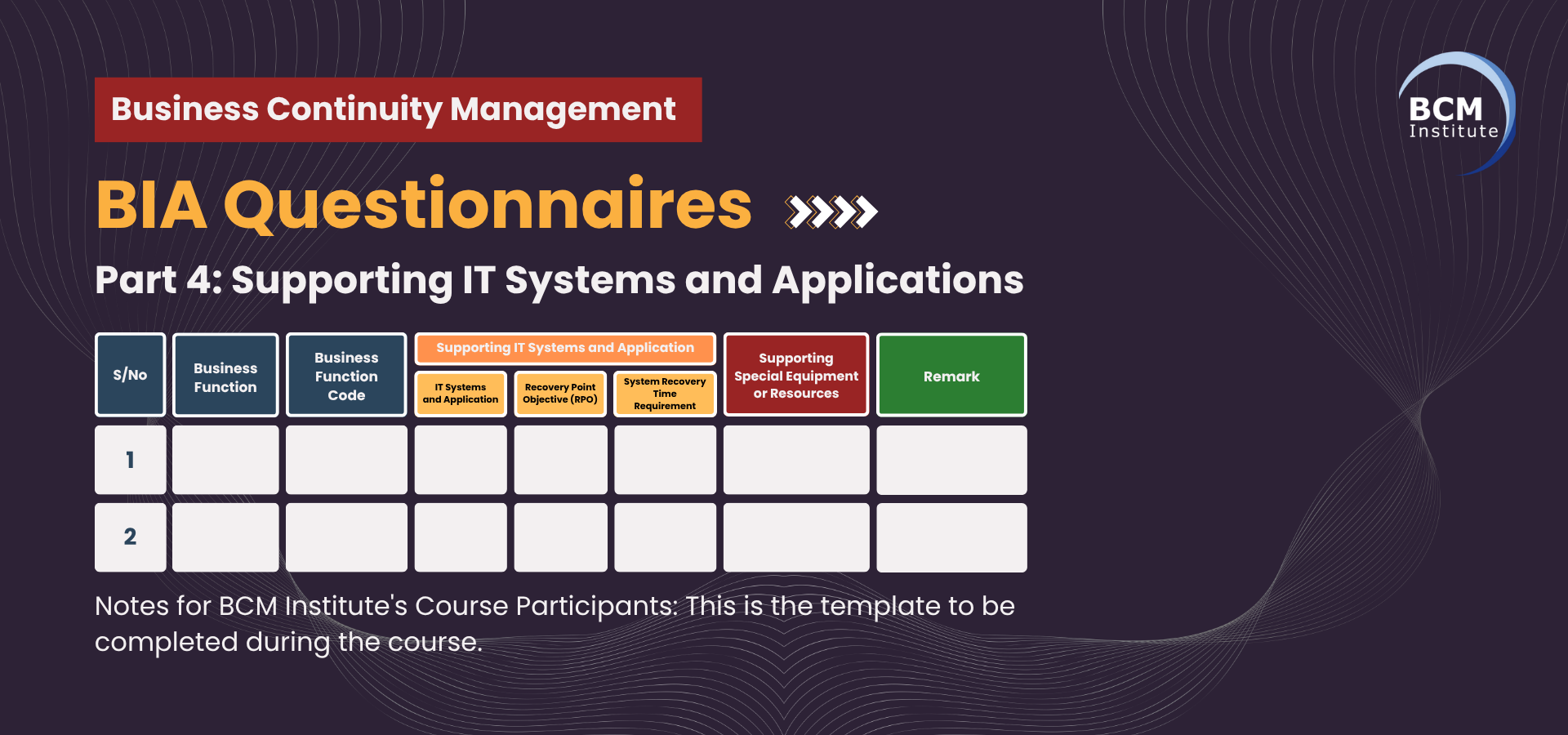
The analysis links each Sub-Critical Business Function (Sub-CBF) to its corresponding IT dependencies, Recovery Point Objective (RPO), System Recovery Time Objective (RTO), and critical supporting equipment or resources.
This mapping supports informed decision-making on IT resilience priorities, disaster recovery planning, and investment in appropriate technological and operational safeguards.
![Banner [Table] [BCM] [E3] [BIA] [P4] Supporting IT Systems and Applications [BIAQ]](https://no-cache.hubspot.com/cta/default/3893111/b0e47631-f680-46d1-b7a9-040fce25e117.png)
Table P4: Supporting IT Systems and Applications for CBF-2
|
Sub-CBF Code |
Sub-CBF |
IT Systems and Applications |
RPO |
System RTO |
Supporting Special Equipment / Resources |
Remarks |
|
2.1 |
Residential Admission & Intake |
Resident Management System, Online Intake Forms, CRM |
1 Day |
4 Hours |
Desktop/Laptop, Scanner, Internet access |
Supports record-keeping, referrals, and placement decisions. Minimal disruption can delay intake processing. |
|
2.2 |
Accommodation & Daily Care |
Care Management System, Meal & Activity Scheduling Software |
1 Hour |
1 Hour |
Tablets, RFID access controls, IoT sensors for monitoring |
Critical for daily supervision, hygiene, meals, and activity tracking. System downtime directly affects residents’ basic needs. |
|
2.3 |
Health & Allied Health Services |
Electronic Medical Records (EMR), Therapy Scheduling System, Medication Management Software |
30 Minutes |
1 Hour |
Medical devices, tablets, secure network access |
Supports medication administration, health monitoring, and therapy scheduling. Rapid recovery essential to prevent health risks. |
|
2.4 |
Safety, Security & Emergency Preparedness |
CCTV Surveillance, Access Control System, Emergency Notification System |
Real-time |
30 Minutes |
Security cameras, alarms, control panels |
Critical for resident safety and emergency response. Any downtime may compromise security and crisis management. |
|
2.5 |
Staffing & Workforce Management |
Staff Rostering System, HRIS, Payroll Software |
1 Day |
4 Hours |
Computers, mobile devices |
Supports staffing allocation, leave management, and payroll. Disruption impacts service coverage. |
|
2.6 |
Community Integration & Day Programmes |
Programme Scheduling Tools, Communication Apps |
2 Days |
8 Hours |
Laptops, projectors, activity materials |
Non-critical activities; temporary downtime manageable but extended outages affect engagement programs. |
|
2.7 |
Family & Caregiver Engagement |
Messaging Platforms, Email, Resident Portal |
1 Day |
4 Hours |
Computers, mobile devices, internet |
Maintains communication with families. Downtime may reduce transparency and increase complaints. |
|
2.8 |
Home-Based Support Continuity |
Mobile Care Apps, GPS Tracking for Home Visits, Incident Reporting Tools |
1 Hour |
2 Hours |
Tablets, mobile devices, vehicle tracking devices |
Essential for monitoring and supporting vulnerable clients at home. Timely system recovery critical. |
|
2.9 |
Community Hub Partnership & Outreach |
Collaboration Tools, Volunteer Management System |
2 Days |
8 Hours |
Computers, projectors, internet |
Supports coordination with partners and volunteers. Downtime affects outreach activities but core residential services remain operational. |
![Banner [BCM] [E3] [BIA] [Summing Up] [P4] Supporting IT Systems and Applications [BIAQ]](https://no-cache.hubspot.com/cta/default/3893111/9bde2d75-0c8e-4d9e-a8ca-e8d1655a082c.png)
The identification of supporting IT systems and applications for CBF-2 highlights the direct dependency of residential and community living services on technology.
Functions involving resident care, health services, and safety monitoring require immediate system recovery and minimal data loss (low RPO), while engagement, communication, and outreach functions have comparatively longer tolerances.
This assessment allows MINDS to prioritise IT continuity measures, allocate resources for critical systems, and define recovery strategies to ensure that essential services remain operational during disruptions, protecting the safety, health, and well-being of residents and maintaining organisational resilience.
Implementing Business Continuity Management for MINDS: Ensuring Continuity of Care and Services |
||||||
| eBook 3: Starting Your BCM Implementation |
||||||
![[BCM] [MINDS] [E3] [BIA] MBCO Corporate MBCO](https://no-cache.hubspot.com/cta/default/3893111/47babf68-4665-40bc-8db7-f34c7a717f49.png) |
![[BCM] [MINDS] [E3] [BIA] [PS] Key Product and Services](https://no-cache.hubspot.com/cta/default/3893111/1d6fd982-7a1c-4245-a1f0-bdd7a3155cc7.png) |
![[BCM] [MINDS] [E3] [RAR] [T1] List of Threats](https://no-cache.hubspot.com/cta/default/3893111/3262c956-93e2-45d4-850e-fa4cb7fab302.png) |
![[BCM] [MINDS] [E3] [RAR] [T2] Treatment and Control](https://no-cache.hubspot.com/cta/default/3893111/32464d64-b115-41e7-98be-850950580336.png) |
![[BCM] [MINDS] [E3] [RAR] [T3] Risk Impact and Likelihood Assessment](https://no-cache.hubspot.com/cta/default/3893111/cf5354bd-6256-4a23-ac6d-14bacb075337.png) |
![BCM] [MINDS] [E3] [BCS] [T1] Mitigation Strategies and Justification](https://no-cache.hubspot.com/cta/default/3893111/0bada7ae-abc1-4a42-bcd7-35ea2895a4d7.png) |
![[BCM] [MINDS] [E1] [C10] Identifying Critical Business Functions](https://no-cache.hubspot.com/cta/default/3893111/cfa9c1eb-7960-4442-8ef7-3ae5faeb4c8b.png) |
| CBF-2 Residential and Community Living Services |
||||||
| DP | BIAQ T1 | BIAQ T2 | BIAQ T3 | BCS T2 | BCS T3 | PD |
![[BCM] [MINDS] [E3] [BIA] [DP] [CBF] [2] Residential and Community Living Services](https://no-cache.hubspot.com/cta/default/3893111/8d1ece79-63a0-4c58-9af2-9c41f70c96bc.png) |
![[BCM] [MINDS] [E3] [BIA] [T1] [CBF] [2] Residential and Community Living Services](https://no-cache.hubspot.com/cta/default/3893111/eb7dc055-0650-4b9b-b3bb-475ea0381ff6.png) |
|
![[BCM] [MINDS] [E3] [BIA] [T3] [CBF] [2] Residential and Community Living Services](https://no-cache.hubspot.com/cta/default/3893111/21b15d91-d4d8-4cac-bcf4-03b17602f924.png) |
![[BCM] [MINDS] [E3] [BCS] [T2] [CBF] [2] Residential and Community Living Services](https://no-cache.hubspot.com/cta/default/3893111/554e6190-68f5-4bc5-b7b1-37c04d106b7b.png) |
![[BCM] [MINDS] [E3] [BCS] [T3] [CBF] [2] Residential and Community Living Services](https://no-cache.hubspot.com/cta/default/3893111/15505492-dd0d-48c8-b499-53c30ea49bac.png) |
![[BCM] [MINDS] [E3] [PD] [CBF] [2] Residential and Community Living Services](https://no-cache.hubspot.com/cta/default/3893111/1aa1440c-5054-4be5-97ae-b828f86709a2.png) |
More Information About Business Continuity Management Courses
To learn more about the course and schedule, click the buttons below for the BCM-300 Business Continuity Management Implementer [BCM-3] and the BCM-5000 Business Continuity Management Expert Implementer [BCM-5].


![Register [BL-B-3]*](https://no-cache.hubspot.com/cta/default/3893111/ac6cf073-4cdd-4541-91ed-889f731d5076.png)



![FAQ [BL-B-3]](https://no-cache.hubspot.com/cta/default/3893111/b3824ba1-7aa1-4eb6-bef8-94f57121c5ae.png)
![Email to Sales Team [BCM Institute]](https://no-cache.hubspot.com/cta/default/3893111/3c53daeb-2836-4843-b0e0-645baee2ab9e.png)


