



![Banner [BCM] [E3] [BIA] [P1] Identification of Business Functions](https://no-cache.hubspot.com/cta/default/3893111/206ddd7e-615a-42c8-aa2a-3416a1ad06b3.png)
CBF-8 ICT Systems Supporting Care and Operations
![[BCM] [MINDS] [E3] [BIA] [T1] [CBF] [8] ICT Systems Supporting Care and Operations](https://no-cache.hubspot.com/cta/default/3893111/6307f97a-c6d0-417e-a418-6800de302534.png)
The Critical Business Function (CBF) 8 focuses on the Information and Communication Technology (ICT) systems that support both care delivery and operational processes at MINDS.
Effective ICT systems are crucial to ensuring that care services are delivered seamlessly, administrative functions operate efficiently, and data integrity and security are maintained.
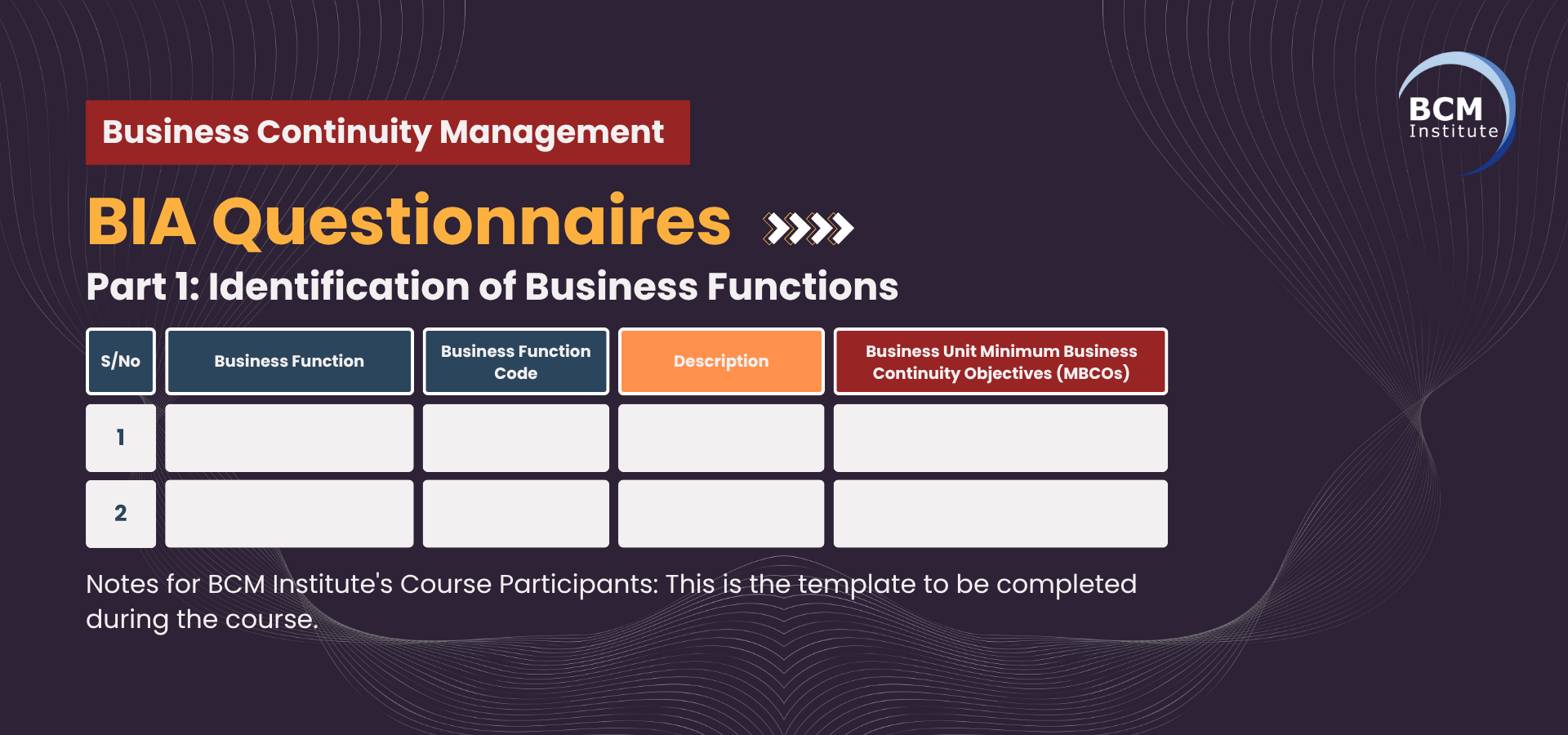
This chapter identifies the sub-critical business functions under CBF-8, providing detailed descriptions and establishing the minimum business continuity objectives (MBCO) for each business unit. Understanding these functions helps MINDS plan for disruptions, ensuring continued support for individuals under their care.
![Banner [Table] [BCM] [E3] [BIA] [P1] Identification of Critical Business Functions](https://no-cache.hubspot.com/cta/default/3893111/4fe499c9-0c19-46b4-8b6f-75450dba07d8.png)
Table P1: Critical Business Functions for CBF-8
|
Sub-CBF Code |
Sub-CBF |
Description of Process / Activity |
Examples (in MINDS context) |
|
8.1 |
ICT Infrastructure Management |
Management of hardware, network, servers, and cloud infrastructure to ensure stable operations. |
Maintain 99% uptime for all critical ICT systems supporting care and operations. |
|
8.2 |
Clinical & Care Management Systems |
Systems that track, record, and manage clinical and care-related information. |
Ensure availability of clinical records within 1 hour during disruption. |
|
8.3 |
Communication & Collaboration Tools |
Tools including email, messaging, and video conferencing to facilitate staff collaboration. |
Ensure staff can communicate internally within 30 minutes of a disruption. |
|
8.4 |
Business & Operational Applications |
Systems that support finance, HR, scheduling, and general administrative functions. |
Maintain operational applications for essential administrative functions within 2 hours. |
|
8.5 |
Data Backup & Recovery |
Processes and systems for regular data backups and restoration in case of loss. |
Restore critical data within 4 hours of any data loss incident. |
|
8.6 |
Security & Access Controls |
Systems and policies ensuring secure access to ICT resources and data. |
Maintain all security controls operational; prevent unauthorised access at all times. |
|
8.7 |
Helpdesk & User Support Services |
IT support services to assist staff in resolving technical issues. |
Ensure helpdesk response within 30 minutes and resolution within 4 hours for critical issues. |
|
8.8 |
System Development & Integration |
Development, customisation, and integration of systems to meet operational needs. |
Ensure key system updates or integrations do not disrupt essential care services. |
|
8.9 |
Monitoring, Alerts & Incident Response |
Tools and processes to monitor system performance and respond to incidents. |
Detect and respond to system incidents within 15 minutes to minimise downtime. |
|
8.10 |
Vendor & Third-Party Service Management |
Management of external ICT service providers to ensure service continuity. |
Ensure vendor services supporting critical ICT functions remain operational or have rapid fallback arrangements. |
![Banner [BCM] [E3] [BIA] [Summing Up] [P1] Identification of Critical Business Functions](https://no-cache.hubspot.com/cta/default/3893111/22330ab3-0a0f-4efd-9da7-43032e1e6573.png)
CBF-8 plays a pivotal role in sustaining MINDS’ operational and care capabilities through robust ICT systems.
By clearly defining sub-CBFs and their associated MBCOs, MINDS can prioritize resources, implement preventive measures, and respond effectively to disruptions.
This structured approach ensures continuity of essential services, supporting both care delivery and operational efficiency, even during unforeseen events.
![Banner [BCM] [E3] [BIA] [P2] Impact Area of Business Functions](https://no-cache.hubspot.com/cta/default/3893111/182e67c2-aa89-4b0b-b3e9-144293680ea4.png)
CBF-8 ICT Systems Supporting Care and Operations
The Critical Business Function (CBF-8) “ICT Systems Supporting Care and Operations” is pivotal to ensuring the smooth delivery of services across the Movement for the Intellectually Disabled of Singapore (MINDS).
ICT systems are the backbone of both administrative and care-related processes, enabling staff to manage client information, schedule programs, maintain communications, and execute operational tasks efficiently.
This function encompasses a broad spectrum of systems and services, including infrastructure management, clinical and care management applications, communication tools, operational software, security measures, and support services.
Each sub-critical business function (Sub-CBF) plays a crucial role in maintaining organisational continuity and operational resilience.
Any disruption to these systems can significantly impact MINDS’ ability to deliver essential care services, maintain regulatory compliance, and safeguard sensitive client data.
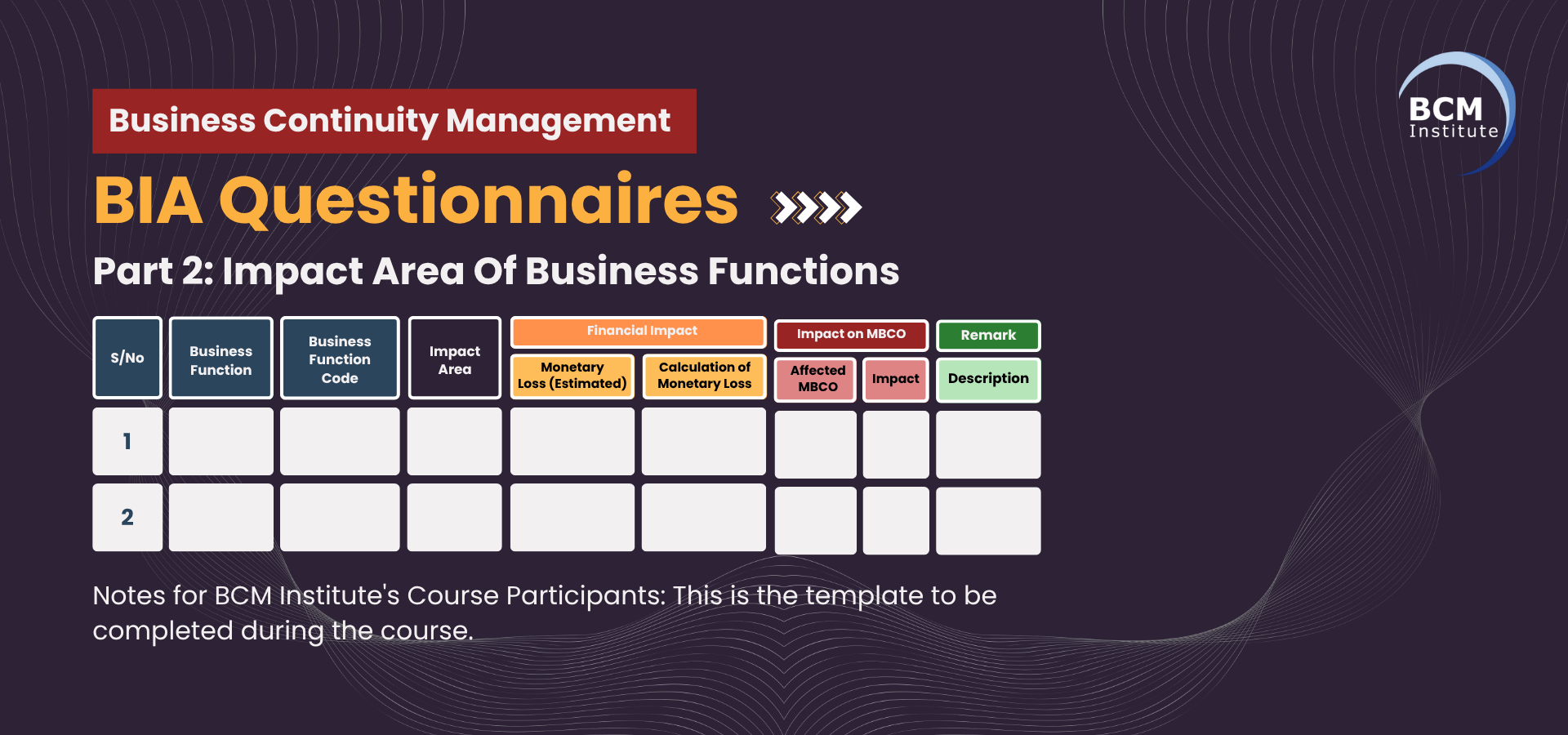
The impact areas of these systems are multidimensional, affecting processes, people, assets, finances, and reputation. Understanding the potential financial, operational, and service-related implications of ICT failures is essential for proactive risk management, prioritization of recovery strategies, and informed decision-making in business continuity planning.
![Banner [Table] [BCM] [E3] [BIA] [P2] Impact Areas of Business Functions [BIAQ]](https://no-cache.hubspot.com/cta/default/3893111/91582408-03ad-40e1-90e8-43ce62079aa6.png)
Table P2: Impact Area Assessment for CBF-8
|
Sub-CBF Code |
Sub-CBF |
Impact Area |
Financial Impact – Monetary Loss (Estimated) |
Financial Impact – Calculation of Monetary Loss (State Formula for Calculations) |
Impact on MBCO – Affect MBCO |
Impact on MBCO – Impact |
Remarks – Description |
|
8.1 |
ICT Infrastructure Management |
Processes, Assets/ICT Systems |
$50,000/day |
Cost of downtime × 1 day |
Corporate ICT Availability |
Critical operations delayed |
Failure disrupts all connected systems supporting care and admin operations |
|
8.2 |
Clinical & Care Management Systems |
Processes, People |
$30,000/day |
Lost billable care sessions × average fee per session |
Client Care Services |
Delayed or missed care delivery |
Disruption affects scheduling, care plans, and clinical records |
|
8.3 |
Communication & Collaboration Tools |
Processes, People |
$10,000/day |
Lost productivity × staff/hourly rate |
Staff Coordination |
Reduced collaboration and response |
Email, chat, and virtual meeting tools unavailable |
|
8.4 |
Business & Operational Applications |
Processes, Financial |
$20,000/day |
Revenue loss from unprocessed admin tasks |
Operations & Admin |
Administrative tasks backlog |
Affects payroll, billing, inventory, and reporting |
|
8.5 |
Data Backup & Recovery |
Processes, Assets/ICT Systems |
$40,000 |
Cost to restore lost data + penalties |
All Critical Services |
Data loss risk, extended downtime |
Failure to restore critical data affects operations and compliance |
|
8.6 |
Security & Access Controls |
Legal/Regulatory, Reputation |
$100,000 |
Cost of breach + regulatory fines |
Corporate Security |
Legal penalties, reputational damage |
Breach or access failure exposes sensitive client and org data |
|
8.7 |
Helpdesk & User Support Services |
People, Processes |
$5,000/day |
Support downtime × avg support tickets × hourly cost |
Staff Support |
Reduced operational efficiency |
Staff cannot resolve ICT issues in time |
|
8.8 |
System Development & Integration |
Processes, Financial |
$15,000/day |
Delayed project × daily operational loss |
Project Delivery |
Projects delayed, reduced system functionality |
Integration failure affects workflow and reporting |
|
8.9 |
Monitoring, Alerts & Incident Response |
Processes, Assets/ICT Systems |
$25,000/day |
Incident impact × downtime |
Incident Management |
Slower response to failures |
Undetected system failures lead to cascading issues |
|
8.10 |
Vendor & Third-Party Service Management |
Processes, Financial |
$20,000/day |
Vendor downtime × service dependency cost |
External Services |
Disruption of outsourced services |
Failure affects support, cloud services, and software maintenance |
![Banner [BCM] [E3] [BIA] [Summing Up] [P2] Impact Areas of Business Functions [BIAQ]](https://no-cache.hubspot.com/cta/default/3893111/76188041-e1c9-43d9-8efa-e550f46ad04d.png)
CBF-8 ICT Systems Supporting Care and Operations is a core enabler of MINDS’ mission to provide care and support to individuals with intellectual disabilities. The resilience of these ICT systems directly influences service delivery, staff efficiency, data integrity, and organizational reputation.
By systematically identifying and analysing the sub-critical business functions under this CBF, MINDS can assess potential impacts, quantify financial exposure, and implement effective mitigation and recovery strategies. Proactive management of ICT systems not only minimises operational disruption but also ensures that clients continue to receive uninterrupted, high-quality care.
Ultimately, safeguarding ICT systems is not solely a technical concern—it is integral to maintaining trust, regulatory compliance, and the long-term sustainability of MINDS’ operations.
Ensuring robust monitoring, maintenance, and recovery mechanisms strengthens the organisation’s overall business continuity posture and supports its commitment to excellence in care and operational management.
Implementing Business Continuity Management for MINDS: Ensuring Continuity of Care and Services |
||||||
| eBook 3: Starting Your BCM Implementation |
||||||
![[BCM] [MINDS] [E3] [BIA] MBCO Corporate MBCO](https://no-cache.hubspot.com/cta/default/3893111/47babf68-4665-40bc-8db7-f34c7a717f49.png) |
![[BCM] [MINDS] [E3] [BIA] [PS] Key Product and Services](https://no-cache.hubspot.com/cta/default/3893111/1d6fd982-7a1c-4245-a1f0-bdd7a3155cc7.png) |
![[BCM] [MINDS] [E3] [RAR] [T1] List of Threats](https://no-cache.hubspot.com/cta/default/3893111/3262c956-93e2-45d4-850e-fa4cb7fab302.png) |
![[BCM] [MINDS] [E3] [RAR] [T2] Treatment and Control](https://no-cache.hubspot.com/cta/default/3893111/32464d64-b115-41e7-98be-850950580336.png) |
![[BCM] [MINDS] [E3] [RAR] [T3] Risk Impact and Likelihood Assessment](https://no-cache.hubspot.com/cta/default/3893111/cf5354bd-6256-4a23-ac6d-14bacb075337.png) |
![BCM] [MINDS] [E3] [BCS] [T1] Mitigation Strategies and Justification](https://no-cache.hubspot.com/cta/default/3893111/0bada7ae-abc1-4a42-bcd7-35ea2895a4d7.png) |
![[BCM] [MINDS] [E1] [C10] Identifying Critical Business Functions](https://no-cache.hubspot.com/cta/default/3893111/cfa9c1eb-7960-4442-8ef7-3ae5faeb4c8b.png) |
| CBF-8 ICT Systems Supporting Care and Operations |
||||||
| DP | BIAQ T1 | BIAQ T2 | BIAQ T3 | BCS T2 | BCS T3 | PD |
![[BCM] [MINDS] [E3] [BIA] [DP] [CBF] [8] ICT Systems Supporting Care and Operations](https://no-cache.hubspot.com/cta/default/3893111/28b1ecaf-f078-4703-b31c-dbec2b9f76c4.png) |
|
![[BCM] [MINDS] [E3] [BIA] [T2] [CBF] [8] ICT Systems Supporting Care and Operations](https://no-cache.hubspot.com/cta/default/3893111/4dfdf6ff-8282-477a-9f81-12604d058d91.png) |
![[BCM] [MINDS] [E3] [BIA] [T3] [CBF] [8] ICT Systems Supporting Care and Operations](https://no-cache.hubspot.com/cta/default/3893111/89d637b4-f6fb-4eec-9f83-5496e1328766.png) |
![[BCM] [MINDS] [E3] [BCS] [T2] [CBF] [8] ICT Systems Supporting Care and Operations](https://no-cache.hubspot.com/cta/default/3893111/39f2428c-c4db-498c-9157-61275e345eb0.png) |
![[BCM] [MINDS] [E3] [BCS] [T3] [CBF] [8] ICT Systems Supporting Care and Operations](https://no-cache.hubspot.com/cta/default/3893111/1f6aa3e0-4538-47d1-8fe3-9ffc77c9825a.png) |
![[BCM] [MINDS] [E3] [PD] [CBF] [8] ICT Systems Supporting Care and Operations](https://no-cache.hubspot.com/cta/default/3893111/12fbbeab-7abf-4f45-9937-4713c8bd276e.png) |
More Information About Business Continuity Management Courses
To learn more about the course and schedule, click the buttons below for the BCM-300 Business Continuity Management Implementer [BCM-3] and the BCM-5000 Business Continuity Management Expert Implementer [BCM-5].


![Register [BL-B-3]*](https://no-cache.hubspot.com/cta/default/3893111/ac6cf073-4cdd-4541-91ed-889f731d5076.png)



![FAQ [BL-B-3]](https://no-cache.hubspot.com/cta/default/3893111/b3824ba1-7aa1-4eb6-bef8-94f57121c5ae.png)
![Email to Sales Team [BCM Institute]](https://no-cache.hubspot.com/cta/default/3893111/3c53daeb-2836-4843-b0e0-645baee2ab9e.png)


