



![Banner [BCM] [E3] [BIA] [P1] Identification of Business Functions](https://no-cache.hubspot.com/cta/default/3893111/206ddd7e-615a-42c8-aa2a-3416a1ad06b3.png)
CBF-7 Governance, Compliance, and Regulatory Reporting
![[BCM] [MINDS] [E3] [BIA] [T1] [CBF] [7] Governance, Compliance, and Regulatory Reporting](https://no-cache.hubspot.com/cta/default/3893111/550f0c7a-4b52-422d-a54b-58bac51634a9.png)
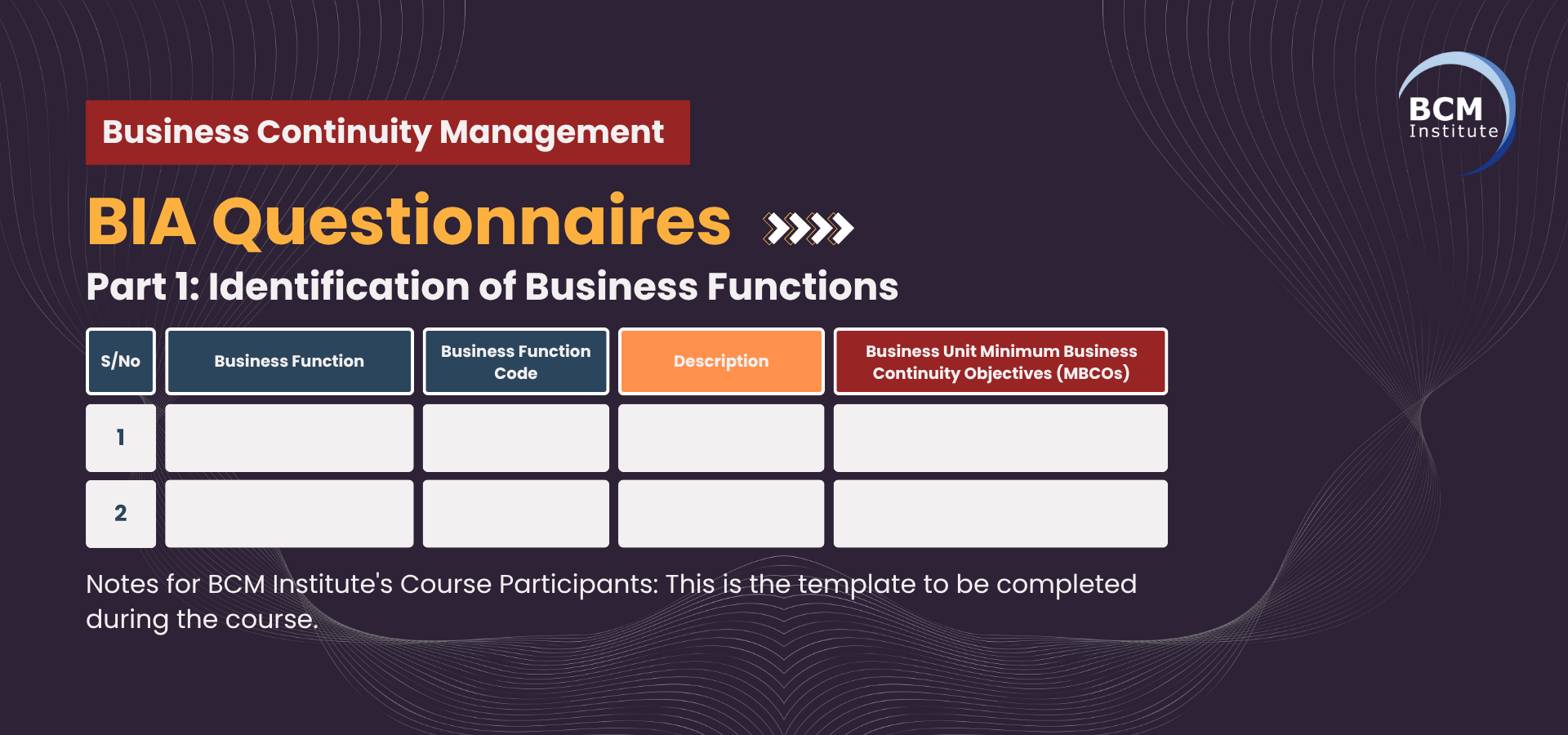
The Governance, Compliance, and Regulatory Reporting function (CBF-7) is critical to ensuring that MINDS operates within the legal, ethical, and regulatory frameworks governing social service organisations in Singapore.
This function encompasses the establishment of robust governance structures, strategic oversight by the Board, policy development, risk management, regulatory compliance, and transparent reporting to stakeholders.
Effective execution of CBF-7 not only safeguards the organisation against legal or reputational risks but also underpins trust among regulators, funders, donors, and the community.
This chapter identifies the sub-critical business functions (Sub-CBFs) that collectively enable MINDS to maintain governance and compliance during normal operations and ensure continuity during disruptions.
By clearly defining each Sub-CBF, along with its scope and Business Unit Minimum Business Continuity Objective (MBCO), MINDS can prioritise resources and plan for sustained operations in alignment with business continuity management (BCM) principles.
![Banner [Table] [BCM] [E3] [BIA] [P1] Identification of Critical Business Functions](https://no-cache.hubspot.com/cta/default/3893111/4fe499c9-0c19-46b4-8b6f-75450dba07d8.png)
Table P1: Critical Business Functions for CBF-7
|
Sub-CBF Code |
Sub-CBF |
Description of Process / Activity |
Examples (in MINDS context) |
|
7.1 |
Board Governance & Strategic Oversight |
Ensures effective oversight by the Board and senior management through meetings, decision-making, and strategic direction, including crisis governance during disruptions. |
Maintain the ability to convene Board or Executive decision-making (physical or virtual) to address statutory, financial, and crisis-related matters within required timeframes. |
|
7.2 |
Policy Development & Review |
Development, approval, periodic review, and communication of organisational policies to ensure alignment with laws, regulations, and best practices. |
Sustain access to current, approved policies and enable urgent policy updates or approvals required for regulatory or operational continuity. |
|
7.3 |
Regulatory Compliance Management |
Monitors compliance with applicable regulations, licensing conditions, funding requirements, and statutory obligations relevant to social service organisations. |
Continue compliance monitoring and escalation for critical regulatory obligations to prevent breaches, penalties, or suspension of services. |
|
7.4 |
Risk Management & Internal Controls |
Identification, assessment, and mitigation of organisational risks, including operational, financial, reputational, and safeguarding risks. |
Maintain core risk monitoring and key internal controls necessary to manage high-impact risks and support safe continuation of services. |
|
7.5 |
Internal Audit & Assurance |
Conducts internal audits and assurance activities to evaluate governance effectiveness, compliance, and internal controls. |
Defer non-critical audit activities if required, while preserving access to audit records and supporting urgent assurance or regulatory requests. |
|
7.6 |
External Reporting & Filings |
Preparation and submission of statutory, regulatory, financial, and funder reports to authorities and stakeholders. |
Ensure timely submission of mandatory reports and filings, prioritising those with legal, funding, or reputational implications. |
|
7.7 |
Stakeholder Accountability & Transparency Communications |
Communication with regulators, funders, donors, members, and the public regarding governance, compliance status, and organisational accountability. |
Maintain accurate and timely communications on critical governance or compliance matters to preserve trust and meet accountability expectations. |
|
7.8 |
Ethics & Whistleblowing Management |
Management of ethics frameworks, whistleblowing channels, investigations, and protection of whistleblowers. |
Ensure whistleblowing channels remain accessible and critical cases are received, assessed, and escalated without undue delay. |
![Banner [BCM] [E3] [BIA] [Summing Up] [P1] Identification of Critical Business Functions](https://no-cache.hubspot.com/cta/default/3893111/22330ab3-0a0f-4efd-9da7-43032e1e6573.png)
CBF-7 forms the cornerstone of organisational integrity, accountability, and regulatory adherence for MINDS.
The identification of its Sub-CBFs and their respective Business Unit MBCOs provides a clear framework for understanding which governance and compliance activities are essential to sustain during a disruption.
This understanding enables MINDS to maintain effective oversight, fulfil statutory obligations, and communicate transparently with stakeholders even in adverse circumstances. Establishing these priorities ensures that MINDS can continue to meet its legal and ethical responsibilities, protect its reputation, and support its mission of serving individuals with intellectual disabilities.
.
![Banner [BCM] [E3] [BIA] [P2] Impact Area of Business Functions](https://no-cache.hubspot.com/cta/default/3893111/182e67c2-aa89-4b0b-b3e9-144293680ea4.png)
CBF-7 Governance, Compliance, and Regulatory Reporting
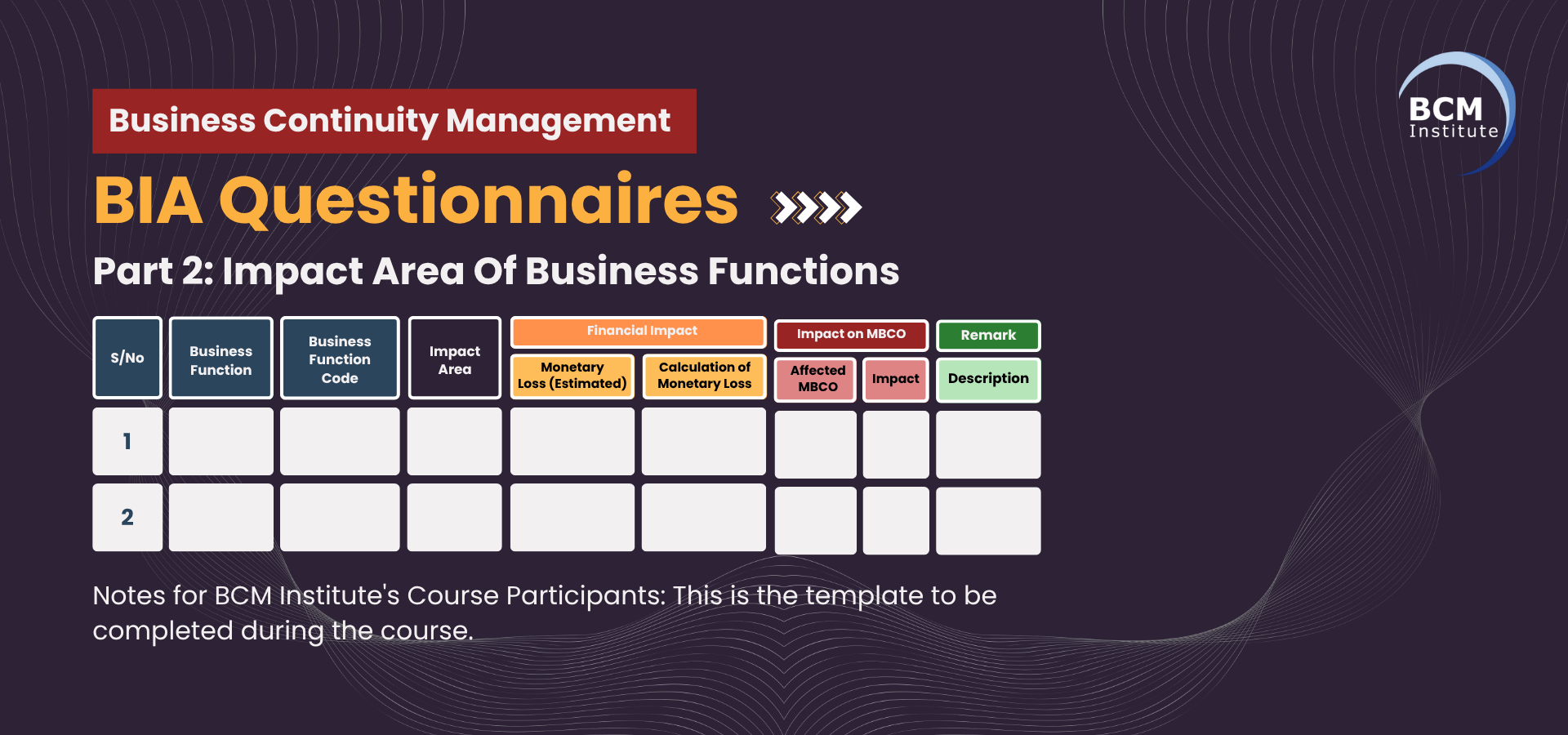
The Governance, Compliance, and Regulatory Reporting function (CBF-7) is fundamental to the operational integrity and accountability of MINDS. This part of the chapter analyses the impact of disruptions on the Sub-Critical Business Functions (Sub-CBFs) within CBF-7, highlighting both financial and operational consequences.
By evaluating the impact areas, including potential monetary loss, effect on Minimum Business Continuity Objectives (MBCO), and broader organisational implications, MINDS can identify which activities are essential to sustain during disruptions.
This assessment considers regulatory obligations, governance responsibilities, stakeholder expectations, and internal controls.
It provides a structured understanding of the vulnerabilities within CBF-7 and serves as the foundation for prioritising mitigation strategies and continuity planning to ensure that MINDS can continue to operate effectively, even under adverse conditions.
![Banner [Table] [BCM] [E3] [BIA] [P2] Impact Areas of Business Functions [BIAQ]](https://no-cache.hubspot.com/cta/default/3893111/91582408-03ad-40e1-90e8-43ce62079aa6.png)
Table P2: Impact Area Assessment for CBF-1
|
Sub-CBF Code |
Sub-CBF |
Impact Area |
Financial Impact – Monetary Loss (Estimated) |
Financial Impact – Calculation of Monetary Loss (State Formula for Calculations) |
Impact on MBCO – Affect MBCO |
Impact on MBCO – Impact |
Remarks – Description |
|
7.1 |
Board Governance & Strategic Oversight |
Strategic decisions, crisis response, Board approvals |
High – potential delayed decisions could result in service disruption, estimated loss: SGD 50,000/day |
Monetary Loss = (Number of disrupted operational days × average daily operational cost for strategic decisions) |
Yes |
Delayed or missed Board decisions can prevent critical approvals, affecting organisational continuity |
Ensures Board meetings, emergency committees, and escalation channels are maintained during disruptions. |
|
7.2 |
Policy Development & Review |
Internal compliance, staff adherence to policies |
Medium – operational inconsistencies or regulatory breaches: SGD 10,000/day |
Monetary Loss = (Number of days policy updates delayed × average cost of compliance-related corrections per day) |
Yes |
Delayed policy updates can lead to non-compliance and operational inefficiencies |
Policies must be accessible and reviewed to reflect regulatory changes, ensuring staff guidance is current. |
|
7.3 |
Regulatory Compliance Management |
Legal and statutory adherence, funding compliance |
High – fines, penalties, or loss of funding: SGD 100,000/event |
Monetary Loss = (Regulatory fines + funding penalties + legal fees) per non-compliance event |
Yes |
Non-compliance can directly breach MBCO, jeopardising minimum service continuity |
Continuous monitoring, reporting, and escalation to mitigate breaches; critical for maintaining licensing and funding. |
|
7.4 |
Risk Management & Internal Controls |
Organisational and operational risk mitigation |
Medium – loss from incidents due to weak controls: SGD 20,000/day |
Monetary Loss = (Number of incidents × estimated cost per incident) |
Yes |
Failure to manage risks can escalate operational disruption and affect continuity |
Critical risk registers and controls must be maintained even during disruptions to prevent cascading failures. |
|
7.5 |
Internal Audit & Assurance |
Assurance of compliance, governance effectiveness |
Low – delayed audits can result in undetected non-compliance: SGD 5,000/day |
Monetary Loss = (Number of audit days deferred × estimated cost of non-detection) |
Partial |
Delay may reduce confidence in controls but core functions continue |
Audit activities may be temporarily deferred, provided urgent compliance issues are addressed. |
|
7.6 |
External Reporting & Filings |
Statutory filings, funder and regulatory submissions |
High – regulatory penalties or funding suspension: SGD 50,000 per missed filing |
Monetary Loss = (Regulatory fines + potential funding withheld) per missed filing |
Yes |
Missed reporting directly breaches MBCO, risking legal and operational continuity |
Prioritise mandatory filings; establish temporary measures if systems or staff are disrupted. |
|
7.7 |
Stakeholder Accountability & Transparency Communications |
Donor, regulator, and public communications |
Medium – reputational damage impacting donations: SGD 15,000/day |
Monetary Loss = (Estimated lost donations or funding × number of days communication delayed) |
Partial |
Delays affect confidence but core service delivery may continue |
Communication channels must be maintained to ensure trust and accountability. |
|
7.8 |
Ethics & Whistleblowing Management |
Investigation of ethical breaches, protection of whistleblowers |
Medium – potential fines, reputational loss: SGD 10,000/case |
Monetary Loss = (Number of unaddressed cases × estimated impact cost per case) |
Yes |
Failure to maintain whistleblowing management can compromise MBCO related to regulatory and ethical compliance |
Ensure whistleblowing mechanisms remain accessible and critical reports are acted upon promptly. |
![Banner [BCM] [E3] [BIA] [Summing Up] [P2] Impact Areas of Business Functions [BIAQ]](https://no-cache.hubspot.com/cta/default/3893111/76188041-e1c9-43d9-8efa-e550f46ad04d.png)
The impact analysis of CBF-7 demonstrates that disruptions to governance, compliance, or reporting activities can have significant operational, financial, and reputational consequences for MINDS.
Maintaining the core functions of Sub-CBFs—ranging from Board oversight and policy management to regulatory compliance and whistleblowing—ensures that the organisation can continue to meet legal and ethical obligations while protecting stakeholder trust.
By clearly mapping the impact areas and linking them to MBCOs, MINDS is better equipped to prioritise resources, implement continuity measures, and safeguard critical governance and compliance processes during emergencies.
This structured approach strengthens organisational resilience, ensuring that MINDS can uphold its mission of supporting individuals with intellectual disabilities, even in the face of operational disruptions.
Implementing Business Continuity Management for MINDS: Ensuring Continuity of Care and Services |
||||||
| eBook 3: Starting Your BCM Implementation |
||||||
![[BCM] [MINDS] [E3] [BIA] MBCO Corporate MBCO](https://no-cache.hubspot.com/cta/default/3893111/47babf68-4665-40bc-8db7-f34c7a717f49.png) |
![[BCM] [MINDS] [E3] [BIA] [PS] Key Product and Services](https://no-cache.hubspot.com/cta/default/3893111/1d6fd982-7a1c-4245-a1f0-bdd7a3155cc7.png) |
![[BCM] [MINDS] [E3] [RAR] [T1] List of Threats](https://no-cache.hubspot.com/cta/default/3893111/3262c956-93e2-45d4-850e-fa4cb7fab302.png) |
![[BCM] [MINDS] [E3] [RAR] [T2] Treatment and Control](https://no-cache.hubspot.com/cta/default/3893111/32464d64-b115-41e7-98be-850950580336.png) |
![[BCM] [MINDS] [E3] [RAR] [T3] Risk Impact and Likelihood Assessment](https://no-cache.hubspot.com/cta/default/3893111/cf5354bd-6256-4a23-ac6d-14bacb075337.png) |
![BCM] [MINDS] [E3] [BCS] [T1] Mitigation Strategies and Justification](https://no-cache.hubspot.com/cta/default/3893111/0bada7ae-abc1-4a42-bcd7-35ea2895a4d7.png) |
![[BCM] [MINDS] [E1] [C10] Identifying Critical Business Functions](https://no-cache.hubspot.com/cta/default/3893111/cfa9c1eb-7960-4442-8ef7-3ae5faeb4c8b.png) |
| CBF-7 Governance, Compliance, and Regulatory Reporting | ||||||
| DP | BIAQ T1 | BIAQ T2 | BIAQ T3 | BCS T2 | BCS T3 | PD |
![[BCM] [MINDS] [E3] [BIA] [DP] [CBF] [7] Governance, Compliance, and Regulatory Reporting](https://no-cache.hubspot.com/cta/default/3893111/5abf1a9c-f98c-4437-8e62-485c8208a695.png) |
|
![[BCM] [MINDS] [E3] [BIA] [T2] [CBF] [7] Governance, Compliance, and Regulatory Reporting](https://no-cache.hubspot.com/cta/default/3893111/51a99e85-b555-4b8d-b5c4-4396f70cfe70.png) |
![[BCM] [MINDS] [E3] [BIA] [T3] [CBF] [7] Governance, Compliance, and Regulatory Reporting](https://no-cache.hubspot.com/cta/default/3893111/e4747462-ccc0-4d39-a7c0-185d1ffd48f0.png) |
![[BCM] [MINDS] [E3] [BCS] [T2] [CBF] [7] Governance, Compliance, and Regulatory Reporting](https://no-cache.hubspot.com/cta/default/3893111/b7fc97c4-e53b-4675-b0cf-f98684477e00.png) |
![[BCM] [MINDS] [E3] [BCS] [T3] [CBF] [7] Governance, Compliance, and Regulatory Reporting](https://no-cache.hubspot.com/cta/default/3893111/7ec5e92b-543a-4a8e-a9fa-45177d13cee5.png) |
![[BCM] [MINDS] [E3] [PD] [CBF] [7] Governance, Compliance, and Regulatory Reporting](https://no-cache.hubspot.com/cta/default/3893111/2aa77e12-ffaf-4a1c-8638-f9af3d7c62e7.png) |
More Information About Business Continuity Management Courses
To learn more about the course and schedule, click the buttons below for the BCM-300 Business Continuity Management Implementer [BCM-3] and the BCM-5000 Business Continuity Management Expert Implementer [BCM-5].


![Register [BL-B-3]*](https://no-cache.hubspot.com/cta/default/3893111/ac6cf073-4cdd-4541-91ed-889f731d5076.png)



![FAQ [BL-B-3]](https://no-cache.hubspot.com/cta/default/3893111/b3824ba1-7aa1-4eb6-bef8-94f57121c5ae.png)
![Email to Sales Team [BCM Institute]](https://no-cache.hubspot.com/cta/default/3893111/3c53daeb-2836-4843-b0e0-645baee2ab9e.png)


