



![Banner [BCM] [E3] [BIA] [P1] Identification of Business Functions](https://no-cache.hubspot.com/cta/default/3893111/206ddd7e-615a-42c8-aa2a-3416a1ad06b3.png)
CBF-5 Family, Caregiver, and Stakeholder Engagement
![[BCM] [MINDS] [E3] [BIA] [T1] [CBF] [5] Family, Caregiver, and Stakeholder Engagement](https://no-cache.hubspot.com/cta/default/3893111/0dd4432e-ec79-46c0-b0a8-904942d2f7e8.png)
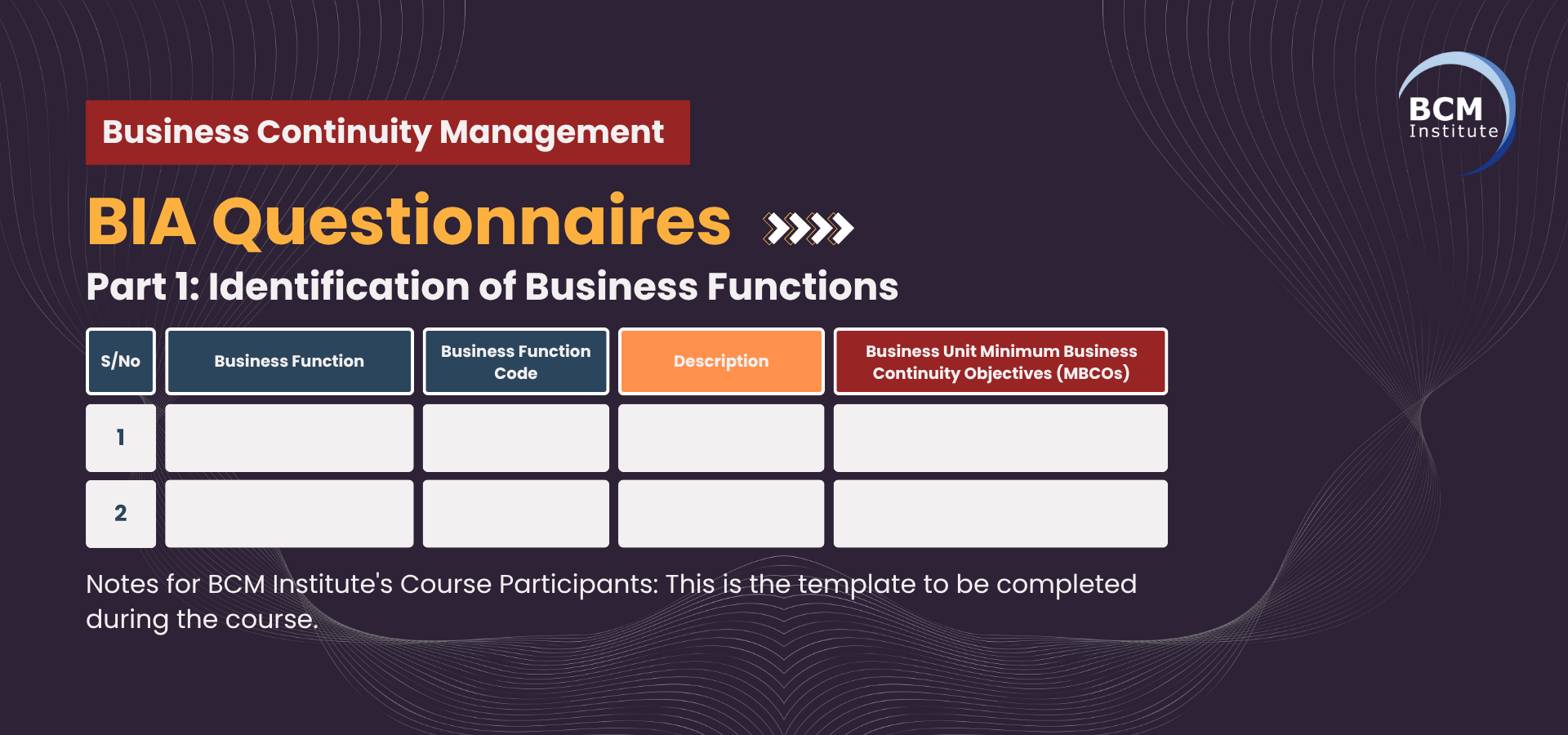
CBF-5 focuses on building strong relationships and support networks with families, caregivers, and key stakeholders of MINDS clients.
This business function ensures that the organisation remains connected to the community it serves, providing guidance, training, and support to caregivers while fostering collaboration with partners and volunteers. The continuity of this function is critical to maintaining trust, engagement, and the overall quality of care provided to individuals with intellectual disabilities.
![Banner [Table] [BCM] [E3] [BIA] [P1] Identification of Critical Business Functions](https://no-cache.hubspot.com/cta/default/3893111/4fe499c9-0c19-46b4-8b6f-75450dba07d8.png)
Table P1: Critical Business Functions for CBF-2
|
Sub-CBF Code |
Sub-CBF |
Description of Process / Activity |
Examples (in MINDS context) |
|
5.1 |
Caregiver Communication & Support Coordination |
Ensures timely and consistent communication with caregivers, providing guidance, updates, and emotional support to enable effective care at home. |
Maintain minimum daily contact with all active caregivers to address urgent concerns and provide essential guidance. |
|
5.2 |
Caregiver Training & Education |
Provides structured training sessions and educational resources to equip caregivers with knowledge and skills to support clients effectively. |
Conduct essential training sessions for new caregivers within a 7-day window and provide ongoing educational support to existing caregivers. |
|
5.3 |
MINDS Care Circle & Peer Network Facilitation |
Facilitates peer support groups and networking opportunities for caregivers and families to share experiences and resources. |
Ensure at least one active peer support session per week to maintain caregiver engagement and emotional well-being. |
|
5.4 |
Family Future Care Planning |
Assists families in planning long-term care and contingencies for clients, including legal, financial, and residential arrangements. |
Maintain availability of advisory services for all high-priority cases to support critical decision-making. |
|
5.5 |
Stakeholder Partnership & Community Engagement |
Engages with external stakeholders, including government agencies, NGOs, and corporate partners, to secure support, resources, and collaborative opportunities. |
Sustain regular communication with key stakeholders to ensure continuity of essential programs and funding partnerships. |
|
5.6 |
Satellite Hub & Community Service Interface |
Coordinates services and support at satellite hubs to ensure accessibility of programs and activities in the community. |
Keep at least one hub operational for urgent client needs and essential service delivery. |
|
5.7 |
Feedback & Quality Assurance Mechanism |
Collects and analyses feedback from families, caregivers, and stakeholders to improve service quality and operational processes. |
Maintain functional feedback channels and resolve high-priority issues within 3 business days. |
|
5.8 |
Volunteer and Youth Engagement Integration |
Manages volunteer and youth participation in programs, ensuring safe and meaningful contributions to client support and community activities. |
Retain a core group of volunteers to support essential programs without interruption. |
![Banner [BCM] [E3] [BIA] [Summing Up] [P1] Identification of Critical Business Functions](https://no-cache.hubspot.com/cta/default/3893111/22330ab3-0a0f-4efd-9da7-43032e1e6573.png)
The Family, Caregiver, and Stakeholder Engagement function is central to MINDS’ mission of delivering high-quality, person-centred support to individuals with intellectual disabilities.
By ensuring continuity in communication, training, peer support, planning, and stakeholder engagement, MINDS strengthens its resilience and sustains its impact on the community.
Properly maintaining these sub-functions during disruptions safeguards the well-being of clients and reinforces the trust and collaboration of caregivers and partners.
![Banner [BCM] [E3] [BIA] [P2] Impact Area of Business Functions](https://no-cache.hubspot.com/cta/default/3893111/182e67c2-aa89-4b0b-b3e9-144293680ea4.png)
CBF-5 Family, Caregiver, and Stakeholder Engagement
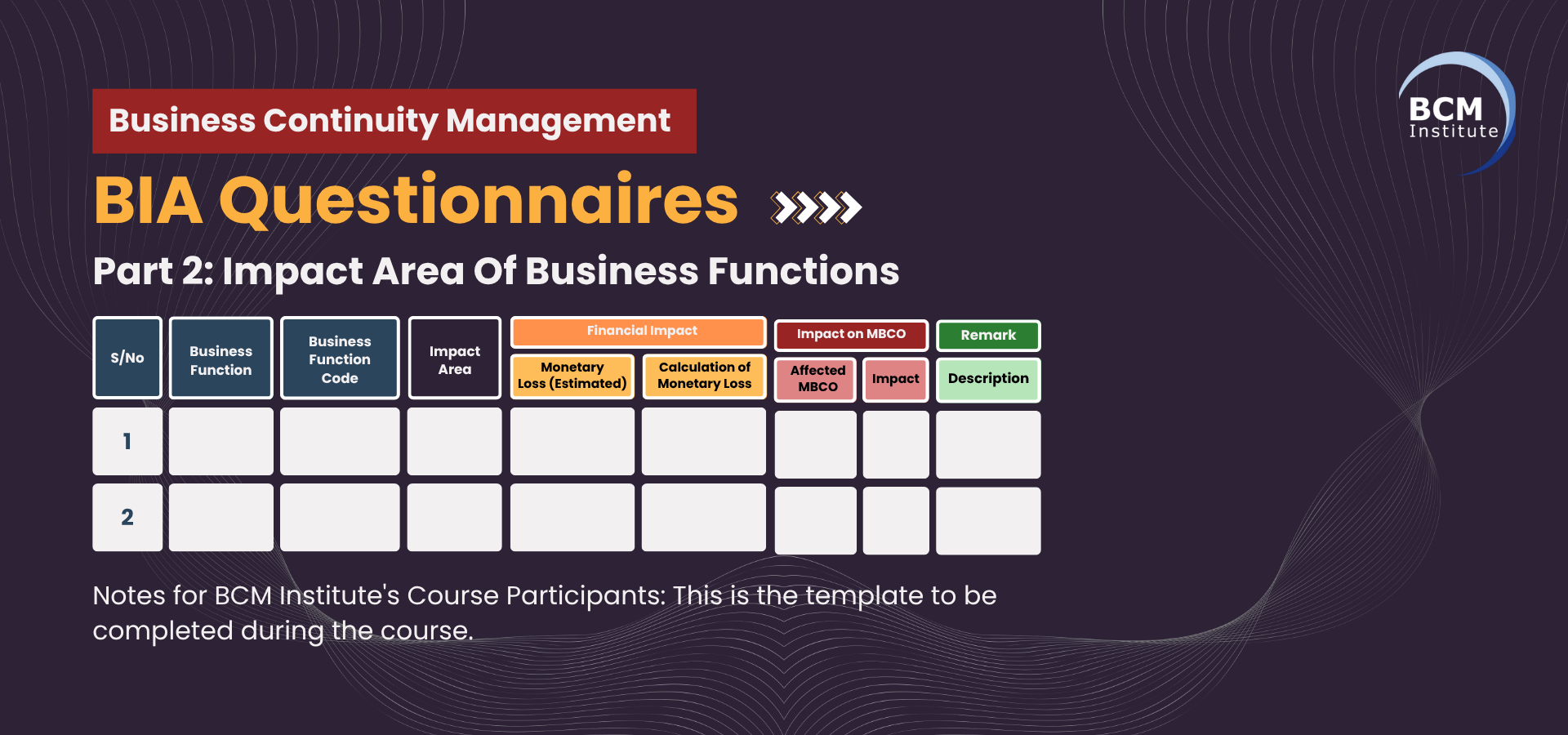
CBF-5 ensures that MINDS maintains strong and effective engagement with families, caregivers, volunteers, and key stakeholders.
Understanding the impact areas of each sub-critical business function (Sub-CBF) allows MINDS to evaluate potential financial, operational, and service delivery risks in the event of disruption.
By quantifying monetary loss and assessing how each Sub-CBF affects the Minimum Business Continuity Objective (MBCO), the organisation can prioritise resources and develop robust continuity strategies.
![Banner [Table] [BCM] [E3] [BIA] [P2] Impact Areas of Business Functions [BIAQ]](https://no-cache.hubspot.com/cta/default/3893111/91582408-03ad-40e1-90e8-43ce62079aa6.png)
Table P2: Impact Area Assessment for CBF-1
|
Sub-CBF Code |
Sub-CBF |
Impact Area |
Financial Impact – Monetary Loss (Estimated) |
Financial Impact – Calculation of Monetary Loss (State Formula for Calculations) |
Impact on MBCO – Affect MBCO |
Impact on MBCO – Impact |
Remarks – Description |
|
5.1 |
Caregiver Communication & Support Coordination |
Client Support & Satisfaction |
SGD 20,000 per week |
Number of critical caregiver inquiries × average cost per unresolved inquiry |
Yes |
Delay in responding to urgent caregiver issues affecting client care |
Disruption may reduce caregiver trust and timely support for clients |
|
5.2 |
Caregiver Training & Education |
Staff & Caregiver Competency |
SGD 15,000 per week |
Number of cancelled training sessions × average cost per session |
Yes |
Delays in caregiver training compromise quality of care |
Disruption can lead to skill gaps among caregivers |
|
5.3 |
MINDS Care Circle & Peer Network Facilitation |
Emotional Support & Community Engagement |
SGD 5,000 per month |
Number of cancelled peer sessions × estimated value per session |
Partial |
Reduced caregiver peer support, possible increase in caregiver stress |
Social isolation of caregivers may impact care quality indirectly |
|
5.4 |
Family Future Care Planning |
Long-Term Client Planning |
SGD 10,000 per case |
Number of delayed care plans × estimated cost of delayed planning per client |
Yes |
Delays in care planning affect critical decision-making for clients |
Disruption can impact legal, financial, and residential arrangements |
|
5.5 |
Stakeholder Partnership & Community Engagement |
Funding & Resource Availability |
SGD 50,000 per month |
Number of disrupted stakeholder engagements × potential funding per stakeholder |
Yes |
Loss of partnership support or funding may affect service continuity |
Maintaining strong relationships is critical to programme sustainability |
|
5.6 |
Satellite Hub & Community Service Interface |
Service Accessibility |
SGD 25,000 per week |
Number of days hub services unavailable × average operational cost per day |
Yes |
Limited access to satellite hub reduces client service delivery |
Disruption affects clients in community-based programs |
|
5.7 |
Feedback & Quality Assurance Mechanism |
Service Improvement & Compliance |
SGD 5,000 per week |
Number of unresolved feedback cases × average cost of rectifying issues |
Partial |
Delayed quality improvements may reduce overall service effectiveness |
Timely feedback helps MINDS adapt programs to client and caregiver needs |
|
5.8 |
Volunteer and Youth Engagement Integration |
Program Support & Community Involvement |
SGD 8,000 per week |
Number of volunteer-supported sessions missed × cost of hiring temporary staff |
Partial |
Reduced volunteer support affects program delivery |
Engaged volunteers provide essential manpower and community connection |
![Banner [BCM] [E3] [BIA] [Summing Up] [P2] Impact Areas of Business Functions [BIAQ]](https://no-cache.hubspot.com/cta/default/3893111/76188041-e1c9-43d9-8efa-e550f46ad04d.png)
CBF-5 plays a pivotal role in maintaining MINDS’ operational effectiveness and the quality of care delivered to clients.
By identifying impact areas, estimating financial losses, and understanding how each Sub-CBF affects the MBCO, the organisation can prioritise risk mitigation strategies during disruptions.
This ensures that critical services continue, caregiver and stakeholder trust is preserved, and the organisation remains resilient in fulfilling its mission.
Implementing Business Continuity Management for MINDS: Ensuring Continuity of Care and Services |
||||||
| eBook 3: Starting Your BCM Implementation |
||||||
![[BCM] [MINDS] [E3] [BIA] MBCO Corporate MBCO](https://no-cache.hubspot.com/cta/default/3893111/47babf68-4665-40bc-8db7-f34c7a717f49.png) |
![[BCM] [MINDS] [E3] [BIA] [PS] Key Product and Services](https://no-cache.hubspot.com/cta/default/3893111/1d6fd982-7a1c-4245-a1f0-bdd7a3155cc7.png) |
![[BCM] [MINDS] [E3] [RAR] [T1] List of Threats](https://no-cache.hubspot.com/cta/default/3893111/3262c956-93e2-45d4-850e-fa4cb7fab302.png) |
![[BCM] [MINDS] [E3] [RAR] [T2] Treatment and Control](https://no-cache.hubspot.com/cta/default/3893111/32464d64-b115-41e7-98be-850950580336.png) |
![[BCM] [MINDS] [E3] [RAR] [T3] Risk Impact and Likelihood Assessment](https://no-cache.hubspot.com/cta/default/3893111/cf5354bd-6256-4a23-ac6d-14bacb075337.png) |
![BCM] [MINDS] [E3] [BCS] [T1] Mitigation Strategies and Justification](https://no-cache.hubspot.com/cta/default/3893111/0bada7ae-abc1-4a42-bcd7-35ea2895a4d7.png) |
![[BCM] [MINDS] [E1] [C10] Identifying Critical Business Functions](https://no-cache.hubspot.com/cta/default/3893111/cfa9c1eb-7960-4442-8ef7-3ae5faeb4c8b.png) |
| CBF-5 Family, Caregiver, and Stakeholder Engagement |
||||||
| DP | BIAQ T1 | BIAQ T2 | BIAQ T3 | BCS T2 | BCS T3 | PD |
![[BCM] [MINDS] [E3] [BIA] [DP] [CBF] [5] Family, Caregiver, and Stakeholder Engagement](https://no-cache.hubspot.com/cta/default/3893111/b997e244-b712-4aa8-ac1c-ab122437ece8.png) |
|
![[BCM] [MINDS] [E3] [BIA] [T2] [CBF] [5] Family, Caregiver, and Stakeholder Engagement](https://no-cache.hubspot.com/cta/default/3893111/8d0e760c-2730-4922-81f4-87ad9900d010.png) |
![[BCM] [MINDS] [E3] [BIA] [T3] [CBF] [5] Family, Caregiver, and Stakeholder Engagement](https://no-cache.hubspot.com/cta/default/3893111/9ba81adf-0d1e-488d-8375-ed844fde78de.png) |
![[BCM] [MINDS] [E3] [BCS] [T2] [CBF] [5] Family, Caregiver, and Stakeholder Engagement](https://no-cache.hubspot.com/cta/default/3893111/dc8406c2-dc4b-4613-b199-bb4380c055ce.png) |
![[BCM] [MINDS] [E3] [BCS] [T3] [CBF] [5] Family, Caregiver, and Stakeholder Engagement](https://no-cache.hubspot.com/cta/default/3893111/7727b109-1fb5-4dde-9122-c8c4bebe8967.png) |
![[BCM] [MINDS] [E3] [PD] [CBF] [5] Family, Caregiver, and Stakeholder Engagement](https://no-cache.hubspot.com/cta/default/3893111/ebcdc542-7e31-420a-afee-33375819c5e9.png) |
More Information About Business Continuity Management Courses
To learn more about the course and schedule, click the buttons below for the BCM-300 Business Continuity Management Implementer [BCM-3] and the BCM-5000 Business Continuity Management Expert Implementer [BCM-5].


![Register [BL-B-3]*](https://no-cache.hubspot.com/cta/default/3893111/ac6cf073-4cdd-4541-91ed-889f731d5076.png)



![FAQ [BL-B-3]](https://no-cache.hubspot.com/cta/default/3893111/b3824ba1-7aa1-4eb6-bef8-94f57121c5ae.png)
![Email to Sales Team [BCM Institute]](https://no-cache.hubspot.com/cta/default/3893111/3c53daeb-2836-4843-b0e0-645baee2ab9e.png)


